
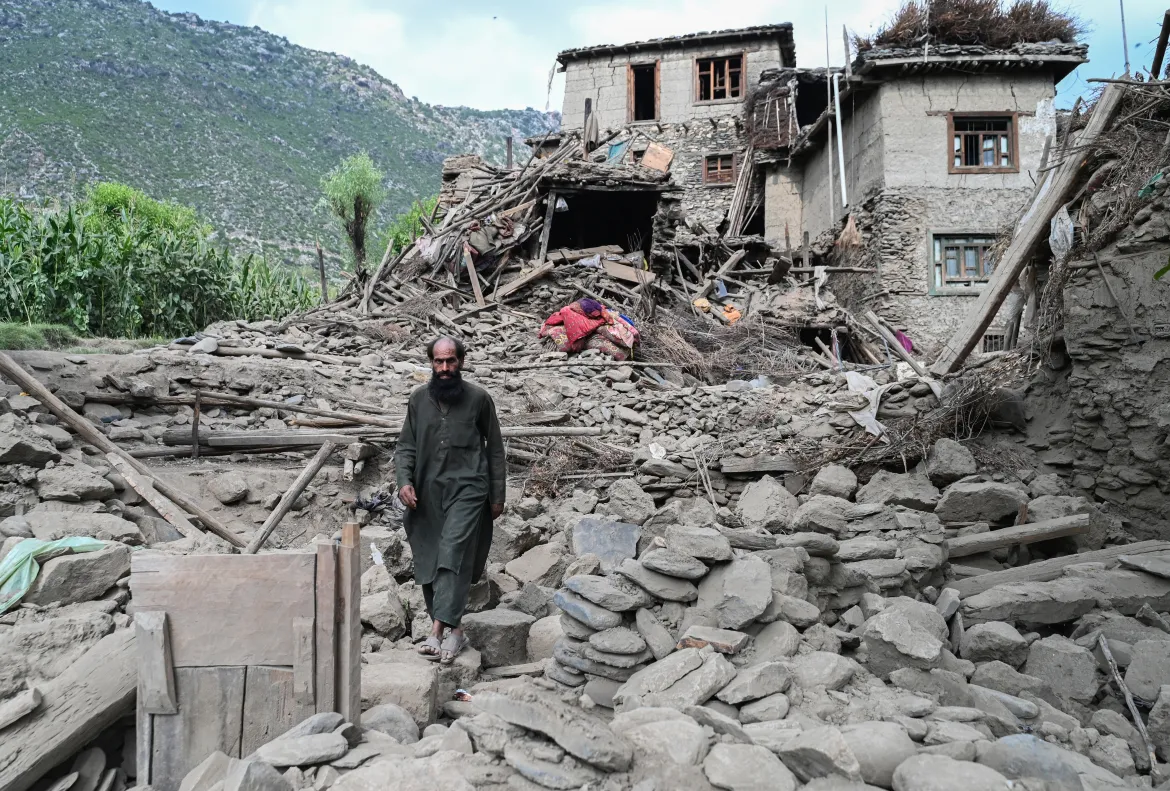
Entire villages collapsed as rescue teams battle poor infrastructure, and limited resources.
By Namith DP | Sept 03, 2025
The earth shook violently at 11:47 p.m. local time on August 31, 2025, transforming a quiet Sunday night into a catastrophic disaster that would claim hundreds of lives across Afghanistan’s mountainous eastern provinces.
• Epicenter Location: The 6.0-magnitude earthquake struck Kunar and Nangarhar provinces, with the epicenter located 27 kilometers east-northeast of Jalalabad city • Immediate Impact: Deadly tremors penetrated remote villages where rescue teams now race against time to reach survivors • Geographic Scope: The disaster affected Afghanistan’s mountainous eastern provinces near the Pakistan border
Taliban government spokesman Zabihullah Mujahid confirmed at a Monday press conference that the death toll has risen to at least 800 people, with more than 2,500 injured.
• Rising Casualties: The casualty figures continue climbing as rescue teams penetrate deeper into the affected mountainous terrain • Village Destruction: Entire villages have been reduced to rubble across the earthquake zone • Official Confirmation: Taliban authorities provided these figures during official government briefings
Geographic Impact and Seismic Details
The earthquake’s epicenter struck a particularly vulnerable region where Afghanistan meets Pakistan, an area characterized by challenging mountainous terrain.
• Construction Challenges: Mountainous terrain complicates both building standards and emergency response efforts • Seismic Depth Data: The United States Geological Survey (USGS) recorded the earthquake at a shallow depth of 8 kilometers (5 miles) • European Measurements: The European-Mediterranean Seismological Centre (EMSC) reported a depth of 10 kilometers
Afghanistan sits within a broad zone of continental deformation within the Eurasian Plate, making the region particularly susceptible to seismic activity.
• Geological Vulnerability: This positioning explains why the country experiences frequent earthquakes • Disaster Pattern: The latest earthquake marks another tragic chapter in Afghanistan’s ongoing struggle with natural disasters • Tectonic Activity: Continental plate movement creates ongoing seismic risks throughout the region
Most Affected Areas
The earthquake devastated multiple districts across two provinces:
• Kunar Province: Most casualties occurred in Kunar, where the earthquake’s impact proved most severe • Nangarhar Province: The worst-hit areas include Nurgal and Siringal districts • Border Communities: Villages near the Pakistan border experienced complete destruction
Emergency Response and Rescue Operations

Taliban authorities deployed 200 soldiers to assist in rescue operations, supplemented by two helicopters and 30 ambulances.
• Resource Deployment: The response highlights both the scale of the disaster and the logistical challenges facing rescue teams • Remote Access Issues: Afghanistan’s remote eastern regions present significant operational difficulties • Government Mobilization: Taliban authorities activated available military and emergency resources
Taliban spokesman Zabihullah Mujahid acknowledged the disaster’s severity, posting on social media that “local officials and residents are making all efforts to rescue affected ones”.
• Official Communication: The statement underscores the government’s mobilization of available resources • Operational Constraints: Mountainous terrain and damaged infrastructure continue hampering access to remote communities • Community Involvement: Local residents participate alongside official rescue teams in search efforts
Rescue Challenges
Emergency teams face multiple obstacles in their life-saving efforts:
• Terrain Accessibility: Mountain roads blocked by landslides and debris • Infrastructure Damage: Destroyed bridges and communication networks • Limited Resources: Afghanistan’s economic constraints limit rescue equipment availability • Weather Conditions: Potential for secondary disasters in unstable terrain
Historical Context of Afghan Seismic Activity
Afghanistan’s position at the intersection of major tectonic plates makes it one of the world’s most earthquake-prone regions.
• October 2023 Precedent: An earthquake struck western Afghanistan, killing at least 2,400 people • Herat Province Disasters: Three 6.3-magnitude earthquakes hit Herat province with Taliban reporting around 4,000 deaths • UN Casualty Estimates: The United Nations estimated 1,500 fatalities from the Herat earthquakes
Recent seismic activity demonstrates the ongoing regional threat:
• August 27, 2025: Magnitude 5.6 earthquake in Hindu Kush region • August 19, 2025: Magnitude 5.2 earthquake in Hindu Kush region
• October 2023: Western Afghanistan earthquake killing thousands
Building Vulnerability and Construction Standards
Buildings in Afghanistan tend to be low-rise constructions, mostly of concrete, which explains the extensive structural damage observed in affected areas.
• Economic Construction Constraints: The country’s construction practices stem from economic limitations rather than seismic safety standards • Rural Building Methods: Communities use traditional construction methods that cannot withstand significant ground motion • Material Limitations: Local builders rely on available materials without earthquake-resistant engineering
The combination of shallow depth and poor building standards created a perfect storm for casualties.
• Structural Weaknesses: Most rural Afghan buildings lack earthquake-resistant design features • Foundation Problems: Traditional stone and mud-brick construction proves inadequate during seismic events • Reinforcement Gaps: Limited access to steel reinforcement and modern building techniques
Construction Industry Challenges
Afghanistan’s construction sector faces multiple barriers to implementing earthquake-resistant building practices:
• Technical Knowledge: Limited access to seismic engineering expertise in rural areas • Material Costs: Earthquake-resistant materials often exceed local economic capacity • Regulatory Framework: Lack of enforced building codes in remote regions • Training Deficits: Construction workers lack specialized training in seismic-safe building techniques
International and Humanitarian Implications
The earthquake strikes Afghanistan during a period of significant economic hardship and international isolation.
• Asset Restrictions: Frozen international assets limit disaster response capabilities • Aid Access Challenges: Restricted humanitarian aid access affects medical supplies and equipment availability • Economic Sanctions: International sanctions impact infrastructure maintenance and emergency preparedness • Cooperation Barriers: Limited international cooperation on disaster response coordination
Since the Taliban’s return to power in 2021, these constraints have created compounding challenges for disaster management:
• Banking Limitations: Restricted access to international banking systems hampers aid transfers • Diplomatic Isolation: Reduced embassy presence limits coordination mechanisms • Recognition Issues: Lack of international recognition complicates formal aid agreements • Security Concerns: International organizations face safety restrictions affecting operational capacity
Humanitarian Access Complications
International relief organizations encounter specific obstacles when responding to Afghan disasters:
• Visa Restrictions: Complex approval processes for international humanitarian workers • Gender Policies: Taliban restrictions on women aid workers limit operational scope • Transport Barriers: Limited commercial flights and border crossing complications • Communication Gaps: Reduced diplomatic channels affect coordination efficiency
Medical Infrastructure Strain
Afghanistan’s already stretched healthcare system faces additional pressure from the earthquake’s aftermath.
• Hospital Overcrowding: Hospitals in Jalalabad and surrounding areas report overwhelming patient influxes • Supply Shortages: Many facilities lack adequate medical supplies and equipment for trauma treatment • Staff Limitations: Medical personnel work extended shifts to handle casualty volumes • Transport Challenges: Ambulance services struggle to reach remote injured survivors
Critical medical needs include:
• Surgical Capacity: Limited operating rooms for treating severe crush injuries and trauma cases • Blood Supply: Urgent need for blood donations to treat hemorrhaging patients • Specialized Equipment: Shortage of X-ray machines and diagnostic equipment for fracture assessment • Pain Management: Insufficient analgesics and anesthetics for treating earthquake victims
Healthcare System Vulnerabilities
The earthquake exposed systematic weaknesses in Afghanistan’s medical infrastructure:
• Rural Clinic Damage: Many primary healthcare facilities suffered structural damage in affected areas • Medical Professional Exodus: Brain drain of healthcare workers since 2021 reduces treatment capacity • Equipment Maintenance: Lack of spare parts and technical support for medical equipment • Emergency Protocols: Limited disaster response training among healthcare workers
Regional Geological Significance
The Hindu Kush region represents one of Earth’s most seismically active zones, where the Indian subcontinent continues pushing northward into the Eurasian plate.
• Tectonic Collision: This ongoing collision creates the towering peaks of the Hindu Kush, Karakoram, and Himalayan mountain ranges • Seismic Generation: The continental collision generates frequent seismic activity across the region • Fault Systems: Multiple active fault lines intersect throughout eastern Afghanistan
Understanding this geological context helps explain earthquake frequency and building code requirements:
• Predictable Activity: Afghanistan experiences regular earthquakes due to its geological position • Risk Assessment: Earthquake preparedness becomes essential rather than optional for protecting vulnerable communities • Engineering Requirements: Building codes must account for ongoing seismic risks in the region
Seismological Analysis
Professional seismologists provide technical insights into the August 31 earthquake characteristics:
• Shallow Depth Impact: The 8-10 kilometer depth amplified ground motion intensity beyond typical expectations • Magnitude Classification: The 6.0 rating indicates moderate earthquake strength with severe local impacts • Ground Motion Patterns: Seismic waves traveled efficiently through solid rock formations • Aftershock Potential: Secondary tremors pose continued risks to damaged structures and rescue operations
Economic Impact Assessment
Preliminary damage assessments suggest extensive economic losses across affected regions with far-reaching implications.
• Residential Destruction: Hundreds of residential structures in rural communities sustained complete or partial collapse • Infrastructure Damage: Critical infrastructure including roads and bridges suffered severe damage • Agricultural Losses: Destroyed agricultural facilities during harvest season threaten food security • Commercial Impact: Small businesses and local markets face reconstruction challenges
For Afghanistan’s struggling economy, reconstruction costs will strain already limited government resources:
• Harvest Season Timing: Damage occurred during critical agricultural harvest period • Food Security Risks: Destroyed storage facilities and processing equipment threaten winter food supplies • Employment Disruption: Local job losses compound existing economic hardship • Recovery Timeline: Reconstruction efforts may extend for months or years given resource constraints
Sector-Specific Economic Damage
Different economic sectors face varying levels of earthquake impact:
• Agriculture: Destroyed grain storage facilities and irrigation systems affect farming communities • Transportation: Damaged mountain roads isolate communities and disrupt trade routes • Energy Infrastructure: Power lines and small hydroelectric facilities sustained damage • Telecommunications: Cell towers and communication infrastructure require extensive repairs
Financial implications extend beyond immediate reconstruction:
• Insurance Gaps: Most rural properties lack earthquake insurance coverage • Microfinance Disruption: Local lending networks face defaults from affected borrowers • Remittance Dependencies: Communities rely heavily on family remittances for reconstruction funding • Development Setbacks: Economic progress in affected areas faces multi-year delays
Scientific Analysis and Future Earthquake Risk
Seismologists emphasize that the August 31 earthquake represents typical seismic activity for the Hindu Kush region.
• Depth Amplification: The shallow depth amplified ground motion intensity, explaining extensive damage despite the 6.0 magnitude classification • Regional Patterns: The earthquake fits established patterns of seismic activity for this geological zone • Energy Release: Ground motion characteristics matched expectations for shallow crustal earthquakes • Damage Correlation: Observed destruction aligns with scientific models for this magnitude and depth combination
Future earthquake risk remains high across eastern Afghanistan due to ongoing geological processes:
• Tectonic Movement: Continuing plate movement ensures sustained seismic activity • Active Fault Systems: Multiple fault systems throughout the region maintain earthquake potential • Stress Accumulation: Accumulated stress along major geological boundaries increases future rupture probability • Historical Patterns: Past earthquake data suggests regular major seismic events in this region
Seismic Monitoring and Prediction Capabilities
Current earthquake monitoring infrastructure in Afghanistan faces significant limitations:
• Instrument Networks: Limited seismograph coverage reduces early detection capabilities • Data Processing: Insufficient technical capacity for real-time seismic data analysis • International Cooperation: Reduced collaboration affects regional earthquake monitoring coordination • Communication Systems: Limited public alert systems for earthquake early warning
Scientific recommendations for earthquake risk reduction include:
• Monitoring Enhancement: Expanded seismograph networks for improved earthquake detection and analysis • Risk Mapping: Detailed seismic hazard mapping for construction planning and emergency preparedness • Research Collaboration: International cooperation on earthquake research and risk assessment • Public Education: Community education programs about earthquake safety and preparedness measures
Government Response and Recovery Plans
![The head of the Kunar Provincial Disaster Management Authority, Ehsanullah Ehsan, said on Tuesday that "operations continued throughout the night." [Wakil Kohsar / AFP]](https://i0.wp.com/theword360.com/wp-content/uploads/2025/09/AFP__20250901__733E2QP__v1__HighRes__AfghanistanEarthquake-1756796538.jpg?resize=640%2C427&ssl=1)
Taliban authorities have initiated immediate response measures while acknowledging the disaster’s overwhelming scale.
• Resource Limitations: The government’s capacity to manage large-scale disasters remains constrained by international sanctions • Economic Constraints: Limited financial resources affect the scope and speed of recovery operations
• Coordination Efforts: Authorities work to coordinate between military, civilian, and local community response teams • Priority Assessment: Government officials prioritize immediate life-saving operations over long-term reconstruction
Recovery efforts focus on multiple critical areas:
• Search and Rescue: Immediate operations in remote mountainous areas where survivors may remain trapped • Medical Emergency Care: Emergency medical treatment for thousands of injured survivors requiring trauma care • Temporary Shelter: Urgent shelter provision as winter weather approaches vulnerable displaced populations • Infrastructure Assessment: Systematic evaluation of damaged roads, bridges, and essential services
Administrative Response Mechanisms
The Taliban government activated specific administrative procedures for disaster management:
• Emergency Declaration: Official disaster declaration enables resource mobilization and international aid requests • Provincial Coordination: Central government coordinates with Kunar and Nangarhar provincial authorities • Military Integration: Armed forces units deployed for logistics support and security in affected areas • Communication Strategy: Regular public updates through official spokespersons and social media channels
Implementation challenges affect recovery timeline and effectiveness:
• Bureaucratic Capacity: Limited administrative infrastructure for managing large-scale disasters • Documentation Systems: Challenges in accurately assessing damage and casualty figures • Resource Allocation: Difficult decisions about prioritizing limited resources across multiple affected communities • Technical Expertise: Shortage of engineering and construction professionals for damage assessment
International Aid and Diplomatic Considerations
The earthquake occurs amid complex international relations affecting humanitarian aid delivery to Afghanistan.
• Political Complications: International organizations face challenges coordinating with Taliban authorities • Recognition Issues: Lack of formal government recognition complicates official aid channels • Funding Constraints: Limited international donor support affects large-scale relief operations • Operational Security: Security concerns restrict international organization access to affected areas
While international organizations typically respond to natural disasters regardless of political considerations, Afghanistan’s current status complicates coordination efforts:
• UN Response: United Nations agencies prepare humanitarian assistance despite political constraints • NGO Limitations: Non-governmental organizations face operational restrictions and security concerns • Bilateral Aid: Individual countries weigh humanitarian needs against diplomatic policies • Regional Cooperation: Neighboring countries like Pakistan coordinate cross-border assistance efforts
Aid Delivery Mechanisms
Humanitarian groups encounter specific logistical and administrative challenges:
• Restricted Financial Access: International banking limitations affect fund transfers for relief operations • Personnel Security: Risks to international aid workers limit on-ground presence and operations • Supply Chain Disruption: Damaged infrastructure complicates delivery of medical supplies and equipment • Coordination Protocols: Complex approval processes slow emergency response implementation
International response strategies adapt to Afghanistan’s unique circumstances:
• Remote Management: Organizations coordinate relief efforts from neighboring countries when direct access proves impossible • Local Partnership: International groups work through Afghan partner organizations to reach affected communities • Cross-Border Operations: Pakistan-based operations provide support to border communities in affected areas • Technology Solutions: Satellite communications and drone assessments supplement limited ground access
Long-term Implications for Afghan Communities
Beyond immediate casualties and destruction, the earthquake highlights Afghanistan’s vulnerability to natural disasters.
• Systemic Vulnerabilities: The combination of geographical exposure, poor building standards, and limited emergency preparedness creates conditions where natural disasters inflict disproportionate damage • International Cooperation: Restricted international cooperation compounds disaster impacts on vulnerable populations • Recovery Challenges: Limited financial resources and technical expertise slow long-term recovery efforts • Community Resilience: Local communities demonstrate remarkable resilience despite systemic constraints
Communities in seismically active regions require comprehensive disaster preparedness improvements:
• Construction Training: Earthquake-resistant construction training and materials for local builders • Early Warning Systems: Seismic activity monitoring and community alert systems • Emergency Protocols: Response protocols adapted to local conditions and available resources • International Cooperation: Enhanced cooperation on disaster risk reduction and preparedness programs
Community-Level Impacts
The earthquake’s effects extend far beyond immediate physical damage:
• Social Disruption: Displacement separates families and disrupts traditional community structures • Educational Interruption: School damage affects children’s education during critical academic periods • Psychological Trauma: Survivors face long-term mental health challenges from disaster exposure • Cultural Heritage: Historic mosques, shrines, and cultural sites sustained irreplaceable damage
Long-term community recovery depends on multiple factors:
• Social Cohesion: Strong community bonds facilitate mutual support during reconstruction • Traditional Knowledge: Local building techniques adapted for seismic resistance using available materials • Economic Diversification: Communities explore alternative livelihoods when traditional activities face disruption • Youth Engagement: Younger generations learn disaster preparedness and modern construction techniques
Regional Development Implications
The earthquake affects broader regional development patterns:
• Migration Pressure: Destroyed communities may trigger internal migration to urban areas • Cross-Border Movement: Proximity to Pakistan border influences population movement and aid coordination • Development Planning: Future infrastructure projects must incorporate enhanced seismic resistance standards • Investment Climate: Natural disaster risks affect long-term investment decisions in the region
Conclusion
The earthquake demonstrates the ongoing challenges facing one of the world’s most disaster-prone regions.
• Casualty Scale: With more than 800 confirmed deaths and 2,500 injured, the disaster ranks among Afghanistan’s most deadly earthquakes in recent years • Regional Vulnerability: The earthquake exposes systematic vulnerabilities affecting rural Afghan communities • Response Limitations: Limited resources and international constraints hamper comprehensive disaster response • Future Risks: Continuing seismic activity threatens additional disasters without improved preparedness
As rescue operations continue and casualty figures climb, the international community faces questions about humanitarian response in politically complex environments:
• Moral Imperatives: Human suffering transcends political boundaries and demands international response • Practical Challenges: Political isolation complicates traditional humanitarian aid delivery mechanisms • Local Capacity: Afghan communities demonstrate resilience while requiring external support for recovery • Coordination Needs: Effective disaster response requires collaboration between international and local actors
The earthquake’s impact extends beyond immediate destruction, highlighting systemic vulnerabilities that leave Afghan communities exposed to future disasters:
• Infrastructure Deficits: Poor building standards and limited emergency preparedness amplify natural disaster impacts • Economic Constraints: Limited financial resources restrict both immediate response and long-term resilience building • Institutional Gaps: Weak disaster management institutions reduce effective response and recovery capabilities • International Relations: Political isolation limits access to technical expertise and financial resources
The tragedy underscores urgent needs for comprehensive disaster risk reduction:
• Building Standards: Improved construction practices using earthquake-resistant design principles • Emergency Preparedness: Community-based disaster preparedness training and resource stockpiling
• International Investment: Long-term commitment to resilient infrastructure and disaster preparedness systems • Regional Cooperation: Enhanced cooperation between Afghanistan and neighboring countries on disaster response
For Afghanistan’s people, rebuilding from this latest catastrophe requires both immediate humanitarian aid and sustained investment in disaster resilience. The international community must balance political considerations with humanitarian imperatives, ensuring that natural disasters do not become amplified tragedies due to inadequate preparation and response capabilities.
See also –
About The Author




Hope everyone affected by this tragedy recover soon