
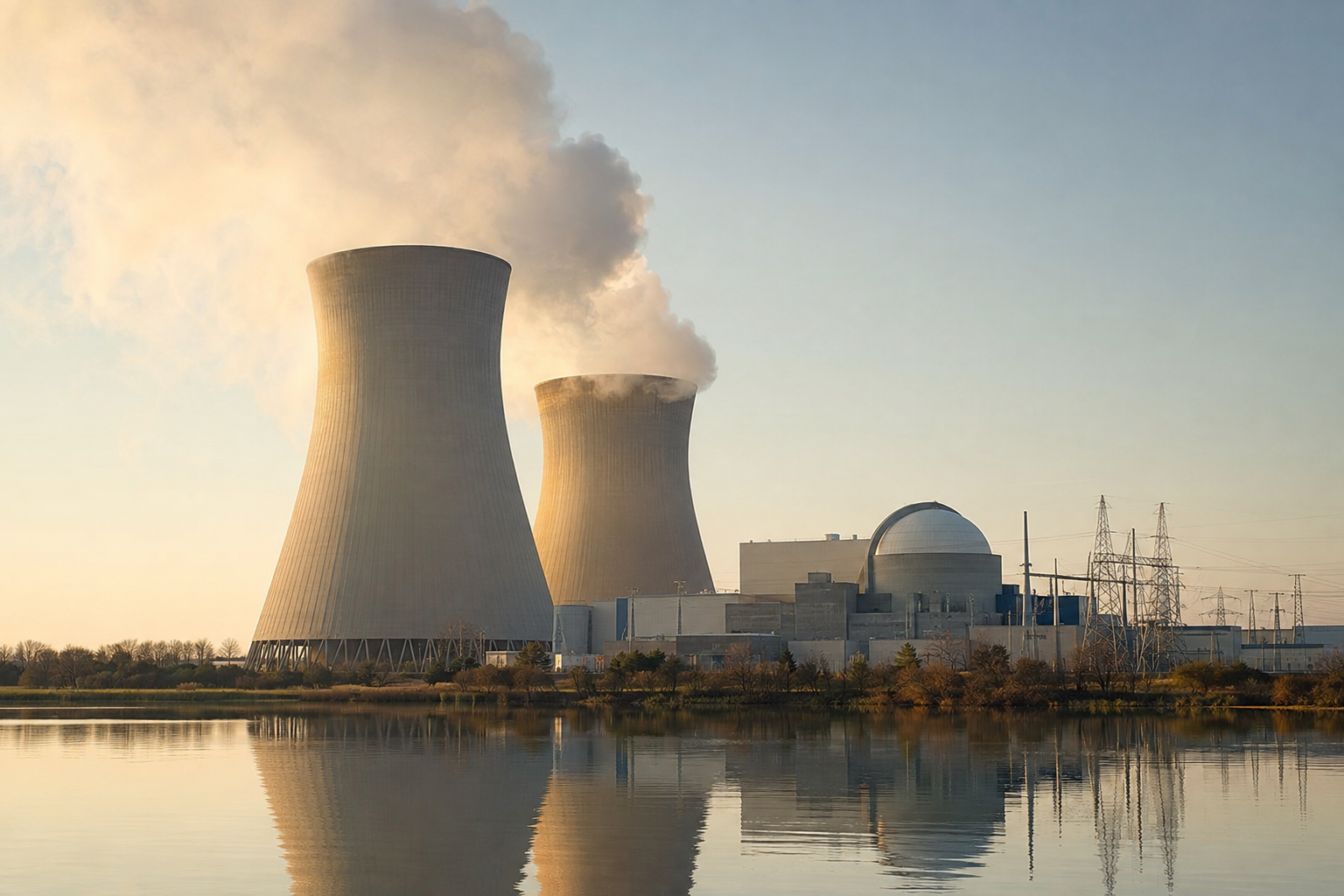
The most revealing development in artificial intelligence infrastructure is not another faster GPU or larger language model. It is the fact that technology companies are beginning to behave like energy companies.
Microsoft has signed a 20-year agreement tied to the restart of Three Mile Island Unit 1. Amazon has secured nuclear capacity from Talen Energy and is helping finance a new generation of small modular reactors. Google has committed to buying power from a fleet of advanced reactors being developed by Kairos Power. Meta has signed a 20-year deal for 1,121 megawatts from Constellation Energy’s Clinton nuclear plant in Illinois.
These are not symbolic clean-energy purchases. They are long-duration corporate nuclear energy pacts designed to secure something that AI companies increasingly cannot take for granted: electricity.
The underlying shift is simple. AI has transformed electricity from an operating expense into a strategic constraint. The companies that control access to reliable power may have an advantage over those that merely control chips, models and data.
The AI Data Center Has Become an Energy Problem
The scale of the problem is becoming difficult to ignore.
The International Energy Agency estimates that global data centers consumed about 415 terawatt-hours of electricity in 2024, around 1.5% of global electricity consumption. In its base case, that figure is expected to more than double to roughly 945 TWh by 2030.
The United States is at the center of this acceleration.
A Lawrence Berkeley National Laboratory study backed by the U.S. Department of Energy estimated that American data centers consumed about 4.4% of total U.S. electricity in 2023. By 2028, the sector could consume between 6.7% and 12% of national electricity demand, depending largely on how quickly AI infrastructure expands.
That creates a problem that conventional renewable procurement cannot solve by itself.
An AI data center does not simply need “clean energy.” It needs enormous quantities of electricity at predictable times, often around the clock. Training clusters can contain tens of thousands of accelerators. Inference workloads run continuously. Cooling systems add another major electrical load.
The commercial requirement is therefore closer to this:
- Large amounts of power
- High availability
- Predictable pricing
- Long-term supply
- Low carbon intensity
- A location close to transmission and computing infrastructure
Nuclear power happens to fit much of that profile.
That is why the emerging corporate nuclear market is less about environmental branding than it is about infrastructure security.
Why Nuclear Power Fits the AI Data Center Model
Nuclear reactors have an unusual characteristic in today’s electricity market: they produce large amounts of electricity continuously.
The U.S. Energy Information Administration notes that a single nuclear reactor generally has capacity of 800 MW or more and that nuclear plants operate continuously, making them naturally compatible with the steady electricity requirements of data centers.
Solar and wind remain essential to the broader electricity transition, but their output varies with weather and time of day. Batteries can smooth some of that variability, yet supplying a massive AI campus entirely through renewable generation plus storage can require substantial additional infrastructure.
Nuclear approaches the problem from the opposite direction.
Instead of asking how much intermittent generation must be built to serve a constant load, a nuclear plant starts with a constant supply and integrates other resources around it.
For hyperscalers, that distinction matters.
The emerging corporate nuclear contract is therefore not simply a power purchase agreement. It is a hedge against the possibility that the grid cannot deliver enough electricity when the next generation of AI campuses comes online.
Microsoft and Three Mile Island: The Existing Reactor Strategy
Microsoft’s September 2024 agreement with Constellation Energy is the clearest demonstration of this strategy.
The 20-year power purchase agreement is intended to support the restart of Three Mile Island Unit 1, renamed the Crane Clean Energy Center. The reactor was shut down in 2019 for economic reasons, not because of the 1979 accident involving Three Mile Island Unit 2. The restarted unit is expected to provide approximately 835 MW of carbon-free electricity.
The important point is what Microsoft did not have to do.
It did not have to wait a decade or more for a completely new nuclear plant to be designed, licensed and constructed. It attached a long-term corporate customer to an existing nuclear asset whose commercial economics had previously become difficult.
That changes the investment equation.
A reactor that looks unattractive under wholesale electricity-market economics can look much more viable when a technology company commits to purchasing its output for two decades.
Analysts have reported that the Microsoft agreement could involve a premium electricity price, reflecting the value of firm, carbon-free supply. Reuters reported estimates of roughly $110 to $115 per megawatt-hour from Jefferies, though the precise commercial terms were not publicly disclosed.
This is a crucial signal for the market.
Big Tech is demonstrating that it may be willing to pay more for electricity if doing so removes a much larger strategic risk: not having enough electricity to operate future AI infrastructure.
Meta’s Clinton Deal Reveals the Other Side of the Nuclear Opportunity
Meta’s agreement with Constellation is equally significant because it shows that the nuclear race is not exclusively about building new reactors.
In June 2025, Meta signed a 20-year PPA covering 1,121 MW from the Clinton Clean Energy Center in Illinois. The agreement begins in 2027 and is designed to support the continued operation and relicensing of the plant after Illinois’ existing zero-emission credit program expires.
The plant itself can produce roughly 1,092 MW, according to Constellation. The agreement also supports a 30 MW uprate.
The significance goes beyond Meta’s own electricity supply.
It illustrates a growing corporate model in which technology companies become the anchor customers that keep existing nuclear assets economically viable.
Meta has effectively said that keeping a reactor online can be as valuable as building new clean generation.
That is an important distinction because the United States does not necessarily need to solve its AI power problem by constructing hundreds of new reactors immediately. Extending the life of existing nuclear plants can deliver capacity much faster.
The World Nuclear Industry Status Report has identified a broader pipeline of nuclear contracts involving data centers and technology companies, with announced arrangements potentially representing tens of gigawatts of generation capacity.
The first phase of the nuclear-AI relationship may therefore be less about futuristic reactors and more about rescuing, extending and uprating existing ones.
Amazon Is Going Further: Buying the Nuclear Supply Chain
Amazon’s strategy is more aggressive.
In March 2024, Amazon Web Services agreed to acquire rights associated with up to 960 MW of capacity from Talen Energy’s Susquehanna nuclear facility in Pennsylvania. By June 2025, the relationship had expanded into a 1,920 MW power purchase agreement covering electricity for Amazon operations supporting AI and cloud technologies.
But Amazon did not stop at purchasing existing nuclear power.
In October 2024, Amazon led an approximately $500 million financing round for X-energy, an advanced nuclear reactor developer. The company said the investment was intended to support a commercial deployment target of more than 5 GW of X-energy reactors in the United States by 2039.
Amazon also backed a proposed 320 MW project with Energy Northwest in Washington and signed an agreement with Dominion Energy to explore SMR development in Virginia.
This is where corporate nuclear procurement starts to resemble industrial policy.
Amazon is not simply buying electrons. It is helping finance the companies, technologies and projects that could eventually produce those electrons.
That creates a potential flywheel:
AI demand creates the need for electricity.
Electricity demand creates demand for reactors.
Corporate contracts reduce financing uncertainty.
Investment accelerates reactor development.
More reactors create additional electricity supply for AI infrastructure.
The hyperscaler becomes part customer, part investor and part project developer.
Google Is Betting on Small Modular Reactors
Google has taken a different route.
In October 2024, the company announced an agreement with Kairos Power to purchase nuclear energy from multiple small modular reactors. Google said the initial objective was to bring the first reactor online by 2030, followed by additional deployments through 2035. The planned portfolio is expected to total approximately 500 MW.
This is important because SMRs are often discussed as if they are simply smaller versions of traditional nuclear plants.
Their commercial attraction is different.
A smaller reactor could potentially be deployed in standardized units, allowing developers to replicate projects rather than treating every nuclear plant as a giant bespoke construction exercise.
That could eventually matter to data centers because AI campuses are themselves becoming standardized infrastructure products.
The traditional nuclear model is enormous. Build one large reactor, connect it to a regional grid and sell power across a wide market.
The emerging model could be more modular: establish a large computing campus, secure a long-term energy contract and develop generation around the needs of that load.
Google reinforced this strategy in 2025 through a partnership involving Kairos Power and the Tennessee Valley Authority. The project is intended to bring 50 MW of advanced nuclear generation onto the TVA system beginning around 2030, supporting electricity demand associated with Google’s data centers.
Google has also provided early-stage capital to Elementl Power to prepare three potential U.S. nuclear sites, each targeting at least 600 MW, with Google retaining an option for commercial offtake.
That last detail may be the most revealing.
The next stage of corporate energy procurement is moving upstream into site development.
Why Big Tech Wants Private Nuclear Agreements Instead of Just Buying Grid Power
A natural question is why these companies cannot simply purchase electricity from utilities like everyone else.
They can. The problem is timing and scarcity.
Electricity markets were designed around a system in which utilities forecast relatively predictable demand growth and build generation accordingly.
AI has disrupted that assumption.
A hyperscale data center can represent a huge new electrical load arriving in a specific location. If several companies build campuses in the same region, utilities suddenly face a capacity problem involving generation, transmission, substations and grid stability.
The data center developer faces the same problem from the other side.
A site with cheap land but no available transmission capacity is not a viable AI campus.
A site with abundant renewable resources but insufficient firm power may not meet the workload’s reliability requirements.
A nuclear contract gives the hyperscaler something much closer to an infrastructure reservation.
It can lock in power for decades while reducing exposure to future wholesale-market volatility.
This also explains the growing interest in “behind-the-meter” and co-located nuclear arrangements, although regulators have increasingly scrutinized how such arrangements affect grid customers and transmission costs.
The central question is no longer simply whether a nuclear plant can produce electricity.
It is who gets access to that electricity, under what contractual structure and who pays for the infrastructure connecting it to the load.
Corporate Nuclear Energy Pacts Are Also a Financing Mechanism
There is a deeper economic story here.
Nuclear power has historically struggled with high upfront capital costs, lengthy construction periods and regulatory complexity.
A long-term corporate PPA changes the financing equation because it provides an identifiable customer for future generation.
For a reactor developer, a hyperscaler with a strong balance sheet can be more than a customer. It can become a form of demand assurance.
That is particularly important for advanced nuclear startups.
A company developing an SMR cannot simply announce a reactor design and wait for the market to appear. It needs capital for engineering, licensing, fuel development, manufacturing capacity and site preparation.
Amazon’s investment in X-energy illustrates the new model. Google has used early-stage capital in nuclear site development. Microsoft and Meta have used long-term contracts to support existing nuclear assets.
The corporate nuclear agreement is therefore evolving into a financial instrument.
It can transfer some market risk from a reactor developer to a technology company that has a powerful reason to guarantee future electricity supply.
The Biggest Risk: The Reactors May Not Arrive When AI Needs Them
There is a serious timing problem beneath the nuclear enthusiasm.
AI demand is expanding now.
Many advanced nuclear projects are targeting electricity production around 2030 or later.
Those dates are not guaranteed.
A new reactor requires design certification, licensing, environmental review, financing, construction, fuel supply and commissioning. Delays in any one stage can push commercial operation years into the future.
The United States has not yet established a large-scale commercial fleet of advanced SMRs. The nuclear industry has repeatedly demonstrated that new projects can experience significant cost and schedule overruns.
This creates an uncomfortable mismatch.
AI companies want power immediately. Nuclear developers are building an energy supply chain for the second half of the decade and beyond.
That explains why Big Tech is pursuing two nuclear strategies simultaneously.
First, secure existing reactors.
Second, finance future reactors.
Microsoft’s Three Mile Island agreement and Meta’s Clinton agreement represent the first strategy. Google’s Kairos program and Amazon’s X-energy investments represent the second.
The companies are effectively buying time.
The Nuclear Strategy Does Not Eliminate the Grid Problem
There is another misconception worth correcting.
A corporate nuclear PPA does not mean an AI data center is physically powered by electrons from a particular reactor every second.
Most corporate PPAs operate through electricity markets and contractual accounting mechanisms. The physical grid remains interconnected.
Amazon’s expanded Talen arrangement is a useful example. Under the new structure, Susquehanna’s electricity is expected to move onto the PJM grid, with Talen supplying Amazon and PPL handling transmission and delivery after planned network changes.
That matters because the infrastructure challenge is larger than generation.
The United States needs:
- New generation
- Transmission capacity
- Substations
- Transformers
- Interconnection upgrades
- Cooling infrastructure
- Fiber networks
- Land with suitable industrial characteristics
A reactor next to an AI campus is useful. A reactor without the necessary transmission and grid architecture is not enough.
The bottleneck is increasingly becoming the entire energy system.
What Happens If Nuclear Power Becomes the New Competitive Moat?
The strategic implications extend well beyond sustainability.
For decades, technology companies competed over chips, software talent, cloud infrastructure and data.
AI introduces another scarce resource: power.
If electricity becomes constrained in the locations where AI infrastructure wants to expand, access to generation could become a competitive advantage.
A company that has secured 20 years of nuclear supply has reduced one of the most difficult uncertainties in its infrastructure planning.
That could influence where data centers are built, which regions attract investment and which utilities receive billions of dollars in infrastructure upgrades.
It also creates a new relationship between Silicon Valley and the energy industry.
Amazon, Google, Microsoft and Meta are no longer simply large electricity customers. Their procurement decisions can determine whether nuclear plants remain open, whether new reactors receive financing and whether advanced nuclear startups have enough demand to reach commercial scale.
That is the real significance of corporate nuclear energy pacts.
The nuclear renaissance is not being driven only by governments and utilities. It is increasingly being underwritten by companies whose core product happens to be computation.
The Next Nuclear Deal Will Tell Us More Than the Last One
The most important metric to watch is not the number of announcements.
It is the number of megawatts that actually reach commercial operation.
A 500 MW SMR agreement signed today does not solve a data center’s 2026 power problem. A 20-year PPA tied to an existing reactor can.
That distinction will separate credible nuclear procurement strategies from corporate positioning.
Watch four indicators over the next several years:
- Whether existing nuclear plants receive extensions and uprates backed by hyperscaler contracts
- Whether advanced reactor projects secure licenses and construction financing on schedule
- Whether utilities can build transmission fast enough to connect new AI loads
- Whether hyperscalers continue paying a premium for firm, carbon-free electricity
If those pieces align, corporate nuclear procurement could become one of the most important infrastructure markets created by the AI boom.
The bigger story is not that Google, Amazon, Microsoft and Meta suddenly became enthusiastic about nuclear power.
It is that the economics of artificial intelligence are forcing technology companies to confront a physical constraint they could previously outsource.
Computing requires electricity. Frontier AI requires vastly more of it. And electricity cannot be generated by software.
The companies building the world’s next generation of AI infrastructure have reached the point where securing compute is no longer enough. They also need to secure the energy behind it.
That may make the next great AI infrastructure deal less about who owns the most GPUs and more about who controls the next gigawatt.
References & Sources
International Energy Agency, Energy and AI, 2025
https://www.iea.org/reports/energy-and-ai
U.S. Energy Information Administration, Data center owners turn to nuclear as potential electricity source
https://www.eia.gov/todayinenergy/detail.php?id=63304
Microsoft, Accelerating the addition of carbon-free energy: An update on progress, September 20, 2024
https://www.microsoft.com/en-us/microsoft-cloud/blog/2024/09/20/accelerating-the-addition-of-carbon-free-energy-an-update-on-progress/
Constellation Energy, Crane Clean Energy Center and Microsoft 20-Year Power Purchase Agreement
https://www.constellationenergy.com/news/2024/Constellation-to-Launch-Crane-Clean-Energy-Center-Restoring-Jobs-and-Carbon-Free-Power-to-The-Grid.html
U.S. Securities and Exchange Commission, Constellation Energy Form 8-K, September 20, 2024
https://www.sec.gov/Archives/edgar/data/1168165/000186827524000058/ceg-20240920.htm
Google, New nuclear clean energy agreement with Kairos Power, October 14, 2024
https://blog.google/company-news/outreach-and-initiatives/sustainability/google-kairos-power-nuclear-energy-agreement/
Google, First advanced nuclear reactor project with Kairos Power and Tennessee Valley Authority, August 18, 2025
https://blog.google/company-news/outreach-and-initiatives/sustainability/google-first-advanced-nuclear-reactor-project-with-kairos-power-and-tennessee-valley-authority/
Google, Google and Elementl Power nuclear energy site development agreement, May 7, 2025
https://blog.google/feed/google-and-elementl-nuclear-energy-site-development/
Amazon and X-energy, Amazon Invests in X-energy to Support Advanced Small Modular Nuclear Reactors, October 16, 2024
https://x-energy.com/news/amazon-invests-in-x-energy-to-support-advanced-small-modular-nuclear-reactors-and-expand-carbon-free-power/
Talen Energy, Talen Energy Expands Nuclear Energy Relationship with Amazon, June 11, 2025
https://ir.talenenergy.com/news-releases/news-release-details/talen-energy-expands-nuclear-energy-relationship-amazon
Dominion Energy, Dominion Energy and Amazon to explore advancement of Small Modular Reactor nuclear development in Virginia, October 16, 2024
https://news.dominionenergy.com/press-releases/press-releases/2024/Dominion-Energy-and-Amazon-to-explore-advancement-of-Small-Modular-Reactor-SMR-nuclear-development-in-Virginia-10-16-2024/default.aspx
Meta, Meta and Constellation Partner on Clean Energy Project, June 3, 2025
https://about.fb.com/news/2025/06/meta-constellation-partner-clean-energy-project/
Constellation Energy, Constellation and Meta Sign 20-Year Deal for Clean, Reliable Nuclear Energy in Illinois, June 3, 2025
https://investors.constellationenergy.com/news-releases/news-release-details/constellation-meta-sign-20-year-deal-clean-reliable-nuclear
World Nuclear Industry Status Report 2025, Nuclear Power Contracts with Data Centers
https://www.worldnuclearreport.org/World-Nuclear-Industry-Status-Report-2025-HTML-version
Lawrence Berkeley National Laboratory, 2024 United States Data Center Energy Usage Report
https://eta-publications.lbl.gov/publications/2024-united-states-data-center-energy
About The Author


