
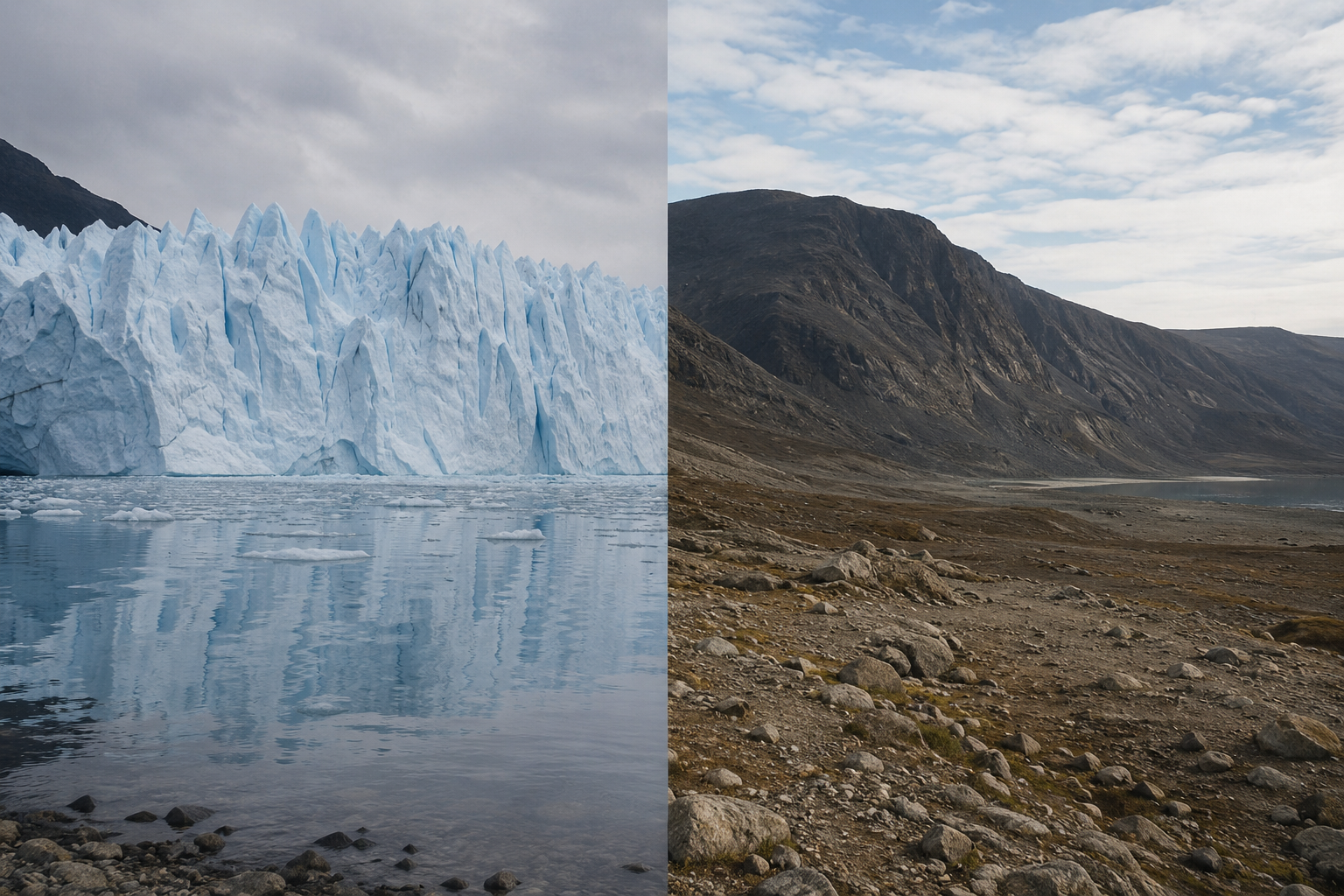
The most dangerous misconception about melting glaciers is that the disaster begins when the ice disappears.
It does not.
The disruption begins decades earlier, when glaciers lose enough mass to alter river systems, when ice sheets accelerate sea-level rise, when mountain slopes destabilize, and when polar freshwater begins changing ocean circulation. By 2025, the warning signals were already unmistakable. The World Meteorological Organization reported that 2015–2025 were the eleven hottest years ever recorded, while the 2023–2024 hydrological year produced the largest global glacier mass loss in the observational record, about 450 billion tonnes of ice.
The real question is therefore not whether Earth’s glaciers will melt. They are already melting.
The question is how much ice will disappear, how quickly, which ice systems cross irreversible thresholds, and what that means for the cities, countries and economies built around today’s climate.
The first distinction: mountain glaciers, Arctic sea ice and polar ice sheets are not the same thing
When people talk about the “North Pole melting,” they often picture the Arctic Ocean covered by ice. That ice is mostly floating sea ice. Its disappearance does not directly produce anything close to the sea-level rise caused by melting land ice.
Greenland is different. Antarctica is different. Mountain glaciers are different again.
Mountain glaciers sit on land. When they melt, their water eventually reaches the oceans and contributes directly to sea-level rise. They are also natural reservoirs that release water into rivers during warm seasons.
Greenland and Antarctica contain enormous land-based ice sheets. NASA estimates that if all the ice in Greenland and Antarctica melted, global sea level would eventually rise by roughly 65 metres.
That would redraw the world’s coastlines.
But it is not a scenario for 2050 or even necessarily 2100. Complete melting would require a much warmer climate sustained over centuries to millennia.
This distinction matters because the most serious damage does not require complete melting.
What is likely to happen by 2050
The next 25 years are more important than many people realize because glacier loss can become a water-security problem long before a glacier vanishes.
The United Nations World Water Development Report 2025 estimates that about two billion people depend on mountain waters. Mountains supply roughly 55–60% of global annual freshwater flows, and 26–41% of global mountain glacier mass could be lost by 2100 across warming levels from 1.5°C to 4°C.
The Himalayan region is especially important.
The Hindu Kush Himalaya, sometimes called the Third Pole, feeds the Indus, Ganges, Brahmaputra and other major river systems. Hundreds of millions of people live downstream, while much larger populations depend indirectly on those rivers for agriculture, electricity, industry and urban water.
The first phase of rapid glacier melting can temporarily increase river flows. That sounds beneficial. It is not.
It is a warning that the reservoir is being liquidated.
Once glacier volume falls sufficiently, annual meltwater begins declining. Rivers that once received dependable summer contributions become increasingly dependent on rainfall and seasonal snow. That creates a far more volatile water system.
UNESCO’s 2025 assessment says the Third Pole could lose around half of its glacier volume by 2100 under continued warming.
The result will not be a single “Day Zero.” It will be a sequence of increasingly difficult years involving water shortages, crop losses, hydropower instability, floods and migration.
The Himalayan problem is bigger than melting ice
The Himalayas face a particularly dangerous combination.
Warmer temperatures melt glaciers faster. Less snow means less reflective surface area. Darker surfaces absorb more solar energy. Glacial lakes can expand behind unstable natural dams. Heavy rainfall can trigger landslides and floods. Permafrost degradation can destabilize mountain infrastructure.
That means a warming Himalaya can produce both too much water and too little water.
In one season, a basin may experience catastrophic flooding. In another, farmers may struggle with inadequate irrigation.
This is why cities such as Delhi, Lahore, Dhaka and Kathmandu should not treat Himalayan glacier loss as a remote mountain problem.
Their vulnerability comes through river basins, food systems, electricity networks and migration.
What happens to Greenland
Greenland is one of the most consequential pieces of ice on Earth.
Unlike floating Arctic sea ice, Greenland’s ice is sitting on land. Its complete loss would eventually raise global sea level by roughly 7 metres.
That does not mean Greenland will disappear this century.
It does mean that warming can push the ice sheet toward states from which recovery becomes extremely difficult.
Research published in Nature has estimated a critical global-mean-temperature threshold for abrupt Greenland ice-sheet loss somewhere around 1.7°C to 2.3°C above the pre-industrial level, although the exact threshold and timescale remain uncertain.
This is one of the most important facts in the entire climate debate.
A tipping point does not mean “the ice sheet melts tomorrow.”
It means the climate can enter a state in which long-term ice loss becomes self-sustaining even if warming subsequently slows. The physical response can unfold over centuries.
That distinction between triggering a process and completing it is essential.
Antarctica is the bigger long-term threat
If Greenland is dangerous, Antarctica is the giant sitting behind the door.
The Antarctic Ice Sheet contains enough ice to produce roughly 58 metres of global sea-level rise if it were completely lost, with Greenland accounting for much of the remainder of the combined approximately 65-metre figure.
West Antarctica is particularly concerning because much of its ice rests below sea level. Its stability depends partly on floating ice shelves that act as brakes on glaciers flowing toward the ocean.
Warmer ocean water can attack these shelves from below.
Once buttressing weakens, inland ice can accelerate toward the sea.
Scientists have identified potential thresholds for major Antarctic ice loss, but the exact timing remains deeply uncertain. Research indicates that warming above roughly 1.5–2°C can commit parts of the Antarctic system to long-term ice loss on centennial to millennial timescales.
That makes Antarctica fundamentally different from a conventional weather forecast.
You can reduce emissions today and still inherit centuries of sea-level consequences from warming already produced.
How much sea-level rise should the world expect by 2100?
The best-established projections are much less dramatic than the 65-metre total-loss scenario, but they are still large enough to transform coastal planning.
The IPCC’s AR6 assessment estimated likely global mean sea-level rise by 2100, relative to 1995–2014, at approximately:
- 28–55 centimetres under very low greenhouse-gas emissions
- 32–62 centimetres under low emissions
- 44–76 centimetres under an intermediate emissions pathway
- 63 centimetres to 1.01 metres under very high emissions
The IPCC also says substantially larger rises cannot be ruled out because of deep uncertainty surrounding rapid ice-sheet processes. Under a very high emissions scenario, a rise approaching 2 metres by 2100 and about 5 metres by 2150 was considered possible, though with low confidence.
The critical point is that sea level does not stop rising in 2100.
The IPCC states that sea level will remain elevated for thousands of years because the deep ocean and ice sheets respond slowly to warming.
Which cities should worry first?
The most exposed cities are not necessarily those closest to glaciers.
They are low-lying coastal cities where millions of people, ports, roads, airports, power systems and property already sit close to sea level.
Cities and metropolitan regions facing serious long-term exposure include:
- Mumbai
- Kolkata
- Dhaka
- Chennai
- Bangkok
- Ho Chi Minh City
- Jakarta
- Manila
- Shanghai
- Guangzhou
- Shenzhen
- Miami
- New Orleans
- New York
- London
- Amsterdam
- Rotterdam
- Alexandria
- Lagos
- Abidjan
The risk is not simply permanent inundation.
A relatively modest rise in average sea level makes storm surges travel farther inland. High tides reach infrastructure more frequently. Drainage systems become less effective. Saltwater can move into groundwater and agricultural land. Roads and subway systems become harder to protect.
A city can therefore become economically difficult to operate long before it is physically underwater.
Why Mumbai, Kolkata and Dhaka face different risks
Mumbai’s principal exposure is coastal flooding, storm surge, extreme rainfall and drainage failure. Rising sea level raises the baseline from which every storm begins.
Kolkata faces a more complicated combination of sea-level rise, cyclone exposure, river flooding, subsidence and the vulnerability of the wider Ganges-Brahmaputra delta.
Dhaka is vulnerable to both ends of the glacier story. It sits downstream of Himalayan water systems while also being exposed to increasing flood risk in a low-lying delta environment.
That combination illustrates why glacier melting should not be viewed only as a “coastal problem.”
The same climate system can create water scarcity upstream and flooding downstream.
What happens to countries if polar ice keeps shifting?
The effects will spread far beyond coastlines.
Countries dependent on imported food may face higher prices when major agricultural regions experience water shortages.
Hydropower-dependent economies can lose reliability as glacier-fed rivers change seasonally.
Insurance markets may retreat from high-risk coastal areas.
Governments will spend more on seawalls, drainage, relocation and disaster recovery.
Ports may require expensive redesign.
Real estate values can diverge sharply between protected and exposed areas.
Freshwater competition can intensify within and between countries.
Migration becomes another major consequence.
This is why the most consequential climate map of the future will not simply show where water reaches. It will show where infrastructure, food production, freshwater and human populations intersect.
What about the North Pole?
Arctic sea ice loss is still enormously important even though melting floating sea ice does not directly produce the same sea-level rise as melting Greenland.
The Arctic strongly influences Earth’s climate system. Loss of reflective sea ice exposes darker ocean water, which absorbs more solar energy. Arctic warming also affects atmospheric and oceanic circulation.
The WMO reported that Arctic sea ice reached a record-low annual maximum in 2025, while Antarctic sea ice was also substantially below average.
The Arctic therefore matters for climate feedbacks, ecosystems, geopolitics and weather patterns even before considering Greenland.
Could melting Greenland disrupt ocean circulation?
Yes, and this is one of the less visible risks.
Large amounts of freshwater entering the North Atlantic can alter the density of surface water. Ocean circulation depends partly on differences in temperature and salinity.
The Atlantic Meridional Overturning Circulation, or AMOC, transports heat northward and plays an important role in the climate of the Atlantic region.
Climate models indicate that continued warming is likely to weaken the AMOC during the 21st century, although the IPCC has assessed an abrupt collapse before 2100 as unlikely based on current evidence.
The distinction is important. Weakening is not the same thing as collapse.
Yet weakening circulation could alter regional climate, rainfall and marine ecosystems, adding another layer of uncertainty to an already unstable system.
How quickly could the crisis accelerate?
There is no scientifically defensible date at which “the glaciers melt.”
Different glaciers respond at different rates. Mountain glaciers can disappear within decades. Large ice sheets can take centuries or millennia to lose most of their mass.
The most useful timeline is therefore based on thresholds and consequences.
2025–2035: The warning decade
The world is already experiencing unprecedented glacier loss.
The WMO reported that the 2023–2024 hydrological year produced a global reference-glacier mass balance of minus 1.3 metres of water equivalent, representing roughly 450 gigatonnes of ice loss.
UNEP’s 2025 assessment says current policies point toward roughly 2.8°C of warming over this century, while full implementation of existing national climate pledges would produce around 2.3–2.5°C.
The world is therefore moving into a temperature range where long-term ice-sheet risks become increasingly important.
2035–2050: Water and coastal adaptation become mainstream infrastructure issues
Glacier-fed river systems become increasingly difficult to manage.
Some small glaciers disappear entirely.
Coastal flooding becomes more frequent as sea level rises.
Governments that have not incorporated future sea levels into urban planning begin facing expensive retrofits.
2050–2100: The divergence becomes enormous
At this point, the difference between a world that limits warming and one that allows higher warming becomes increasingly visible.
Mountain glacier losses accelerate.
Sea-level rise continues.
Polar ice-sheet instability becomes a more important contributor to future projections.
Some coastal communities face repeated flooding severe enough to make permanent relocation economically rational.
After 2100: The long tail of today’s decisions
This is where the climate system becomes profoundly unforgiving.
Even if atmospheric temperatures stabilize, oceans remain warm for a long time and ice sheets continue responding.
Some sea-level rise becomes effectively locked in for centuries.
A decision made in the 2020s can therefore influence coastlines in the 2200s.
Are we already too late?
No.
But the nature of the objective has changed.
The world is unlikely to avoid every consequence associated with 1.5°C of warming. UNEP says the multi-decadal global temperature average is now very likely to temporarily exceed 1.5°C within the next decade.
That does not make 1.6°C, 1.8°C, 2.0°C and 2.8°C equivalent.
They are not.
Every fraction of a degree avoided reduces the probability and severity of irreversible changes.
Climate Action Tracker’s 2025 assessment puts current-policy warming at about 2.6°C by 2100, while UNEP’s current-policy estimate is around 2.8°C. The precise number varies by methodology, but both assessments point to the same strategic conclusion: the world is not yet on a pathway consistent with the Paris temperature goals.
The argument that climate action only matters if it can “stop” warming is therefore misplaced.
Stopping an additional metre of sea-level rise matters.
Preserving part of a glacier matters.
Preventing an ice shelf from destabilizing matters.
Keeping a river system reliable for another generation matters.
The cities that prepare early will have an enormous advantage
The smartest response is not to wait for a dramatic photograph of a collapsing glacier.
Governments need to work backward from physical risk.
For mountain regions, that means watershed monitoring, glacier-lake warning systems, stronger hydropower planning, drought-resilient agriculture and alternative water storage.
For coastal cities, it means incorporating sea-level projections into zoning, drainage, ports, transport systems, power infrastructure and building codes.
For countries dependent on glacier-fed agriculture, it means treating water security as national infrastructure rather than seasonal weather management.
And for the global economy, it means recognizing that ice is infrastructure.
A glacier is a reservoir.
An ice sheet is a planetary-scale regulator.
A snowpack is seasonal water storage.
An ice shelf is a brake.
When these systems weaken, humanity does not simply lose frozen water. It loses some of the physical infrastructure that has helped stabilize rivers, coastlines and climate conditions for thousands of years.
The decisive period is not the moment when the last glacier disappears. It is the next several decades, when today’s warming determines which ice systems merely shrink and which begin long-term retreat that future generations may no longer be able to reverse.
The central climate question has therefore moved from “Will the ice melt?” to something much harder: “How much irreversible change are we willing to lock into the planet before we stop adding heat to it?”
References & Sources
Intergovernmental Panel on Climate Change, Climate Change 2021: The Physical Science Basis, Summary for Policymakers
https://www.ipcc.ch/report/ar6/wg1/chapter/summary-for-policymakers/
Intergovernmental Panel on Climate Change, Chapter 9: Ocean, Cryosphere and Sea Level Change
https://www.ipcc.ch/report/ar6/wg1/chapter/chapter-9/
World Meteorological Organization, State of the Global Climate 2025
https://wmo.int/publication-series/state-of-global-climate/state-of-global-climate-2025
World Meteorological Organization, State of the Global Climate 2025: Update for COP30
https://wmo.int/sites/default/files/2025-11/State%20of%20the%20Climate%202025%20Update%20COP30%20%2831%20oct%29.pdf
UNESCO, United Nations World Water Development Report 2025: Mountains and Glaciers: Water Towers
https://www.unesco.org/en/reports/wwdr/2025
UNESCO, Cryospheric Change and Its Impact on Water Resources
https://www.unesco.org/reports/wwdr/en/2025/cryospheric-change
NASA, The Anatomy of Glacial Ice Loss
https://www.nasa.gov/science-research/earth-science/the-anatomy-of-glacial-ice-loss/
NASA Sea Level Change Portal, Rising Waters: Out-of-Balance Ice Sheets
https://sealevel.jpl.nasa.gov/resources/1235/rising-waters-out-of-balance-ice-sheets/
UNEP, Emissions Gap Report 2025: Off Target
https://www.unep.org/resources/emissions-gap-report-2025
Climate Action Tracker, Emissions Pathways to 2100
https://climateactiontracker.org/global/emissions-pathways/
Nature, The Multi-Millennial Antarctic Commitment to Future Sea-Level Rise
https://www.nature.com/articles/nature15706
Nature Climate Change, The Greenland and Antarctic Ice Sheets Under 1.5 °C Global Warming
https://www.nature.com/articles/s41558-018-0305-8
Nature, Overshooting the Critical Threshold for the Greenland Ice Sheet
https://www.nature.com/articles/s41586-023-06503-9
World Glacier Monitoring Service
https://wgms.ch/
About The Author


