
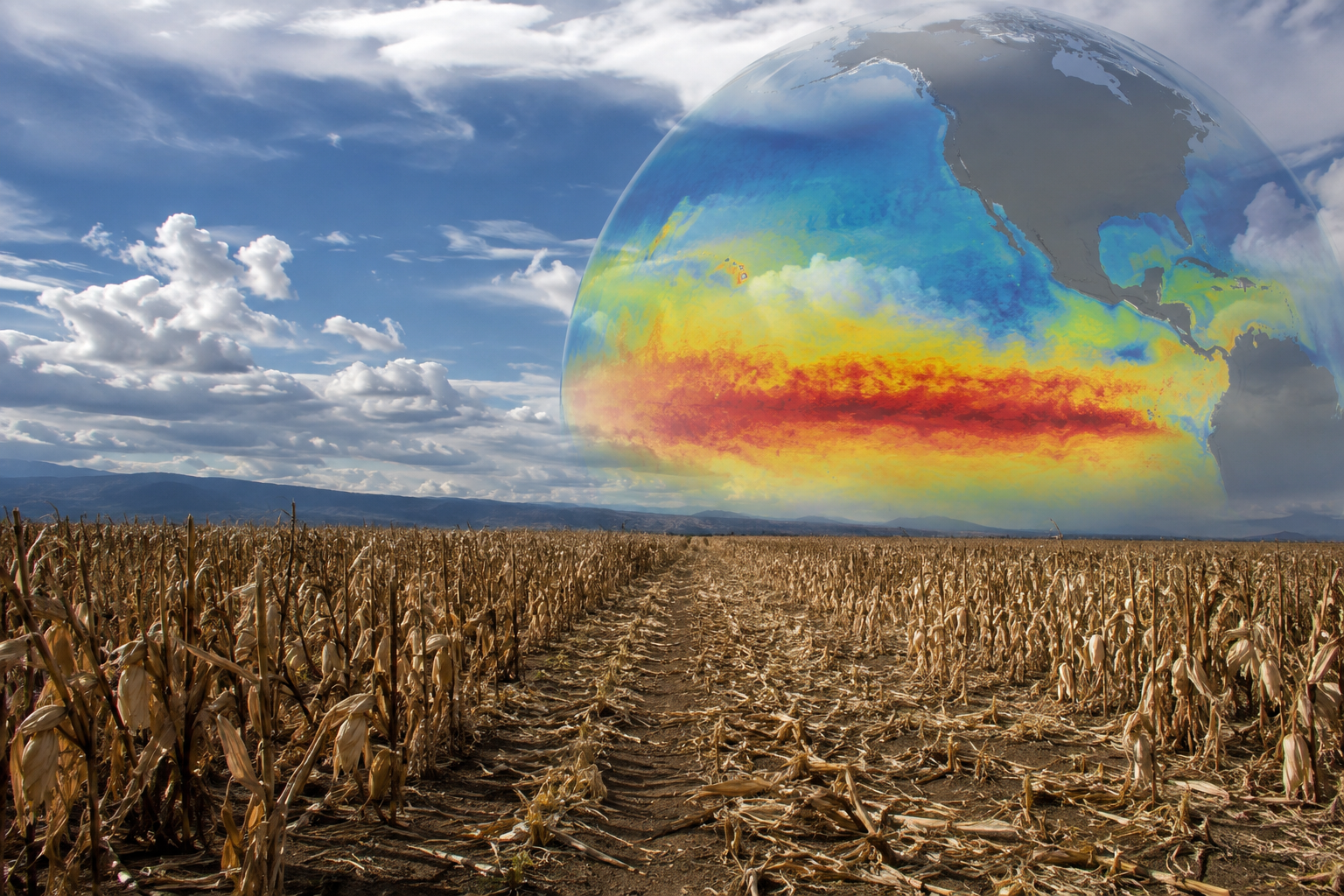
The most important commodity-market signal of August 2026 is not sitting on an exchange screen. It is sitting in the Pacific Ocean.
As of August 13, NOAA’s Climate Prediction Center said El Niño was strengthening, with more than a 90% probability of a very strong event during the Northern Hemisphere fall and winter of 2026-27. Sea-surface temperature anomalies had already exceeded 2°C in parts of the eastern equatorial Pacific, while the July Niño-3.4 index reached 1.4°C.
That matters because commodity markets do not wait for a harvest failure to price weather risk. They price the possibility of one.
Coffee, cocoa, sugar, rice, palm oil, grains and even some metals are now entering a period in which the weather premium can become as important as inventories, freight rates or geopolitics. The crucial question is not whether El Niño will make the world hotter. It will.
The question is which commodities will feel the supply shock first, which markets are already pricing it, and where investors and businesses are still underestimating the risk.
El Niño August 2026 intensification: what changed?
The 2026 El Niño story has moved unusually quickly.
In June, the World Meteorological Organization gave an 80% probability of El Niño conditions during June-August and close to 90% odds that the event would continue through at least November. At that point, most models expected a moderate event with the possibility of stronger development.
By July, the outlook had shifted materially. WMO’s seasonal model projected an average sea-surface temperature anomaly of roughly 2°C for July-September. By its July 31 update, the forecast for August-October had climbed to approximately 2.9°C, with the intensification expected to continue toward a November peak.
NOAA’s August assessment was even more consequential for markets. It reported significant subsurface temperature anomalies reaching approximately 10°C at depth, a sign that substantial heat was stored beneath the Pacific surface.
This is why August matters.
The market is moving from a forecast of an El Niño event to the pricing of its potential consequences.
That distinction is critical. A forecast can change. A crop already damaged by heat, drought or excessive rain cannot be recovered by a revised weather model.
Why commodities react before the weather damage becomes obvious
Commodity markets are forward-looking businesses.
A coffee trader does not need to see a 10% reduction in Brazil’s next crop before adjusting prices. If weather models indicate that flowering, rainfall or soil moisture could deteriorate during a critical growing period, futures prices can move months before the physical supply deficit appears.
That creates a three-stage transmission mechanism:
- Weather models identify a potential production shock.
- Traders reprice futures and options before physical inventories tighten.
- Higher input and raw-material costs reach manufacturers and consumers months later.
The third stage is particularly important for inflation.
The UN Food and Agriculture Organization has warned that commodity price increases typically take several months to feed through into consumer food prices. Reuters reported in August that FAO estimates the transmission can take roughly three to six months.
So an El Niño event that intensifies in August does not necessarily produce its biggest supermarket impact in August.
The more consequential window may arrive in late 2026 and into 2027.
Coffee is becoming an early-warning market
Coffee is one of the clearest places to watch the El Niño signal.
Vietnam and Indonesia are major producers of robusta coffee and are particularly exposed to heat and rainfall disruption. Brazil’s Arabica crop has a different weather sensitivity, meaning El Niño does not simply translate into “less coffee everywhere.” The geographic distribution of the weather shock matters.
Colombia provides an important real-time example.
The National Federation of Coffee Growers expects Colombian production to decline from 13.7 million 60-kilogram bags in 2025 to approximately 12.5 million bags in 2026, an estimated decline of about 8%. The federation attributed the deterioration to earlier excessive rainfall and the emerging El Niño pattern.
That is more important than a generic El Niño forecast because it shows how weather risk is interacting with an actual crop cycle.
Colombia is the world’s third-largest coffee producer and the leading supplier of washed Arabica. Its experience gives buyers an indication of what can happen when excessive rain and subsequent weather disruption collide.
There is another lesson here.
The market does not need a global coffee shortage to become volatile. It only needs a few major producing countries to experience simultaneous production problems while inventories are already tight.
That is why coffee may remain one of the most sensitive soft commodities through the 2026-27 crop cycle.
Cocoa faces a different kind of El Niño problem
Cocoa is even more exposed to weather volatility because production is heavily concentrated in West Africa.
Ivory Coast and Ghana account for roughly half of global cocoa supply. Strong El Niño episodes have historically been associated with production problems in the region, and the 2023-24 El Niño period demonstrated how quickly weather stress can translate into extreme cocoa prices.
The 2026 market is entering the event from a complicated starting point.
Cocoa prices have already experienced enormous volatility. The market has had periods of abundant supply expectations alongside fears about the next crop. That makes the weather premium particularly unstable.
In early August, London cocoa futures rose to a one-month high amid concerns about El Niño and weaker production forecasts for Ivory Coast and Ghana.
This creates a classic commodity-market problem.
If the crop survives, speculative weather premiums can disappear quickly. If the crop deteriorates, traders can discover that the market had underestimated the physical shortage.
Cocoa therefore offers one of the clearest examples of why price direction cannot be inferred simply from the existence of El Niño.
The relevant question is whether actual crop conditions validate the weather signal.
Sugar may become the sleeper commodity
Sugar deserves considerably more attention than it receives in mainstream discussions about El Niño.
Brazil dominates global sugar exports. India and Thailand are also major producers, creating a geographic setup in which different parts of the world’s sugar supply can experience different weather effects at the same time.
Brazil has already experienced harvesting disruptions linked to excessive rainfall. Industry participants have also warned that rainfall can reduce sugar content in cane. By August 13, raw sugar futures had risen above 17 cents per pound, reaching their highest level since June 2025. India’s rainfall was reported to be 11.7% below normal at that point.
That is a powerful combination.
Brazil faces harvest and cane-quality risks while India faces rainfall concerns.
Energy markets can amplify the effect. Sugarcane can be processed into ethanol, so higher crude oil prices can change the economic incentive for Brazilian mills to produce ethanol rather than sugar.
Sugar is therefore sitting at the intersection of three markets:
- Weather
- Food
- Energy
That makes it particularly vulnerable to a second-round price shock.
Rice and palm oil are the next markets to watch
Rice has a different risk profile because production and consumption are heavily concentrated in Asia.
El Niño can produce drought conditions in parts of Southeast Asia, while a positive Indian Ocean Dipole can reinforce regional rainfall disruptions. WMO expects a positive Indian Ocean Dipole to develop alongside the strengthening Pacific El Niño.
For rice-importing countries, the risk is not simply a higher futures price.
It is export policy.
When governments become concerned about domestic food inflation, they can restrict exports or increase strategic procurement. That can turn a regional production problem into a global trade shock.
Palm oil faces a similar geographic concentration issue. Indonesia and Malaysia dominate global production, while the crop is highly sensitive to rainfall and heat.
The important distinction is timing.
Coffee and cocoa can react quickly because financial markets are intensely focused on their crop cycles. Palm oil can have a slower transmission mechanism because plantations respond differently to weather stress and production changes can take time to appear in official output data.
That makes palm oil less of an immediate headline trade and more of a medium-term supply-risk indicator.
Grains are where investors should resist simplistic El Niño narratives
One of the easiest mistakes in 2026 is to assume that El Niño automatically means higher prices for every agricultural commodity.
It does not.
Wheat, corn and soybeans respond to a much broader set of variables, including acreage, global inventories, fertilizer availability, Black Sea exports, Brazilian weather, U.S. crop conditions and currency movements.
Recent market data illustrates the problem.
A specialized August El Niño market assessment noted that wheat prices had risen sharply, but warned that attributing that entire move to ENSO would not be defensible. The same analysis pointed to Australia’s projected 2026-27 wheat production of 26.7 million tonnes, down from 36 million tonnes the previous season, while stressing that the decline had multiple drivers.
This distinction matters for anyone trading the theme.
El Niño is a risk multiplier, not a universal explanation for commodity prices.
The strongest trades will emerge where the weather signal intersects with an already tight supply-demand balance.
El Niño is also a fisheries shock
The commodity story extends beyond agriculture.
Peru’s anchovy fishery is one of the most important sources of fishmeal and fish oil used in global animal-feed and aquaculture supply chains. El Niño warms Pacific waters and can disrupt the marine ecosystem that supports anchovy populations.
Reuters reported that Peru’s first north-central anchovy season in 2026 had a total allowable catch of 1.9 million tonnes, roughly 36% below the previous first-season quota. Fishing was suspended in May because of the high share of juvenile fish.
This is an important second-order commodity risk.
A disruption in Peruvian fisheries does not stay in Peru.
It can raise costs for aquaculture producers, livestock-feed manufacturers and other industries dependent on fishmeal and fish oil.
The El Niño transmission chain therefore runs from ocean temperatures to fisheries, then into animal protein markets.
Metals are not immune
The strongest El Niño effects are usually discussed in agricultural markets, but metals can also be exposed through energy and infrastructure.
Copper is a useful example.
Zambia is attempting to dramatically expand copper production, yet its mining sector remains exposed to electricity availability. El Niño-related drought can reduce hydropower generation, increasing power shortages and raising operational risks for mines. Reuters has reported that Zambia’s mining ambitions face this weather-related vulnerability.
That creates a less obvious commodity linkage.
The climate shock does not have to damage a mine directly.
It only has to reduce the electricity available to operate it.
This is increasingly important as mining companies expand into countries where hydropower provides a large share of electricity.
The real inflation threat is the combination of shocks
The most dangerous feature of the 2026 El Niño is not El Niño by itself.
It is the possibility that El Niño arrives in an already stressed commodity system.
The world is simultaneously dealing with geopolitical conflict, energy-market volatility, fertilizer constraints, shipping risks and disrupted agricultural inputs. FAO has warned that the combination could create another wave of food inflation toward the end of 2026 and into 2027.
That creates a nonlinear risk.
A 5% production decline in a commodity with comfortable inventories may barely matter.
The same 5% decline when inventories are low, fertilizer is expensive and importing countries are building strategic stocks can produce a much larger price response.
Commodity markets are governed by marginal supply.
The last few million tonnes can determine the price of the entire market.
India may be one of the most important El Niño stories
For India, the commodity implications deserve special attention because weather risk feeds directly into the agricultural economy and inflation.
Corporate concern is already visible.
A Reuters analysis of company filings and earnings calls between May and August found 478 companies mentioning El Niño across 1,443 documents. Indian companies accounted for nearly 900 mentions, far more than companies in several other major economies.
That is not a trivial corporate talking point.
It tells you that companies are already incorporating weather uncertainty into planning.
India’s exposure runs across sugar, rice, edible oils, agricultural inputs, consumer goods and rural demand. If rainfall becomes sufficiently disruptive, the consequences can move from farm output to food inflation, government intervention and household consumption.
The positive Indian Ocean Dipole expected alongside El Niño adds another layer of uncertainty because the interaction between Pacific and Indian Ocean conditions can modify the typical El Niño rainfall pattern.
For Indian businesses, the relevant question is therefore not simply “Will El Niño hurt the monsoon?”
It is “Which agricultural regions, crops and supply chains will experience the largest deviation from normal rainfall, and when?”
What commodity traders should watch between August 2026 and early 2027
The next several months will be defined by confirmation rather than discovery.
Watch five signals closely:
- NOAA’s monthly Niño indices and the probability of a very strong El Niño.
- Crop-condition reports from Brazil, Colombia, Vietnam, Indonesia, India, Thailand and West Africa.
- Government export restrictions and strategic food-stock purchases.
- Physical inventories and exchange warehouse stocks for coffee, cocoa, sugar and grains.
- Freight, fertilizer and energy prices that can amplify weather-driven supply shocks.
The most important signal may be the divergence between futures prices and physical markets.
If futures rise while inventories remain comfortable and crop conditions hold, the market may be carrying a large weather premium.
If futures rise while physical differentials, inventories and export restrictions also deteriorate, the market is moving from speculation toward genuine scarcity.
That distinction can determine whether an El Niño trade has already run too far or is only beginning.
The 2026 El Niño market is not a single commodity trade
The old way of thinking about El Niño was simple.
Drought here. Flooding there. Crop losses. Higher food prices.
The 2026 episode is more complicated because global supply chains are already optimized for efficiency rather than redundancy.
That means a localized weather disruption can travel through several markets before reaching consumers.
A dry spell in Vietnam can affect coffee.
A disrupted coffee supply affects roasters.
Higher roasting costs affect consumer prices.
A simultaneous sugar shock raises beverage costs.
Higher energy and fertilizer prices increase agricultural production costs.
A fisheries disruption increases feed costs.
The result is not one commodity spike.
It is a synchronized increase in supply-chain volatility.
Historical evidence supports caution. World Bank analysis of past El Niño episodes shows that commodity responses have varied sharply across events and products. There is no mechanical rule that every El Niño produces a universal agricultural price boom.
That is precisely why 2026 deserves close attention.
The bigger risk begins after the headlines disappear
The most visible part of an El Niño event is usually the heat.
The economically important part is what happens after the weather headline moves off the front page.
Harvest decisions made in late 2026 can determine inventories in early 2027. Government procurement decisions can alter international trade flows. Farmers can change planting patterns. Manufacturers can redesign sourcing. Traders can rebuild positions.
And consumers may only feel the full effect months later.
The WMO’s July forecast projected the El Niño signal to strengthen through August-October, with the event expected to peak around November. NOAA’s August assessment put the probability of a very strong event above 90% for the Northern Hemisphere fall and winter.
That makes the next six months more important than the past six.
The 2026 El Niño is not simply a weather story. It is becoming a test of how resilient the world’s commodity system really is.
The first winners and losers will not necessarily be the countries with the hottest temperatures. They will be the producers, traders and consumers sitting on the wrong side of a supply chain when the weather changes.
And the clearest market signal may arrive long before the supermarket shelf changes: when traders stop pricing what the weather might do and start pricing what farmers can no longer produce.
References & Sources
- World Meteorological Organization (WMO) — Strong El Niño Expected to Intensify, July 2026
WMO — Strong El Niño Expected to Intensify - World Meteorological Organization — Global Seasonal Climate Update: August–September–October 2026
WMO — Global Seasonal Climate Update, ASO 2026 - NOAA Climate Prediction Center — ENSO Diagnostic Discussion, August 13, 2026
NOAA — ENSO Diagnostic Discussion, August 13, 2026 - NOAA Climate Prediction Center — Official ENSO Strength Probabilities, August 2026
NOAA — Official ENSO Strength Probabilities - NOAA — ENSO Recent Evolution, Current Status and Predictions
NOAA — ENSO Current Status and Predictions PDF - Reuters — Why a Super El Niño Leaves Tropical Commodities Acutely Exposed, August 18, 2026
Reuters — Why a Super El Niño Leaves Tropical Commodities Acutely Exposed - Reuters — How Will Latin America’s Super El Niño Affect the Top Food-Exporting Region?, August 13, 2026
Reuters — Latin America’s Super El Niño and Food Exports - Reuters — El Niño, Not Quake, to Hit Colombian Coffee Harvest, August 21, 2026
Reuters — El Niño and Colombian Coffee Harvest - Reuters — “Super” El Niño Could Trigger a Global Food Price Shock, June 3, 2026
Reuters — Super El Niño and Global Food Prices - Food and Agriculture Organization of the United Nations — El Niño Is Coming: Here Is Where the Risks to Agriculture Are Highest, June 22, 2026
FAO — El Niño Agricultural Risk Assessment - FAO — FAO Food Price Index
FAO — Food Price Index - FAO — FAO Food Price Index, June 2026
FAO — June 2026 Food Price Index - World Bank — Commodity Markets Outlook: Understanding El Niño
World Bank — Commodity Markets Outlook: Understanding El Niño - International Coffee Organization — Coffee Market Information and Reports
International Coffee Organization - International Cocoa Organization — February 2026 Quarterly Bulletin of Cocoa Statistics
ICCO — February 2026 Quarterly Bulletin of Cocoa Statistics - International Cocoa Organization — Cocoa Statistics and Market Data
ICCO — Cocoa Statistics - U.S. Department of Agriculture — World Agricultural Supply and Demand Estimates (WASDE)
USDA — WASDE Reports - USDA National Agricultural Library — World Agricultural Supply and Demand Estimates Archive
USDA — WASDE Archive
About The Author


