
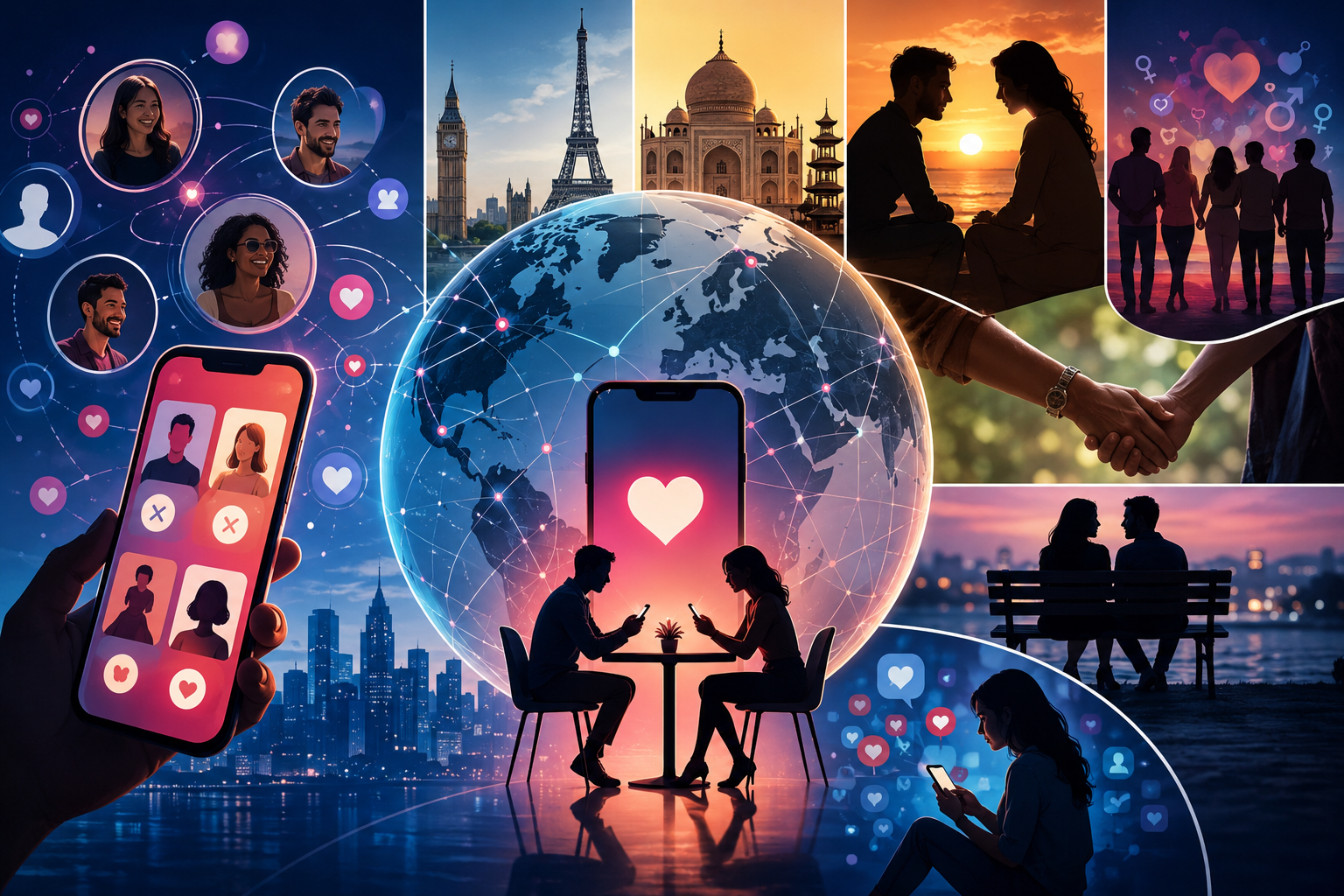
The biggest disruption to dating did not come from changing social values. It came from your smartphone.
In less than two decades, billions of people shifted from meeting partners through family, friends, workplaces, schools, and neighborhoods to relying on algorithms, digital profiles, and endless scrolling. The result is one of the fastest social transformations in modern history. Dating has become more global, more accessible, more diverse, and more complicated than at any other point in history.
Research from the Pew Research Center shows that online dating has become a mainstream way to form relationships in many countries. Match Group, which owns Tinder, Hinge, OkCupid, and Plenty of Fish, reported hundreds of millions of users across its platforms. Bumble built an international business around a model that challenged traditional gender norms. At the same time, marriage rates have declined across many developed nations, people are marrying later than previous generations, and surveys report rising levels of loneliness among young adults.
These developments raise an uncomfortable question. Have we expanded opportunities for meaningful relationships, or have we turned romance into another digital marketplace driven by speed, choice, and constant comparison?
The answer sits somewhere between those extremes. Five major shifts have fundamentally changed dating across the globe. Each has created new opportunities while introducing new challenges that previous generations never faced.
1. Dating Has Become Digital Before It Becomes Personal
For most of modern history, attraction started with physical presence. You met someone through mutual friends, work, education, religion, or your local community. You observed behavior before exchanging phone numbers. Today, many people experience the reverse. They study photographs, biographies, interests, and social media profiles before they ever hear someone’s voice.
The scale of this change is remarkable.
The global online dating market now generates billions of dollars annually and continues to grow. Mobile-first dating platforms operate across North America, Europe, Asia, Latin America, Africa, and the Middle East. Users can connect with potential partners within minutes regardless of geography.
This shift offers clear advantages.
You now have access to people who share your interests, values, career ambitions, or lifestyle preferences. Someone living in a small town no longer depends entirely on local social circles. Professionals with demanding careers can meet compatible partners outside traditional environments.
Yet the same technology changes human behavior.
Dating apps reward speed, visual appeal, and rapid decision-making. Many users make judgments within seconds. Psychology researchers have repeatedly found that excessive choice often reduces satisfaction. When another profile always waits one swipe away, many users hesitate to invest fully in any single connection.
You should ask yourself a difficult question. Are you choosing people because they genuinely match your values, or because the platform encourages constant comparison?
The answer often determines whether digital dating works for you or works against you.
2. Globalization Has Redefined Who You Can Date
Previous generations often selected partners from similar cultural, linguistic, religious, or geographical backgrounds because those represented their available social networks.
Today, international travel, migration, remote work, global education, and social media have expanded those networks dramatically.
Cross-cultural relationships have become increasingly common. Students study abroad. Professionals relocate internationally. Remote workers collaborate across continents. Social media platforms introduce people who may never have met under traditional circumstances.
This trend has reshaped expectations.
Many young adults now prioritize shared values over shared geography. Compatibility increasingly revolves around communication style, life goals, emotional maturity, political views, financial habits, and long-term ambitions rather than neighborhood or nationality.
For countries with large migrant populations, this shift has become especially visible. International marriages continue to rise in many developed economies. Dating platforms now include language preferences, religious filters, education levels, and cultural compatibility tools that barely existed fifteen years ago.
Yet globalization introduces new complexities.
Long-distance relationships require significant emotional commitment. Immigration laws affect relationship timelines. Cultural expectations around family, marriage, gender roles, and parenting still differ substantially across societies.
People often underestimate these practical realities during the excitement of early attraction.
Successful international couples usually spend more time discussing finances, future residence, family expectations, religion, and career priorities than couples from similar backgrounds.
Global dating expands possibilities. It also demands stronger communication skills.
3. Social Expectations Around Gender Have Changed Faster Than Dating Rules
Modern dating no longer follows one universal script.
For decades, traditional expectations remained relatively predictable. Men initiated conversations. Women often waited to be approached. Marriage followed a socially accepted sequence of dating, engagement, and family approval in many cultures.
That consistency has largely disappeared.
Women now achieve higher educational outcomes in many countries. Female workforce participation has expanded significantly across developed and emerging economies. Financial independence has altered relationship dynamics.
Apps such as Bumble built entire business models around women making the first move.
Men increasingly face different expectations. Emotional intelligence, communication, shared household responsibilities, mental health awareness, and respect for boundaries now influence dating success alongside financial stability.
This evolution represents progress for many people.
Relationships increasingly reflect partnership rather than predefined gender roles. Couples negotiate responsibilities instead of automatically inheriting them from previous generations.
Still, confusion remains widespread.
Many surveys reveal uncertainty about who should initiate dates, split expenses, define exclusivity, or propose long-term commitment.
Social media amplifies conflicting advice.
One influencer promotes traditional masculinity. Another encourages complete financial equality. Another rejects dating entirely. Millions consume contradictory guidance daily.
You cannot build healthy relationships through internet debates.
Every successful relationship eventually requires two people to communicate openly about expectations rather than relying on outdated assumptions or viral opinions.
4. Social Media Has Become the Third Person in Every Relationship
Dating no longer begins and ends between two individuals.
Instagram, TikTok, Snapchat, WhatsApp, Facebook, LinkedIn, and countless messaging platforms shape how people present themselves and evaluate others.
Many first impressions now happen online long before a first date.
Potential partners examine photographs, travel history, political opinions, career achievements, fitness routines, friendships, and even music preferences through digital footprints.
This creates both transparency and pressure.
You gain valuable insight into someone’s interests and lifestyle before investing time.
You also inherit unrealistic expectations.
Highly curated profiles rarely reflect ordinary life. People naturally share achievements, celebrations, vacations, and carefully selected moments. They rarely post loneliness, conflict, financial stress, or personal uncertainty.
Dating under these conditions encourages comparison.
Questions quietly emerge.
Why does another couple seem happier?
Why did someone stop viewing your stories?
Why has a message remained unread for four hours?
Relationship researchers increasingly examine digital behaviors that previous generations never encountered.
Ghosting.
Breadcrumbing.
Orbiting.
Love bombing.
Soft launching.
Hard launching.
These terms now describe relationship behaviors familiar to millions of users worldwide.
Technology did not invent unhealthy communication.
It accelerated it.
You should evaluate someone’s consistency in real conversations more seriously than their consistency on social media.
One predicts relationship quality.
The other predicts content performance.
5. People Want More From Relationships Than Ever Before
Marriage once served practical purposes beyond romance.
Families shared economic responsibilities. Communities reinforced social expectations. Many people married earlier because financial independence often depended on partnership.
Modern relationships operate under different conditions.
Many adults now expect a partner to provide emotional support, intellectual stimulation, financial compatibility, shared parenting values, career encouragement, sexual compatibility, personal growth, friendship, and long-term commitment simultaneously.
That represents an extraordinarily high standard.
People also spend more years dating before marriage.
According to demographic trends across many developed nations, average ages at first marriage continue to rise. Education, career development, housing affordability, and financial uncertainty all contribute.
Young adults increasingly delay major life decisions until they achieve economic stability.
This creates both freedom and pressure.
You gain more time to understand yourself.
You also spend more time evaluating countless possibilities while wondering whether someone better exists.
Choice can improve outcomes.
Too much choice can delay commitment indefinitely.
Researchers studying decision-making have repeatedly observed that abundance sometimes increases anxiety rather than satisfaction.
Dating reflects that reality.
Many people struggle less with finding attractive partners than with deciding when to stop searching.
The healthiest relationships often emerge when individuals shift from seeking perfection to evaluating compatibility, respect, reliability, and shared values.
Is Modern Dating Better or Worse?
The debate usually produces extreme opinions.
Some argue technology destroyed romance.
Others celebrate unprecedented freedom and equality.
Reality supports neither position completely.
Modern dating offers remarkable benefits.
You can meet people beyond your immediate geography.
You can avoid incompatible relationships through better communication.
You can leave unhealthy partnerships more easily than previous generations.
You can find communities that support diverse identities and relationship preferences.
The disadvantages deserve equal attention.
Digital fatigue affects millions of users.
Choice overload reduces commitment.
Social media encourages comparison.
Algorithms prioritize engagement rather than lasting relationships.
Mental health researchers continue to examine links between loneliness, excessive digital interaction, and declining face-to-face socialization among younger populations.
The technology itself remains neutral.
Your habits determine whether it strengthens or weakens your relationships.
What You Should Focus On Instead of Following Dating Trends
Many dating trends disappear within months.
Human psychology changes much more slowly.
If you want stronger relationships, focus on principles that consistently predict long-term success.
Ask yourself these questions before investing in someone.
- Do your values align beyond physical attraction?
- Can you resolve disagreements respectfully?
- Do your long-term goals support each other?
- Does the relationship improve your emotional wellbeing?
- Can both of you communicate honestly without relying on games or mixed signals?
These questions matter far more than response times, follower counts, dating app rankings, or perfectly curated profiles.
Relationships still depend on trust, consistency, emotional maturity, and mutual respect.
Technology cannot automate those qualities.
Neither can artificial intelligence.
Neither can algorithms.
The Future of Dating Will Depend Less on Technology Than on Human Choices
Artificial intelligence already influences matchmaking, profile recommendations, identity verification, and conversation suggestions. Virtual reality dating experiences continue to evolve. Biometric authentication may reduce fake profiles. Governments continue strengthening digital safety regulations to address fraud, harassment, and identity deception.
The technology will become smarter.
That does not guarantee healthier relationships.
The future of dating depends on whether people choose meaningful conversations over endless scrolling, emotional honesty over digital performance, and genuine compatibility over instant validation.
Every generation believes its dating challenges are unique.
This generation faces unprecedented technological influence. It also possesses unprecedented freedom to define relationships on its own terms.
That freedom brings responsibility.
The dating game has changed across the globe because society changed. Work changed. Technology changed. Culture changed.
Human connection remains remarkably consistent.
You still need trust.
You still need respect.
You still need shared values.
Everything else represents the tools you use to find those qualities.
The tools will continue evolving.
Human expectations never stop evolving either.
The real question is not whether modern dating is good or bad.
The better question asks whether your choices bring you closer to the kind of relationship you actually want.
References
Pew Research Center. The Virtues and Downsides of Online Dating.
https://www.pewresearch.org
Pew Research Center. The Future of Digital Life.
https://www.pewresearch.org
Match Group Annual Reports.
https://ir.mtch.com
Bumble Inc. Annual Reports and Investor Relations.
https://investor.bumble.com
World Bank. World Development Indicators.
https://data.worldbank.org
Organisation for Economic Co-operation and Development. Society at a Glance Reports.
https://www.oecd.org
United Nations Department of Economic and Social Affairs. World Population Prospects.
https://population.un.org
American Psychological Association. Research on Choice Overload and Decision Making.
https://www.apa.org
Our World in Data. Marriage and Divorce Trends.
https://ourworldindata.org/marriages-and-divorces
World Health Organization. Mental Health and Well-being Reports.
https://www.who.int
About The Author


