
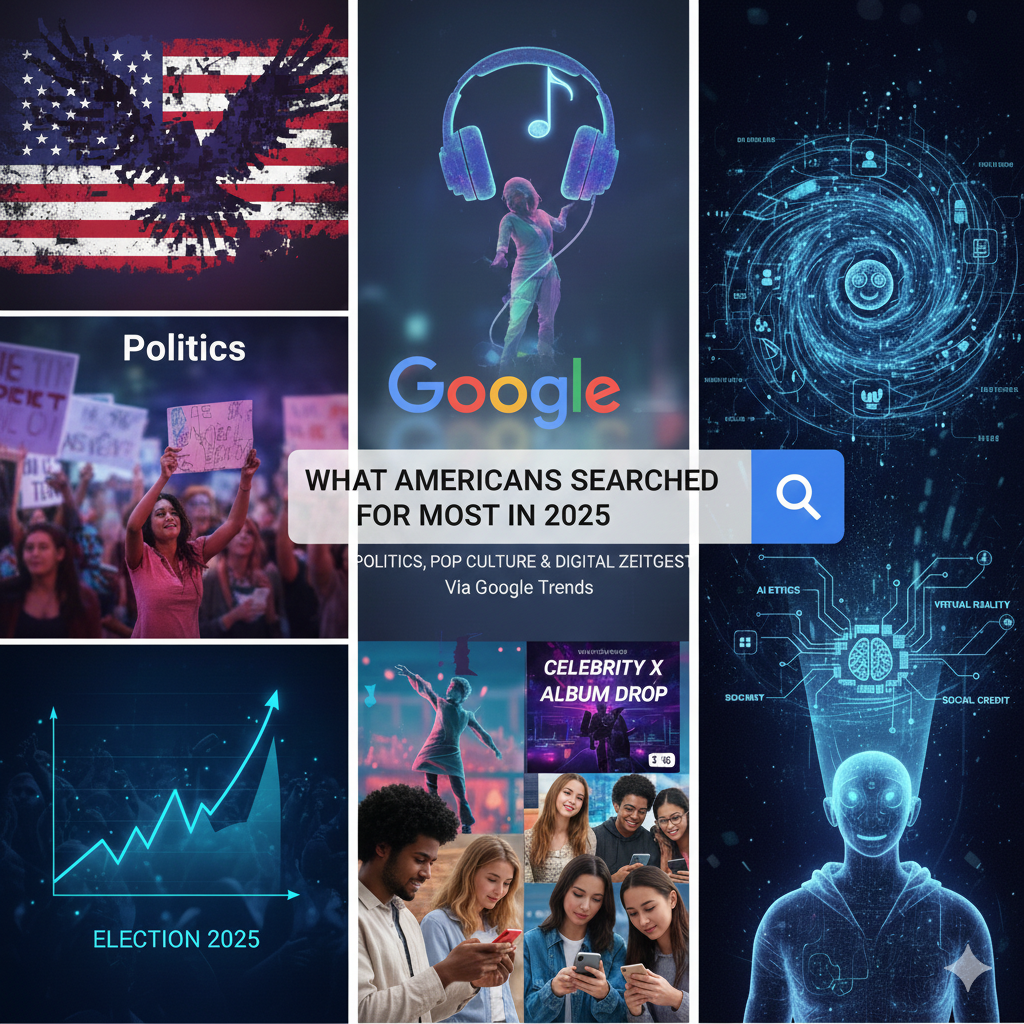
In 2025, Americans did not just follow the news. They searched it in real time. Search spikes outpaced cable commentary. Breaking headlines triggered instant queries. Google Trends evolved into a behavioral dashboard of national anxiety, curiosity, and political tension.
If you want to understand where the United States focused its attention this year, you do not start with opinion polls. You start with search data.
Google’s Year in Search for the United States shows that political events and figures dominated the fastest-rising queries. Names surged overnight. Legislative phrases that once lived inside policy briefings entered everyday Google bars. Searches revealed urgency, confusion, and shock.
You can dismiss search data as noise. Or you can recognize it as one of the clearest reflections of what Americans urgently needed to know.
The political searches that defined 2025 expose deeper patterns about trust, polarization, and how you now consume information.
The Surge Around Charlie Kirk: When a Name Becomes a National Query
When “Charlie Kirk” became the top trending search in the United States in 2025, it did not climb gradually. It spiked within hours.
Charlie Kirk, founder of Turning Point USA and a prominent conservative activist, has built a large digital and campus presence over the past decade. His name has often circulated in partisan debates. The 2025 surge followed a violent incident at a speaking event that sent shockwaves through political communities and newsrooms alike.
Search behavior tells you something critical.
Americans immediately searched for:
- “What happened to Charlie Kirk?”
- “Charlie Kirk news today”
- “Where was Charlie Kirk speaking?”
Follow-up searches centered on security, motive, and political implications.
When a political figure becomes the most searched term in the country, you are witnessing more than curiosity. You are watching a digital response to instability.
This spike reflects structural shifts in U.S. political culture.
First, politics has become hyper-personalized. Voters attach attention to individuals more than institutions. A single figure can dominate national discourse within hours.
Second, Americans no longer wait for evening broadcasts. They search instantly when something breaks. Real-time search behavior has replaced passive news consumption.
Third, digital polarization loops accelerate spikes. Social media amplification triggers Google queries. Google queries feed algorithmic visibility. The cycle intensifies quickly.
Yet the data shows something reassuring. Americans did not simply react emotionally. They sought verification. In a fragmented media ecosystem, search functions as a fact-checking reflex.
When headlines scatter across platforms, users return to Google to triangulate information. In 2025, search engines served as the final checkpoint before belief.
Ask yourself what you do when major political news breaks. You probably search before you share. That behavior mirrors national patterns.
“Government Shutdown”: Institutional Anxiety Returns
Few phrases generate recurring tension in Washington like “government shutdown.” In 2025, the phrase surged again into top trending territory.
The United States has experienced multiple shutdowns in recent decades, including extended closures in 1995–1996, 2013, and 2018–2019. Each episode triggered measurable spikes in search interest. The 2025 surge followed renewed budget standoffs and funding disputes in Congress.
Americans searched:
- “Is the government shutting down?”
- “What closes during a shutdown?”
- “Will federal employees get paid?”
- “Does Social Security stop?”
These are not abstract constitutional questions. They reflect personal financial concern.
A shutdown affects roughly 2 million federal civilian employees, military pay processing, national parks, passport services, regulatory agencies, and federal contractors who often lack guaranteed back pay. Each headline translates into household uncertainty.
Search data reveals that Americans do not treat shutdowns as distant legislative drama. They interpret them as direct risk.
This behavioral shift carries strategic consequences.
When citizens monitor budget disputes through search in real time, political actors lose the luxury of opacity. Voters track developments hour by hour. Policy uncertainty becomes searchable anxiety.
Search spikes also expose information gaps. During funding disputes, many Americans still search basic structural questions about how shutdowns work. That persistent confusion signals a communication failure between institutions and the public.
If policymakers want credibility, they must anticipate these queries. Search data offers a blueprint for clarity.
The “One Big Beautiful Bill Act”: Legislative Branding Meets Public Confusion
One of the most searched legislative phrases of 2025 was the “One Big Beautiful Bill Act.” When a bill title trends nationally, you are observing deliberate political branding intersecting with widespread uncertainty.
Legislation rarely trends unless it affects taxes, healthcare, immigration, or national security. A branded title can drive attention, but attention does not equal comprehension.
Search queries revealed immediate confusion:
- “What is the One Big Beautiful Bill Act?”
- “Who benefits from the One Big Beautiful Bill Act?”
- “When does the bill start?”
- “How does the bill affect me?”
These questions show a gap between messaging and substance.
Modern legislation increasingly adopts marketing logic. Titles aim to resonate emotionally before voters grasp policy mechanics. Political actors understand that a memorable phrase travels faster than a dense summary.
Google Trends data shows that Americans respond with skepticism. They search for clarification before accepting branding at face value.
When a bill trends, two dynamics unfold simultaneously. Political actors amplify the name. The public seeks explanation.
That dynamic creates opportunity. Journalists who publish clear breakdowns capture traffic and trust. Analysts who provide plain-language summaries shape public interpretation. At the same time, misinformation can exploit search volume if credible sources lag.
Search visibility now intersects directly with governance. Legislative influence increasingly depends on whether the public can quickly understand what a bill does.
You should recognize what this means for democratic accountability. If citizens must search aggressively to decode legislation, transparency remains incomplete.
Tariffs: Economic Policy Reenters the Search Bar
Trade policy returned to center stage in 2025. The term “tariffs” surged amid renewed debates about U.S.–China trade tensions, supply chain resilience, and inflation pressures.
Tariffs sound technical. Yet Americans searched for them in plain language:
- “What are tariffs?”
- “Do tariffs increase prices?”
- “Are tariffs good for the economy?”
- “Who pays for tariffs?”
These searches reveal a deeper shift. Economic policy now connects directly to consumer psychology.
When inflation remains a persistent concern, even incremental trade proposals trigger anxiety. Consumers link tariffs to grocery prices, electronics costs, auto loans, and housing affordability.
Surveys from institutions like the University of Michigan have shown that inflation expectations influence consumer sentiment. When economic uncertainty rises, search behavior follows. Americans seek clarity before making purchasing decisions.
Search trends around tariffs illustrate a feedback loop:
Political rhetoric intensifies.
Media coverage amplifies debate.
Consumers search for personal financial impact.
Market expectations adjust.
Search data does not predict policy outcomes. It reflects perceived risk and urgency.
In 2025, Americans demonstrated that they no longer treat trade policy as distant geopolitics. They treat it as a line item in their household budget.
That mindset shapes elections, consumer spending, and business strategy.
What Political Search Trends Reveal About You
When you examine these political search surges collectively, patterns emerge.
Americans use Google as a verification engine. They search before forming firm opinions.
Institutional trust remains fragile. Spikes around shutdowns and legislation show precautionary behavior. Citizens expect disruption and seek reassurance.
Political communication now depends on search visibility. If credible explanations rank highly, clarity improves. If misinformation dominates results, confusion spreads.
Emotional events drive immediate query surges. Sudden violence, legislative surprises, or policy shocks generate digital shockwaves that outpace traditional news cycles.
Search engines have become the connective tissue between breaking events and public understanding.
If you are a journalist, daily monitoring of Google Trends offers a real-time editorial map. It tells you which developments demand explanation.
If you are a policymaker, search queries tied to your proposals reveal misunderstanding instantly. Ignoring them invites narrative drift.
If you are a voter, your search history documents what unsettled you this year. It captures moments when you paused to verify, question, or reassess.
Political discourse in 2025 did not unfold quietly. It pulsed through search engines at measurable speed.
Yet politics did not monopolize attention. Alongside legislative battles and economic fears, Americans also searched for entertainment spectacles, new technology releases, and emerging AI tools. Those cultural and technological spikes reveal another side of the national psyche: distraction, aspiration, and digital curiosity.
To understand the full picture of American attention in 2025, you must look beyond politics and into the entertainment and tech queries that competed for the same search bar space.
The same search bar that absorbed political shockwaves also captured something else in 2025: distraction, aspiration, and technological curiosity. Americans did not live inside legislative debates alone. They toggled between anxiety and entertainment, between economic uncertainty and product anticipation. Google Trends makes that oscillation visible.
If politics revealed what unsettled the country, culture and technology revealed what energized it.
KPop Demon Hunters: Fandom Goes Mainstream
One of the fastest-rising entertainment queries in the United States this year was “KPop Demon Hunters.” The title alone blends global pop music with supernatural fantasy. Its search spike tells you something more important than plot popularity.
Americans searched:
- “What is KPop Demon Hunters?”
- “Is KPop Demon Hunters on Netflix?”
- “KPop Demon Hunters cast”
- “Is KPop Demon Hunters based on a true story?”
The volume reflects more than casual curiosity. It signals how globalized entertainment now penetrates U.S. mainstream attention.
K-pop has grown steadily in American markets for over a decade. Groups like BTS and BLACKPINK have sold out U.S. stadium tours and topped Billboard charts. Streaming platforms have accelerated that integration. By 2025, American audiences no longer treat Korean pop culture as niche.
“KPop Demon Hunters” became searchable because it fused three high-engagement categories:
- Established global music fandom
- Fantasy storytelling
- Streaming platform distribution
When a show trends on Google, it means audiences want access and context. They search where to watch it, who stars in it, and whether it connects to broader franchises.
Streaming services understand this pattern. A title’s visibility on Google often correlates with subscriber acquisition and retention. If you track entertainment search spikes alongside platform releases, you can see how digital word-of-mouth amplifies launch cycles.
The rise of a series like “KPop Demon Hunters” also highlights demographic shifts. Younger audiences increasingly drive search spikes. According to Pew Research Center, younger Americans rely heavily on digital platforms for both news and entertainment. Their search habits shape national trending lists.
In 2025, fandom is not passive consumption. It is active participation. Viewers search, post, remix, and analyze. Search engines become gateways to deeper engagement.
You should notice how entertainment search behavior contrasts with political queries. Political searches often stem from urgency. Entertainment searches reflect anticipation and cultural momentum.
Both patterns share one trait: immediacy.
iPhone 17: Product Anticipation as National Ritual
Few product launches generate predictable annual search spikes like Apple’s flagship phone. In 2025, “iPhone 17” surged months before official announcements.
Americans searched:
- “iPhone 17 release date”
- “iPhone 17 features”
- “iPhone 17 price”
- “iPhone 17 vs iPhone 16”
This cycle repeats every year, yet the search volume remains high. That persistence reveals something structural about consumer behavior.
Apple has built a release cadence that trains consumers to anticipate upgrades. According to industry shipment data from firms like IDC and Counterpoint Research, smartphone replacement cycles in the United States typically span two to three years. Each new release triggers comparison queries among consumers evaluating upgrades.
Search behavior reflects financial calculation. Consumers want to know whether new features justify cost. In an environment shaped by inflation and economic caution, price-related queries dominate.
Technology launches now operate as national micro-events. Media speculation, leak culture, and influencer previews amplify attention before official announcements. Search spikes often peak around keynote presentations.
The “iPhone 17” trend demonstrates how corporate marketing intersects with organic curiosity. Apple does not need to explain basic product awareness. Consumers search preemptively.
You can treat this as a ritualized pattern of digital anticipation. The search bar becomes a pre-purchase research tool.
This behavior also underscores the power of ecosystem lock-in. When millions of Americans rely on a single brand’s devices for communication, banking, and work, product updates carry functional consequences. That drives search volume.
Unlike political spikes, which often emerge unexpectedly, product-related search trends follow predictable calendars. Yet they still reveal consumer priorities.
When Americans search release dates and pricing first, they signal cost sensitivity. When they search camera upgrades or AI integration, they signal performance curiosity.
Search queries function as market research at scale.
DeepSeek: AI Curiosity Moves Beyond Silicon Valley
Artificial intelligence dominated headlines for years. In 2025, “DeepSeek” emerged as one of the fastest-rising AI-related search terms in the United States.
Americans searched:
- “What is DeepSeek?”
- “Is DeepSeek better than ChatGPT?”
- “How to use DeepSeek AI”
- “Is DeepSeek free?”
When users compare AI tools directly in search queries, you are observing competitive benchmarking at scale. Consumers no longer treat AI as abstract innovation. They treat it as a daily productivity instrument.
The broader AI landscape includes companies like OpenAI and Google, both of which expanded generative AI integrations into search, productivity software, and enterprise tools.
Search behavior reveals that Americans approach AI with both curiosity and caution. They want functionality, pricing clarity, and privacy reassurance.
AI queries often combine practical intent with evaluation:
- Can this tool improve my workflow?
- Is it safe?
- Is it accurate?
The normalization of AI search terms marks a turning point. Five years ago, AI discussions largely revolved around industry insiders. In 2025, average users actively compare tools.
Search trends indicate diffusion beyond tech hubs. AI curiosity now spreads across education, small business, and creative industries.
If you analyze AI-related search spikes alongside employment data, you can see another pattern. Workers increasingly search whether AI will replace or augment their roles. That anxiety fuels tool exploration.
The rise of “DeepSeek” signals that AI competition no longer revolves around a single dominant platform. Market fragmentation drives comparative search behavior.
When Americans search “DeepSeek vs ChatGPT,” they reveal a shift from novelty to evaluation.
Labubu: Viral Consumer Culture in the Algorithm Era
Another unexpected entry into trending searches was “Labubu,” a designer toy character that surged in popularity across social media platforms.
At first glance, a collectible toy trending nationally might seem trivial compared to legislation or AI. Yet search data tells a different story.
Americans searched:
- “What is Labubu?”
- “Where to buy Labubu?”
- “Why is Labubu so popular?”
- “Labubu resale price”
Those queries reflect scarcity-driven demand. Viral consumer culture thrives on limited releases, influencer endorsements, and resale markets.
Platforms like TikTok and Instagram amplify aesthetic products quickly. When influencers showcase collectibles, search spikes follow within hours.
The resale economy intensifies this behavior. Limited-edition items often appear on secondary marketplaces at marked-up prices. Search queries about resale value reveal speculative interest.
Consumer psychology researchers have long studied scarcity bias. When supply appears limited, perceived value increases. In the digital era, algorithmic amplification accelerates that effect.
“Labubu” trending in the United States signals how global micro-brands can capture attention rapidly. Search engines serve as the bridge between social discovery and purchasing intent.
Unlike product launches backed by billion-dollar corporations, viral collectibles often rely on grassroots digital momentum. Search data tracks that momentum precisely.
When you see a toy trend nationally, you are observing algorithm-driven commerce in action.
Entertainment, Technology, and the Attention Economy
What do these cultural and technological trends share?
They compete for the same limited resource: attention.
Political crises demand urgency. Entertainment offers escape. Technology promises improvement. Viral consumer goods promise belonging.
Search engines quantify that competition.
In 2025, Americans moved fluidly between:
- Searching legislative bills in the morning
- Comparing smartphone features in the afternoon
- Streaming a global fantasy series at night
- Exploring AI tools for work productivity
The search bar captures that multidimensional behavior.
For businesses, this data carries strategic value. Monitoring search spikes reveals timing opportunities. If AI tools trend, educational content demand rises. If entertainment franchises surge, merchandise sales follow.
For media organizations, search data highlights editorial priorities. A sudden spike in a show title signals audience appetite for explainers or reviews.
For policymakers, cultural search trends matter as well. They reveal generational shifts in attention and identity.
Search engines have become behavioral archives. They record not what Americans say they care about, but what they actively seek.
The political and cultural trends of 2025 do not contradict each other. They coexist. A nation can worry about tariffs while hunting for limited-edition collectibles. It can track budget negotiations while anticipating a smartphone upgrade.
If you want to understand modern America, you must accept that seriousness and spectacle share the same digital infrastructure.
The deeper question is what this blended search behavior means for influence, trust, and future public discourse.
The political shocks, legislative branding battles, streaming sensations, AI comparisons, and viral collectibles of 2025 share a common thread. They all passed through the same gateway: a search bar.
If you step back from individual spikes and examine the full year, Google Trends does not just reveal what Americans searched. It reveals how they process uncertainty, opportunity, and identity in a hyperconnected economy.
The search bar has become the most honest instrument of public attention in the United States.
What 2025 Search Trends Tell You About Power and Influence
Search data captures intent. Social media captures expression. The difference matters.
When Americans post online, they perform identity. When they search, they reveal need.
In 2025, political searches revealed verification behavior. Entertainment searches revealed cultural alignment. Tech searches revealed cost–benefit analysis. AI searches revealed professional recalibration. Viral product searches revealed scarcity psychology.
These patterns expose a deeper reality. Influence now depends on discoverability.
If a political bill trends but credible information fails to rank prominently, narrative control drifts. If a tech product launch generates high search demand but review content lacks clarity, consumer trust weakens. If misinformation fills high-volume queries, perception hardens quickly.
Search optimization no longer belongs exclusively to marketers. It now intersects with governance, journalism, and public education.
Consider what this means for institutions.
Government agencies must anticipate common queries during crises. When Americans search “Will Social Security stop during a shutdown?” official information should rank clearly and prominently.
Corporations must monitor consumer search phrasing before launch cycles. If pricing dominates early queries, messaging should address affordability directly.
Media organizations must treat Google Trends as an editorial radar. When a cultural phenomenon spikes, audiences expect analysis immediately.
In 2025, attention moved too quickly for reactive communication strategies. Institutions that monitored search intent gained advantage.
The Acceleration of Real-Time Public Curiosity
Search spikes in 2025 demonstrated a pattern of compression. Attention cycles shortened.
A political incident triggered immediate queries within minutes. A streaming premiere spiked within hours. A product leak spread across platforms and drove searches before confirmation.
This compression changes how you consume information.
You no longer wait for a weekly summary. You search as events unfold. You compare sources instantly. You evaluate before committing to a viewpoint.
That behavior signals sophistication, but it also introduces vulnerability.
Speed can outpace context. When searches surge before facts solidify, early content can shape long-term perception. Ranking first carries disproportionate influence.
That dynamic places responsibility on content creators, analysts, and policymakers. Visibility without accuracy damages public trust.
The 2025 search landscape shows that Americans crave immediate clarity. Institutions must match that urgency with precision.
Politics and Pop Culture Share Infrastructure
One of the most revealing aspects of 2025 trends is not which topics surged. It is the fact that all of them competed in the same ecosystem.
The same platform that hosted searches for Charlie Kirk also hosted queries for KPop Demon Hunters and iPhone 17.
That convergence changes public discourse.
Politics no longer occupies a separate media lane. It competes directly with entertainment releases and technology launches. Attention shifts fluidly between seriousness and spectacle.
This does not mean Americans trivialize politics. It means digital infrastructure flattens categories.
When legislative debates trend alongside fantasy series and smartphone rumors, you witness a democratized attention economy. All topics rise or fall based on immediacy, amplification, and perceived relevance.
This reality forces communicators to adapt.
If you want sustained public focus on policy, you must present information clearly and accessibly. If you rely solely on institutional channels, you risk invisibility in a crowded search environment.
Search trends in 2025 reveal that discoverability equals influence.
Economic Sensitivity and Consumer Vigilance
Search behavior around tariffs and product pricing signals another shift: heightened economic vigilance.
Americans consistently searched cost-related queries first. Release dates mattered. Features mattered. Prices mattered more.
Inflationary pressure in recent years conditioned consumers to evaluate purchases carefully. That caution carried into 2025 technology and consumer trends.
Even entertainment searches often included “where to watch” or “is it free,” signaling subscription fatigue and cost awareness.
Economic sensitivity influences political search behavior as well. Budget disputes trigger paycheck-related queries. Trade debates prompt consumer price questions.
This convergence reveals a public increasingly aware of macroeconomic forces affecting personal finances.
Search engines function as financial risk assessment tools.
If you analyze the language of 2025 queries, you notice how often Americans asked variations of one core question: “How does this affect me?”
That self-referential framing does not signal selfishness. It reflects practical evaluation in an uncertain environment.
AI Normalization and the Productivity Imperative
The rise of DeepSeek and comparisons with tools from OpenAI show that AI moved from experimental novelty to productivity expectation.
Search queries asked whether AI tools were better, cheaper, safer, or more efficient.
This marks a shift in workforce psychology.
Workers no longer ask whether AI will exist. They ask how to use it effectively. Students no longer debate whether AI tools matter. They compare performance metrics.
When AI terms trend nationally, you are observing diffusion across sectors.
Search engines now mediate not only consumption but skill acquisition. Americans search tutorials, prompts, and comparisons before integrating tools into daily routines.
That pattern indicates competitive adaptation. In a fast-moving labor market, search becomes a survival instrument.
The Strategic Takeaway
If you work in media, business, policy, or research, you cannot ignore search data.
Google Trends provides real-time evidence of what Americans urgently seek. It reveals emotional intensity, economic concern, and cultural momentum.
The strategic advantages are clear:
- Monitor trending searches daily to anticipate narrative shifts.
- Analyze phrasing, not just volume. Language reveals intent.
- Respond quickly with verified, accessible content.
- Treat search visibility as a pillar of public engagement.
In 2025, the organizations that understood search behavior moved faster and communicated more effectively.
Those that ignored it risked irrelevance.
What the Search Bar Ultimately Reveals
The United States in 2025 appeared divided, distracted, innovative, and economically cautious all at once.
Search data captures that complexity without editorial bias.
It shows a nation that verifies before believing. A nation that worries about shutdowns while streaming fantasy epics. A nation that compares AI tools while calculating grocery bills.
The search bar does not editorialize. It records.
If you want to understand American attention in 2025, you do not start with commentary panels. You start with query logs.
And if you want to anticipate what comes next, you should watch where search interest accelerates first. Trends do not begin in headlines. They begin in questions.
The most honest reflection of public consciousness is not what Americans declare online. It is what they type privately into a search field.
That is where 2026 will begin as well.
References
Google Trends – Trending Searches (United States)
https://trends.google.com/trending?geo=US
Google Year in Search – United States
https://about.google/stories/year-in-search/
Pew Research Center – News Consumption Across Social Media
https://www.pewresearch.org
University of Michigan – Surveys of Consumers
https://data.sca.isr.umich.edu
IDC Worldwide Smartphone Tracker
https://www.idc.com
Counterpoint Research – Smartphone Market Reports
https://www.counterpointresearch.com
Author Profile
Astha Agrawal is a writer covering trends in India across politics, public policy, psychology, media, literature and culture. Her work focuses on clarity, relevance, and data-backed analysis of evolving narratives.
Connect with her on LinkedIn: http://www.linkedin.com/in/astha-agrawal-105255331
About The Author


