
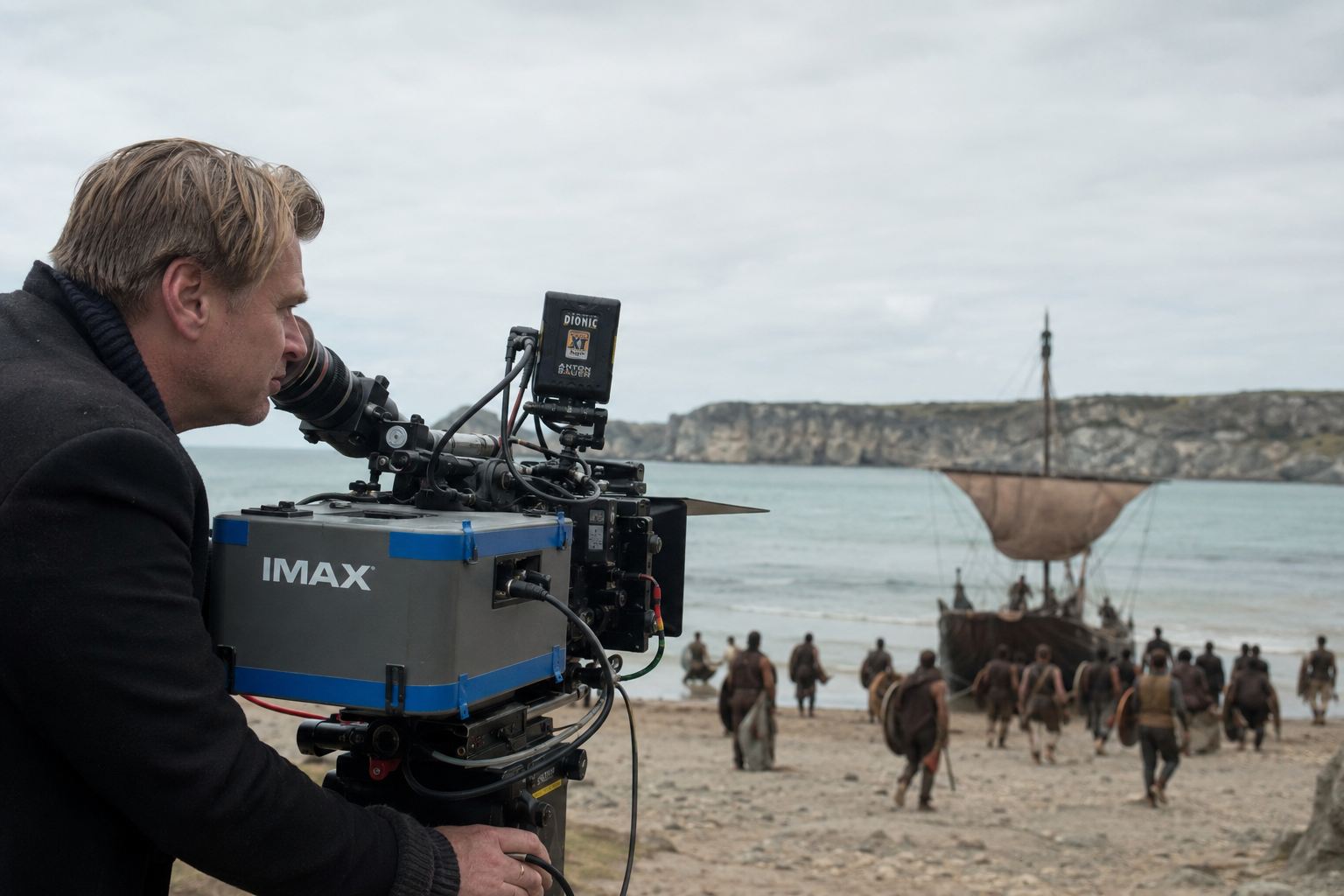
Christopher Nolan did not make The Odyssey simply by putting Homer’s ancient epic in front of a large-format camera. He rebuilt the production process around a problem that has frustrated filmmakers for decades: how do you make an ancient story feel physically present without allowing digital technology to make the physical world feel artificial?
The answer is unusually radical. The Odyssey became the first feature-length theatrical film shot entirely with IMAX film cameras. Nolan and cinematographer Hoyte van Hoytema exposed approximately 2.1 million feet of IMAX film while working with IMAX to develop new camera and sound technology specifically for the production. The film opened worldwide on July 17, 2026, with a reported production budget of about $250 million.
That makes The Odyssey more than another Christopher Nolan spectacle. It is a large-scale experiment in whether modern cinema can use new technology to move closer to physical filmmaking rather than further away from it.
Here are the 10 innovations that matter most.
1. The Odyssey was shot entirely on IMAX film
The most consequential innovation is also the easiest to misunderstand.
Nolan has used IMAX cameras extensively since The Dark Knight, but previous productions mixed IMAX photography with other formats. The Odyssey crossed a technological threshold by becoming the first feature-length theatrical release photographed entirely with IMAX film cameras.
That decision changes the economics and physical logistics of filmmaking.
IMAX 65mm film captures an enormous amount of visual information. The finished 70mm IMAX presentation uses 15-perforation film, producing an image substantially larger than conventional 35mm cinema. IMAX describes the format as capable of approaching 18K image resolution under optimal conditions.
But bigger is not automatically better.
Large-format film is expensive, heavy and demanding. Cameras are physically cumbersome. Film magazines have limited running time. Reloading interrupts production. Every shot carries a material cost that digital cinematography largely removed.
Nolan chose to accept those limitations for nearly three hours of mythology.
That is the important innovation. He turned a limitation of analogue cinema into part of the production philosophy.
2. The Keighley camera makes IMAX more practical for narrative filmmaking
The most important piece of new hardware created for The Odyssey is the IMAX Keighley film camera.
Nolan’s problem was straightforward. Traditional IMAX cameras were never designed to function like lightweight modern production cameras for long-form dialogue-heavy filmmaking. They were noisy, large and difficult to operate in situations requiring intimate performances.
Nolan and van Hoytema worked with IMAX to develop a new generation of equipment for The Odyssey. The resulting camera was named the Keighley after IMAX quality executives David and Patricia Keighley.
This matters beyond one film.
The future significance of The Odyssey may not be the movie itself. It may be the equipment developed to make the movie possible.
If large-format film becomes easier to use for dialogue, handheld work, confined spaces and complex location photography, filmmakers have a new option between conventional 35mm production and digital large-format systems.
Nolan effectively used a $250 million movie as a research and development laboratory.
3. Synchronized sound finally meets large-format IMAX film at scale
The camera was only half the problem.
IMAX film cameras have historically created enough mechanical noise to make direct dialogue recording difficult. That is manageable for documentary filmmaking or scenes that can be extensively re-recorded. It is a serious obstacle when a director wants actors delivering live performances while shooting on location.
The Odyssey required a new solution.
IMAX developed a specially engineered sound blimp that could enclose the camera while reducing the mechanical noise enough to allow synchronized sound recording. IMAX describes this as enabling dialogue scenes to be captured with synchronized sound on IMAX film at production scale for the first time.
This is one of the film’s least visible innovations and potentially one of its most important.
Audiences will not notice the blimp.
They will notice the consequence.
When actors speak in a physically constructed environment while the camera records the environment, movement and performance together, the resulting image has a different relationship with reality than a scene assembled largely from digital elements and later reconstructed through post-production.
For The Odyssey, sound became part of the push toward physical immersion.
4. Nolan pushed practical production into locations rather than treating them as backdrops
The Odyssey was filmed across multiple countries, including Greece and Iceland, as well as locations in Morocco and Italy. Reuters reported that the production used real ships and large-scale crowd scenes while Nolan pursued practical environments and effects.
That is significant because Homer’s story is inherently geographic.
Odysseus does not simply move between plot points. His journey is the story.
The sea, cliffs, caves, islands, settlements and storms are not decorative scenery. They determine what the character can physically do and how long his journey takes.
Nolan’s approach therefore treats geography as part of character development.
A real coastline imposes limitations. A real ship moves differently from a digital vessel. Natural light changes. Weather interferes with schedules. Actors experience cold, wind, water and physical exhaustion.
Those inconveniences are precisely what digital filmmaking is designed to eliminate.
Nolan chose to retain them.
5. The production uses physical scale as a storytelling device
The Odyssey required enormous numbers of performers and large physical environments. Matt Damon has described the production as exceptionally demanding, while reports from the set have highlighted sequences involving large crowds, ships and physically challenging locations.
The distinction between “practical effects” and “visual effects” is often too simplistic.
The more interesting question is scale.
If an actor is surrounded by hundreds or thousands of real people, the actor’s performance changes. Eye lines change. Movement changes. The atmosphere changes. The director can photograph the interaction rather than manufacture it later.
For an epic about a king returning from war, this becomes particularly valuable.
The crowd is not merely an effect.
The crowd establishes political power, military consequence and social pressure.
That is why Nolan’s preference for physical scale is not just nostalgia for old Hollywood. It is a performance strategy.
6. IMAX’s enormous frame is being used for mythology rather than spectacle alone
The most obvious advantage of IMAX is size.
The more interesting advantage is spatial information.
Homer’s world is built around distance. Odysseus is repeatedly confronted by landscapes that dwarf him. Mountains, oceans, storms and strange islands represent forces beyond individual control.
A large-format frame allows Nolan to preserve that relationship between human beings and their environment.
The audience can see more of the surrounding world without the image becoming visually insignificant.
That is especially important in a story where scale changes constantly.
A character can be physically tiny inside a huge landscape and then become visually dominant in an intimate close-up. The contrast is part of the storytelling grammar.
Nolan has therefore matched the technical characteristics of IMAX to the central psychological idea of the Odyssey: one human being trying to navigate a world far larger than himself.
7. The film’s aspect ratio turns exhibition into part of the experience
The Odyssey was designed for premium theatrical presentation, with IMAX 70mm remaining the highest-profile version.
That creates another technological innovation that is often overlooked: the film is not completely defined by a single screen configuration.
Depending on the theatre, audiences encounter different presentations of the same photographic material. IMAX 70mm venues can present the large-format image in its most expansive form, while IMAX digital and other premium formats provide different versions of the theatrical experience.
This makes exhibition part of the filmmaking equation.
Nolan’s cinema has increasingly been designed with the auditorium in mind. The Odyssey pushes that principle further.
The screen is no longer just a delivery mechanism.
Its dimensions determine how much of the image the audience receives and how physically dominant the world becomes.
That is a useful reminder in an era when studios increasingly design films around the assumption that audiences will eventually watch them on televisions, laptops and phones.
The Odyssey was made to resist that logic.
8. Film itself becomes a competitive advantage in the digital era
The most provocative technological choice may be the decision to use film at all.
Digital cinema has obvious advantages. It is cheaper to shoot, easier to monitor, easier to store and easier to manipulate. Most contemporary large-scale productions depend heavily on digital capture and digital post-production.
Nolan has gone in the opposite direction.
The Odyssey consumed approximately 2.1 million feet of IMAX film. IMAX says that distance is longer than the physical distance between Toronto and New York.
The point is not that film is automatically superior.
The point is that scarcity changes behavior.
When every take consumes physical film, directors and cinematographers make different decisions. Preparation matters more. Blocking matters more. Exposure matters more. Camera placement matters more.
The technology therefore influences creative discipline.
That is one reason Nolan’s use of film is more significant than a simple preference for grain or image texture.
9. The physical camera becomes part of the director’s visual language
There is a broader Nolan pattern here.
He does not treat cameras as neutral recording devices.
The physical properties of the camera influence where it can go, how it moves and what it can capture.
For The Odyssey, developing the Keighley camera effectively expanded the vocabulary available to Nolan and van Hoytema.
That is a major distinction from the conventional digital workflow, where filmmakers can often solve physical limitations later with visual effects, stabilization, compositing or virtual environments.
The Nolan approach starts with the opposite question.
What can we make the camera physically do?
That philosophy has consequences for staging.
A camera that is actually present in the environment must interact with the environment. Its movement must be planned. Its position must be earned. The actors must respond to something real rather than an invisible reference point.
The result is not necessarily more “realistic” in the conventional sense.
It is more physically accountable.
10. The biggest innovation may be the industrial model behind the film
This is where The Odyssey becomes bigger than Christopher Nolan.
The film reportedly cost about $250 million and opened to approximately $264.1 million worldwide in its first weekend. IMAX generated $52 million of that opening, representing roughly 20% of the global debut.
That is not merely a box-office statistic.
It is evidence that the market can still reward a theatrical experience built around expensive physical production and premium exhibition.
The economics are important because studios have spent years shifting toward digital-first production, franchise ecosystems and streaming distribution.
The Odyssey offers a different proposition.
Spend heavily on production.
Develop proprietary technology.
Shoot on an expensive physical format.
Design the film around premium screens.
Then sell the experience as something that cannot be perfectly replicated at home.
IMAX’s subsequent performance reinforces the point. In August 2026, the company reported that The Odyssey had become its highest-grossing film release ever, with more than $289 million in IMAX box office at that point.
That creates an interesting feedback loop.
Nolan needs IMAX to deliver the scale he wants.
IMAX needs filmmakers capable of making audiences care about the format.
The Odyssey gives both sides a reason to keep investing.
Why The Odyssey’s technology matters beyond Christopher Nolan
The temptation is to treat every Nolan production as a unique exercise that no other filmmaker can replicate.
That would miss the larger story.
The real innovation is the combination of technologies and production choices.
A new IMAX camera makes large-format photography more flexible.
A quieter camera enclosure makes synchronized sound more practical.
Better large-format workflows make more scenes possible.
More practical locations reduce dependence on digital environments.
Premium exhibition gives the finished image a commercial purpose.
And the success of the finished film gives manufacturers and studios an economic reason to continue investing in the technology.
That is how production innovation becomes an industry trend.
It starts as an expensive exception.
It becomes a viable option.
Eventually, another filmmaker gets access to the same tools at a lower cost.
That is the path by which technology actually changes cinema.
What makes The Odyssey different from conventional Hollywood spectacle?
The simplest answer is that Nolan has tried to make the production method reinforce the story.
The Odyssey is about a man moving through a physically dangerous world over an extraordinary distance.
Nolan’s filmmaking process deliberately subjected the production to many of the same physical constraints.
Real locations create logistical difficulty.
Real ships move unpredictably.
Large-format film limits shooting time.
Large cameras restrict movement.
Practical crowds require coordination.
Physical environments expose actors to real weather.
Synchronized sound requires engineering solutions.
Those constraints sound like disadvantages.
For Nolan, they become part of the aesthetic.
That is the central lesson of The Odyssey.
The film does not represent a return to old filmmaking technology. It represents something more interesting: the use of modern engineering to preserve forms of physical filmmaking that contemporary production has largely abandoned.
The irony is that the most technologically ambitious film of Nolan’s career may also be his most determinedly physical.
The Odyssey therefore points toward a possible future for cinema that is neither purely analogue nor purely digital. It is a hybrid future in which digital tools remain essential, but physical capture becomes a premium feature rather than an outdated production method.
Nolan has spent much of his career arguing that cinema works best when the audience feels the size of the screen, the weight of the image and the presence of the world being photographed.
With The Odyssey, he has pushed that argument into the machinery itself.
The next question is not whether other directors will copy Nolan.
It is whether the technology developed for him will eventually make this kind of large-format, location-driven filmmaking accessible to directors who do not have Nolan’s budget, bargaining power or appetite for production difficulty.
If that happens, The Odyssey will be remembered for more than adapting Homer.
It will mark the point when Hollywood discovered that, in an age of limitless digital imagery, physical reality itself could become a premium cinematic technology.
References & Sources
IMAX Corporation, “The Odyssey — Shot Entirely With IMAX Film Cameras”
https://www.imax.com/movie/the-odyssey
IMAX Corporation, “Christopher Nolan’s The Odyssey Delivers Record-Breaking $52 Million Worldwide Debut in IMAX”
https://www.imax.com/pr/christopher-nolans-odyssey-delivers-record-breaking-52-million
IMAX Corporation, “Christopher Nolan’s The Odyssey Triumphs as Highest Grossing IMAX Release of All Time”
https://investors.imax.com/news-releases/news-release-details/christopher-nolans-odyssey-triumphs-highest-grossing-imax/
IMAX Corporation, “IMAX Corporation Reports Second Quarter 2026 Results”
https://investors.imax.com/news-releases/news-release-details/imax-corporation-reports-second-quarter-2026-results/
Associated Press, “What to know: 70mm? IMAX? Dolby? Christopher Nolan breaks down his favorite big screen formats”
https://apnews.com/article/9a6287a15dd50de018295ac5fe27325a
Associated Press, “Christopher Nolan’s next film is based on ‘The Odyssey’”
https://apnews.com/article/6a6287d4714817dad985d88ad557e4af
Reuters, “Matt Damon calls ‘The Odyssey’ the most challenging film of his career”
https://www.reuters.com/lifestyle/matt-damon-calls-the-odyssey-most-challenging-film-his-career-2026-07-07/
Reuters, “A Minute With: Christopher Nolan on telling the epic ‘Odyssey’ story on the big screen”
https://www.reuters.com/business/media-telecom/minute-with-christopher-nolan-telling-epic-odyssey-story-big-screen-2026-07-05/
Reuters, “‘The Odyssey’ brings in $264.1 million in worldwide ticket sales, studio says”
https://www.reuters.com/business/media-telecom/the-odyssey-brings-2641-million-worldwide-ticket-sales-studio-says-2026-07-19/
Reuters Breakingviews, “‘The Odyssey’ triumph casts IMAX suitors adrift”
https://www.reuters.com/commentary/breakingviews/the-odyssey-triumph-casts-imax-suitors-adrift-2026-07-20/
About The Author


