
Most property owners believe their environments are efficient because they installed a few light-emitting diode bulbs and a programmable thermostat. This is a fundamental misunderstanding of thermodynamics and building science. You are likely losing thirty percent of your paid energy to invisible structural failures and obsolete behavioral patterns that no smart device can fix. Energy waste is not just a matter of leaving a light on in an empty room. It is a systemic leak within your thermal envelope and a parasitic draw from your connected devices. If you want to stop the financial and ecological hemorrhage, you must look past the obvious and audit the invisible.
Energy efficiency in the twenty-first century requires a shift from superficial upgrades to a sophisticated understanding of how energy moves through a space. Data from the Department of Energy indicates that the average American home wastes nearly a third of its energy through air leaks and inefficient systems. This is an engineering failure that persists because you cannot see the waste. You see the utility bill, yet you lack the diagnostic tools to identify the specific points of failure. This editorial examines the authoritative signs of energy waste, supported by building science metrics, mechanical engineering data, and real-world economic impacts.
THE FAILURE OF THE THERMAL ENVELOPE
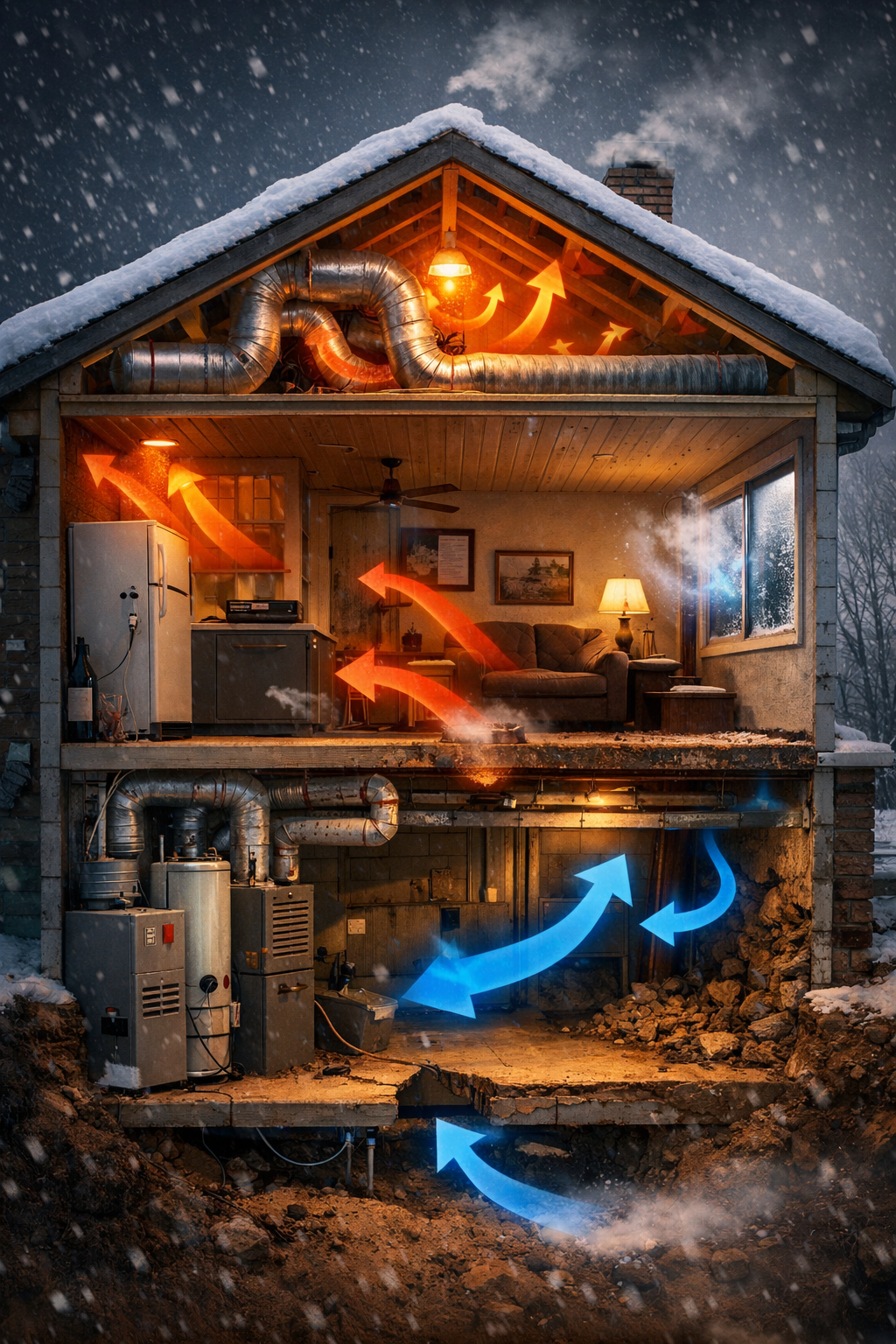
Your home functions as a pressurized vessel. If the seal of that vessel is compromised, your climate control systems must work twice as hard to maintain a steady state. The most significant sign of energy waste is not a window left open. It is the cumulative effect of hundreds of micro-leaks in your walls, ceilings, and floors. This is known as the stack effect. In winter, warm air rises and escapes through gaps in your attic, creating a vacuum that pulls cold air in through your basement and crawl space. In summer, the process reverses.
You can identify this failure through the simple observation of inconsistent temperatures. If one room is significantly colder or warmer than another, your thermal envelope is compromised. This is often the result of thermal bridging. Materials like wood and metal conduct heat more efficiently than insulation. If your wall studs are not properly shielded, they act as conduits that bypass your insulation entirely. You are paying to heat the structure of your house rather than the air inside it.
Another definitive sign involves the behavior of your windows. If you see condensation between panes or feel a draft near the frame, your windows have reached the end of their lifecycle. Modern double and triple-pane windows use argon gas as an insulator. When that seal fails, the window becomes a thermal hole in your wall. Still, the glass itself is often less problematic than the frame. Air leakage around the perimeter of the window can account for up to ten percent of your total heating and cooling costs. Why do you spend thousands on a high-efficiency furnace while allowing the heated air to leak out through the trim?
The attic bypass represents a particularly egregious point of failure. These are hidden passages that allow air to travel from the living space into the attic. Common bypasses include the gaps around recessed lights, plumbing stacks, and chimney flues. If your attic insulation shows dark patches of dust, you have found an air leak. The insulation is acting as a filter for the air escaping your home. You must seal these gaps with expanding foam or caulk to restore the integrity of your ceiling. A well-insulated attic is useless if the air can simply blow through the gaps in the floorboards.
THE PARASITIC DRAW OF THE VIRTUAL INFRASTRUCTURE
We live in an era of phantom power. This is the energy consumed by electronic devices while they are in standby or off mode. You likely believe that when you press the power button, the device stops consuming resources. This is a delusion. Modern electronics, specifically those in the Internet of Things category, require a constant stream of energy to maintain a network connection and respond to voice commands.
This parasitic draw, also known as vampire load, accounts for nearly ten percent of residential energy use. Your microwave, your coffee maker, your television, and your smart speakers are constantly sipping power. In the average home, this adds up to roughly two hundred dollars a year for electricity that performs no useful function. If you have multiple televisions with instant-on features, you are wasting the equivalent of a lightbulb burning twenty-four hours a day for every unit.
You can identify this waste by touching your devices. If a transformer or a power brick feels warm to the touch when the device is not in use, it is wasting energy. This heat is the byproduct of electrical resistance in the conversion of alternating current to direct current. Smart power strips and physical unplugging are the only authoritative solutions to this drain. Why do you allow your appliances to tax your budget for the convenience of being ready three seconds faster?
Game consoles represent a significant portion of this waste. A console left in “instant-on” mode consumes about fifteen watts of power twenty-four hours a day. Over a year, this single device can add twenty-five dollars to your bill for zero gameplay. If you multiply this across all the connected devices in your home, the financial impact is substantial. You must audit your settings. Most modern devices offer an “energy saver” mode that reduces standby consumption to less than one watt. Making this change across your entire electronics suite is a zero-cost efficiency win.
THE SHORT-CYCLING OF MECHANICAL SYSTEMS
Your heating, ventilation, and air conditioning system is the largest consumer of energy in your environment. The most visible sign of inefficiency in this system is short-cycling. This occurs when the unit turns on and off frequently rather than running for a sustained period. This is not a sign of a powerful system. It is a sign of an oversized or improperly maintained one.
A furnace or air conditioner consumes the most energy during the startup phase. When the system short-cycles, it stays in this high-consumption state indefinitely. This leads to premature mechanical wear and a massive spike in your utility bill. This often results from a dirty air filter or a blocked vent. If your filters are clogged with particulate matter, the system cannot move air efficiently, causing the heat exchanger to overheat and shut down for safety.
Duct leakage represents another silent drain. Statistics from the Environmental Protection Agency show that the average duct system leaks twenty to thirty percent of the air it moves. This means you are paying to heat your attic, your crawl space, and the interior of your walls. If you notice a high amount of dust in your home despite regular cleaning, your return ducts are likely pulling air from unconditioned spaces. This forces your system to filter and heat air that was never meant to be in your living space.
Static pressure in your ductwork is another overlooked metric. If your vents are noisy or if you feel a strong blast of air from some registers but almost nothing from others, your system is poorly balanced. This forces the blower motor to work against high resistance, increasing electricity use and reducing the lifespan of the motor. You should ensure that all internal doors remain open or have sufficient under-door clearance to allow air to return to the central unit. Closing doors in unused rooms does not save energy. It creates pressure imbalances that increase leakage and force the system to work harder.
THE WATER HEATING ENERGY-WATER NEXUS
Water heating is the second largest energy expense in most households. The most common sign of waste here is a temperature setting that is too high. Most water heaters come from the factory set at one hundred and forty degrees Fahrenheit. This is hot enough to cause third-degree burns in seconds and it leads to significant standby heat loss.
When you keep fifty gallons of water at this extreme temperature, the tank must fire frequently to maintain that state, even when you are not home. Lowering the setting to one hundred and twenty degrees reduces your water heating costs by up to ten percent without impacting your comfort. You also slow the accumulation of mineral scale in your tank, extending the life of the appliance.
Another sign of waste is the temperature of the pipes themselves. If your hot water pipes are not insulated, they act as a radiator, shedding heat into the surrounding air as the water moves from the tank to the faucet. This leads to the phenomenon of waiting for the water to get hot. Every second you spend at the sink waiting for hot water is a second where you are wasting both water and the energy used to heat it. Why are you paying to heat the copper in your walls?
Recirculation pumps provide a luxury experience but often at a high energy cost. If your pump runs twenty-four hours a day, it is constantly pulling heat out of your water heater and shedding it through your uninsulated pipes. You must install a timer or a motion sensor for your recirculation system. This ensures the pump only runs when you are likely to need hot water. Moreover, if you have a traditional tank-style heater, you are paying for the “standby loss” of the tank. Switching to a tankless system eliminates this waste, but only if you manage the “cold water sandwich” effect that can lead to increased water use during the startup phase.
THE OBSOLESCENCE OF ILLUMINATION AND APPLIANCE RATINGS
While lighting is a smaller portion of the total energy budget, it is often the most poorly managed. The sign of waste here is not just the type of bulb, but the control of the light. If you rely on traditional dimmers with light-emitting diode bulbs, you might be experiencing flickering or reduced efficiency. Dimmers designed for incandescent bulbs work by rapidly cutting the current, which can cause modern drivers to work harder and fail sooner.
Your appliances provide another clear metric. If your refrigerator is more than fifteen years old, it is likely using twice as much energy as a modern equivalent. The seals on older refrigerators eventually lose their elasticity, allowing cold air to escape. You can test this by placing a dollar bill in the door. If you can pull the bill out easily, the seal is compromised. You are essentially leaving the door cracked open twenty-four hours a day.
The same logic applies to your dishwasher and clothes washer. Older machines use significantly more water, which requires more energy to heat. Modern machines use soil sensors to adjust the cycle length and water volume, ensuring that only the necessary amount of resources is consumed. If you find yourself pre-rinsing dishes or running half-loads of laundry, you are sabotaging the efficiency of your equipment. Modern detergents are designed to latch onto food particles. Rinsing your dishes before putting them in the machine actually reduces the effectiveness of the soap and wastes gallons of water.
MAGNETIC VS ELECTRONIC BALLASTS IN LIGHTING
If you still use fluorescent tubes in your garage or basement, you are likely wasting energy through obsolete ballast technology. Older magnetic ballasts are heavy, noisy, and inefficient. They consume power even when the bulbs are off if the circuit remains energized. Switching to electronic ballasts or, better yet, bypassing the ballast entirely with direct-wire light-emitting diode tubes, can reduce lighting energy use by forty percent.
You should also audit your exterior lighting. Many property owners leave porch lights or floodlights on throughout the night. This is a massive waste that provides a false sense of security. Motion sensors are a more effective deterrent and reduce your lighting energy use to near zero. Why pay to illuminate the sidewalk for eight hours when the light is only needed for the thirty seconds you spend walking to your door?
THE VIRTUAL ENERGY FOOTPRINT OF THE DIGITAL LIFESTYLE
We often ignore the energy cost of our digital habits because the waste happens elsewhere. Still, the energy required to support your high-definition streaming and cloud storage is a significant factor in global energy demand. If you stream video in 4K resolution on a small device that cannot display those pixels, you are wasting energy on both ends of the connection.
Data centers currently account for nearly two percent of global electricity consumption. When you leave unused browser tabs open or store thousands of duplicate photos in the cloud, you are requiring a server somewhere to stay powered and cooled to protect that data. This is the virtual energy waste of the modern era. While it does not show up directly on your home meter, it is a sign of a high-consumption lifestyle that ignores the physical reality of the internet.
Artificial Intelligence has dramatically increased this digital load. A single query to a large language model consumes nearly ten times as much electricity as a standard search engine query. As you integrate these tools into your daily workflow, you must consider the aggregate energy cost of your digital interactions. Are you using high-compute resources for trivial tasks? Efficiency in the digital realm requires the same intentionality as efficiency in the physical realm.
Your home network equipment is another hidden drain. Routers and modems are designed to stay on twenty-four hours a day. In many homes, these devices are older and use more power than necessary. Upgrading to modern, energy-efficient networking gear can reduce this constant draw. Are you paying for a digital infrastructure that stays at full power while you sleep? Some modern routers feature “eco-modes” that reduce signal strength during the night, further cutting your baseline power use.
THE GEOPOLITICS OF THE UTILITY BILL
The cost of energy is not just a personal expense. It is a geopolitical factor. When you waste energy, you increase the demand for fossil fuels and put pressure on the global supply chain. This demand drives up prices for everyone and funds extraction in environmentally sensitive regions.
Authority over your energy use provides you with a level of sovereign resilience. A home that requires less energy to function is a home that is less vulnerable to energy price spikes and grid instability. This is the actuarial value of efficiency. By reducing your waste, you are de-risking your life. You are moving from a state of dependence to a state of optimization.
This shift requires a professional mindset. You must treat your home as a facility manager would treat a commercial building. This means performing regular audits, maintaining mechanical systems, and understanding the thermodynamics of the structure. The data is available. The tools are inexpensive. The only missing variable is your willingness to act on the evidence. Every kilowatt-hour you do not use is a unit of energy that does not have to be generated, transported, or secured.
THE ENGINEERING OF CHOICE AND BEHAVIORAL SLUDGE
Sustainability is often thwarted by what behavioral economists call sludge. This consists of the small frictions that make the efficient choice more difficult than the wasteful one. If your recycling bin is difficult to reach, you will throw more recyclables in the trash. If your smart thermostat has a confusing interface, you will revert to manual overrides.
You must engineer your environment to remove this sludge. Place your compost and recycling bins in the path of least resistance. Use automated power strips that turn off your peripherals when your computer shuts down. By removing the need for constant conscious effort, you ensure that your efficiency gains are permanent. If you rely on willpower to save energy, you will fail. If you rely on system design, you will succeed.
Ask yourself how many of your wasteful habits are the result of poor architecture. Is your light switch poorly located? Is your laundry room too far from your bedrooms, leading to half-loads? By identifying and fixing these structural frictions, you create a lifestyle that is efficient by default. This is the hallmark of a sophisticated approach to energy management.
THE PSYCHOLOGY OF THE ENERGY REBOUND
A significant barrier to real efficiency is the rebound effect. This occurs when a person improves the efficiency of a system and then uses that improvement as a justification for increased consumption. You install a more efficient air conditioner and then set the temperature lower. You buy an electric vehicle and then drive more miles.
This behavioral trap negates the engineering gains. You must recognize that efficiency is not an excuse for indulgence. It is a tool for absolute reduction. If your energy use stays the same after an upgrade, you have not become more efficient. You have simply changed the nature of your waste. True sustainability requires the discipline to maintain your behavioral standards as your technology improves.
Ask yourself what your goal is. If you want to reduce your impact and your costs, you must be authoritative with your habits. This means setting a firm thermostat schedule and sticking to it. It means being mindful of the digital resources you consume. It means viewing every kilowatt-hour as a precious unit of capital. Efficiency should be a path toward liberation from high utility costs, not an invitation to waste more.
THE THERMODYNAMICS OF THE KITCHEN
The kitchen is often the most energy-dense room in the house. The sign of waste here is frequently related to the physics of heat transfer. Using a large oven to heat a small meal is a massive waste of energy. A toaster oven or an air fryer uses nearly seventy percent less energy for the same task because it has a smaller thermal mass to heat.
Your refrigerator placement also matters. If your refrigerator is located next to your oven or in direct sunlight, the compressor must run more frequently to counteract the external heat. You should ensure there is at least an inch of space around the unit to allow for proper airflow over the condenser coils. If these coils are covered in dust, the refrigerator cannot shed heat efficiently, leading to a twenty percent increase in power use. Cleaning your refrigerator coils once a year is a five-minute task that can save you fifty dollars in electricity.
What about your cooking habits? Using a lid on a pot reduces the energy required to boil water by half. Matching the size of the pan to the size of the burner prevents heat from escaping around the edges. If you use an electric stovetop, you can turn off the burner a few minutes before the food is finished. The residual heat in the coil will complete the cooking process. These micro-habits require no financial investment but yield significant cumulative savings.
A TIMELINE FOR THE ENERGY AUDIT
You cannot solve all these issues in a single weekend. A professional approach involves a staggered implementation of audits and upgrades.
MONTH ONE: THE THERMAL ENVELOPE AND AIR SEALING
Focus on the integrity of your pressurized vessel. Use a thermal leak detector or even a simple stick of incense to find drafts around windows, doors, and electrical outlets. Seal these gaps with caulk or weather stripping. Check your attic for bypasses and ensure the hatch is properly insulated. This phase provides the highest return on investment because it directly reduces the load on your HVAC system.
MONTH TWO: VAMPIRE LOADS AND ELECTRONICS
Audit every device that stays plugged in. Invest in smart power strips for your home office and entertainment center. Navigate the settings menus of your televisions and game consoles to enable energy-saving modes. Unplug guest room electronics that are rarely used. You will see an immediate drop in your baseline power use, often referred to as your “always-on” load.
MONTH THREE: MECHANICAL SYSTEMS AND FILTRATION
Change your air filters and check your ductwork for visible leaks or disconnected sections. Schedule a professional tune-up for your furnace or air conditioner to ensure the refrigerant levels are correct and the coils are clean. Ensure that your water heater is set to one hundred and twenty degrees. Insulate the first six feet of your hot water pipes.
MONTH FOUR: APPLIANCE AUDIT AND SEAL INTEGRITY
Perform the dollar bill test on your refrigerator and freezer seals. Clean the condenser coils. Review the age of your major appliances and research the potential ROI of replacing the most inefficient units. Adjust the settings on your dishwasher to skip the heated dry cycle.
MONTH FIVE: LIGHTING AND CONTROLS
Replace any remaining incandescent or halogen bulbs with high-quality light-emitting diodes. Swap out old magnetic ballasts. Install motion sensors for exterior lighting and timers for any decorative interior lighting. Ensure your dimmers are compatible with your bulbs to prevent driver waste.
MONTH SIX: DIGITAL AND BEHAVIORAL REVIEW
Audit your digital habits. Clear out your cloud storage and unsubscribe from unnecessary services. Establish a firm thermostat schedule and commit to the “eighty percent” rule: aim for eighty percent efficiency with zero percent human intervention through better system design.
THE ACTUARIAL VALUE OF EFFICIENCY
Energy efficiency is the only investment that provides a guaranteed, tax-free return on your money. When you reduce your utility bill by fifty dollars a month, that is equivalent to earning an extra seven hundred dollars a year. You are essentially giving yourself a raise by removing the friction from your lifestyle.
Furthermore, a home with a documented history of low energy use is a more valuable asset in the real estate market. Buyers are increasingly aware of the long-term costs of home ownership. A home with high-performance windows, a sealed envelope, and efficient systems is a premium product. You are not just saving money today. You are building equity for tomorrow. Real estate data shows that energy-efficient homes sell faster and for a higher percentage of the asking price than their inefficient counterparts.
This actuarial value extends to insurance. As climate volatility increases, homes that are resilient to grid failures and have lower operating costs are seen as lower risks. In some regions, insurers are already beginning to offer discounts for homes that meet specific efficiency and resilience standards. You are building financial armor for your future.
THE FUTURE OF RESIDENTIAL ENERGY MANAGEMENT
We are moving toward an era of circuit-level energy monitoring. Modern electrical panels can now track the consumption of every individual circuit in your home. This level of granularity removes the guesswork from efficiency. You can see exactly which appliance is failing or which habit is costing you the most.
As the grid transitions toward renewable energy, your ability to manage your load will become a market asset. Programs like “demand response” will pay you to reduce your energy use during peak periods. A home that is already efficient is perfectly positioned to profit from these programs. You are transitioning from a passive consumer of energy to an active manager of a resource.
Can you afford to keep ignoring the signs? The heat rising through your attic, the water cooling in your pipes, and the devices sipping power in the dark are all silent witnesses to a system in failure. You have the authority to fix it. You have the data to guide you. The only question remains: why are you still paying for waste? The solution is not more gadgets. It is better engineering and more intentional living. Audit your invisible leaks today and reclaim your resources.
REFERENCES
US Department of Energy: Energy Waste and Residential Efficiency Statistics
Environmental Protection Agency: Duct Sealing and HVAC Performance Metrics
https://www.google.com/search?q=https://www.energystar.gov/campaign/seal_insulate/duct_sealing
The Stack Effect and Building Science Thermodynamics
https://www.google.com/search?q=https://www.wbdg.org/resources/air-barriers-and-air-tightness
Vampire Power and Standby Consumption Data
Water Heating Temperature and Standby Loss Analysis
Life Cycle Assessment of Older vs Modern Refrigerators
The Energy Footprint of Data Centers and High-Definition Streaming
Thermal Bridging and Insulation Efficiency Research
Smart Meter Data and Leak Detection Capabilities
The Psychology of the Energy Rebound Effect
https://www.google.com/search?q=https://www.nature.com/articles/nclimate1411
The Energy Cost of Artificial Intelligence and Large Language Models https://www.google.com/search?q=https://www.scientificamerican.com/article/the-ai-boom-could-use-a-shocking-amount-of-electricity
Static Pressure and HVAC System Longevity https://www.google.com/search?q=https://www.acca.org/standards/technical-manuals/manual-j
Magnetic vs Electronic Ballasts in Residential Lighting https://www.google.com/search?q=https://www.lrc.rpi.edu/programs/nlpip/lightinganswers/latube/abstract.asp
Real Estate Premiums for Energy Efficient Homes https://www.google.com/search?q=https://www.nar.realtor/research-and-statistics/research-reports/realtors-and-sustainability
Author bio
Julian is a graduate of both mechanical engineering and the humanities. Passionate about frugality and minimalism, he believes that the written word empowers people to tackle major challenges by facilitating systematic progress in science, art, and technology. In his free time, he enjoys ornamental fish keeping, reading, writing, sports, and music. Connect with him here https://www.linkedin.com/in/juliannevillecorrea/
About The Author


