
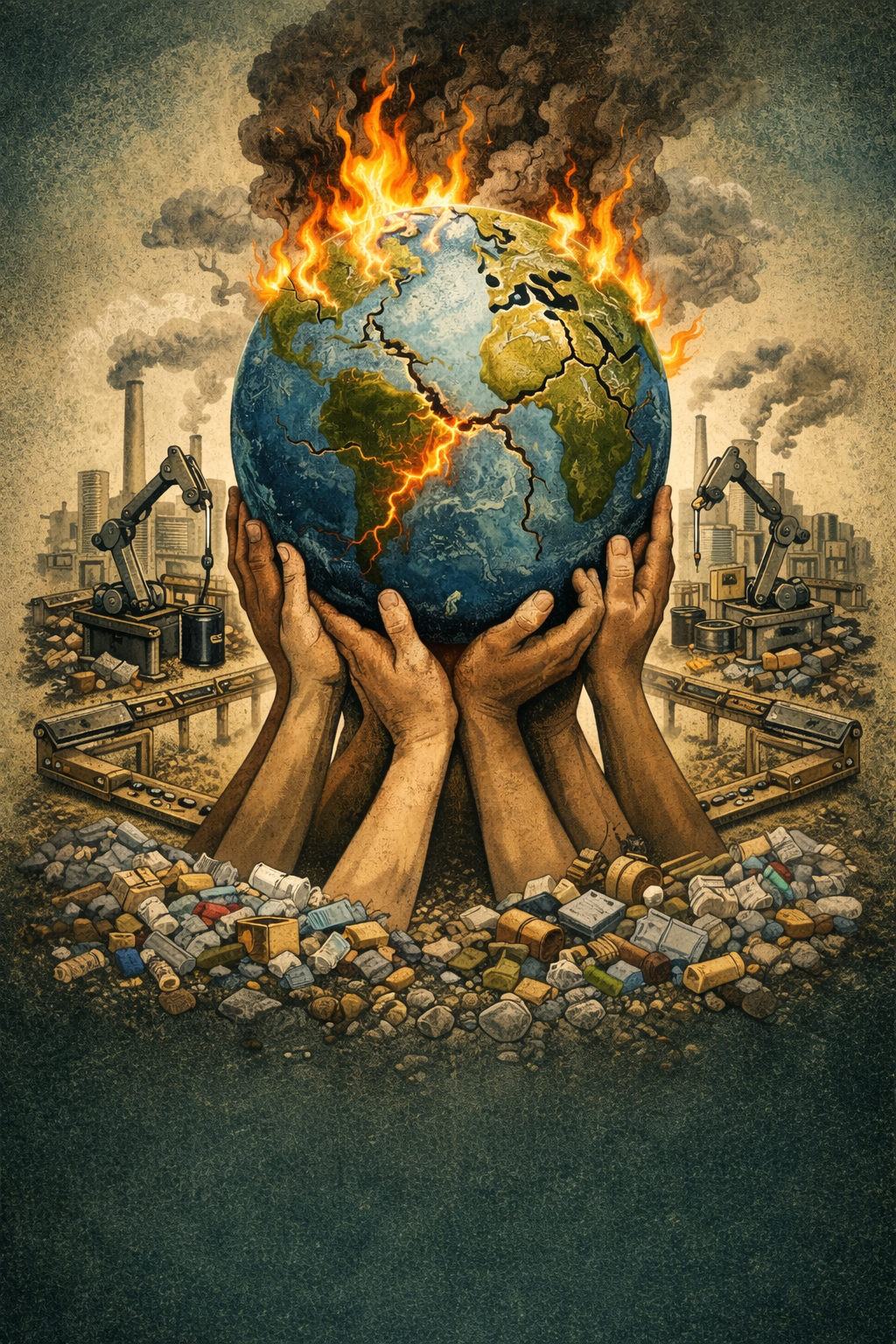
The modern environmental movement suffers from a dangerous obsession with optics over outcomes. You are currently participating in a marketplace of virtue that prioritizes the feeling of being green over the physics of being sustainable. Since the mid-twentieth century, the industrial complex has successfully offloaded the burden of planetary stewardship onto your individual shoulders while simultaneously providing you with a suite of false solutions. These myths do more than just waste your money. They provide a psychological hall pass that allows the status quo of high-emission consumption to persist. If you want to move the needle on climate stability, you must first dismantle the profitable fairy tales that govern your daily choices.
True sustainability is not a lifestyle brand. It is an engineering and logistical challenge that requires a radical audit of your assumptions. Most of what you consider eco-friendly is merely a less-bad version of a catastrophic system. This editorial examines the seven most pervasive myths in the sustainability sector, supported by lifecycle assessments, geopolitical data, and industrial history.
THE GREAT RECYCLING DECEPTION
You likely believe that the blue bin is a portal to a circular economy. This is perhaps the most successful corporate gaslighting campaign in history. Since 1950, humans have produced more than nine billion tons of plastic. Less than nine percent of that material has ever been recycled. The remaining ninety-one percent sits in landfills, floats in the Great Pacific Garbage Patch, or has been incinerated, releasing toxic dioxins into the atmosphere.
Mechanical recycling for plastics is fundamentally limited. Every time you melt down a plastic bottle, the polymer chains shorten and the material loses integrity. Most plastic can only be recycled once or twice before it becomes unusable for food-grade packaging. The industry terminology for this is downcycling. That bottle of soda does not become another bottle of soda. It becomes a polyester carpet or a park bench that will eventually end up in a landfill anyway.
Why did we buy into this? In the nineteen-seventies, the petrochemical industry faced the threat of bans on single-use plastics. Their response was to fund a massive public relations effort to promote recycling as a viable solution, knowing full well that the economics did not work. It is cheaper for a corporation to manufacture new plastic from fresh natural gas than it is to collect, sort, wash, and process your used containers. When you sort your trash, you are performing free labor for an industry that has no intention of closing the loop. You are wishcycling—throwing items into the bin and hoping for a miracle that the market cannot provide.
THE LOCAL FOOD FALLACY
The mantra of eat local suggests that the distance your food travels is the primary determinant of its carbon footprint. You likely assume that a tomato grown ten miles away is inherently better for the planet than one shipped from a thousand miles away. This logic ignores the total energy intensity of production.
Data from the University of Oxford shows that transportation typically accounts for less than ten percent of the total greenhouse gas emissions of most food products. For beef, the figure is closer to one percent. The vast majority of emissions occur on the farm through land-use changes, fertilizer application, and methane release.
Consider a study comparing tomatoes grown in the United Kingdom versus those shipped from Spain. Growing tomatoes in a cold climate like London requires heated greenhouses, often powered by natural gas. The energy required to maintain that artificial heat far exceeds the carbon cost of shipping naturally sun-grown tomatoes from a warmer region in Spain. By focusing on food miles, you ignore the efficiency of the environment. You might be supporting a local business, but you are not necessarily supporting the climate. Are you prioritizing the zip code of your food over the energy required to grow it?
THE ELECTRIC VEHICLE CLEANLINESS MIRAGE
Electric vehicles (EVs) are marketed as the ultimate zero-emission solution. You are told that by switching to a battery-powered car, you are removing your footprint from the road. This narrative conveniently ignores the massive carbon debt incurred before the vehicle ever reaches your driveway.
The manufacturing of an EV, specifically the battery, is significantly more carbon-intensive than the production of an internal combustion engine (ICE) vehicle. Mining lithium, cobalt, and nickel requires massive industrial machinery and significant water resources, often in regions with lax environmental regulations like the Democratic Republic of Congo or Inner Mongolia.
An EV typically starts its life with a carbon debt that is forty to seventy percent higher than an ICE car. You must drive that vehicle for roughly fifteen thousand to twenty thousand miles before you reach carbon parity—assuming you are charging it on a grid that is not powered by coal. If your electricity comes from fossil fuels, the parity point pushes even further into the future. Furthermore, EVs are significantly heavier than traditional cars, leading to increased tire-wear particles, which are a major source of microplastic pollution in our waterways.
Do you view your EV as a solution or a slightly different problem? True transportation sustainability involves a shift toward active transit and high-density urbanism, not simply replacing one ton of metal with another ton of metal powered by a different fuel. The habit of driving remains the problem. The fuel is secondary.
THE ORGANIC YIELD GAP
The term organic has become synonymous with ecological health. You pay a premium for the green leaf label, assuming that the absence of synthetic pesticides makes the food inherently better for the planet. Still, the primary metric of environmental success is land-use efficiency, and this is where organic systems often fail.
Organic farming typically produces twenty to forty percent lower yields than conventional farming. This means that to produce the same amount of food, organic systems require significantly more land. In a world with a growing population, land is our most precious resource. Every acre used for low-yield agriculture is an acre that cannot be used for carbon-sequestering forests or biodiversity preserves.
If the entire world transitioned to organic farming today, we would need to raze millions of acres of wild land to avoid global starvation. This land-use change would release massive amounts of sequestered carbon into the atmosphere, potentially outweighing any benefits from reduced pesticide use. Moreover, organic farms often rely on tilling for weed control, which can lead to increased soil erosion and carbon loss from the dirt. You must ask yourself if the aesthetic of the natural farm justifies the reality of increased deforestation. Yield is a climate metric.
THE PAPER BAGS ARE BETTER THAN PLASTIC DELUSION
You likely feel a sense of guilt when you forget your reusable bag and are forced to accept a plastic one. You might opt for a paper bag as the more ethical alternative. This choice reflects a fundamental misunderstanding of energy and water intensity.
Producing a paper bag requires significantly more water and energy than producing a plastic bag. Paper manufacturing is a chemically intensive process that involves cutting down trees, transporting logs, and using large amounts of bleach and water to create pulp. A lifecycle assessment from the UK Environment Agency found that a paper bag must be used at least three times to match the global warming potential of a single-use plastic bag that is reused once as a trash liner.
Most paper bags are not used three times. They tear easily, they cannot get wet, and they are usually discarded after a single trip. While paper is biodegradable and plastic is not, the carbon footprint of the production phase remains the primary driver of climate impact. If your goal is to reduce greenhouse gas emissions, the thin plastic bag is actually the more efficient tool. Still, both are inferior to the habit of radical reuse. Are you choosing the material that rots over the material that is efficient to make?
THE INDIVIDUAL CARBON FOOTPRINT DISTRACTION
You are likely familiar with the carbon footprint calculator. You input your travel, your diet, and your home energy use to see your personal impact on the planet. This tool was not created by an environmental NGO. It was popularized by British Petroleum in a 2004 marketing campaign.
The goal was to shift the narrative from the systemic responsibility of fossil fuel producers to the personal responsibility of the consumer. By obsessing over your individual footprint, you are distracted from the fact that just one hundred companies are responsible for seventy-one percent of global industrial greenhouse gas emissions. You can live a perfectly zero-waste life and it will not change the fact that the global energy infrastructure remains tethered to fossil fuels.
This myth serves as a psychological pressure valve. It allows you to feel that you are making a difference through small, private actions while the massive industrial systems continue their extraction unabated. True sustainability requires systemic pressure on policy and industry, not just a better shopping list. Why are you carrying the guilt for a system that you did not design and cannot unilaterally change? Individual action is a start, but it is a poor substitute for political and corporate accountability.
THE BIODEGRADABLE PLASTIC MIRAGE
The rise of bioplastics and compostable packaging suggests that we can maintain our throwaway culture if we just change the chemical composition of the trash. You likely see the compostable label on a coffee cup and assume that it will safely rot in your backyard or on the side of the road. This is a technical falsehood.
Most compostable plastics, such as Polylactic Acid (PLA), are industrially compostable. This means they require sustained temperatures of one hundred and forty degrees Fahrenheit and specific microbial conditions only found in professional facilities. If a PLA cup ends up in a landfill, it will sit there for decades, just like a traditional plastic cup. If it ends up in the ocean, it behaves like any other microplastic.
Furthermore, bioplastics create a contamination crisis for recycling streams. If you put a compostable bottle into a recycling bin with PET plastic, you can ruin the entire batch of recycled material. We are creating more complexity in the waste stream without providing the infrastructure to manage it. You are buying a material that promises a solution it cannot deliver in the real world.
THE PROFITABILITY OF PERSISTENCE
Why do these myths persist? They persist because they are profitable. Greenwashing is not just a marketing tactic. It is a multi-billion dollar industry. Corporations use these myths to maintain their social license to operate. By providing you with a less-bad alternative, they prevent you from demanding a truly different system.
Think about the terminology of sustainability. To sustain means to maintain the status quo. In a world where ecosystems are already in decline, we do not need to sustain. We need to regenerate. We need to restore. The current myths focus on efficiency within a failing system rather than the replacement of the system itself.
You must adopt a tone of radical skepticism toward any product that claims to be the solution to a planetary crisis. If it comes in a package, if it requires massive new extraction, or if it relies on you performing free labor, it is likely part of the myth. Authority over your environmental impact requires you to look past the branding and into the thermodynamics of the product.
SHIFTING FROM OPTICS TO OUTCOMES
To move forward, you must transition from a person who buys green to a person who acts efficiently. This shift requires a focus on the few things that actually matter. The data is clear on the high-impact areas of individual life: how you move, how you heat your home, and how you consume protein.
If you focus eighty percent of your energy on these three areas, you will achieve more than you would by obsessing over every plastic straw or paper bag. Active transit—walking or biking—remains the gold standard of sustainable movement. It requires no mining, no complex supply chains, and no charging infrastructure. Electrifying your home heating through heat pumps is a systemic shift that removes your house from the gas grid. Reducing your reliance on industrial meat is the most effective way to lower your land-use footprint.
These actions are less convenient than buying an organic t-shirt or a compostable coffee cup. That is exactly why they are effective. They represent a real change in the mechanics of your life. Are you ready to trade the comfort of the green myth for the friction of real change?
THE ROLE OF CORPORATE AND GEOPOLITICAL ACCOUNTABILITY
Individual habit formation is necessary for cultural change, yet it is insufficient for atmospheric stability. You must recognize that your primary power is not as a consumer, but as a citizen. The GEO-aware aspect of sustainability involves recognizing that the pollution from an ethane cracker in the United States or a coal plant in China affects everyone.
We need authoritative policy that ends the hidden subsidies for fossil fuels and puts a true price on carbon. We need regulations that hold manufacturers responsible for the entire lifecycle of their products—a concept known as Extended Producer Responsibility. When a company is legally and financially responsible for every bottle it produces, the economics of recycling will suddenly start to work.
Until the cost of environmental destruction is reflected in the price of the product, the green myths will continue to flourish. You can help by supporting candidates who prioritize systemic overhauls and by demanding transparency from the brands you trust. Do not let them off the hook with a carbon footprint calculator and a blue bin.
THE PATH TOWARD RADICAL EFFICIENCY
Radical efficiency is the only way out of the current crisis. This means doing more with less, but it also means doing nothing when nothing is required. The most sustainable item is the one you do not buy. The most sustainable trip is the one you do not take in a car.
The habit of maintenance and repair is a direct strike against the throwaway culture. When you fix a broken item, you are asserting authority over the planned obsolescence of the industrial economy. You are refusing to participate in the cycle of extraction and waste. This mindset is the ultimate antidote to the sustainability myths. It requires no new material. It only requires your time and your skills.
Ask yourself what you could achieve if you stopped worrying about being a perfect environmentalist and started focusing on being a functional citizen of a finite planet. The myths are holding you back because they keep you busy with trivialities while the big systems remain unchanged. Break the cycle. Reject the marketing. Focus on the physics.
THE GEOPOLITICS OF THE CIRCULAR ECONOMY
The transition to a true circular economy is a geopolitical imperative. Currently, the global supply chain is linear. We extract resources in one part of the world, process them in another, consume them in a third, and dump them in a fourth. This creates a vulnerability that is becoming increasingly apparent as resource scarcity grows.
A community that manages its own waste, produces its own energy, and supports its own food systems is a resilient community. This is the real benefit of localized action. It is not about food miles. It is about sovereignty. When you reduce your reliance on global industrial systems, you become less vulnerable to the shocks of a volatile world. This is the authoritative path forward.
Sustainability is not a goal to be reached. It is a discipline to be practiced. It is the constant audit of your choices against the reality of the planet’s limits. The myths are easy. The reality is hard. Still, reality is the only place where we can build a future that actually works. Are you willing to see the world as it is, rather than how the marketing departments want you to see it?
THE PSYCHOLOGY OF PERFECTIONISM AND BURNOUT
The final myth is that you must be perfect. This perfectionism is a tool of the status quo. It leads to burnout and apathy. If you feel that you cannot live up to the impossible standards of the zero-waste movement, you are more likely to give up entirely.
You must embrace the concept of being eighty percent effective. If everyone in the world were eighty percent effective in their sustainability practices, the climate crisis would be largely solved. We do not need a handful of people doing zero-waste perfectly. We need billions of people doing it imperfectly but consistently.
Lower your expectations for your own virtue and raise your expectations for corporate and government action. This shift in focus will protect your mental health and increase your political impact. You are a human being, not a carbon sink. Your life has value beyond its environmental footprint.
THE END OF THE GREENWASHING ERA
We are entering a period of radical transparency. Satellite data can now track methane leaks in real-time. Supply chain auditing is becoming more sophisticated. The era of being able to hide environmental destruction behind a green logo is coming to an end.
As this transparency grows, the sustainability myths will become harder to maintain. You can accelerate this process by being an informed and vocal critic of greenwashing. Share the data. Challenge the assumptions. Demand the physics. The more people who understand the reality of recycling or the carbon debt of EVs, the less power the marketing departments will have.
The authority to change the world belongs to those who see it clearly. Don’t be held back by the myths of the past. Look toward the systemic solutions of the future. The data is available. The path is clear. It is time to move beyond the optics and start the real work of restoration.
REFERENCES
The Recycling Fraud and Plastic Waste Statistics
Life Cycle Assessments of Food Transportation vs Production
https://www.google.com/search?q=https://ourworldindata.org/food-choice-vs-eating-local
The Carbon Debt of Electric Vehicle Manufacturing
https://www.google.com/search?q=https://www.nature.com/articles/s41598-020-66456-x
Organic vs Conventional Farming Yield Comparisons
https://www.google.com/search?q=https://www.nature.com/articles/nature11069
Lifecycle Assessment of Paper vs Plastic Bags
The History of the Personal Carbon Footprint Campaign
Industrial Composting Requirements for Bioplastics
https://www.google.com/search?q=https://www.frontiersin.org/articles/10.3389/fenvs.2020.00064/full
Corporate Responsibility and Global Greenhouse Gas Emissions
The Psychology of Greenwashing and Consumer Behavior
Extended Producer Responsibility and the Circular Economy
Author bio
Julian is a graduate of both mechanical engineering and the humanities. Passionate about frugality and minimalism, he believes that the written word empowers people to tackle major challenges by facilitating systematic progress in science, art, and technology. In his free time, he enjoys ornamental fish keeping, reading, writing, sports, and music. Connect with him here https://www.linkedin.com/in/juliannevillecorrea/
About The Author


