
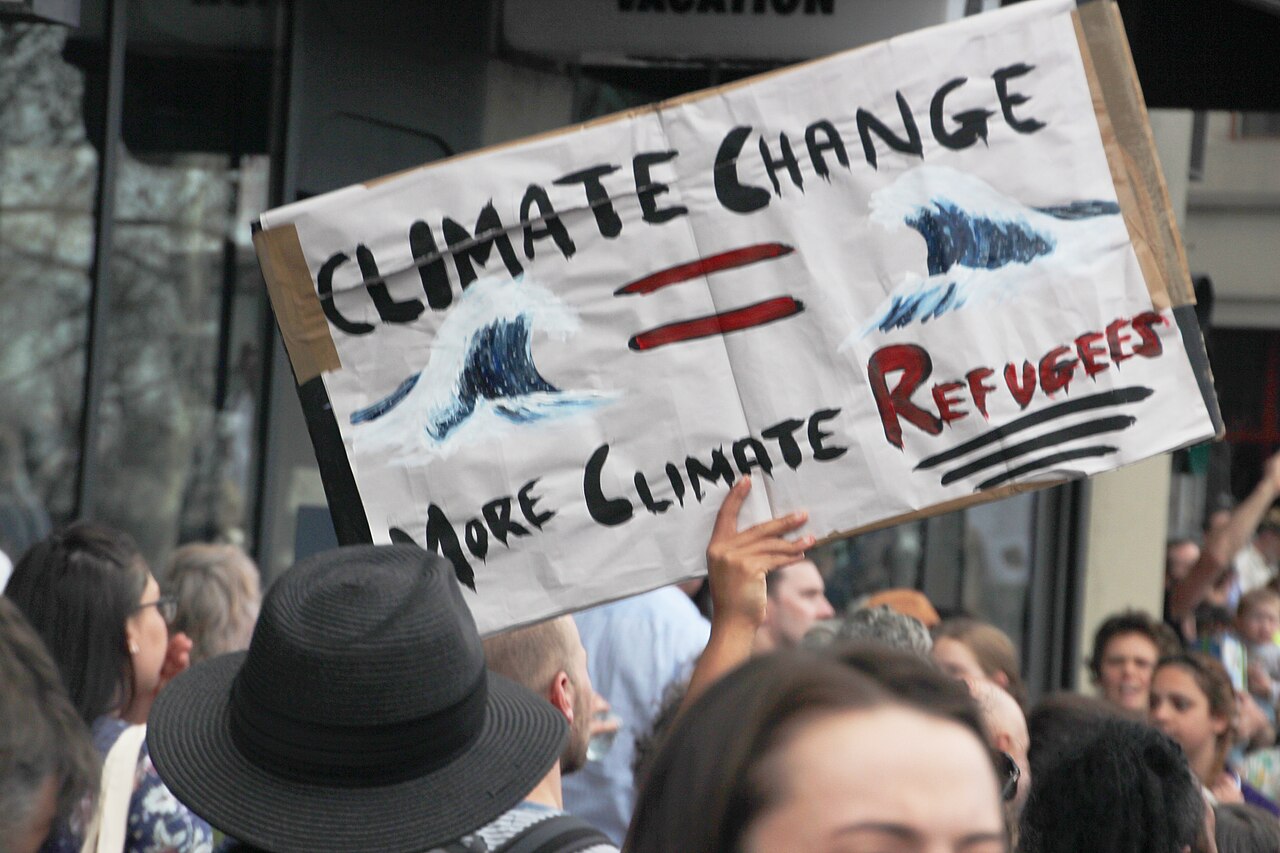
Upto 216 million people could be forced to move within their countries by 2050.
By Namith DP | Aug 16, 2025
Introduction
Climate-driven displacement is no longer a forecast; it is a measurable reality. Every year, disasters linked to climate change push tens of millions of people out of their homes, and most never cross borders. They are forced to move within their own countries, often into fragile urban peripheries where infrastructure, health systems, and social protections are already overstretched. The numbers are growing fast, legal protections remain thin, and adaptation funding is far below what is required. Without decisive action, climate refugees—more accurately called people displaced in the context of climate and disaster events—will become the defining humanitarian challenge of the coming decades.
The numbers reveal a system under strain

Disasters are now the leading driver of internal displacement worldwide. According to the Internal Displacement Monitoring Centre (IDMC), there were 46.9 million new internal displacements across conflicts and disasters in 2023. Of these, 26.4 million displacements were caused by disasters, primarily floods, storms, and wildfires. That means more than half of new displacement cases were directly tied to environmental shocks.
The cumulative figures are even more striking. At the end of 2023, IDMC recorded 75.9 million people living in internal displacement. By the end of 2024, that number rose further to 83.4 million. Climate hazards are not the only driver—conflict plays a major role—but climate impacts are consistently pushing these numbers higher.
Looking ahead, the World Bank’s Groundswell reports project up to 216 million internal climate migrants by 2050 across six major regions if emissions remain high and adaptation lags. These movements will not be gradual. The Groundswell models identify climate migration “hotspots” that could form as early as the 2030s, particularly in Sub-Saharan Africa, South Asia, and Latin America.
Why climate displacement is mostly internal
Although the term “climate refugee” is common in media and policy debates, most people forced to move because of climate impacts do not cross international borders. Several factors explain why:
- Cost and social networks: Displaced households often lack the resources to migrate internationally. Moving within national borders allows families to remain closer to social and cultural ties.
- Legal barriers: The 1951 Refugee Convention protects people fleeing persecution based on race, religion, nationality, political opinion, or membership of a particular social group. Climate shocks do not fall under these grounds, leaving most climate-displaced people outside international refugee law.
- Regional progress: Africa’s Kampala Convention is the only binding legal instrument explicitly covering displacement caused by natural disasters, including climate-related ones. While significant, it applies only to signatory African states and focuses on internal displacement.
- Soft-law guidance: The Nansen Initiative Protection Agenda and the Platform on Disaster Displacement provide states with guidance on managing cross-border disaster displacement, but they remain non-binding frameworks.
The result is a legal protection gap. Those uprooted within their countries are recognized as internally displaced persons (IDPs) but often lack the rights, documentation, and services needed to rebuild their lives. This gap makes climate-related internal displacement an under-recognized humanitarian emergency.
Regional flashpoints where climate migration is accelerating
South Asia
South Asia is emerging as a climate displacement epicenter. Bangladesh faces sea-level rise that could submerge large swathes of the delta. India’s urban centers are absorbing millions displaced by floods, cyclones, and extreme heat. The Groundswell report estimates tens of millions of climate migrants in the region by 2050 if adaptive investments remain weak.
Sub-Saharan Africa
The region combines high climate exposure with low adaptive capacity. Recurrent drought in the Horn of Africa forces pastoralists and farmers to abandon traditional livelihoods, while floods in Nigeria and Mozambique repeatedly displace millions. Nearly half of the world’s internally displaced people are located in Africa, with climate shocks compounding conflict-driven mobility.
East Asia and the Pacific
Coastal megacities such as Manila, Jakarta, and Ho Chi Minh City face risks from sea-level rise and storm surges. In the Pacific, entire villages in Fiji and other island nations have already been relocated inland due to sea-level rise, setting precedents for planned relocation.
Small Island Developing States
Low-lying atoll nations such as Tuvalu and Kiribati may lose significant habitable land to rising seas. These countries are negotiating migration pathways and adaptation support as part of their climate diplomacy strategies.
The humanitarian crisis ahead: four converging pressures
1. Housing and infrastructure strain
In 2023, climate disasters destroyed millions of homes worldwide. Families displaced by floods and storms often crowd into temporary shelters or low-cost rentals in urban peripheries. Local governments struggle to expand water, sanitation, electricity, and transport services to match the sudden influx. Without planned urban expansion, displaced populations are likely to settle in informal settlements at high risk of future disasters.
2. Public health pressures
Crowded shelters and camps increase exposure to waterborne and vector-borne diseases, especially after floods. Prolonged heatwaves reduce labor productivity and increase hospital admissions, straining already underfunded health systems. Climate migration often shifts population burdens onto urban hospitals unequipped for large surges.
3. Livelihood collapse
Displacement often destroys or disrupts livelihoods, particularly in agriculture. Drought and rainfall variability cut yields, forcing households into precarious informal work in cities. Without access to documentation, displaced families are excluded from public benefits and formal labor markets, deepening cycles of poverty.
4. Chronic funding gaps
The UNEP Adaptation Gap Report 2023 estimates that developing countries face an annual adaptation gap of US$194–366 billion, yet current flows are only a fraction of this. The gap is 10 to 18 times larger than current levels of international adaptation finance. Without closing this gap, countries cannot build resilient housing, early warning systems, or social safety nets to absorb climate migrants.
Lessons from recent displacement crises
- Flood displacement in Pakistan (2022): Record monsoon floods displaced more than 8 million people, many of whom remain without permanent housing. This single event illustrated how climate disasters can overwhelm national response systems.
- Cyclone Idai in Mozambique (2019): More than 400,000 people were displaced. Recovery has been slow, with many still living in temporary settlements years later, underscoring the protracted nature of climate displacement.
- Pacific Island relocations: Fiji has relocated entire villages threatened by sea-level rise. These relocations show the logistical and cultural complexity of moving entire communities while preserving livelihoods and social cohesion.
What governments must prioritize
- Legal recognition of climate displacement
- Integrate climate and disaster displacement into national IDP laws.
- Use Africa’s Kampala Convention as a model for protection mandates.
- Cross-border humanitarian measures
- Expand use of humanitarian visas and temporary protection for those fleeing disasters.
- Operationalize frameworks such as the Nansen Initiative Protection Agenda.
- Investment in adaptation and anticipatory action
- Fund housing retrofits, resilient infrastructure, and social safety nets.
- Scale forecast-based financing and early action protocols to reduce losses when disasters strike.
- Urban planning for migration hotspots
- Prioritize land-use zoning, flood-resilient housing, and basic services in identified receiving areas.
- Ensure displaced populations have access to IDs, cash transfers, and healthcare.
- Safeguarded planned relocation
- Adopt human-rights-based relocation standards: participation, consent, livelihood restoration, and cultural continuity.
- Monitor outcomes long-term to prevent secondary displacement.
What businesses and investors should prepare for

Climate migration will reshape markets and labor forces. Companies need to anticipate:
- Supply chain disruptions: Extreme weather and displacement will disrupt agricultural and manufacturing hubs.
- Labor force shifts: Migration patterns will affect availability of skilled and unskilled labor in urban centers.
- New infrastructure demands: Private capital can co-invest in resilient housing, water systems, and healthcare infrastructure in receiving cities, reducing risks while opening growth opportunities.
Communicating climate displacement accurately
- Avoid mislabeling: While “climate refugee” is widely used, UNHCR does not recognize it as a legal status. Preferred terms are “climate-related internal displacement” or “displacement in the context of climate and disasters.”
- Use trusted data sources: Cite IDMC for annual displacement data and World Bank Groundswell for projections.
- Highlight multi-causality: Climate is a risk multiplier that interacts with economic, political, and social pressures. This framing avoids oversimplification and informs better policy design.
A five-year action agenda
- Map hotspots and expand city-level services in receiving areas.
- Strengthen early warning systems and fund forecast-based response mechanisms.
- Mobilize at least US$200 billion annually in adaptation finance for high-risk countries.
- Update national IDP laws to include climate displacement with enforceable protections.
- Implement voluntary, rights-based planned relocation where needed.
- Integrate climate displacement into National Adaptation Plans and urban development policies.
Conclusion
The evidence is clear: climate displacement is already reshaping demographics, economies, and humanitarian response systems. In 2023 alone, disasters drove 26.4 million new internal displacements, and projections point to 216 million internal climate migrants by 2050 if global inaction persists. Legal frameworks lag behind reality, and funding gaps leave communities unprotected.
The world faces a choice. By investing in adaptation, creating legal safeguards, and planning for safe, orderly movement, governments can manage climate-driven mobility as part of resilience strategies. Failure to act will turn climate displacement into the next protracted humanitarian crisis—one measured not in abstract numbers but in millions of disrupted lives.
See also –
About The Author




[…] Why Climate Refugees Could Trigger the Next Humanitarian Crisis […]