
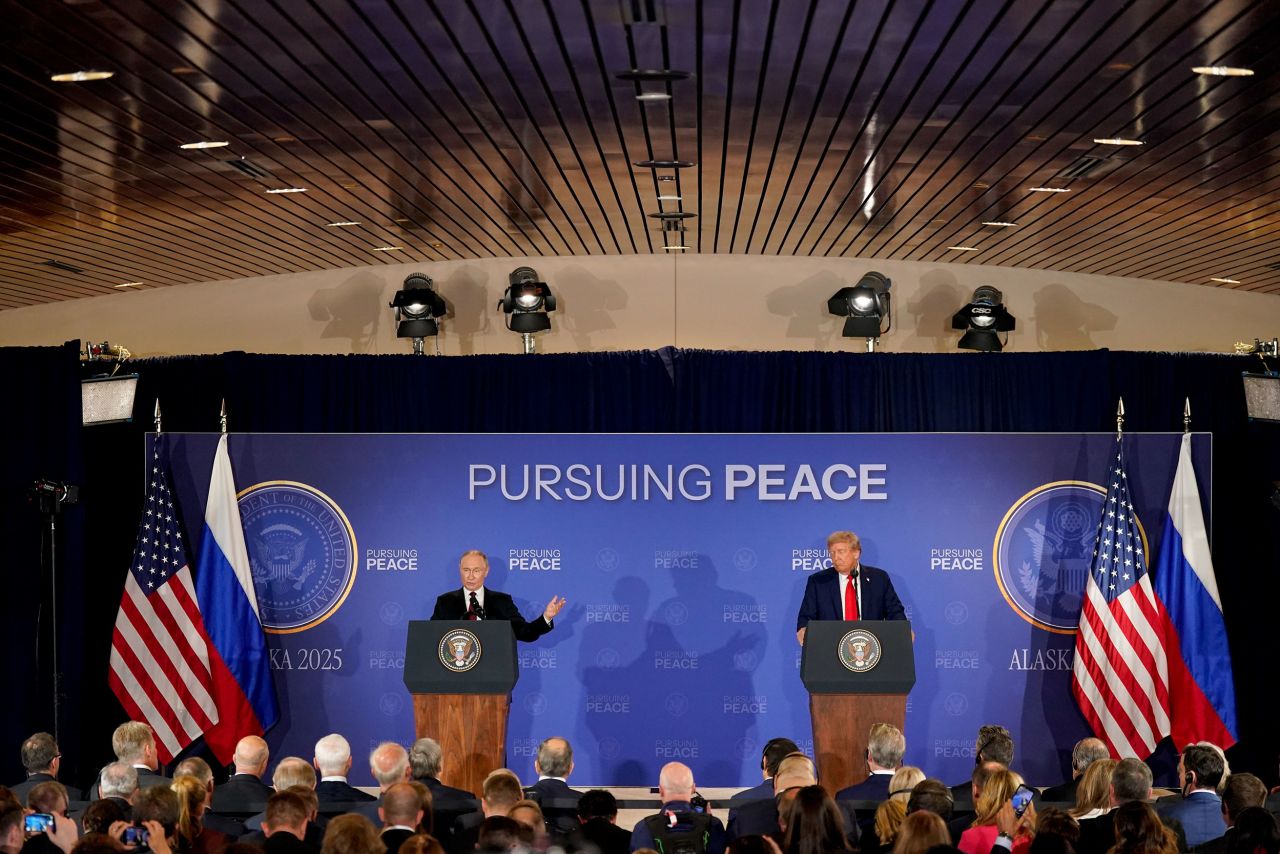
While the talks ended without a ceasefire, the meeting highlighted a shift in U.S. strategy and raised new questions for NATO.
By Namith DP | Aug 16, 2025
Introduction
On August 15, 2025, U.S. President Donald Trump met Russian President Vladimir Putin at Joint Base Elmendorf–Richardson in Anchorage, Alaska. The encounter marked the first face-to-face engagement between the two leaders since Trump returned to office and unfolded against the backdrop of a war in Ukraine that has entered its fourth year with no sign of resolution. The summit lasted for nearly three hours and concluded with short statements. Both leaders described the conversation as “productive,” but no ceasefire was reached, no joint statement was issued, and no verifiable commitments were confirmed.
The meeting’s limited output underscored the gulf between U.S. and Russian positions. Trump sought to present the session as a step toward a comprehensive peace framework. Putin emphasized dialogue but did not concede on battlefield realities or sanctions. With active fighting continuing across eastern Ukraine, the Alaska summit served more as a signal of intentions than a breakthrough in substance.
The Meeting

The Anchorage session followed a tightly controlled format:
- Date and location: August 15, 2025, Anchorage, Alaska.
- Duration: Approximately three hours of closed-door discussions.
- Participants: President Trump, Secretary of State Marco Rubio, envoy Steve Witkoff, interpreters, and Putin’s delegation.
- Agenda: Ukraine war, sanctions regimes, military balance, and prospects for arms control.
By excluding reporters from the substantive discussions and limiting public remarks to brief statements, both leaders maximized control of optics while minimizing accountability for specifics.
Core Outcomes
No Ceasefire
Despite heavy speculation, neither side announced a ceasefire. Active fighting in Donetsk, Kharkiv, and Zaporizhzhia continued during the summit. Reports from Ukrainian and Western observers confirmed no decrease in shelling or drone activity.
Shift in U.S. Language
The most notable development was Trump’s pivot from calling for an “immediate ceasefire” to emphasizing pursuit of a “comprehensive peace agreement.” That subtle change aligned more closely with Moscow’s preferred framing, which links a cessation of hostilities to broader negotiations over territory, sanctions relief, and recognition of current control lines.
Absence of Joint Statement
Unlike summits that end with communiqués or working group mandates, the Anchorage meeting concluded without documentation. Analysts viewed this as a deliberate choice to avoid binding commitments and to retain flexibility ahead of further talks.
U.S. Objectives
Washington’s immediate priorities appeared to be:
- Testing Putin’s willingness to negotiate: Trump sought to evaluate whether Moscow would consider halting combat without locking in territorial concessions.
- Preserving leverage through sanctions: Maintaining economic pressure while signaling conditional openness to phased relief.
- Demonstrating support for Ukraine: Trump scheduled President Volodymyr Zelenskyy’s Washington visit for the following Monday, ensuring Kyiv remained part of the process.
Russian Objectives
Moscow approached the meeting with different calculations:
- Legitimacy through optics: Appearing with the U.S. president on American soil provided symbolic recognition of Russia’s role as a central actor in global diplomacy.
- Reframing negotiations: Putin avoided discussion of an unconditional ceasefire, pushing instead for talks tied to political and territorial terms.
- Testing Western cohesion: By engaging Trump directly, Moscow aimed to probe divisions within NATO and the EU over sanctions enforcement and weapons deliveries.
Historical Context: U.S.–Russia Summits and Trump–Putin Meetings
To assess Anchorage properly, it must be compared with previous high-level engagements.
Helsinki Summit, July 2018
Trump and Putin met in Helsinki during Trump’s first term. The press conference became controversial after Trump appeared to side with Putin’s denials of election interference over U.S. intelligence assessments. That meeting illustrated the risks of poorly framed optics, where perceptions of alignment with Moscow undercut U.S. credibility. Unlike Anchorage, Helsinki produced no war-time stakes but carried domestic political repercussions.
Geneva Summit, June 2021
President Joe Biden met Putin in Geneva after high-profile cyberattacks and tensions over Ukraine. Biden emphasized “strategic stability” and red lines, including cyber and military escalation. Geneva produced a joint statement on arms control dialogue, a modest but concrete deliverable absent in Anchorage.
Cold War Precedents
Earlier U.S.–Soviet summits, such as Reykjavik (1986) or Geneva (1985), demonstrated that even when breakthroughs failed, summits often produced working groups and a roadmap for arms control. Anchorage diverged sharply: no joint verification structures, no follow-up process, and no roadmap.
Continuity and Change with Trump
The Anchorage summit continued Trump’s pattern of high-visibility engagements with Putin but departed in context. Unlike Helsinki, where domestic optics dominated, or Trump’s prior calls for “better relations,” Anchorage unfolded during a hot war. That elevated the stakes but also increased constraints: concessions risk undermining Ukraine, while failure to move Putin risks prolonging conflict.
Reactions from Stakeholders

Ukraine
Kyiv emphasized that no settlement could be reached without Ukraine’s direct involvement. Officials noted that while Putin gained international visibility, the meeting produced no tangible outcomes for Ukraine.
Europe
European leaders expressed cautious approval of renewed dialogue but reaffirmed that sanctions and aid would remain until Russia withdrew forces. EU officials stressed that premature concessions risked legitimizing territorial seizures.
U.S. Policy Experts
Commentary from Washington think tanks highlighted the absence of verifiable deliverables. Analysts pointed to Putin’s consistent refusal to compromise and emphasized that optics without substance risk prolonging the conflict.
Strategic Context: Why Anchorage
Anchorage was chosen for logistical and symbolic reasons:
- Geographic proximity to Russia: Alaska provided neutral geography within U.S. territory.
- Security control: A military base minimized risks and tightly managed access.
- Symbolism of U.S. leadership: Hosting Putin on American soil highlighted Washington’s central role while avoiding the complexities of a European venue.
Policy Questions Now in Play
- Ceasefire versus Comprehensive Agreement
Whether fighting can stop without immediate political concessions remains central. Ukraine prefers a staged approach, while Russia insists on linking a ceasefire to recognition of territorial control. - Security Guarantees for Ukraine
Kyiv seeks binding defense commitments, including air defense coverage, resupply guarantees, and cyber defense cooperation. Washington will need to specify the scope of such guarantees. - Sanctions Architecture
European officials demand clear milestones for sanctions relief with enforceable snap-back clauses. Moscow seeks immediate easing but has not indicated readiness for verifiable compliance. - Territorial and Humanitarian Issues
The Anchorage talks did not address border disputes, war crimes accountability, or the return of displaced persons, leaving these critical issues unresolved.
Implications for Ukraine and Europe
Ukraine
The battlefield remains decisive. Without a ceasefire, Ukrainian forces must rely on continued Western support. Air defense systems, long-range munitions, and economic assistance remain essential.
Europe
European states must maintain sanctions unity and sustain defense budgets. Any fragmentation would undermine leverage in future talks.
Global Markets
Energy and shipping markets remain sensitive to sanctions enforcement and Black Sea risks. Anchorage offered no new assurances to traders, keeping volatility high.
Building a Credible Process
To transform symbolism into substance, several steps are required:
- Inclusion of Ukraine at every stage of negotiations.
- Independent monitoring of ceasefire compliance using drones, satellite imagery, and third-party observers.
- Sequenced sanctions relief linked to verifiable milestones, with rapid re-imposition for violations.
- Binding security guarantees including integrated air defenses, rapid munitions resupply, and joint training programs.
- Humanitarian provisions such as prisoner exchanges and safe civilian corridors with defined timelines.
Risks Ahead
- Optics without substance: Future summits that prioritize appearance over verifiable outcomes will extend the war’s costs.
- Fragmentation among allies: Divergent approaches to sanctions or aid could erode negotiating power.
- Battlefield escalation: Both sides may intensify operations to improve leverage before any next round of talks.
Conclusion
The Trump–Putin meeting in Anchorage was significant for its symbolism but limited in substance. It generated international headlines, adjusted U.S. language toward a “comprehensive peace agreement,” and provided Putin with a high-profile platform. However, it did not halt fighting, establish verifiable commitments, or change the trajectory of the war.
When viewed against the backdrop of past U.S.–Russia summits — Helsinki 2018, Geneva 2021, and Cold War precedents — Anchorage stands out for what it did not produce: no joint statement, no verification process, no follow-on roadmap. It reinforced the gap between optics and substance.
The next decisive moment will be Zelenskyy’s Washington visit, where security guarantees and the structure of any negotiation track will be discussed. Until measurable steps emerge — monitored ceasefire mechanisms, enforceable security arrangements, and a credible sanctions roadmap — the Alaska summit remains a diplomatic signal rather than a strategic breakthrough.
See also –
About The Author




Hope peace prevails