
By Namith DP | June 26, 2025
Introduction
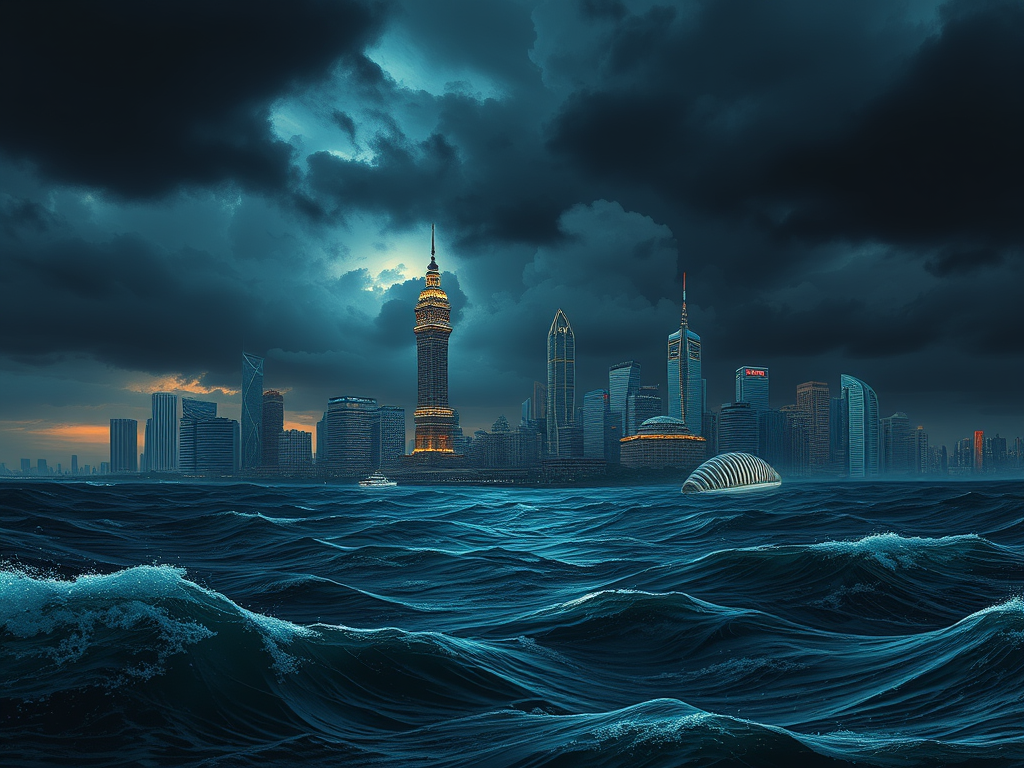
The global coastline is under threat. As sea levels rise due to melting glaciers and thermal expansion, low-lying coastal cities face existential risks. Scientific consensus from the Intergovernmental Panel on Climate Change (IPCC) indicates a potential sea-level rise of up to 2 meters by 2100 under worst-case emissions scenarios (IPCC, 2021). This would submerge entire neighborhoods, displace tens of millions, and trigger economic devastation on a global scale.
Part 1: Cities on the Brink – Asia’s Most Vulnerable Urban Areas

1. Jakarta, Indonesia
- Risk Factor: Land subsidence + sea-level rise
- Current Threat: Jakarta is sinking at a rate of 10 cm per year in some areas (NASA, 2020).
- Projected Impact by 2100:
- One-third of Jakarta could be underwater.
- Over 10 million residents affected.
- Infrastructure—including the presidential palace—faces inundation.
Why It’s Sinking:
- Excessive groundwater extraction.
- Poor urban drainage.
- Unregulated construction on swampy terrain.
Countermeasures:
- Indonesia is relocating its capital to Borneo (Nusantara) by 2045.
- The $40 billion “Giant Sea Wall” project aims to protect coastal areas but faces funding and environmental setbacks.
2. Bangkok, Thailand
- Risk Factor: Flood-prone delta city built on soft clay.
- Current Threat: Bangkok may be submerged within 50–100 years (World Bank, 2020).
- Projected Impact by 2100:
- Up to 40% of the city below sea level.
- Coastal storms could displace millions.
Why Bangkok Is Vulnerable:
- Located on the low-lying Chao Phraya River delta.
- Heavy infrastructure causes ground subsidence.
- High urban heat increases sea-level expansion.
Adaptation Efforts:
- Construction of green spaces and retention ponds.
- Proposals for elevated roads and drainage tunnels.
- New zoning laws to control groundwater usage.
3. Mumbai, India
- Risk Factor: Coastal development + monsoonal flooding.
- Current Threat: Mumbai faces annual flooding that worsens with climate variability.
- Projected Impact by 2100:
- 2.7 million people at risk of permanent inundation (Climate Central, 2021).
- Mumbai’s financial district, Bandra, and the airport may be submerged.
Vulnerability Profile:
- High-rise development on reclaimed land.
- Inadequate drainage and informal settlements in flood-prone areas.
- Seasonal high tides and storm surges compound the risk.
Current Mitigation Projects:
- Coastal Road Project (2024) to build elevated roads and seawalls.
- Stormwater drainage upgrades under the BRIMSTOWAD initiative.
4. Guangzhou, China
- Risk Factor: Rapid urbanization + low elevation.
- Current Threat: Ranked among the most economically exposed cities to sea-level rise.
- Projected Impact by 2100:
- 10 million people at risk (World Bank, 2021).
- $330 billion in infrastructure and real estate could be lost.
Urban Risk Elements:
- Built on the Pearl River Delta.
- High industrial and export concentration.
- Low resilience in older infrastructure zones.
Adaptation Strategy:
- Dikes, levees, and sea walls along vulnerable rivers.
- Smart urban planning to divert water.
- Expansion of urban green infrastructure.
5. Ho Chi Minh City, Vietnam
- Risk Factor: Deltaic city with high flood frequency.
- Current Threat: 45% of the city lies less than 1 meter above sea level.
- Projected Impact by 2100:
- Over 7 million people threatened by chronic flooding (IPCC, 2021).
- Urban growth puts more people in danger.
Major Issues:
- Urban expansion into former wetlands.
- Sea-level rise combined with Mekong Delta subsidence.
- Pollution clogs drainage systems during monsoons.
Government Measures:
- $1 billion climate adaptation package with Dutch support.
- Urban renewal projects to elevate key infrastructure.
Part 2: Coastal Collapse – Cities at Risk in Africa and the Americas

6. Lagos, Nigeria
- Risk Factor: Uncontrolled urbanization + Atlantic coastal erosion
- Current Threat: Lagos sits less than 2 meters above sea level and has experienced significant shoreline retreat.
- Projected Impact by 2100:
- Nearly 4 million people at risk of displacement (UN-Habitat, 2022).
- Victoria Island and Lekki Peninsula among the most threatened areas.
Why It’s At Risk:
- High coastal erosion rates (up to 30 meters/year in some zones).
- Poor drainage and informal housing in low-lying wetlands.
- Population growth—projected to reach 40 million by 2100—complicates urban planning.
Adaptation Strategies:
- The Eko Atlantic project is creating a new barrier city on reclaimed land.
- Seawall and revetment investments have slowed some erosion.
- Climate-smart housing and elevated structures under pilot phase.
Source: UN-Habitat. “Climate Resilience in African Cities.” 2022. https://unhabitat.org/
7. Alexandria, Egypt
- Risk Factor: Mediterranean Sea rise + delta subsidence
- Current Threat: Alexandria’s average elevation is 1.5 meters above sea level.
- Projected Impact by 2100:
- 8 million people could be affected in Alexandria and the Nile Delta (Nature Communications, 2021).
- Agriculture in the delta faces saltwater intrusion.
Critical Vulnerabilities:
- Nile Delta subsiding due to damming and reduced sediment deposits.
- Ancient historical sites like Pompey’s Pillar and the Bibliotheca Alexandrina are within flood-prone zones.
- Sea-level rise is already triggering displacement and agricultural loss.
Planned Defenses:
- Government has built concrete barriers and revetments along key sites.
- New research collaboration with EU-funded CLIMA project for sustainable urban drainage.
8. New York City, United States
- Risk Factor: Atlantic storm surge + high economic exposure
- Current Threat: Hurricane Sandy (2012) caused $19 billion in damages, revealing the city’s vulnerability.
- Projected Impact by 2100:
- 37% of NYC’s total landmass could be at risk (NOAA, 2022).
- Over 800,000 residents may face recurrent flooding.
Factors Driving Risk:
- Built on multiple islands with low-lying boroughs like Queens, Brooklyn, and Staten Island.
- Sea level around NYC is rising faster than the global average (3.2 mm/year).
- Legacy infrastructure was not designed for future climate loads.
Adaptation Investments:
- $1.45 billion East Side Coastal Resiliency (ESCR) project under construction.
- The “Big U” initiative proposes a 16-km protective system around Lower Manhattan.
- New zoning ordinances encourage climate-resilient buildings.
9. Miami, United States
- Risk Factor: Sea-level rise + limestone geology
- Current Threat: Miami experiences “sunny day flooding” multiple times a year.
- Projected Impact by 2100:
- Up to $3.5 trillion in real estate assets under threat (Union of Concerned Scientists, 2020).
- Miami-Dade County could lose 30% of its land to the ocean.
Unique Challenges:
- Porous limestone bedrock allows seawater to seep up from below, limiting the effectiveness of sea walls.
- Heavy investment in coastal property despite clear climate risk.
- Growing frequency of king tides already impacts traffic and property values.
What’s Being Done:
- Miami Forever Bond allocates $192 million for stormwater infrastructure, pump stations, and raised roads.
- Real estate developers now include climate disclosure clauses in contracts.
- Ongoing research partnerships with NOAA and FIU.
10. Rio de Janeiro, Brazil
- Risk Factor: Urban sprawl + sea-level rise + landslides
- Current Threat: More than 1 million residents live in at-risk coastal zones.
- Projected Impact by 2100:
- Copacabana and Ipanema beaches could disappear.
- Favelas near sea level may be submerged during future storm surges.
Urban Risk Overview:
- Coastal development limits retreat zones.
- Sea-level rise worsens coastal flooding and slope destabilization in hillside communities.
- Heavy rainfall events increase flood-mudslide hybrid disasters.
Action Plans:
- Coastal zoning reforms introduced by the Municipal Climate Plan (2022).
- Mangrove restoration and sandbank elevation experiments underway in Guanabara Bay.
- Collaboration with the C40 Cities network for emissions reductions and urban adaptation.
Part 3: Strategies for Survival – What Can Be Done?

Understanding the Global Cost of Inaction
The World Bank estimates that more than 800 million people live in low-lying coastal zones at risk of flooding and sea-level rise by 2100. Global economic damages from coastal flooding alone could exceed $1 trillion annually without aggressive intervention (World Bank, 2020). The cost of inaction far outweighs the investment required to protect vulnerable cities.
What Needs to Happen
To prevent the disappearance of coastal cities, comprehensive adaptation and mitigation measures must be implemented globally. Below are the key strategies:
1. Massive Infrastructure Investments
Cities must upgrade or redesign infrastructure to withstand future climate realities.
- Protective barriers: Levees, seawalls, and breakwaters, such as NYC’s East Side Coastal Resiliency project.
- Floodproof architecture: Elevating homes and constructing waterproof foundations in Miami and Ho Chi Minh City.
- Green infrastructure: Wetlands restoration and urban retention ponds in Bangkok and Lagos.
Example: The Netherlands spends over $1.25 billion annually on dike and levee maintenance. Their Delta Works program has set a global standard for flood defense.
2. Managed Retreat Policies
In many cases, defending every inch of coastline is not feasible. Some areas must be vacated to preserve life and economic stability.
- Relocation: Jakarta is moving the capital to Borneo due to subsidence and flooding.
- Zoning laws: Rio’s climate plan restricts new construction in erosion-prone zones.
- Buyout programs: FEMA has offered voluntary home buyouts in flood-prone US regions.
Challenge: Managed retreat remains politically unpopular and economically difficult for low-income populations.
3. Global Climate Financing and Equity
Developing nations like Vietnam, Nigeria, and Egypt lack the funds to implement long-term adaptation at scale.
- Green Climate Fund (GCF): Offers financing for climate adaptation in developing economies.
- International partnerships: Ho Chi Minh City works with Dutch engineers; Lagos partners with UN-Habitat.
Policy Gaps:
- Current financing commitments remain under $100 billion/year, far short of the estimated $300–$500 billion needed by 2050.
- Funding mechanisms are slow, bureaucratic, and lack enforcement.
4. Early Warning and Data Systems
Real-time monitoring and public awareness can prevent loss of life even if infrastructure fails.
- Tide gauges and satellite tracking: Used by NOAA, NASA, and regional governments.
- Urban flood maps: Cities like New York and Mumbai are investing in climate risk visualizations.
- Digital twin modeling: Guangzhou and Singapore are adopting simulation systems to plan infrastructure upgrades.
Example: The European Space Agency’s Sentinel satellites provide near-daily elevation data for coastal mapping worldwide.
5. Legal and Institutional Reform
Protecting coastal cities requires long-term planning and coordination across sectors.
- Integrated coastal zone management (ICZM): Combines environment, urban development, and disaster management under one legal framework.
- Climate-resilient building codes: Mandated in Miami and New York City post-Hurricane Sandy.
- Public-private partnerships: Encourage innovation in water-resilient construction and climate insurance.
Success Case: Rotterdam’s multifunctional flood defense system doubles as a public park and business district, funded through municipal-private cooperation.
Summary Table: The 10 Most At-Risk Coastal Cities by 2100
| City | Region | Risk Level | Primary Threats | Key Adaptation Effort |
|---|---|---|---|---|
| Jakarta | Asia | Extreme | Subsidence, sea-level rise | Capital relocation, sea wall |
| Bangkok | Asia | High | Delta floods, soft soil | Retention parks, elevated infrastructure |
| Mumbai | Asia | High | Monsoons, storm surge | Coastal road, drainage upgrades |
| Guangzhou | Asia | High | Pearl River flooding | Green infrastructure, levees |
| Ho Chi Minh City | Asia | Severe | Delta collapse, urban sprawl | Dutch collaboration, drainage |
| Lagos | Africa | Severe | Erosion, drainage failure | Eko Atlantic, green housing pilots |
| Alexandria | Africa | High | Delta subsidence, erosion | Concrete barriers, zoning reforms |
| New York City | North America | High | Surge flooding, sea level rise | Big U, zoning code overhaul |
| Miami | North America | Extreme | Sunny day flooding, porous geology | Miami Forever Bond, climate disclosure |
| Rio de Janeiro | South America | Moderate | Rain-driven flood-mudslide combo | Urban reform, mangrove restoration |
Conclusion: The Future of Coastal Cities
If nothing changes, cities like Jakarta, Miami, Lagos, and Alexandria face a future underwater. Yet the science is clear and the solutions are known. What’s missing is unified action and political will. Long-term urban survival hinges on aligning policy, finance, and technology to transform cities before the sea does.
About The Author




Good insight.
[…] 10 Coastal Cities in Danger of Disappearing by 2100 […]