
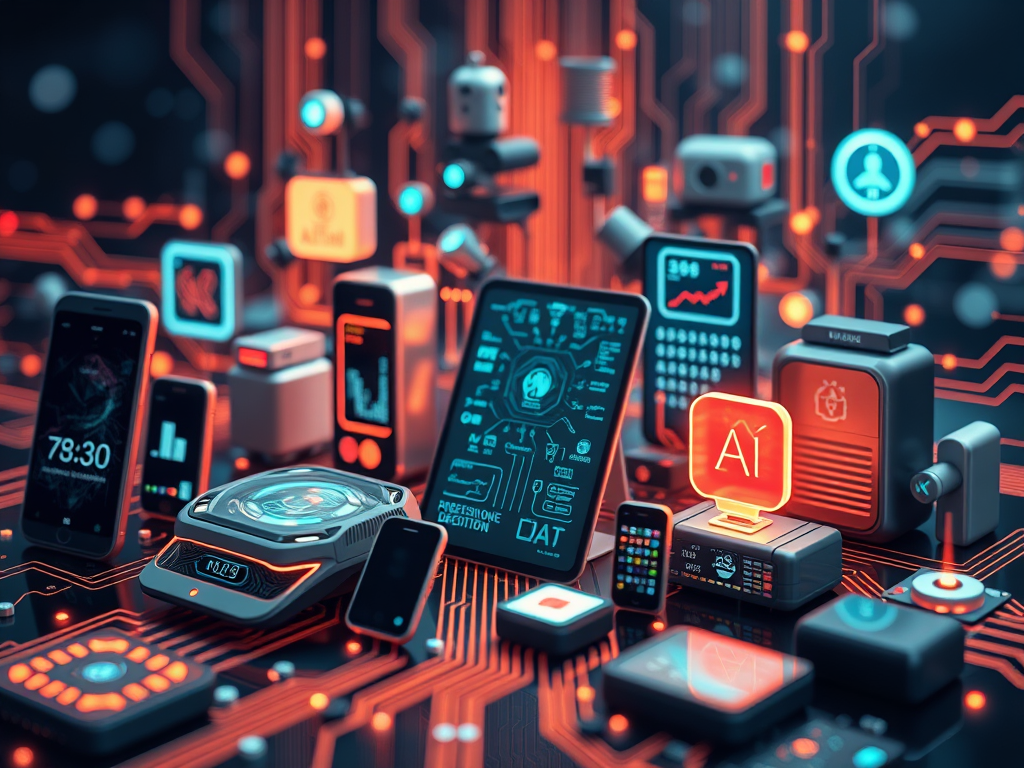
Exploring the Business, Technical, and Social Value of Edge AI Applications
“By 2025, more than 75% of enterprise-generated data will be created and processed outside a traditional centralized data center or cloud.”
— Source: IDC (https://www.idc.com)
This transition is no longer hypothetical. It’s already reshaping your home, your devices, and the global economy. At the center of this transformation lies edge AI—the most significant evolution in computing since the rise of mobile apps.
What Is Edge AI?
Edge AI refers to artificial intelligence models deployed directly on local hardware—such as smartphones, smartwatches, autonomous vehicles, drones, cameras, and industrial equipment—without constant reliance on cloud-based computing.
This change isn’t just technical. It alters how you interact with everyday devices by enabling:
- Real-time responses without internet dependency
- Local data processing for improved privacy
- More energy-efficient systems
- Resilience in remote or disconnected areas
Unlike cloud-based AI, edge AI reduces latency, protects privacy, and allows autonomous decision-making—core requirements for today’s hyperconnected environment.
Why Edge AI Applications Matter in 2025
According to Statista, global data creation will surpass 180 zettabytes by 2025.
Source: https://www.statista.com/statistics/871513/worldwide-data-created
Centralized cloud infrastructures cannot manage this volume without delays, cost surges, or serious privacy risks. Edge AI solves those problems by enabling devices to:
- Filter and process data locally
- Minimize dependency on external networks
- React faster than any cloud pipeline can allow
These advances make edge AI the foundation of innovation across consumer, enterprise, and public infrastructure sectors.
Real-World Edge AI Applications Already in Use
Edge AI is no longer emerging tech. It powers many of the devices you use daily. Below are major use cases across key industries.
1. Smartphones and Wearables
Examples: Apple iPhone, Google Pixel, Samsung Galaxy, Apple Watch, Fitbit
Core Applications:
- Facial recognition using Apple Face ID and Google Face Unlock
- Offline voice assistance with Google Assistant and Siri
- Battery optimization through AI-based behavioral prediction
- Camera enhancements through edge-based neural image processing
Apple Neural Engine handles up to 11 trillion operations per second, enabling deep learning on-device without cloud latency.
Source: https://www.apple.com/iphone-14-pro/specs/
Wearables:
- Heart rate monitoring in real time
- Fall detection and alerts
- Blood oxygen level estimation
- Sleep quality assessment
These features do not require cloud support, saving bandwidth and improving responsiveness.
2. Automotive: AI-Driven Safety and Autonomy
Examples: Tesla FSD, GM Cruise, Toyota Guardian, Ford BlueCruise
Functions Handled at the Edge:
- Pedestrian detection
- Lane-keeping assistance
- Adaptive cruise control
- Emergency braking
- Driver monitoring systems
Tesla’s Dojo supercomputer stack supports real-time edge inference across 10+ onboard neural networks.
Source: https://www.tesla.com/AI
Local processing is critical in vehicles where every millisecond can prevent an accident. The automotive edge AI market will exceed $10 billion by 2030, according to McKinsey.
3. Home Appliances and Consumer IoT
Examples: Google Nest, Amazon Echo, LG ThinQ appliances, Ring Cameras
Smart Features Enabled by Edge AI:
- Personalized thermostat settings based on behavior
- Voice recognition from multiple users
- Object and person detection via security cameras
- Spoiled food detection in smart fridges
- On-device video analytics for doorbell alerts
Nest Cam uses on-device processing to recognize familiar faces without cloud upload, improving privacy and reducing costs.
4. Retail and Commerce
Examples: Amazon Go, Walmart Smart Carts, Sephora AI mirrors
Retailers deploy edge AI for:
- Real-time inventory monitoring
- In-store shopper behavior tracking
- Queue length prediction
- Frictionless checkouts using computer vision
Amazon Go uses localized visual and sensor data to eliminate the need for checkout lines altogether. These technologies operate without constant cloud feedback, increasing reliability.
5. Healthcare and Medical Devices
Examples: Butterfly iQ+, Medtronic AI pacemakers, Fitbit ECG
On-device health monitoring includes:
- Blood glucose trend prediction
- ECG signal interpretation
- Seizure detection in wearables
- Ultrasound imaging in low-resource settings
Edge AI supports diagnostic imaging in rural areas with poor connectivity. Devices like Butterfly iQ+ allow trained healthcare workers to use portable ultrasounds powered by AI without needing cloud access.
6. Industrial IoT and Smart Factories
Examples: Siemens MindSphere, GE Predix, Schneider Electric
Capabilities:
- Predictive maintenance of equipment
- Real-time safety monitoring via edge cameras
- Quality control using machine vision
- Local anomaly detection in production lines
According to McKinsey, predictive maintenance through AI can reduce downtime by up to 50% and cut costs by 40%.
Factories can now make decisions without waiting on cloud servers, improving yields and safety.
Technologies Enabling Edge AI Applications
Edge AI’s success depends on several enabling technologies.
1. Dedicated Edge AI Hardware
These chips allow devices to run neural networks locally:
- Apple Neural Engine (ANE)
- Google Tensor
- Qualcomm Hexagon DSPs
- NVIDIA Jetson Xavier
- Intel Movidius Myriad X
These processors execute models with lower latency and power consumption than traditional CPUs or cloud setups.
2. TinyML and Model Compression
TinyML refers to running AI models on ultra-low-power microcontrollers.
- Models are often under 1MB
- Power usage is typically <1mW
- Examples: speech recognition in hearing aids, gesture control in wearables, soil monitoring in agriculture
Frameworks like TensorFlow Lite Micro and Edge Impulse support TinyML for embedded applications.
Source: https://www.tensorflow.org/lite/microcontrollers
3. Federated Learning
In federated learning, devices collaboratively train a model without sharing raw data.
- Used by Google Gboard for text prediction
- Improves personalization while preserving privacy
- Only model weights—not personal data—are transmitted
This decentralizes training and makes systems more efficient and secure.
4. Advanced Toolkits and Frameworks
Key platforms for edge AI development include:
- TensorFlow Lite
- PyTorch Mobile
- ONNX Runtime
- NVIDIA DeepStream
- OpenVINO from Intel
These tools help developers build models for deployment across diverse edge devices.
Why Edge AI Surpasses Cloud AI
Comparative Overview:
| Feature | Cloud AI | Edge AI |
|---|---|---|
| Latency | >100ms | <10ms |
| Bandwidth | High | Minimal |
| Privacy | Data must be uploaded | Stays on device |
| Resilience | Dependent on connectivity | Works offline |
| Energy Cost | High server load | Localized, lower power |
| Scalability | Constrained by backend limits | Horizontally scalable across devices |
These differences make edge AI a necessity for use cases that require real-time, private, and scalable intelligence.
Edge AI in Public Infrastructure
Governments and cities are integrating edge AI for:
- Traffic management (smart traffic lights)
- Air quality sensing
- Public safety through surveillance analytics
- Smart grid energy optimization
Example: Singapore’s smart city initiative uses edge-based traffic cameras to manage congestion dynamically without latency from cloud processing.
Impact on Global Digital Equity
The World Bank emphasizes that expanding digital capacity leads to GDP growth and social upliftment.
Source:
Edge AI allows underserved regions to access services without requiring high-speed cloud infrastructure.
Use Cases:
- Offline translators for education
- Rural diagnostics via handheld AI imaging tools
- Agriculture automation without cloud dependency
These enable progress in areas with limited internet or electricity, closing the global digital divide.
Challenges to Widespread Edge AI Adoption
Despite its benefits, edge AI adoption isn’t universal. Key barriers include:
1. Hardware Cost and Availability
- High-performance edge chips are expensive
- Manufacturers may hesitate to redesign devices
2. Fragmented Ecosystem
- No universal development standard
- Lack of cross-platform compatibility
3. AI Model Optimization
- Models must be pruned and quantized for smaller chips
- Developers need to customize for each device type
4. Security and Regulation
- Edge devices may be physically vulnerable
- Data governance laws need updates to handle decentralized AI
Strategic Business Implications
Companies deploying edge AI stand to benefit through:
1. Lower Infrastructure Costs
- Reduced reliance on cloud GPU usage
- Less data transfer, saving bandwidth
2. Faster Time to Market
- Ship features that work offline
- Reduce iteration time through real-world edge testing
3. Increased User Trust
- Privacy is a brand advantage
- Local data handling boosts transparency and compliance
What Businesses and Developers Should Do Now
1. Invest in Edge-Centric Hardware and Partnerships
- Work with OEMs integrating AI accelerators into consumer devices
2. Optimize for Edge-Specific Architectures
- Design smaller, faster, energy-efficient models
- Use pruning, quantization, and distillation techniques
3. Adopt Federated and Private AI Protocols
- Prepare for regulations like the EU AI Act and CCPA
- Build systems that don’t compromise user control
4. Test Across Variable Network Conditions
- Simulate real-world connectivity constraints
- Ensure performance in low-bandwidth or offline scenarios
Regulatory and Ethical Considerations
Governments and industry must clarify:
- Accountability: Who is responsible for AI-driven edge decisions?
- Auditability: Can actions be traced if processed entirely on-device?
- Bias Control: How to ensure fairness in decentralized learning?
Without clear answers, sectors like healthcare, defense, and mobility may hesitate to expand edge AI applications.
Conclusion: Edge AI Is the Infrastructure of the Future
Edge AI is no longer a niche concept or a stopgap between cloud computing and more advanced technologies—it is the next foundational layer of the digital ecosystem. As we enter an era defined by real-time responsiveness, data autonomy, and privacy-by-design architecture, Edge AI is poised to become the cornerstone of intelligent systems across both consumer and enterprise landscapes.
In 2025 and beyond, we will see a paradigm shift where cloud computing is no longer the default, especially for applications that demand immediacy, mobility, and decentralized intelligence. The growing pressure on bandwidth, the need for compliance with strict data protection regulations like GDPR and HIPAA, and the explosion of connected devices in smart homes, cities, and industries all signal a clear trend: centralized cloud solutions cannot scale alone. Edge AI fills this void with localized decision-making and energy-efficient, privacy-preserving computation.
Why Edge AI Is Unstoppable
- The volume of data being generated daily is astronomical—and most of it is ephemeral, valuable only in the moment. Edge AI ensures that this data can be processed at the source before it’s irrelevant.
- AI models are getting smaller and smarter, enabling even low-powered sensors and wearables to perform intelligent tasks that once required server farms.
- Investment from tech giants—including Google, Apple, NVIDIA, Qualcomm, and Microsoft—continues to pour into Edge AI chipsets and infrastructure, proving long-term commitment and innovation in the space.
- Legislation is catching up, making data localization not just a technical advantage but a legal necessity. Edge AI offers compliance-friendly alternatives in sectors like finance, healthcare, defense, and education.
Edge AI applications are now embedded in products you use daily—from smartphones that optimize photos with AI-driven filters, to vehicles that brake milliseconds faster using real-time lane detection, and home security systems that recognize familiar faces without ever connecting to the internet. These are not futuristic features. They are today’s reality—quietly running on billions of edge-enabled devices around the world.
The Strategic Imperative for Businesses
Companies that continue to rely exclusively on cloud-centric strategies are not just lagging—they’re risking obsolescence. Consumers increasingly demand faster services, better privacy, and reliability in offline or low-connectivity environments. These needs cannot be met by cloud infrastructure alone.
Building for the edge is no longer optional. It’s a strategic imperative. Enterprises that embrace this transition will:
- Ship more responsive, intelligent, and user-centric products
- Build deeper trust with customers by keeping data local and secure
- Lower operational costs by reducing reliance on expensive cloud resources
- Gain a first-mover advantage in industries that will inevitably demand on-device intelligence
The Societal Impact of Edge AI
Beyond commercial applications, Edge AI has the potential to democratize access to technology. In rural or underdeveloped areas where reliable internet is scarce, edge-enabled tools can deliver medical diagnostics, educational content, and agricultural insights—all offline. This means Edge AI can become a major equalizer, closing digital divides and fostering sustainable development.
Edge AI also contributes to environmental sustainability. By processing data locally, it reduces energy-intensive data transmission and storage, aligning with global goals for carbon neutrality and green computing.
Edge AI is the infrastructure of the future—not a transitional phase, but a permanent, mission-critical evolution in computing. Its advantages in latency, cost-efficiency, energy savings, user trust, and scalability are too powerful to ignore.
As developers, engineers, entrepreneurs, or executives, the time to act is now:
- Rethink product architectures
- Invest in edge-compatible technologies
- Embrace decentralized, privacy-first AI systems
The edge is no longer the frontier—it’s the new foundation.
Organizations that fail to pivot to this reality may find themselves outpaced, outperformed, and eventually replaced by those who did.
References
- IDC. (2021). IDC FutureScape: Worldwide IT Industry 2022 Predictions. Retrieved from https://my.idc.com/getdoc.jsp?containerId=US48312921IDC+2My IDC+2My IDC+2
- Statista. (2023). Volume of data/information created, captured, copied, and consumed worldwide from 2010 to 2025. Retrieved from https://www.statista.com/statistics/871513/worldwide-data-created
- Apple Inc. (2023). iPhone 14 Pro – Technical Specifications. Retrieved from https://support.apple.com/en-us/111849Apple Support+1Apple Support+1
- Tesla Inc. (2023). AI & Robotics. Retrieved from https://www.tesla.com/AI
- TensorFlow. (n.d.). LiteRT for Microcontrollers. Retrieved from https://www.tensorflow.org/lite/microcontrollersTensorFlow+1TensorFlow+1
- McKinsey & Company. (2022). Adopting AI at speed and scale: The 4IR push to stay competitive. Retrieved from https://www.mckinsey.com/capabilities/operations/our-insights/adopting-ai-at-speed-and-scale-the-4ir-push-to-stay-competitiveMcKinsey & Company
- The World Bank. (2021). World Development Report 2021: Data for Better Lives. Retrieved from https://wdr2021.worldbank.org/wdr2021.worldbank.org+1World Bank+1
About The Author


Informative content, really very helpfull
this is brilliantly written! would love to know more!!