

Ruling sparks nationwide protests, activists urge vaccination and sterilization over forced removal.
By Namith DP | Aug 19, 2025
Introduction
On August 11, 2025, the Supreme Court issued a sweeping order that requires authorities across Delhi–NCR to remove all stray dogs from public spaces and house them in shelters—without releasing any dog back to the streets. The Court gave a hard eight-week timeline to create shelter capacity and warned that anyone obstructing pickups would face contempt. Five days later, a three-judge Bench heard petitions to stay the directions and reserved its order; until the Court says otherwise, the August 11 directions remain in force. (Hindustan Times)
The Order—Key Directions You Need to Know

Bench and case: A two-judge Bench of Justices J.B. Pardiwala and R. Mahadevan passed interim directions in Suo Motu Writ Petition (C) No. 5 of 2025 titled “City Hounded by Strays, Kids Pay Price.”
What the Court directed (operative points):
- Immediate pickups: GNCTD, MCD, NDMC, and authorities of Noida, Ghaziabad, Gurugram, and Faridabad must “at the earliest” start rounding up stray dogs from all localities, prioritising vulnerable areas.
- No release back: Dogs detained in shelters “shall not be released back on the streets/public places” under any circumstance. The Court ordered CCTV monitoring of shelters to ensure compliance.
- Shelter infrastructure: Authorities must create shelters/pounds across NCR within eight weeks and begin with capacity for ~5,000 dogs within 6–8 weeks, scaling up as needed.
- Standards of care: Shelters must have sufficient personnel; dogs must be sterilised, dewormed, and immunised; shelters must avoid overcrowding; at least two responsible staff must be present at all times; and vulnerable dogs should be housed separately.
- Adoption with safeguards: Adoption may be allowed under the Standard Protocol for Adoption of Community Animals (17 May 2022), but any adoption must not lead to re-release on streets.
- Helpline and rapid response: Authorities must create a helpline within one week and pick up reported dogs within four hours of a complaint; obstruction will invite contempt.
- Data and reporting: Daily capture and shelter occupancy records must be maintained and submitted to the Court on the next date.
Subsequent development: On August 14, 2025, a three-judge Bench (Justices Vikram Nath, Sandeep Mehta, N.V. Anjaria) heard challenges to the order and reserved a decision on the request for a stay. The Bench also observed that local-body inaction aggravated the situation. (mint, Live Law, Supreme Court Observer)
The Legal Backdrop: PCA Act and ABC Rules, 2023
- India regulates community dog management under the Prevention of Cruelty to Animals Act, 1960 and Animal Birth Control (ABC) Rules, 2023, which supersede the 2001 Dog Rules. The 2023 Rules mandate sterilisation, immunisation, and humane handling, and place primary responsibility on local authorities to plan and execute ABC programmes. (Press Information Bureau, Animal Welfare Board)
- The August 11 order references the ABC Rules, 2023 and requires capture–sterilise–immunise inside shelters, while prohibiting release back to public places—departing from long-standing “catch–neuter–vaccinate–release” (CNVR) practice followed in many cities.
Why the Court Acted: Data That Shaped the Decision
- Bite burden: Government data show 3.7 million dog-bite cases in 2024. Reuters reported 430,000 bites in January 2025 alone nationwide. Delhi recorded 68,090 bite cases in 2024 and 35,198 animal bites in January–June 2025, per municipal data cited by media. (Reuters, The Economic Times)
- Rabies risk: News reports and government submissions referenced rising concerns over rabies exposures and vaccine availability, which the Court addressed by directing Delhi to publish stock and location details of anti-rabies vaccines. (Hindustan Times)
- Population pressure: Reuters estimated ~52.5 million stray dogs nationally, with about 1 million in Delhi alone, and only ~8 million in shelters across India—highlighting the scale gap that shelters must bridge. (Reuters)
What Changes Now—for Residents, RWAs, Feeders, and NGOs
Residents and RWAs
- Expect active pickups in your locality, starting with schools, markets, transit hubs, and other vulnerable zones. Keep bite incident evidence (photos/video, location, time) and report to the helpline once notified by your local body. The Court expects pickups within four hours of a complaint.
- RWAs should maintain a bite-incident register, share CCTV clips where relevant, and coordinate with the municipal team for access control during capture drives.
Community Feeders
- Street feeding in public spaces is no longer a pathway to keep dogs on the street in NCR. Adoption through approved protocols or volunteering inside shelters are compliant routes under the order. Prior related observations from July 2025 also asked individual feeders to avoid creating nuisance in public areas. (www.ndtv.com)
NGOs and ABC Implementers
- Align operations to shelter-based sterilisation and vaccination instead of release. Recruit or second veterinarians, para-vets, and handlers to municipal shelters to meet staffing norms. Ensure CCTV coverage, segregation of weak/vulnerable animals, and 24×7 staffing as the order requires.
- Adoption events must follow the AWBI Adoption Protocol (17 May 2022); maintain documentation to show no “adopted” animal returns to street colonies.
Implementation Feasibility: Capacity, Timelines, and Risks
Shelter capacity and throughput
- The Court directs authorities to start with capacity for ~5,000 dogs in 6–8 weeks and expand progressively. Given ~1 million dogs estimated in Delhi alone, throughput will depend on multi-site sheltering, high-volume sterilisation, and strict intake–care–adoption pipelines. (Reuters)
Staffing and logistics
- Meeting the Court’s minimum staffing expectations (two responsible personnel present at all times per shelter, plus veterinarians and handlers) will require round-the-clock rosters, procurement of capture vans and crates, and inventory of vaccines, dewormers, and surgical supplies.
Public-health safeguards
- The Court requires Delhi to publish real-time anti-rabies vaccine stock and facility locations, which can reduce post-exposure delays and improve outcomes. Municipal dashboards should integrate helpline ticketing, pickup timestamps, and bite-care referrals for audit trails.
Legal exposure
- The order threatens contempt for obstructing pickups and for any re-release of dogs. RWAs, NGOs, and individuals should update SOPs and volunteer guidance to avoid violations.
Reactions and Counter-Arguments

- Government stance: The Solicitor General supported the move, arguing that sterilisation alone has not eliminated risk, and urged swift sheltering to protect children. (Reuters)
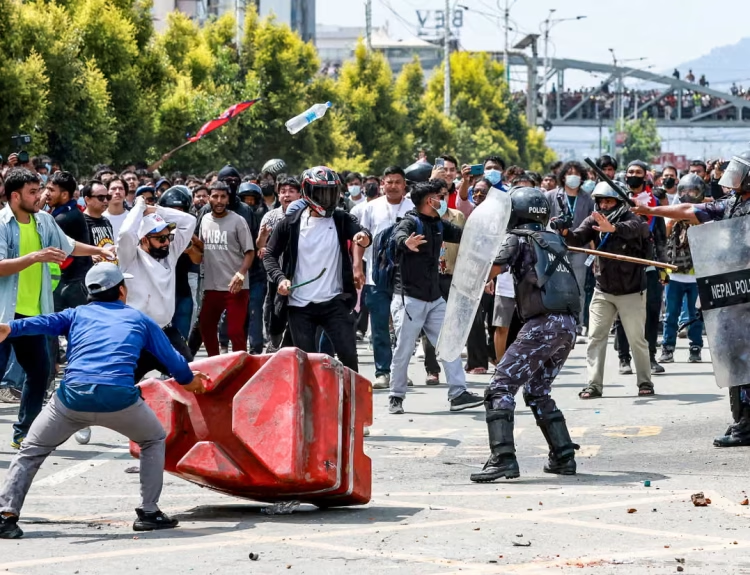
- Civil society: Animal welfare groups and conservationists question feasibility, citing capacity gaps and urging mass vaccination and targeted sterilisation as proven tools. Public protests followed in several cities, while some public figures backed the order on safety grounds. (The Times of India, The Economic Times)
- Public opinion data: A LocalCircles snapshot reported 71% support among respondents for removing stray dogs from Delhi-NCR within eight weeks, though methodology and representativeness require scrutiny. (Business Standard)
How This Interacts with ABC Rules, 2023
Under ABC Rules, 2023, local bodies must run sterilisation and immunisation programmes, form monitoring committees, and ensure animal welfare standards. The August 11 order preserves sterilisation and vaccination but shifts the locus to shelters and forbids re-release—an interpretation many experts say departs from CNVR’s “release to original location” practice embedded in guidance since 2001 and carried into the 2023 framework. Policymakers and courts will need to reconcile this divergence as the larger Bench considers the stay. (Press Information Bureau, Animal Welfare Board)
Practical Compliance Checklist (NCR)
For Municipal Authorities
- Map hotspots (schools, transit nodes, garbage points) and schedule area-wise pickups with daily targets.
- Commission modular shelters and retrofit existing facilities to meet CCTV, staffing, segregation, and veterinary care norms.
- Publish helpline number, SLA (4-hour pickup), and vaccine stock dashboards.
- Maintain daily capture logs, shelter occupancy, sterilisation/immunisation counts, and submit status reports to the Court.
For RWAs and Institutions
- Provide access and on-ground support for capture teams.
- Share CCTV footage of bite incidents when requested.
- Redirect community volunteers toward shelter-based care and adoption drives.
For NGOs and Volunteers
- Sign MoUs with municipalities to staff shelters, operate high-volume spay-neuter lines, and manage adoptions under AWBI protocol.
- Set up record-keeping to demonstrate compliance and prevent any re-release.
What Happens Next
- Status as of August 19, 2025: The August 11 directions stand. A three-judge Bench has reserved its order on pleas seeking a stay and may clarify the relationship between sheltering and the ABC regime. Stakeholders should prepare for strict implementation while tracking the next hearing and any modification. (mint, Hindustan Times)
Data Signals to Watch
- Bite trends and PEP access: Track bite incidence, time-to-PEP, and PEP stockouts across Delhi-NCR. The Court asked Delhi to publish vaccine availability and monthly treatment numbers.
- Shelter KPIs: Occupancy, staff-to-animal ratios, post-op complication rates, and adoption throughput.
- Legal developments: Any stay or modification by the three-judge Bench; transfer and consolidation of related High Court cases. (Hindustan Times)
Bottom Line
- Immediate effect: Delhi–NCR authorities must remove stray dogs from public spaces, build shelter capacity within eight weeks, sterilise and vaccinate dogs in-shelter, and prevent any re-release.
- Enforcement: Individuals or groups obstructing pickups risk contempt. Municipalities must run helplines, respond within four hours to bite complaints, and publish rabies vaccine availability.
- Next milestone: Await the reserved order on stay by the three-judge Bench; prepare operations to comply meanwhile. (mint)
Note: This article reflects the status as of August 19, 2025 (IST). Always verify any new Supreme Court orders or modifications before updating local SOPs. (Hindustan Times)
Sources and Further Reading
- Supreme Court order (full text, Aug 11, 2025) — In Re: “City Hounded by Strays, Kids Pay Price” (Suo Motu WP(C) No. 5/2025). Key directions on pickups, shelters, CCTV, helpline, and no re-release.
- Hearing update (Aug 14, 2025) — Three-judge Bench reserved order on stay; observations on local-body inaction. (mint, Supreme Court Observer)
- Reuters explainer (Aug 11, 2025) — Order details; national bite statistics; estimated stray population. (Reuters)
- ABC Rules, 2023 — Government notification and AWBI reference. (Press Information Bureau, Animal Welfare Board)
- Delhi and national data snapshots — MCD/Delhi bite and rabies figures; recent reporting on vaccine access and public sentiment. (The Economic Times, Hindustan Times, Business Standard)
See also –
About The Author




Hope a mutually beneficial conclusion can be reached soon