
A Tale of Two Classrooms
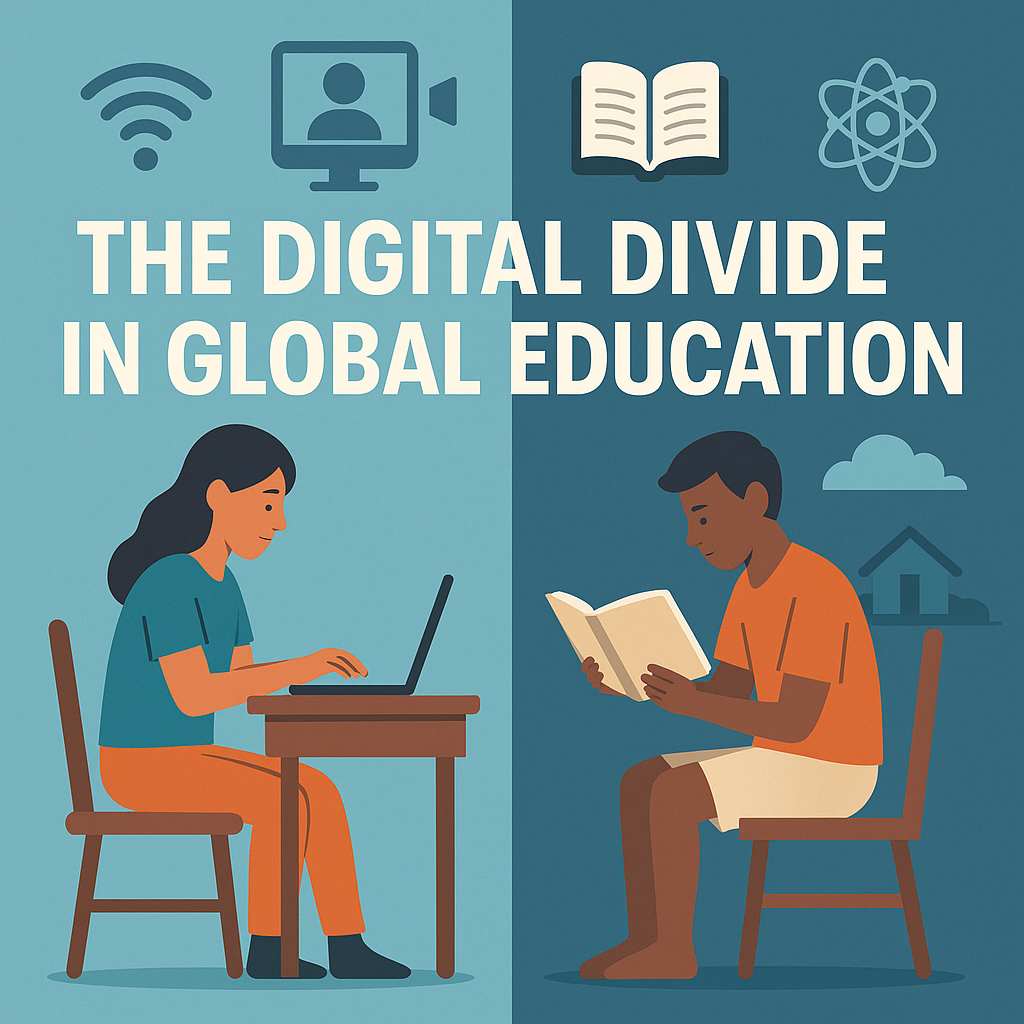
Imagine two students. One sits in a well-lit room in New York, laptop open, engaging with AI-powered educational tools, attending Zoom classes, and browsing scholarly databases. The other, in a rural village in India, walks miles to access a single community device — only to find the internet too weak to load even basic content.
This is not a fictional story — it’s the stark reality of the digital divide in education, a global chasm that is increasingly determining who thrives and who is left behind.
What is the Digital Divide?
The digital divide refers to the gap between those who have access to digital technologies and those who do not — encompassing internet connectivity, devices, digital literacy, and tech-enabled resources. In the context of education, it translates into unequal access to:
- Learning platforms and e-books
- Live or recorded lectures
- Online assignments and exams
- Virtual collaboration tools
- Career guidance and digital credentials
This divide is not just a matter of technology — it’s a divide in opportunity, equity, and the future of learning itself.
The Global Scope of Inequality

1. Infrastructure Gaps
According to UNESCO, over 50% of students globally lack internet access at home. In Sub-Saharan Africa, fewer than 1 in 5 schools have internet connectivity. Meanwhile, in many OECD countries, broadband and 1:1 device-student ratios are becoming the norm.
Case Example: During the COVID-19 pandemic, schools in the Philippines and Kenya relied on paper modules delivered weekly, while those in countries like Finland transitioned seamlessly to Zoom classes and cloud-based learning.
2. Urban vs Rural Disparities
Urban areas usually benefit from stronger digital infrastructure, while rural communities suffer from:
- Poor connectivity
- Fewer digital training programs
- Limited tech maintenance
- Low device affordability
India’s BharatNet initiative, for instance, aims to connect rural areas, but millions of rural students still face frequent dropouts and disengagement due to unreliable digital tools.
3. Gender Divide in Education Technology
Globally, women and girls are 20% less likely than men to own a smartphone or use mobile internet. Cultural norms, household priorities, and digital safety concerns prevent girls in countries like Afghanistan, Pakistan, and parts of Africa from accessing digital learning spaces.
4. Special Needs and Accessibility
Children with disabilities often lack access to assistive technologies, such as screen readers or speech-to-text tools. When online learning platforms aren’t designed with accessibility in mind, these students are effectively excluded from remote education.
Root Causes of the Digital Divide in Education
- Socioeconomic Disparities: Low-income families prioritize food and shelter over tablets or data plans.
- Lack of Government Investment: Many nations underfund digital education infrastructure.
- Cultural and Language Barriers: Many platforms are only in English or lack culturally contextual content.
- Digital Illiteracy: Teachers and students alike may lack the skills to navigate digital platforms effectively.
Consequences of the Digital Divide
1. Learning Loss and Dropouts
Students without digital access miss out on lessons, fall behind, and are more likely to drop out — especially in emergencies like COVID-19.
📉 World Bank estimates that COVID-related school closures could cause over 70% of 10-year-olds in low-income countries to be unable to read a simple story.
2. Widening Achievement Gap
Wealthier students benefit from personalized learning apps, AI tutors, and online test prep. Poorer students face patchy, outdated materials — if they get any at all.
3. Mental Health Impacts
Social isolation, frustration from lagging behind, and the stress of navigating online tools without help affect the emotional well-being of students already in vulnerable situations.
4. Long-Term Economic Inequality
Unequal digital learning leads to fewer qualifications, lower job prospects, and a perpetuation of poverty cycles — generation after generation.
Bridging the Digital Divide: Global Efforts and Innovations
1. Low-Tech Learning Models
- Radio and TV-based education (used successfully in Sierra Leone, Mexico, and Bangladesh)
- SMS-based quizzes and tutoring for feature phones
- Offline-first apps that sync content when internet is available
2. Public-Private Partnerships
- Google’s Internet Saathi trained rural women in India in digital skills.
- The GIGA initiative by UNICEF and ITU aims to connect every school in the world to the internet.
- EduTech startups are creating regionally tailored tools in multiple languages.
3. Government Interventions
- Brazil’s Connected Education Program is building infrastructure for 138,000 schools.
- South Korea introduced national digital curriculum platforms back in 2004, setting a global example.
4. Community and School-Based Solutions
- Shared community devices
- Local digital training workshops
- School-sponsored internet subsidies for families
The Role of Digital Literacy: From Access to Empowerment
Access without understanding is not empowerment.
A device in every hand means little if the mind holding it doesn’t know how to use it meaningfully. That’s why digital literacy must go hand-in-hand with digital access. It’s not enough to distribute laptops or mobile phones — we must ensure that users, from students to parents to teachers, are truly capable of navigating the digital world.
Teachers must be trained not only in using tools but in digital pedagogy — how to structure online lessons, assess student progress remotely, and use technology to foster curiosity rather than passive consumption.
Students must develop core digital skills, but also:
- Learn critical thinking to analyze the flood of online information.
- Understand cyber safety, from managing passwords to identifying misinformation and avoiding online threats.
- Grasp digital ethics to build respectful, responsible online communities.
Parents too need support. In many low-income households, caregivers are digitally illiterate or unfamiliar with the educational platforms their children are expected to use. Without their involvement, home-based learning becomes fragmented and ineffective.
One of the strongest examples comes from Uruguay, where every child receives a laptop through the national Plan Ceibal program. But the initiative goes far beyond hardware—it includes comprehensive teacher training, curriculum integration, and ongoing digital skill development. This holistic model has dramatically improved engagement, closing not just the access gap but also the participation gap.
Digital literacy is not a technical skill. It’s a human right in a digital age—the gateway to education, participation, and freedom in a connected world.
🎓 In Uruguay, every child receives a laptop through Plan Ceibal, along with teacher training, drastically improving engagement and outcomes.
The Future of Equitable Education: Redesigning from the Ground Up
The future of education is dazzling in theory. Artificial Intelligence can deliver adaptive, personalized tutoring. Virtual Reality can turn a rural classroom into a virtual museum or space lab. Blockchain promises secure credentials that follow learners anywhere.
But these innovations mean little if a student still cannot connect to the internet, cannot afford a device, or cannot understand the content displayed on a screen.
To build a truly equitable digital education system, we must:
- Rethink edtech design for low-bandwidth, offline-first environments.
- Create culturally relevant and multilingual content that reflects local identities and realities.
- Subsidize data, devices, and digital access for marginalized learners.
- Engage communities in planning and managing local digital learning solutions.
- Enshrine digital education as a right, not a privilege, through legislation and public investment.
The goal is not merely to include more people in the existing system — but to reshape the system so that it reflects the needs of every learner, regardless of geography, gender, income, or ability.
Final Thoughts: Education Without Borders
The digital divide in education is not just about bandwidth and devices. It’s about justice.
A world where some children attend AI-enhanced virtual classrooms while others share printed worksheets under a dim bulb is not just unequal — it’s unacceptable.
In the digital age, knowledge is the new currency. When access to that knowledge is uneven, we create a two-tiered society: those who build the future and those who are left behind by it.
Closing this divide is not just a technological mission. It is a moral imperative — one that requires compassion, creativity, and collective will.
If we are to believe in the power of education as the great equalizer, then we must act now to ensure it is equally available to all. That means no more borders drawn by bandwidth. No more futures limited by geography. Only then can education fulfill its promise — as a universal force for dignity, opportunity, and freedom.
References
- UNESCO. (2023). Global Education Monitoring Report. https://en.unesco.org/gem-report/
- UNICEF & ITU. (2024). GIGA Initiative. https://giga.global/
- World Bank. (2022). COVID-19 Learning Loss. https://www.worldbank.org/en/topic/education
- GSMA. (2022). Mobile Gender Gap Report. https://www.gsma.com/r/gender-gap/
- OECD. (2021). Digital Education Outlook. https://www.oecd.org/education/
About The Author


