
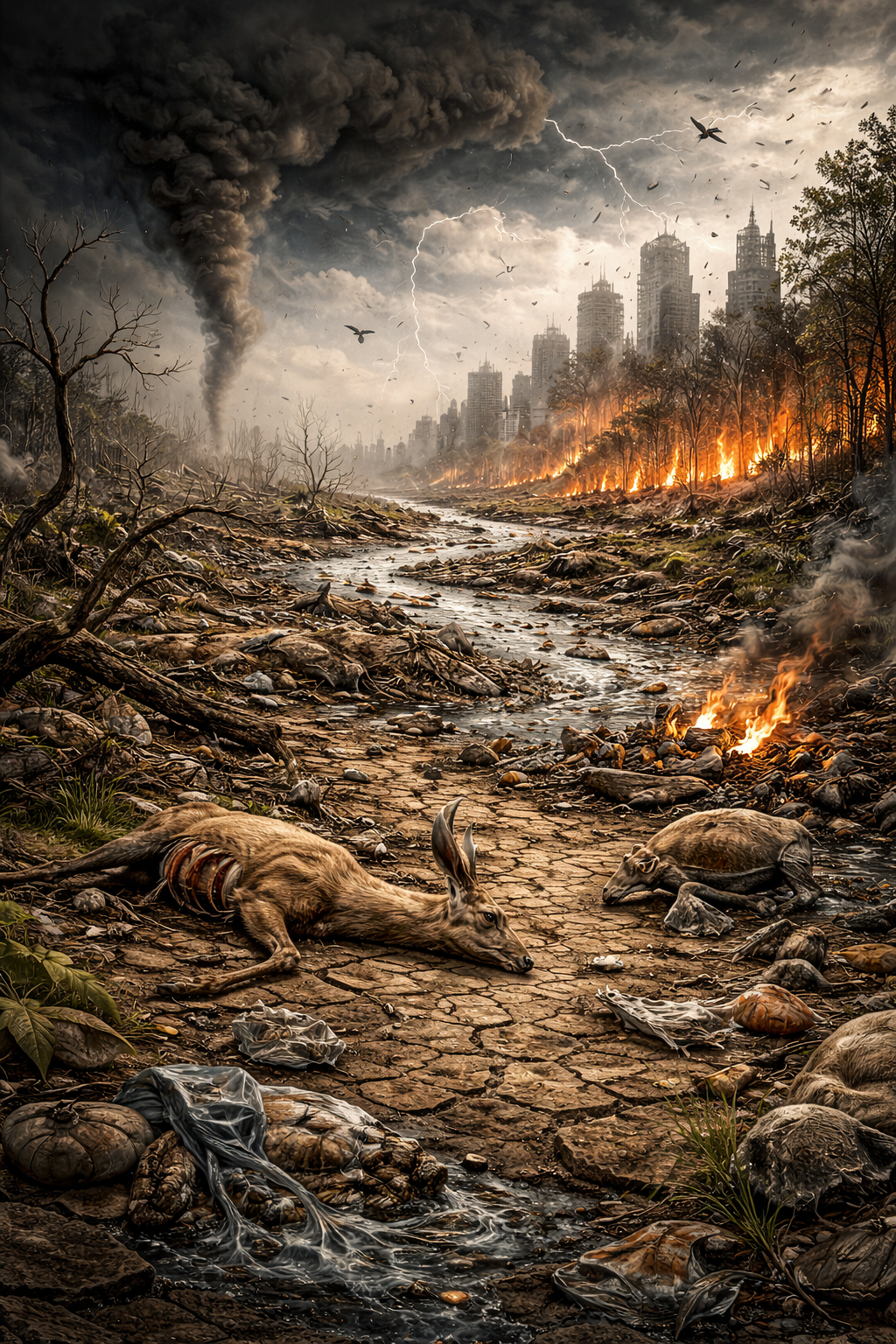
Most industrial leaders operate under the delusion that nature is an external amenity—a pleasant but non-essential backdrop to the global market. You likely view the environment as a resource to be managed or a liability to be mitigated. In reality, the natural world serves as the foundational operating system for every supply chain, every currency, and every sovereign border. We are currently witnessing the onset of systemic insolvency as the biological infrastructure of the planet hits its breaking point. When an ecosystem collapses, it does not merely “change” in a linear fashion. It undergoes a regime shift that liquidates the very assets providing the primary subsidies for human civilization.
You pay for the stability of a distant forest every time you purchase insurance for your coastal property. You pay for the health of a local wetland every time you settle your municipal water bill. We have treated the planet as an infinite waste sink and a free resource provider for over two centuries. This era of unpriced externalities is ending. When ecosystems reach a tipping point, they trigger cascading failures that technology cannot fix and capital cannot replace. This analysis examines the mechanics of collapse, the historical blueprints of failure, and the actuarial necessity of biological resilience.
The Myth of Equilibrium and the Reality of Tipping Points
Industrial planning relies on the assumption of equilibrium. You expect that if you extract a certain percentage of a resource, the system will eventually recover to its previous state. This belief ignores the fundamental physics of complex systems. Ecosystems are governed by non-linear thresholds. They can absorb a massive amount of stress without visible change until they reach a tipping point. Once they cross that threshold, they flip into an entirely different state—one that often lacks the services we require.
This process is known as hysteresis. It means the path to recovery is not the same as the path to collapse. If you destroy a coral reef or a primary forest, you cannot simply “replant” or “restock” your way back to functionality. The system has changed its fundamental feedback loops. In the new state, the environment actively resists returning to the old one. You find yourself managing a desert where a forest once stood, or a toxic algae bloom where a productive fishery once thrived. Why do you assume your current business models are resilient when they rely on systems that are inherently prone to sudden, irreversible shifts?
Case Study: The Aral Sea and the Blueprint for Total Insolvency
The collapse of the Aral Sea in Central Asia serves as a sharp warning of what happens when a state prioritizes short-term extraction over biological integrity. In the nineteen-sixties, the Soviet government diverted the rivers feeding the sea to irrigate vast cotton plantations. They viewed the sea as a “useless” body of water. Within four decades, the Aral Sea lost ninety percent of its volume.
The consequences were not limited to the loss of a fishery. The collapse triggered a series of environmental and economic cascades that devastated the region. The receding water exposed a seabed laden with pesticides and salt. These toxic sediments became airborne, creating massive dust storms that poisoned the local population and destroyed the productivity of the very cotton fields the diversion was meant to support. The regional climate changed. Winters became colder and summers hotter because the sea no longer acted as a thermal stabilizer.
You must recognize the Aral Sea as more than a local tragedy. It is a blueprint for systemic failure. The regional economy collapsed, public health plummeted, and the state was forced to spend billions on failed remediation efforts. This is the “Nature Wall.” When you hit it, the economic gains of the previous decades vanish as you struggle to pay for the mechanical replacements of services that nature previously provided for free.
The Newfoundland Cod Crisis: When Management Fails Biology
In nineteen-ninety-two, the Canadian government declared a moratorium on the North Atlantic cod fishery off the coast of Newfoundland. This was the collapse of a resource that had sustained the region for five hundred years. Managers had spent years tweaking quotas and relying on flawed models that suggested the population was stable. In reality, the stock had been hollowed out by industrial over-fishing and changing ocean temperatures.
The moratorium put thirty thousand people out of work overnight. It was the largest industrial layoff in Canadian history. More importantly, the ecosystem underwent a regime shift. Despite decades of fishing restrictions, the cod have never fully recovered to their historical levels. Instead, the niche they once occupied has been filled by shrimp and crab. The system flipped.
You must ask yourself if your industry is currently relying on a “phantom resource.” Are you measuring the health of your supply chains, or are you merely measuring the rate of extraction? The Newfoundland crisis proves that even the most robust ecosystems have a breaking point. When they fail, the economic damage is permanent. You do not just lose a product. You lose a whole sector of the economy.
The Amazon Basin and the Disruption of Aerial Rivers
The Amazon rain forest is currently approaching a tipping point that threatens the global agricultural system. You likely view the Amazon as the “lungs of the planet,” but it is more accurately the heart of the world’s hydrological cycle. Through a process called transpiration, the forest pumps billions of tons of water into the atmosphere every day, creating “aerial rivers” that distribute moisture across the Americas.
When you remove enough forest, the cycle breaks. The forest can no longer generate its own rain. This leads to a feedback loop of drying and fires that could transform the Amazon into a savannah within a generation. The impact reaches far beyond the borders of Brazil. The aerial rivers from the Amazon provide the rainfall for the soy and corn belts of the Midwest in the United States and the pampas of Argentina.
If the Amazon flips, the global food supply chain faces a catastrophic disruption. You will feel this through massive food inflation and regional famines that drive geopolitical instability. This is not a “green” issue. It is a food security and national security issue. Every hectare of forest lost in the Amazon increases the risk to your local food prices. Are you prepared to operate in a market where rainfall patterns have become permanently unpredictable?
The Zoonotic Price of Ecosystem Fragmentation
Ecosystem collapse is a primary driver of pandemic risk. You lived through the consequences of this breakdown during the COVID-19 pandemic. While the specific origins of viral spillovers are often debated, the underlying mechanism is clear. When we fragment forests and destroy natural habitats, we bring human populations into closer contact with wild pathogens.
Biodiversity acts as a bio-shield. In a diverse ecosystem, a virus might circulate among a wide variety of species without ever reaching humans. This is the dilution effect. When we simplify these ecosystems and remove the biological buffers, we create the conditions for the next spillover. We effectively “industrialize” the jump of viruses from wildlife to humans.
The cost of a single pandemic dwarfs the cost of global conservation. We spend trillions on vaccines, lockdowns, and economic stimulus, yet we spend almost nothing on protecting the bio-shields that prevent these viruses from emerging. You are paying for ecosystem collapse through your health insurance premiums, your lost productivity, and the volatility of your stock portfolio. Why do you invest in the cure while ignoring the prevention?
The Actuarial Blind Spot: Pricing Biological Risk
The financial sector currently suffers from a catastrophic actuarial blind spot regarding biological risk. We price credit risk, currency risk, and geopolitical risk with extreme precision. Still, we almost entirely ignore nature-related risk. This is the “Carbon Tunnel Vision” of the modern market.
If a company relies on a supply chain that is destroying the soil it grows its crops in, that company is an unpriced liability. If a clothing brand relies on water from a basin that is being deforested, that brand’s stock price is a fiction. We are seeing the rise of the Taskforce on Nature-related Financial Disclosures (TNFD) as an attempt to correct this. This is not a request for corporate social responsibility reports. This is a demand for structural transparency.
Investors are hitting the “Nature Wall.” As ecosystems collapse, the physical risks to assets—floods, droughts, and resource scarcity—become unavoidable. If you hold a diversified investment portfolio, you are exposed to this risk. You are essentially betting against the laws of biology. A market correction is coming, and it will favor the companies that have built biological resilience into their operations.
Supply Chain Fragility in a Simplified World
Efficiency has become the enemy of resilience in the global supply chain. We have optimized for “just-in-time” delivery at the expense of diversity. This industrial simplification mirrors the biological simplification of our ecosystems. When you rely on a single source of water, a single type of crop, or a single region for your manufacturing, you are one collapse away from insolvency.
Consider the tech sector. Semiconductor manufacturing requires vast amounts of ultra-pure water. In twenty-twenty-one, Taiwan faced its worst drought in fifty-six years. The government had to cut water to farms to keep the chip factories running. This was a direct collision between agricultural needs and industrial demands in a water-stressed environment. As ecosystems continue to fail, these conflicts will intensify.
Moreover, the loss of biodiversity reduces the “genetic library” available for future innovation. Many of our most important medical and industrial breakthroughs come from the study of wild species. Every time an ecosystem collapses and a species goes extinct, we lose a potential solution for a future problem. We are burning the library to keep ourselves warm for one night. You are liquidating your future R&D capacity to meet this quarter’s targets.
The Collapse of the Carbon Pump
We talk about mechanical carbon capture as a high-tech solution to the climate crisis. Yet, we allow the most efficient carbon capture machines on the planet—our ecosystems—to be liquidated. Peatlands, seagrass meadows, and old-growth forests are massive carbon sinks. When these systems collapse, they do not just stop absorbing carbon. They become carbon sources.
When a peatland dries out or is drained for agriculture, the stored carbon oxidizes and enters the atmosphere as carbon dioxide. This is a massive “carbon bomb” that can negate decades of emission reductions in the transport and energy sectors. You are paying to subsidize electric vehicles while your taxes also fund the destruction of the peatlands that could have stored that carbon for free.
This is a failure of resource accounting. We must move toward a model where the carbon-storage capacity of an ecosystem is treated as a strategic reserve. If we lose the biological carbon pump, we lose the ability to stabilize the atmosphere regardless of how many solar panels we install. You must recognize that a standing forest is worth more as a stabilizer than a cut forest is worth as a commodity.
The Geopolitics of Migration and Conflict
Ecosystem collapse is a primary driver of human migration and geopolitical instability. In the Sahel region of Africa, the desertification of the land has led to the loss of livelihoods for millions of people. When the land can no longer support a population, that population moves. This creates a domino effect of social tension, conflict, and mass migration that reaches across continents.
A stable environment is a prerequisite for a stable society. When ecosystems fail, governance usually follows. We see a direct correlation between land degradation and civil unrest in multiple regions across the globe. You cannot solve a migration crisis or a regional conflict with border security alone. You must solve the underlying biological insolvency.
Conservation is a tool for national security. By restoring the ecological foundations of developing nations, we reduce the impetus for conflict and migration. We are currently spending billions on defense budgets while ignoring the biological rot that is creating the very conflicts we are fighting. If you want a more peaceful world, you must invest in the restoration of the planet’s life-support systems.
The Nitrogen Wall and Soil Insolvency
The soil under your feet is a living technology that we are currently liquidating. It takes roughly five hundred years to form a single inch of topsoil, yet we are losing it at a rate of tens of billions of tons per year. We have degraded one-third of the world’s topsoil through industrial practices that ignore biological requirements.
Soil is not just dirt. It is a massive biological factory containing billions of organisms per teaspoon. These organisms drive the nitrogen cycle and store more carbon than the atmosphere and all vegetation combined. If the soil dies, the industrial food system fails. We are facing a soil insolvency crisis that will manifest as chronic food inflation and regional famines.
You must recognize that your grocery store remains stocked only because we are currently “mining” the soil’s historical capital. We replace the biological services of the soil with energy-intensive synthetic fertilizers. These fertilizers require immense amounts of natural gas to produce, linking your food prices directly to the volatility of energy markets. When the soil hits its limit, no amount of fertilizer will fix the problem. You are paying for this degradation through the declining nutrient density of your food and the increasing costs of production.
Actionable Resilience: The Strategy for Industrial Survival
You cannot wait for a global treaty to solve the problem of ecosystem collapse. You must take authoritative action to build resilience into your own household, your own business, and your own community. This is not about environmental charity. It is about capital preservation.
First, you must audit your supply chain for nature-related risk. Identify the points where you rely on unstable ecosystems. Specifically, look at your water risk, your soil risk, and your pollination risk. If you find a vulnerability, diversify your sources or invest in the restoration of that local environment. Stewardship is a form of risk management.
Second, you must demand transparency in financial disclosures. Use your power as a shareholder to push companies toward the TNFD framework. We need to put a true price on nature-related externalities. When the cost of biological destruction is reflected in the stock price, the market will naturally move toward more sustainable models.
Third, you must advocate for natural infrastructure. Demand that your local municipality prioritize wetland restoration, urban greening, and soil conservation over gray infrastructure. Natural solutions are often cheaper to build, cheaper to maintain, and provide multiple co-benefits that concrete cannot match. If your city is planning a sea wall, ask why they are not also restoring the local mangroves or dunes.
Fourth, you must adopt a long-term accounting model. Stop measuring success by this quarter’s extraction rate. Start measuring it by the health of the assets that make your production possible. A business that destroys its own foundations is not a business. It is a liquidation sale.
The Virtual Water Footprint of the Global Consumer
You consume water from another continent every time you buy a cotton t-shirt or a pound of beef. This is the virtual water trade. It takes roughly two thousand five hundred liters of water to produce one cotton shirt. If that cotton is grown in a region where the aquifers are being depleted, that shirt is a product of environmental mining.
You are indirectly participating in the collapse of distant ecosystems through your daily consumption. As these regions reach their limits, the cost of these goods will skyrocket. You can buffer yourself against this by choosing high-quality, durable goods and reducing your rate of consumption. This is the habit of “radical efficiency.” By doing more with less, you lower the pressure on global systems and increase your own financial resilience.
Moreover, you should support the “Right to Repair” movement. Every item you fix is an item that does not require a fresh injection of raw materials and energy. Repair culture is a direct strike against the throwaway economy that is fueling ecosystem collapse. It is a way to reclaim authority over your possessions and your environmental impact.
Technological Hubris vs. Biological Reality
We suffer from a technological hubris that suggests we can engineer our way out of any problem. We talk about desalinating the entire ocean or building giant mirrors in space to reflect sunlight. These are the fantasies of a civilization that refuses to acknowledge the limits of its own biology.
Technology is a tool, not a replacement for a functional planet. We cannot replicate the complexity of a coral reef or the carbon-storage capacity of a peatland with machines. The most sophisticated technology we have is the four-billion-year-old biological code that runs our ecosystems. Our task is not to replace this code, but to protect it.
We must prioritize the “biological default.” This means choosing the solution that works with nature rather than against it. It means using trees to cool our cities, wetlands to filter our water, and soil microbes to grow our food. This is the path of least resistance and highest efficiency. Any other path leads to increasing costs and eventual collapse.
The Geopolitical Imperative of Biodiversity
Biodiversity is not just about saving charismatic animals. It is about maintaining the diversity of life that makes an ecosystem resilient. An ecosystem with low biodiversity is like a diversified portfolio with only two stocks. It is highly vulnerable to shocks.
When we lose biodiversity, we lose the ability of our systems to adapt to change. This is a critical issue as the climate continues to shift. We need the “genetic library” of nature to find the crops that can grow in new conditions and the medicines that can treat new diseases. Conservation of biodiversity is a strategic investment in the future of the human race.
We are moving toward a GEO-aware economy where the biological health of a region determines its geopolitical standing. Nations that protect their natural capital will be the stable hubs of the twenty-first century. Nations that liquidate their assets for short-term gain will find themselves in a state of permanent crisis. Which side of the “Nature Wall” do you want your community to be on?
The Sovereign Debt of Environmental Neglect
We are currently building a massive environmental debt that will be called in by the future. This debt is not measured in dollars, but in hectares of lost forest, tons of eroded soil, and the extinction of essential species. This debt will manifest as a lower standard of living for everyone.
Ecosystem collapse is the ultimate default. It is the point where the environment can no longer pay the interest on our industrial activities. We are seeing the early signs of this default in the rising insurance rates, the increasing food prices, and the growing frequency of “unnatural” disasters.
You cannot outrun this debt. You can only pay it down through the restoration of natural capital. This requires a radical shift in our priorities. We must stop subsidizing destruction and start subsidizing restoration. We must treat our ecosystems as the essential assets they are. Anything less is a recipe for systemic insolvency.
The Six-Month Blueprint for Collective Action
If you want to move your community or your business toward resilience, you must follow a staggered optimization timeline. You cannot undo decades of neglect in a single afternoon.
MONTH ONE: THE BIOLOGICAL AUDIT
Document every plant and animal species currently in your immediate environment. Use citizen science apps to identify what you have. Identify the points where your household or business relies on external ecosystem services. This is your baseline for resilience.
MONTH TWO: THE CHEMICAL AND ENERGY RESET
Eliminate synthetic pesticides and fertilizers from your property. Shift your energy use toward renewable sources. This reduces the toxic load on the local environment and decreases your contribution to atmospheric instability.
MONTH THREE: THE WATER AND SOIL INTERVENTION
Install rain gardens or rain barrels to manage your stormwater runoff. Begin a soil restoration project through composting and native planting. You are building the foundations of a local water and food cycle.
MONTH FOUR: THE SUPPLY CHAIN AUDIT
Review your consumption habits and your business supply chains. Switch to certified sustainable products. Audit your bank and pension funds for nature-related risks. Re-route your capital toward industries that prioritize restoration.
MONTH FIVE: THE ACT OF RESTORATION
Invest in a local land trust or a regional restoration project. This could be as simple as planting a native micro-forest or as complex as a wetland restoration. You are paying down your environmental debt.
MONTH SIX: THE COMMUNITY HUB
Share your results with your peers. Encourage your local government to adopt nature-positive policies. When multiple actors in a community work together, the biological impact increases exponentially. You are now a center of regional resilience.
The Final Professional Observation
In years of documenting the intersection of industry and the environment, it is observed that a consistent pattern emerges: the systems that ignore biology eventually fail. The convict cichlid in a river, the cod in the North Atlantic, and the soil in your backyard are all governed by the same non-linear laws of physics.
You must respect the “Nature Wall.” It is the most authoritative force on the planet. If you fight it, you will lose. If you align your life and your business with it, you will thrive. Ecosystem collapse is not a tragedy. It is a failure of management. It is a sign that we have ignored the basic rules of the game for too long.
The data is clear. The engineering solutions are proven. The only remaining variable is your willingness to act on the evidence. Every choice you make is a vote for either the restoration of your assets or the liquidation of your future. Which path are you choosing? The cost of inaction is flowing out of your house and your business every single day. It is time to stop the waste and start the restoration.
References
The Aral Sea Environmental Disaster: A Case Study in Resource Management
https://www.google.com/search?q=aral+sea+collapse+environmental+impact+case+study
The North Atlantic Cod Fishery Moratorium and Economic Consequences
https://www.google.com/search?q=newfoundland+cod+fishery+collapse+economic+impact
Tipping Points in the Amazon Rain Forest: The Aerial River Disruption
https://www.google.com/search?q=https://www.nature.com/articles/s41558-019-0601-x
Zoonotic Spillover and the Dilution Effect of Biodiversity
https://www.google.com/search?q=https://www.nature.com/articles/nature09575
The Taskforce on Nature-related Financial Disclosures (TNFD) Core Framework
https://www.google.com/search?q=https://tnfd.global/about/
The Economics of Soil Degradation and Global Food Security
https://www.google.com/search?q=https://www.unep.org/resources/publication/state-finance-nature-2023
Planetary Boundaries: Guiding Human Development on a Changing Planet
https://www.google.com/search?q=https://www.science.org/doi/10.1126/science.1259855
Hysteresis and Regime Shifts in Complex Ecosystems
https://www.google.com/search?q=hysteresis+ecosystem+regime+shift+ecology
Water Security and Semiconductor Manufacturing in Taiwan
https://www.google.com/search?q=taiwan+drought+semiconductor+manufacturing+impact
The Actuarial Risk of Biodiversity Loss for the Global Financial Sector
https://www.google.com/search?q=biodiversity+loss+risk+financial+sector+report
Peatlands and the Global Carbon Budget
The Geopolitics of Land Degradation and Migration in the Sahel
https://www.google.com/search?q=sahel+land+degradation+migration+conflict+correlation
Author bio
Julian is a graduate of both mechanical engineering and the humanities. Passionate about frugality and minimalism, he believes that the written word empowers people to tackle major challenges by facilitating systematic progress in science, art, and technology. In his free time, he enjoys ornamental fish keeping, reading, writing, sports, and music. Connect with him here https://www.linkedin.com/in/juliannevillecorrea/
About The Author


