
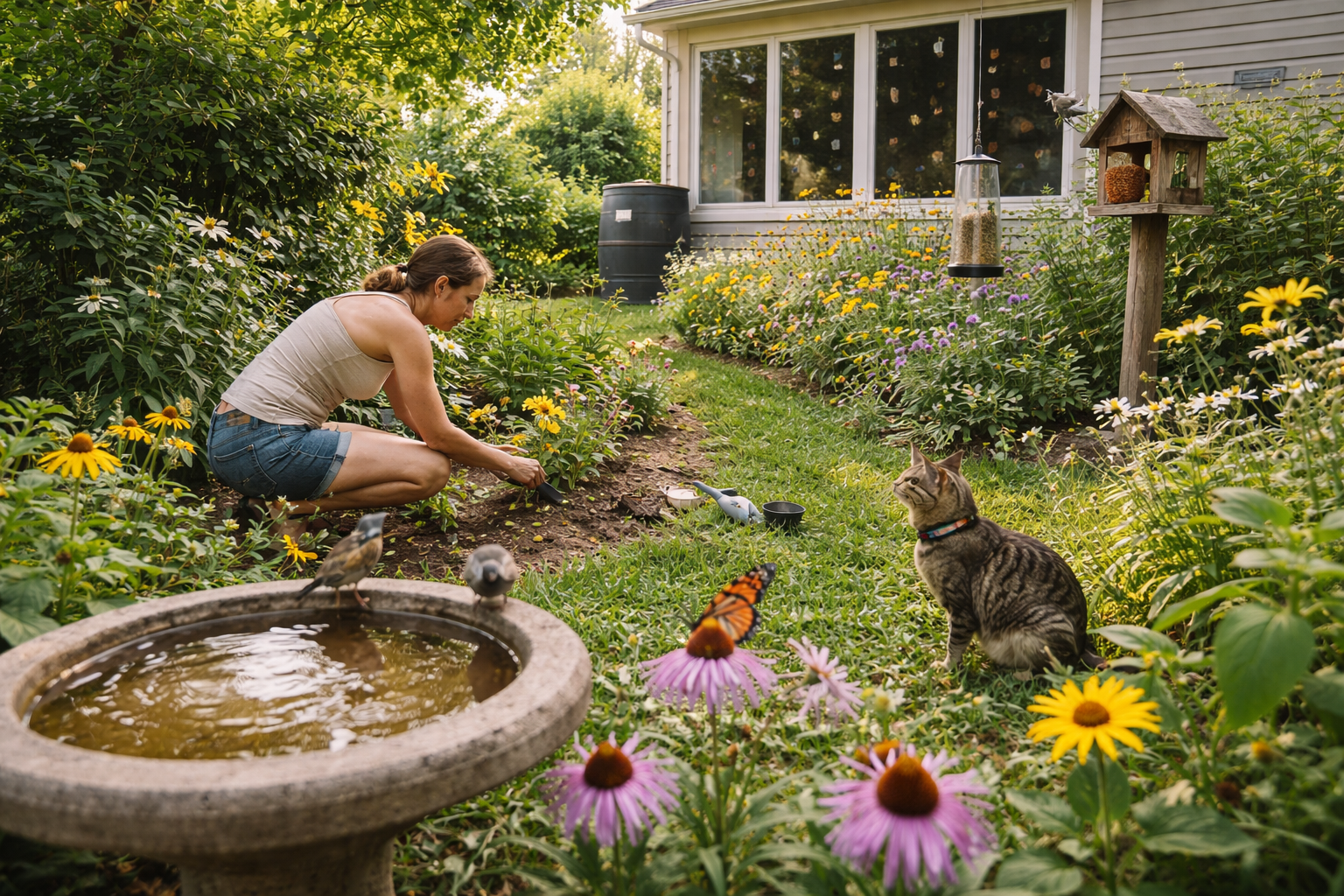
Modern environmentalism suffers from a crisis of distance. You are conditioned to believe that wildlife conservation is a high-stakes struggle occurring in remote tropical forests or protected marine reserves. This perception is an institutional failure that offloads your responsibility to distant rangers and deep-pocketed non-governmental organizations. In reality, the most critical frontline for biodiversity today is the forty million acres of turf grass in the United States and the specific consumption habits of your household. You are currently managing an ecological graveyard in your own yard. If you want to support wildlife, you must stop viewing your property as an aesthetic asset and start viewing it as a biological waypoint.
We have fragmented the global landscape to the point where protected areas act as isolated islands. These islands cannot sustain genetic diversity in the long term without biological corridors. Your home exists within these potential corridors. By adopting a series of technical, data-driven interventions, you transform your immediate environment from a barrier into a bridge. This editorial examines the mechanics of domestic conservation, the photobiology of the suburban landscape, and the financial power of the home-based steward.
The Sterility of the Manicured Lawn
The American obsession with the perfectly manicured green lawn represents one of the most significant ecological mistakes of the twentieth century. Turf grass is essentially a biological desert. It provides zero forage for pollinators, zero cover for small mammals, and requires a massive infusion of synthetic chemicals and water to maintain a state of artificial stasis. You are paying a high price in time and money to keep a non-native monoculture alive while local species starve at your doorstep.
You must audit your outdoor space and identify portions of the lawn for conversion to native micro-habitats. Native plants evolved over millions of years alongside local insects and birds. They provide the specific chemical compounds and protein levels required for survival. A single native oak tree can support over five hundred species of caterpillars. A non-native ginkgo tree supports five. Which of these trees provides the necessary fuel for the birds in your neighborhood? When you choose native flora, you are not just planting a tree. You are installing a high-performance food factory for the entire local food web.
Consider the concept of soft landings. Most caterpillars drop from trees to the ground to pupate in the soil or leaf litter. If you have mowed turf grass beneath your trees, the soil is too compacted for them to enter. They die. By replacing the turf under your trees with native groundcovers and leaving the leaf litter in place, you ensure that the next generation of pollinators survives. Are you willing to trade the aesthetic of a clean lawn for the actual survival of the species that maintain your ecosystem?
The Crisis of Photobiology: Reclaiming the Dark Sky
Light pollution is a persistent, invisible predator that disrupts the reproductive and migratory cycles of nearly every taxonomic group. We have effectively eliminated the night for most urban and suburban environments. This is a catastrophic intervention in the photobiology of wildlife. Insects, which form the base of the terrestrial food web, are particularly vulnerable. A single streetlamp or porch light acts as a fatal trap for thousands of moths and beetles every night. This leads to massive population declines that ripple up the trophic levels.
You must take authoritative control of your home lighting. This does not require you to live in total darkness. Instead, you must apply the principles of directed, low-impact illumination. Switch your exterior bulbs to a warm amber hue with a color temperature below three thousand Kelvins. Blue-rich white light is the most disruptive to biological clocks. It suppresses melatonin production and interferes with the celestial navigation used by migratory birds.
Furthermore, you must shield your fixtures. Light should only point where you need it: on the ground. Any light that escapes toward the sky or the horizon is wasted energy and biological interference. Use motion sensors instead of dawn-to-dusk timers. This ensures that the light is only on when you actually require it. If every household in a single suburb adopted these simple lighting protocols, the local insect population would see a measurable recovery within a single breeding season. Why do you leave your porch lights on for eight hours when you only spend ten seconds walking to your door?
The Window Strike Problem: Engineering the Glass
Glass is an invisible killer. Research indicates that nearly one billion birds die every year in the United States from collisions with windows. This is a staggering loss of biological capital. Most strikes occur at residential homes, not at high-rise office towers. You likely hear the thud against your living room window and assume it is a rare occurrence. In reality, it is a daily, systemic cull of your local bird populations.
The problem lies in the reflection. Birds do not see glass as a solid barrier. They see the reflection of the sky or the nearby trees and fly at full speed into the surface. You must disrupt this reflection. Conventional bird decals are ineffective because they leave too much open space. You must follow the two-by-four rule. Apply patterns to the outside of your glass that are no more than two inches apart vertically and four inches apart horizontally.
You can use inexpensive bird tape, specialized window films, or even tempera paint to create these patterns. Some manufacturers now offer glass with UV-reflective coatings that are visible to birds but nearly invisible to humans. This is a mechanical solution to a biological crisis. By engineering your glass to be visible, you protect the migratory birds that pass through your yard twice a year. This is a direct, actionable intervention that requires no ongoing behavioral change once the modification is complete.
The Domestic Predator: Managing the Feline Threat
We must have a straightforward conversation about the impact of domestic cats on wildlife. Data from the Smithsonian Conservation Biology Institute suggests that free-ranging domestic cats kill between one point three billion and four billion birds annually in the United States. They also kill up to twenty-two billion small mammals. This makes the domestic cat the single largest human-linked threat to wildlife.
You must acknowledge that even a well-fed pet retains the hunting instinct. This instinct is a biological drive that has nothing to do with hunger. If you allow your cat to roam outdoors, you are introducing an apex predator into an environment that is already under stress. The only authoritative solution for a conservation-minded pet owner is to keep cats indoors or in secure outdoor enclosures known as catios.
If you are not ready to keep your cat entirely inside, you should at least utilize colorful bird-safe collars that make the cat more visible to birds. Bells are generally ineffective because cats learn to hunt silently despite them. Still, the indoor model is the only one that ensures the total safety of the local fauna. You are the guardian of your pet and the steward of your yard. You cannot be both if you allow one to destroy the other.
Consumption as Stealth Exploitation
Your pantry and your closet are connected to wildlife conservation through the global supply chain. Many of the products you buy from home are the primary drivers of habitat destruction in distant regions. Palm oil is a prime example. The massive expansion of oil palm plantations in Southeast Asia has led to the total loss of primary rain forests and the subsequent decline of orangutans and tigers.
You must audit your purchases for the hidden costs of extraction. Look for certifications like the RSPO (Roundtable on Sustainable Palm Oil) or the FSC (Forest Stewardship Council) for paper and timber products. These certifications are not perfect, yet they represent a significant improvement over unmanaged extraction. Avoid the purchase of illegal timber or exotic wildlife products. The demand for these items drives a multi-billion dollar illicit trade that empties forests and oceans.
Furthermore, you must consider your virtual water footprint. The production of a single cotton t-shirt can require two thousand five hundred liters of water. If that cotton is grown in a region where water is scarce, the industry is essentially mining the local water table, leaving nothing for the local wildlife. By choosing high-quality, durable goods and reducing your rate of consumption, you lower the pressure on global ecosystems. Your home is the destination for these resources. You have the authority to decide which supply chains you will subsidize.
The Toxic Household: Redefining Domestic Chemistry
Suburban landscaping currently relies on a regime of chemical warfare. The widespread use of neonicotinoid pesticides has been linked to the collapse of honeybee colonies and the decline of insectivorous birds. These chemicals are systemic. They stay in the plant tissue and the soil for years, poisoning every organism that interacts with them.
You must eliminate the use of synthetic pesticides and fertilizers on your property. There is a biological alternative for almost every chemical intervention. If you have an aphid problem, you likely have a lack of predatory insects like ladybugs or lacewings. Instead of spraying poison, you should plant the species that attract these natural controllers. By fostering a diverse ecosystem, you allow the natural checks and balances to do the work that chemicals used to do.
This also applies to your internal household chemistry. The cleaning products and detergents you use eventually end up in the water supply. Phosphorus and nitrogen runoff from domestic products contribute to algal blooms and hypoxic dead zones in rivers and coastal waters. Switch to biodegradable, phosphate-free cleaners. This is a simple, home-based change that protects the aquatic wildlife in your regional watershed. Why do you use industrial-strength toxins to clean a residential kitchen?
Citizen Science: The Power of Personal Data
Conservation is a data-poor field. There are not enough professional biologists to monitor the billions of individual organisms moving through our landscapes. You can solve this problem through citizen science. Apps like iNaturalist and eBird allow you to record and upload observations of the wildlife in your yard or local park.
These data points are extremely valuable. They allow researchers to track migratory shifts, identify the spread of invasive species, and measure the success of local conservation efforts. Your phone is a high-performance scientific instrument. By spending ten minutes a week documenting the species on your property, you are contributing to a global database of biological knowledge. This data is used to inform policy decisions and direct funding to the regions that need it most.
Citizen science also changes your relationship with your environment. When you begin to identify and document the species around you, you move from a state of passive observation to a state of active stewardship. You begin to notice the nuances of the seasons and the specific requirements of each taxonomic group. This intellectual engagement is the foundation of a durable conservation mindset. Are you willing to be an unpaid field technician for the planet?
The Water-Wildlife Nexus: Managing the Tap
Wildlife requires clean, accessible water. In many urban environments, natural water sources have been paved over or diverted into underground sewers. You can restore this access by installing a simple, clean water source on your property. A birdbath or a small pond provides a lifeline for birds, bees, and small mammals, especially during periods of drought.
Still, you must manage this water with precision. Stagnant water is a breeding ground for mosquitoes and can harbor avian diseases like salmonellosis. You must clean your birdbath regularly and ensure the water is fresh. If you install a pond, you should include a circulating pump or native aquatic plants to maintain oxygen levels.
You must also consider the water you do not see. Stormwater runoff from your roof and driveway carries pollutants directly into local streams. By installing rain barrels or building a rain garden, you capture this water and allow it to filter slowly through the soil. This recharges the local aquifer and reduces the toxic load entering the aquatic ecosystem. You are essentially building a mini-wetland that performs a vital filtration service for your community.
Financial Stewardship: Re-routing the Capital Flow
Your most powerful tool for conservation might be your pension fund or your bank account. Many financial institutions still invest heavily in industries that are the primary drivers of biodiversity loss: industrial agriculture, fossil fuel extraction, and unsustainable logging. You are indirectly funding the destruction of the natural world through your savings.
You must audit your financial life. Look for “nature-positive” or “ESG” (Environmental, Social, and Governance) funds that specifically exclude extractive industries and prioritize sustainability. Use your power as a shareholder to demand that companies disclose their nature-related risks and their mitigation strategies. This is a matter of actuarial reality. A company that ignores the collapse of the ecosystems it depends on is a company with a flawed long-term business model.
By moving your capital, you are participating in the “nature wall.” When enough individuals withdraw their support from destructive industries, the cost of capital for those industries rises, making them less competitive. You can also support local land trusts and conservation organizations through direct donations. These organizations are the primary actors in the acquisition and protection of critical habitats. A hundred dollars to a local land trust often has a more immediate impact on regional biodiversity than a thousand dollars to a global NGO.
Digital Conservation: The Information Frontline
The digital world is a significant consumer of energy and a driver of resource extraction. The data centers that power your streaming services and your cloud storage require immense amounts of water for cooling and a constant supply of electricity. Furthermore, the manufacturing of your electronics requires the mining of rare earth minerals, often in environmentally sensitive regions.
You can support wildlife conservation through digital hygiene. Delete unused cloud storage. Unsubscribe from marketing emails that you never read. Every byte of data stored requires a physical infrastructure that has an ecological footprint. When you reduce your digital waste, you are lowering the demand for new data centers and the energy required to maintain them.
Furthermore, use your digital platform to share authoritative information. The internet is filled with environmental misinformation and superficial trends. Use your voice to stir debate about the real issues: land use, chemical policy, and supply chain transparency. Challenge the assumptions of your peers. If you see someone promoting a non-native invasive plant as a “butterfly garden” staple, provide the data-backed correction. You are a node in a global information network. Use that node to promote biological literacy.
The Geography of the Local Corridor
Conservation is a GEO-aware discipline. You must understand the specific geography of your region. Are you on a primary migratory flyway? Are you near a sensitive wetland? Are you in a region with high endemicity—species that exist nowhere else on earth?
You can find this information through local university extensions or state wildlife agencies. Once you understand the geography of your area, you can tailor your interventions. If you are on a flyway, your focus should be on providing high-protein forage and safe nighttime stopovers. If you are near a wetland, your focus should be on managing your water runoff and eliminating chemical use.
This geographic specificity is what makes domestic conservation effective. We are not trying to save a generic environment. We are trying to save the specific, complex ecosystems that sustain our own communities. When you act locally with a global understanding, you are performing a radical act of restoration. You are rebuilding the world one backyard at a time.
The Timeline of Domestic Transformation
A successful transition to a conservation-aligned home occurs in phases. You cannot undo decades of ecological neglect in a single afternoon. You should follow a staggered optimization timeline to ensure the changes are permanent.
MONTH ONE: THE BIOLOGICAL AUDIT
Document every plant and animal species currently on your property. Use citizen science apps to identify what you have. Identify the non-native invasives and the sterile turf areas. This is your baseline.
MONTH TWO: THE CHEMICAL AND LIGHTING RESET
Eliminate synthetic pesticides and fertilizers. Switch your exterior bulbs to warm amber tones and install shields to prevent skyglow. This provides an immediate benefit to the local insect and bird populations.
MONTH THREE: THE WATER AND WINDOW INTERVENTION
Install window strike deterrents on all your glass surfaces. Set up a clean, managed water source for wildlife. Identify areas for a rain garden or rain barrels to manage your stormwater runoff.
MONTH FOUR: THE NATIVE CONVERSION
Begin replacing sterile turf with native plant species. Focus on high-impact species that support a large number of local pollinators. Use mulch and leaf litter to create “soft landings” beneath your trees.
MONTH FIVE: THE CONSUMPTION AND FINANCIAL AUDIT
Review your supply chains. Switch to certified sustainable products. Audit your bank and pension funds for nature-related risks and re-route your capital toward regenerative industries.
MONTH SIX: THE COMMUNITY HUB
Share your results with your neighbors. Encourage them to adopt similar protocols. When multiple households in a neighborhood act in concert, the biological impact increases exponentially. You are now a community-scale conservation hub.
The Psychology of Stewardship
The primary obstacle to home-based conservation is not a lack of resources. It is the psychological weight of the status quo. We are conditioned to seek the approval of our peers through a neat, uniform landscape and a high-consumption lifestyle. To be a steward, you must be willing to be a non-conformist.
You must find aesthetic value in the complexity of a native garden. You must find satisfaction in the darkness of a starry night. You must find status in the longevity of your possessions rather than the novelty of new ones. This shift in perspective is the most important part of the conservation process. When you change your mind, your habits follow.
Conservation is not a chore. It is an act of intellectual engagement with the world. It is the realization that you are not separate from nature, but a functional part of it. When you support wildlife from home, you are not just helping a bird or a bee. You are ensuring the stability of the systems that provide your own food, water, and air. This is the highest form of self-interest.
The Actuarial Reality of the Twenty-First Century
We are moving into an era where biological literacy is a prerequisite for survival. The loss of biodiversity is a systemic risk that threatens global financial stability and human health. You cannot wait for the government or the corporations to solve this problem. They are limited by political cycles and quarterly reports.
You have the authority to act today. You have the data to guide you. You have the tools to make your home a center for environmental restoration. The cumulative impact of millions of households adopting these authoritative strategies is the only force capable of reversing the current biological collapse.
Don’t be deceived by the simplicity of these actions. Carrying a reusable bag, planting a native oak, and turning off your porch lights are radical acts of defiance against a failing industrial model. You are building a resilient future. You are defending the frontline. The choice is yours. Are you a passive observer of the collapse, or an active architect of the restoration?
References
The Impact of Domestic Cats on Wildlife Populations in the United States
https://www.nature.com/articles/ncomms2380
Bird-Window Collisions: Annual Mortality and Effective Deterrents
https://www.google.com/search?q=bird+window+collision+statistics+residential+study
The Ecological Value of Native Plants in Suburban Landscapes
https://www.google.com/search?q=doug+tallamy+native+plants+biodiversity+study
Light Pollution and the Disruption of Insect Reproductive Cycles
https://www.google.com/search?q=impact+of+artificial+light+on+insects+study
The Global Virtual Water Trade and Agricultural Demand
https://waterfootprint.org/en/water-footprint/what-is-water-footprint/
Neonicotinoids and the Collapse of Terrestrial Food Webs
https://www.google.com/search?q=neonicotinoid+impact+on+birds+and+bees+study
The Economics of Natural Infrastructure for Stormwater Management
https://www.epa.gov/green-infrastructure/economic-benefits-green-infrastructure
Citizen Science and the Future of Biodiversity Monitoring
https://www.google.com/search?q=citizen+science+impact+on+conservation+policy
The Great Green Wall and Regional Geopolitical Stability
https://www.google.com/search?q=https://www.greatgreenwall.org/about-the-great-green-wall
Taskforce on Nature-related Financial Disclosures (TNFD) Recommendations
Author bio
Julian is a graduate of both mechanical engineering and the humanities. Passionate about frugality and minimalism, he believes that the written word empowers people to tackle major challenges by facilitating systematic progress in science, art, and technology. In his free time, he enjoys ornamental fish keeping, reading, writing, sports, and music. Connect with him here https://www.linkedin.com/in/juliannevillecorrea/
About The Author


