
Portugal declares national mourning, formal investigation begins.
By Namith DP | Sept 04, 2025
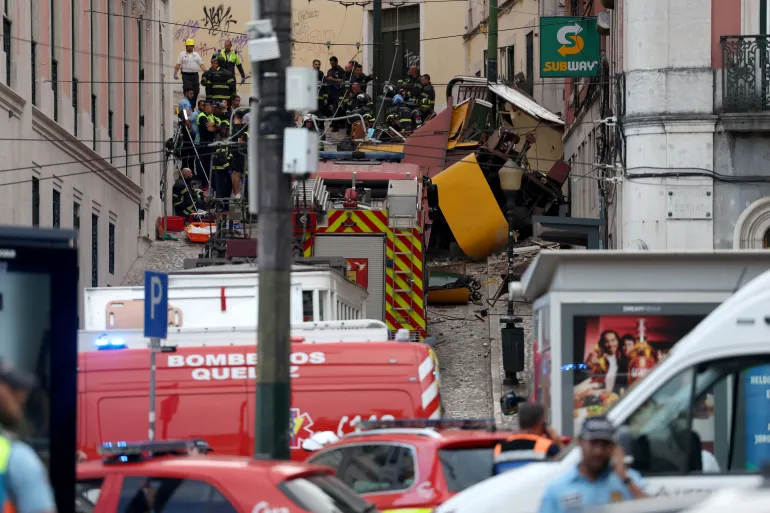
At 6:05 PM on Wednesday evening, September 3, 2025, the screech of metal against metal pierced through Lisbon’s bustling evening rush hour as the iconic yellow carriages of the Gloria funicular lost control and derailed, killing at least 15 people and injuring 18 others in what marks the deadliest public transportation accident in Portugal’s capital in decades.
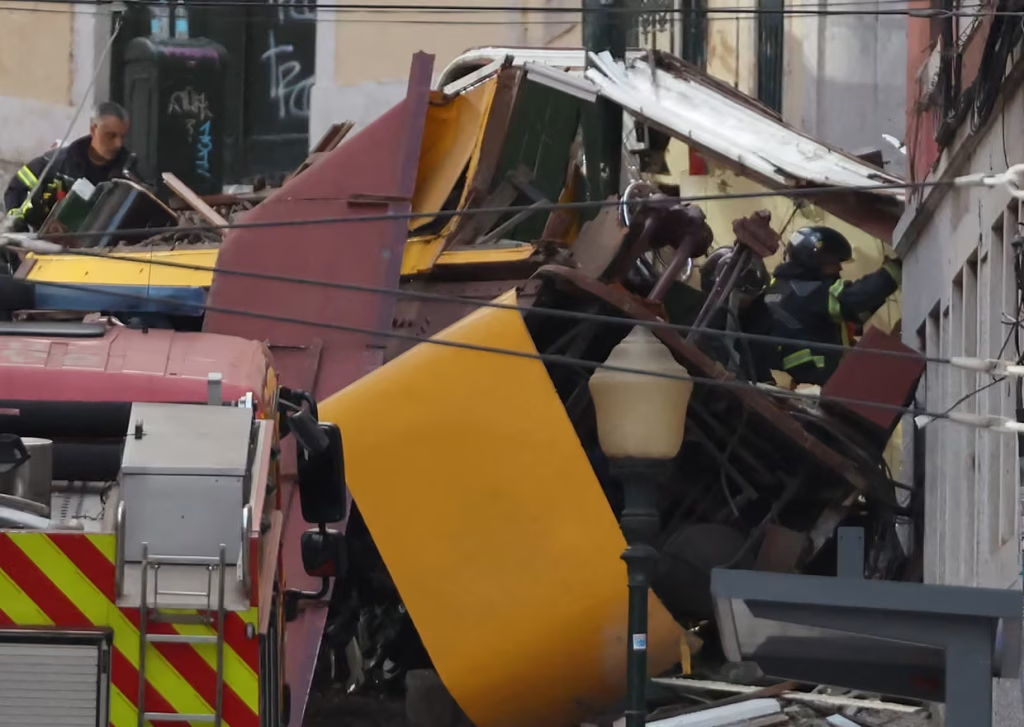
The Ascensor da Glória, a beloved funicular railway that has connected Lisbon’s Praça dos Restauradores with the Bairro Alto district since 1885, became the site of unprecedented tragedy when its distinctive yellow carriages crashed into a neighboring building after derailing on its steep 140-year-old track.
Emergency Response and Casualty Details

Immediate Response Operations
Emergency crews deployed rapidly to the accident scene, mobilizing 62 rescuers and 22 support vehicles to extract survivors trapped in the twisted wreckage. The rescue operation demonstrated the coordinated efficiency of Portugal’s emergency services under extreme pressure.
All victims were successfully extracted from the wreckage within just over two hours, with the last patient transported to local hospitals by 8:30 PM local time. Emergency responders worked methodically through the evening to clear the crash site.
Casualty Statistics and Medical Response
Current casualty reports vary among official sources, highlighting the ongoing nature of the emergency response:
• NBC News reports 15 fatalities and 18 injured individuals
• ABC News confirms 15 deaths with 23 injured, including five in serious condition
• TIME Magazine cites 17 confirmed deaths and 21 injuries, including a three-year-old child
Among the victims were foreign nationals, reflecting the funicular’s popularity with international tourists visiting Lisbon’s historic neighborhoods. Local hospitals activated emergency protocols to handle the influx of trauma patients.
Technical Analysis of the Accident
Preliminary Investigation Findings
The Lisbon Firefighters Regiment reported that a cable detached along the funicular line, causing the railway car to lose control and crash into a neighboring building. This mechanical failure represents a catastrophic breakdown of the funicular’s primary safety systems.
Investigators believe the crash resulted from a malfunction in the overhead cable system, which stripped the funicular of its ability to maintain controlled movement along the steep incline. The cable system serves as both the propulsion mechanism and primary braking system for funicular railways.
Historical Safety Record
The funicular has operated since 1885 without experiencing any accident of this magnitude, according to local testimony from regular passengers who have used the railway for decades. This unblemished safety record makes Wednesday’s catastrophe particularly shocking for Lisbon residents.
The Gloria funicular represents one of Lisbon’s three historic funicular railways, engineered during the late 19th century to navigate the city’s challenging topography. These railways use a counterbalance system where two cars are connected by a cable running over a pulley at the summit.
Operational Impact and Safety Measures
System-Wide Shutdown
Lisbon’s City Council immediately shut down operations of all other streetcars and ordered immediate inspections of the city’s public transportation infrastructure. This precautionary measure affects thousands of daily commuters who rely on Lisbon’s historic tram network.
The shutdown encompasses: • All three funicular railways (Gloria, Bica, and Lavra) • Historic tram lines throughout the city center • Cable-operated transportation systems pending safety verification
Investigation Protocols
Carris, Lisbon’s public transportation company, opened an immediate investigation alongside municipal authorities to determine the precise cause of the accident. The investigation will examine mechanical systems, maintenance records, and operational procedures.
Authorities have stated that the investigation into the causes will begin once the rescue operation concludes, ensuring that emergency response takes priority over evidence gathering.
Economic and Tourism Implications
Tourist Industry Impact
The Gloria funicular serves as a critical link between Lisbon’s lower commercial district and the trendy Bairro Alto neighborhood, transporting approximately 2.5 million passengers annually. The accident strikes at the heart of Lisbon’s tourism infrastructure during peak season.
Tourism officials face immediate challenges: • Rerouting visitor access to Bairro Alto’s restaurants and nightlife • Managing international media coverage of the accident • Reassuring travelers about broader transportation safety
Transportation Network Disruption
The citywide shutdown of historic transportation systems creates significant operational challenges for Lisbon’s 547,000 residents and millions of annual visitors. Alternative transportation routes must accommodate displaced passenger volume while inspections proceed.
Government Response and National Mourning
Portugal’s government declared national mourning following the tragedy, reflecting the accident’s profound impact on the nation’s collective consciousness. The designation of national mourning demonstrates the government’s recognition of the tragedy’s significance.
Portuguese leaders offered official condolences to the families of victims and survivors, while emergency services continue providing support to affected individuals and their families.
Safety Engineering Analysis
Funicular Railway Mechanics
Funicular railways operate through a cable system that connects two cars, allowing one to ascend while the other descends. The system relies on: • Steel cables with multiple safety redundancies • Automatic braking systems activated by cable tension loss • Track-mounted safety switches and sensors • Regular mechanical inspections and maintenance protocols
Maintenance and Oversight
SITRA, a transportation workers’ trade union, confirmed that one of its members died in the accident, highlighting the human cost beyond passengers and tourists. Union involvement suggests potential labor and maintenance issues may factor into the investigation.
Historic transportation systems require specialized maintenance expertise and replacement parts that may be difficult to source. The 140-year operational history of the Gloria funicular presents unique engineering challenges for contemporary safety standards.
Looking Forward: Transportation Safety Reform
The Lisbon funicular accident will likely trigger comprehensive reviews of Portugal’s historic transportation infrastructure. Similar cable-operated systems worldwide will examine their own safety protocols in response to this tragedy.
Key areas for potential reform include: • Enhanced cable inspection frequencies and technologies • Upgraded emergency braking systems for heritage railways • Improved passenger evacuation procedures • Real-time monitoring systems for mechanical components
The investigation’s findings will provide crucial data for transportation engineers and safety regulators managing historic railway systems in urban environments globally.
Regulatory Response and Future Oversight
Portugal’s National Authority for Railway Safety (AMF) announced plans for comprehensive audits of all heritage transportation systems operating in Portuguese cities. This review will examine maintenance protocols, safety equipment standards, and operator training requirements.
The European Railway Agency has indicated it will monitor the investigation’s findings to determine whether additional safety directives are necessary for heritage funicular systems across the European Union. Current regulations focus primarily on modern high-speed rail systems rather than historic urban transportation.
Technology Integration Opportunities
Modern funicular systems incorporate advanced safety technologies unavailable during the Gloria system’s original construction: • Digital load monitoring systems providing real-time cable tension data • GPS-based position tracking for precise location monitoring • Automated emergency braking systems with multiple redundant triggers • Passenger communication systems enabling direct contact with operators
Retrofitting historic systems with contemporary safety technology presents engineering challenges but could significantly reduce accident risks while preserving cultural heritage value.
Memorial and Community Impact
Lisbon Mayor Carlos Moedas announced plans for a memorial to honor the victims of the accident, while city officials work with families to provide counseling and financial support. The tragedy has united the city in mourning while raising important questions about balancing historic preservation with modern safety requirements.
Local community groups have organized vigils at the accident site, where residents leave flowers and messages for the victims. The outpouring of support demonstrates the deep emotional connection between Lisbon residents and their historic transportation network.
As police and emergency personnel cleared the crash site by 9:00 PM local time, the investigation into this devastating accident began in earnest, marking the start of what promises to be a thorough examination of one of Lisbon’s most tragic transportation disasters.
The Gloria funicular’s yellow carriages, once symbols of Lisbon’s charm and engineering heritage, now serve as stark reminders of the critical importance of transportation safety in preserving both human life and cultural legacy. The lessons learned from this tragedy will shape the future of heritage transportation systems not only in Portugal but throughout Europe and beyond.
See also –
About The Author




May all those who lost their lives in this tragedy rest in peace