

Trump says move will bring down crime rate, criticized.
By Namith DP | Aug 13, 2025
Introduction
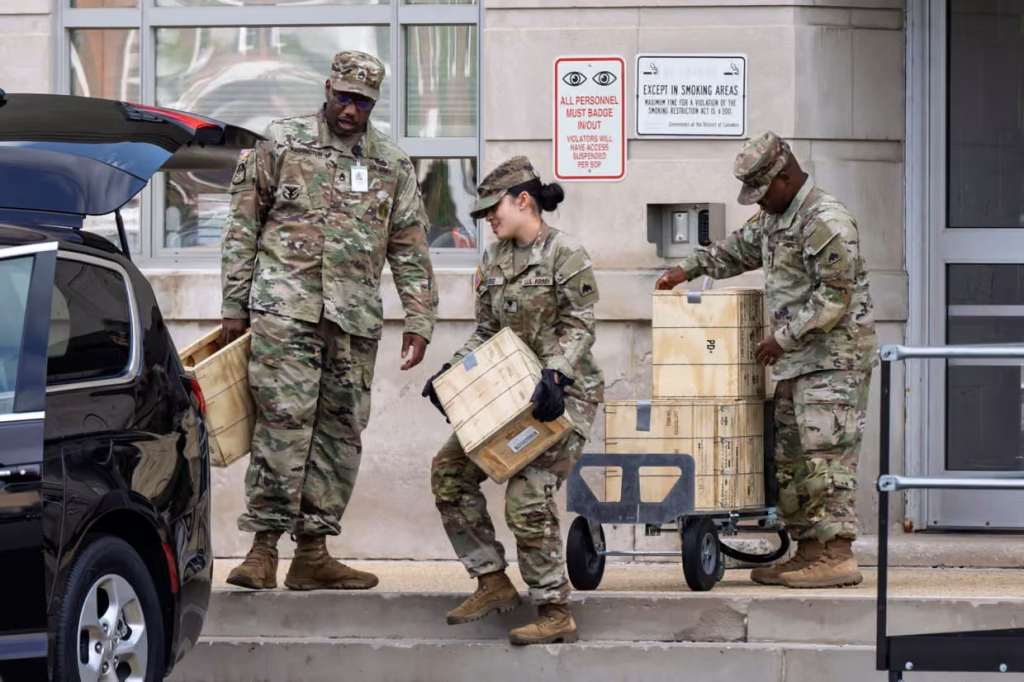
On August 11–12, 2025, the White House initiated a significant security operation in the nation’s capital. The executive branch deployed roughly 800 personnel from the District of Columbia National Guard and assumed temporary control of the Metropolitan Police Department (MPD) under a provision of the Home Rule Act. The official justification frames this as a public-safety emergency response. At the same time, crime data reveal that violent crime in Washington, DC declined 35% in 2024, followed by an additional 26% drop through July 2025 relative to 2023. The legal authority enabling this action is unique to DC and far broader than in any U.S. state.
1. The Announcement: Detailed Facts

- Scope of deployment: The President activated approximately 800 D.C. National Guard personnel under Title 32 status, placing them under federal funding while maintaining militia status. Officials described a rotating deployment of 100–200 personnel at any single time to support law enforcement operations. Sources include Reuters and CBS News.
- Police authority shift: The President invoked Section 740 of the Home Rule Act, enabling temporary assumption of MPD leadership for up to 30 days, with mandatory congressional notification. This move empowers federal direction of MPD operations.
- Federal surge: Multiple federal law enforcement agencies—FBI, U.S. Marshals Service, ATF, DHS components—launched coordinated operations. In the first days, authorities made 23 arrests and seized firearms, according to official White House statements cited in CBS News.
- Crime data: Crime statistics show a 35% drop in violent crime across 2024, following a spike in 2023. The trend continued with another 26% reduction through July 2025 compared to the same year-to-date window in 2023. Reuters reported these figures based on city and federal data.
2. Legal Authority: Why DC Differs from States
A. Presidential Control of DC Guard
In all 50 states, governors command National Guard units unless federalized. In contrast:
- In DC, the President serves as commander-in-chief of the D.C. National Guard even when it operates in militia (non-federalized) status. That distinction allows a direct timeline and fewer procedural barriers to activation.
B. Statutory Framework
Three statutes form the legal foundation:
- D.C. Code § 49-103: Authorizes Guard use for law enforcement support during tumult, riot, mob, or threatened disturbance, upon request from specified officials (e.g., Mayor, U.S. Marshal).
- D.C. Code § 49-102: Sets general roles for the Guard, often interpreted to include “other duties” and giving flexibility for civilian support tasks beyond training and ceremonial functions.
- Title 32 (32 U.S.C. § 502(f)): Enables Guard members to operate under federal funding while retaining militia status. In Title 32 status, the Posse Comitatus Act restrictions on federal troops do not apply to Guard personnel.
- Home Rule Act § 740: Allows the President to direct the Mayor to provide MPD services for federal purposes for up to 30 days under conditions of emergency. Legal scholars consider this statute a powerful tool for executive control.
C. Summary of Legal Impact
- The combination of D.C. Code §§ 49-102 and 49-103, Title 32 funding status, and the Home Rule Act grants the President exceptional authority in DC.
- Lawfare.org describes these provisions as “broad and long-standing,” with limited short-term checks or oversight.
3. What Guard Troops Can and Cannot Do
Authorized Roles (Based on CBS News and legal interpretation)
- Guard personnel may support law enforcement through:
- Perimeter security around federal buildings.
- Operational checkpoints, especially near targets of enforcement.
- Logistical support—transporting equipment, fencing, managing operational staging.
- Crowd control assistance in coordination with law enforcement presence.
- Presence deterrence, using visible staffing at critical nodes.
- Title 32 status allows some powers of temporary detention or interdiction, but only while handing over suspects to sworn law enforcement officers.
Activities Not Permitted for Guard Personnel
- Guard members cannot perform:
- Independent investigations or detective work.
- Routine neighborhood patrols without law enforcement collaboration.
- Long-term detention or case processing responsibilities.
These limitations aim to maintain civilian law enforcement prerogatives while extending capacity.
4. Official Statements: What Leaders Are Saying
White House / Federal Officials
- The administration emphasizes that the mission aims to support law enforcement operations and enhance safety through logistical and operational presence.
- The Department of the Army confirms that 100–200 personnel will be active at a time.
District Leadership
- Mayor Muriel Bowser described the action as “unsettling.” She emphasized declining crime rates, questioned the necessity of federal takeover, and said she will continue coordination during the period.
- The DC Attorney General flagged review and potential legal challenges, citing concerns about precedent and statutory interpretation.
5. Crime Trends Versus Policy Rationale
Crime Trends
- After a spike in 2023, violent crimes in DC dropped:
- 35% in 2024.
- 26% through January–July 2025 compared to the same period in 2023.
Policy Rationale
- The White House cites rising public safety threats linked to weapons, encampments, and vehicle infractions.
- Independent analysis points out that the timing of the deployment does not align directly with crime statistics. The action appears to raise broader questions of federal authority over local governance.
Reconciling Data and Decision
Authorities may rely on qualitative incidents—such as weapons seizures or enforcement backlogs—rather than headline crime figures. The Home Rule Act allows action under “emergency conditions,” even amid improving statistics.
6. Oversight, Duration, and Extension Risk
Duration Parameters
- MPD remains under federal direction for up to 30 days under the Home Rule Act.
- Guard deployment stays active until the President certifies that safe conditions have returned. No fixed timeline beyond 30 days exists.
Oversight Mechanisms
- Law requires notification to congressional leadership within 48 hours of assuming control.
- Legal experts at Lawfare warn of limited transparency at initiation, potentially curbing oversight of rules of engagement.
Extension Risks
- The President has indicated the possibility of replicating similar actions in other cities, triggering legislative and legal debate.
- A court challenge over a proposed Los Angeles deployment is already underway.
7. Impact on Residents, Businesses, and Community Groups
Operational Implications
- Increased federal presence in neighborhoods, federal building zones, and high-traffic corridors.
- Traffic control and road closures around enforcement areas. Drivers, pedestrians, and cyclists may face periodic restrictions.
- Law enforcement emphasis on firearms, outstanding warrants, reckless driving, weapon possession, and public order violations.
- Clearing of encampments on federal land, depending on agency priorities and resource availability.
What Citizens and Stakeholders Should Do
- Monitor MPD and DC Homeland Security & Emergency Management Agency alerts for operation notices.
- Businesses near federal properties should confirm access protocols and delivery schedules.
- Community organizations should proactively coordinate with local law enforcement liaison officers on planned events.
- Individuals with open legal matters (unresolved warrants, citations) may face heightened exposure; legal counsel should stay informed.
8. Legal and Policy Questions to Monitor
- Chain of command clarity: Will MPD, federal agencies, and Guard units clearly understand who controls operations on the ground? Formal agreements or memoranda of understanding could improve coordination.
- Activation basis: Did the administration act based on a specific request under D.C. Code § 49-103, or rely solely on Title 32 or Home Rule Act authority? Public confirmation could clarify statutory pathways.
- Use-of-force protocols: Defense officials noted that Guard members will receive de-escalation and use-of-force training. Transparency on these rules, including after-action reviews, will matter for civil rights oversight.
- Operational metrics: Data on arrests, firearms recovered, citations issued, and location-specific enforcement outcomes will gauge effectiveness.
- Judicial review: The DC Attorney General’s statement suggests possible lawsuits challenging the legality of federal takeover under the Home Rule Act or Staple Code provisions.
9. Historical Precedent: What Came Before
Past Deployments of DC Guard
- 2020 protests: Title 32 activations occurred after the murder of George Floyd; Guard members aided in crowd control and property protection.
- January 6, 2021: Guard mobilization overlapped with Capitol unrest responses. Both operations occurred under Title 32 authorization.
- Inaugurations and national events: Regular Guard support for security at authorized events with federal coordination.
Comparing with States
- In states, governors control Guard unless federalized—through the Insurrection Act—activating stricter rules and federal oversight.
- DC’s structure bypasses those steps because the President controls the Guard permanently in militia status.
Lawfare underscores that this unique structure amplifies executive discretion in the District.
10. Metrics to Watch in the Next 30 Days
| Metric | Importance | Data Source |
|---|---|---|
| Violent crime counts | Evaluate whether on-ground operations further reduce crime | MPD crime dashboards; FBI UCR data |
| Firearm recoveries | Reflects impact of weapons enforcement | MPD and federal agency joint reports |
| Arrest-to-charge ratios | Indicates processing efficiency and case flow | Prosecutor offices, law enforcement data |
| Geographic enforcement distribution | Shows if deployment targets high-harm areas | Incident mapping and public safety updates |
| Traffic incident trends | Assess disruption or control of reckless driving | DC DOT and MPD reports |
| Civil liberties complaints or filings | Measure public pushback or concerns on overreach | Civil rights groups; court filings |
| Coordination statements | Clarify command roles, after-action assessments | Joint press briefings, MOU releases |
| Exit declarations | Statements on returning control to city government | White House, Mayor’s Office releases |
12. Final Assessment: What This Deployment Could Mean
- Precedent: This case sets a look-ahead example where the federal executive can operationally control a municipal police department under emergency claims. That precedent raises questions for future city–federal relations.
- Safety impact: Short-term, increased enforcement and presence may deter street-level crime and weapon offenses. However, given crime was already trending downward, determining the deployment’s marginal effect is essential.
- Governance tension: The maneuver highlights friction between federal authority and local autonomy, especially as states lack equivalent tools. Political and legal clashes may arise during and after the deployment.
- Transparency stakes: If operations lack clear communication on chain of command, use-of-force rules, or exit criteria, legitimacy concerns may mount among residents and civil liberties advocates.
- Outcome potential:
- If measurable safety improvements unfold in high-harm zones, the deployment might be branded effective—even if symbolic.
- If data show negligible safety gains, the deployment may be judged as heavy-handed or politically charged.
- Legal challenges may lead to judicial clarification of the statutory limits and proper use of emergency powers in DC.
Conclusion
The deployment of the D.C. National Guard and temporary federal control over MPD starting August 11–12, 2025, represents a rare assertion of executive emergency authority in the District of Columbia. The legal framework allowing that move spans D.C. Code, Title 32, and the Home Rule Act. While federal officials frame it as public-safety reinforcement, underlying crime metrics were already improving significantly. The deployment tests whether the executive branch can efficiently coordinate federal enforcement while maintaining respect for local governance and civil rights. The next four weeks will reveal the deployment’s impact and offer vital lessons on urban security, federalism, and emergency authority.
See also –
About The Author




I hope this issue is solved soon
[…] National Guard Deployed in DC to ‘curb crime’, says Trump […]