
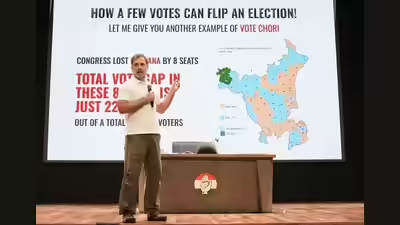
Opposition parties and watchdogs allege widespread voting irregularities, pushing courts, election authorities, and forensic teams into action amid growing calls for electoral reform.
By Namith DP | August 09, 2025
Introduction
India, the world’s largest democracy, has built its political identity on the principle of free and fair elections. However, recent allegations of electoral fraud have triggered a wave of political debate, legal scrutiny, and public concern. These claims have come from opposition leaders, civil society groups, and independent observers, raising questions about electoral integrity in a country where voting involves hundreds of millions of citizens. The situation has intensified following the latest national and state-level polls, where irregularities were reported in multiple constituencies.
The Election Commission of India (ECI) has responded by reiterating its commitment to transparency and dismissing many allegations as unfounded. Yet, mounting evidence, contested narratives, and public pressure have kept the issue in the spotlight.
Background of the Allegations

Electoral fraud claims are not new to Indian politics, but the scale and timing of the current allegations have amplified the issue. Reports have surfaced from several states, including Uttar Pradesh, West Bengal, and Maharashtra, suggesting possible irregularities during voter registration, polling, and counting stages.
- Voter List Discrepancies
Independent watchdog groups have alleged the deletion of genuine voters from rolls and inclusion of duplicate entries. These irregularities could potentially alter the outcome in closely contested seats. - Electronic Voting Machine (EVM) Concerns
Critics have raised questions about the security of EVMs, despite repeated assurances from the ECI that they are tamper-proof. Some opposition parties have demanded a return to paper ballots. - Vote-Buying Accusations
Instances of cash distribution, gifts, and promises of welfare schemes in exchange for votes have been reported, especially in rural constituencies. - Polling Booth Irregularities
Allegations include intimidation of voters, presence of unauthorized personnel inside booths, and selective allowance of certain voters.
Government and ECI Response
The Indian government and the ECI have denied systemic electoral fraud, emphasizing that India’s election process is among the most robust globally.
- Election Commission’s Position
The ECI has released multiple statements asserting that EVMs are secure and backed by layers of procedural safeguards. They have cited mock polling, sealing protocols, and physical security measures. - Legal Actions
The Commission has initiated inquiries into specific complaints, with some cases leading to re-polling in select booths. However, the opposition argues that investigations have been slow and insufficient. - Public Outreach
In an attempt to restore public trust, the ECI has organized press briefings, released data on voter turnout, and invited domestic observers to witness polling processes.
Opposition’s Stand
Several opposition leaders have accused the ruling party of manipulating electoral mechanisms to secure favorable results.
- Demands for Audit
Parties such as the Indian National Congress and the Aam Aadmi Party have called for independent forensic audits of EVMs and voter lists. - Legal Petitions
Opposition parties have filed petitions in the Supreme Court and High Courts demanding verification of EVM votes against Voter Verifiable Paper Audit Trails (VVPATs) for all constituencies. - International Attention
Some leaders have urged international election observers to monitor future polls, arguing that external scrutiny could enhance credibility.
Case Studies of Reported Irregularities
Uttar Pradesh
Multiple constituencies reported missing names from electoral rolls, with local media estimating over 50,000 voters affected in one district alone. Opposition candidates allege targeted deletion of voters from minority communities.
West Bengal
Allegations of violence and booth capture dominated headlines. Video evidence circulated on social media showing groups preventing voters from entering polling stations. The ECI ordered re-polling in 11 booths after confirming procedural violations.
Maharashtra
Reports emerged of EVM malfunctions in urban constituencies, leading to delays and voter frustration. Opposition leaders claimed the delays discouraged turnout in their strongholds.
Legal and Constitutional Framework
India’s electoral process is governed by a detailed legal framework under the Representation of the People Act, 1950 and 1951, and the Constitution.
- Electoral Offences
The Acts classify offences such as bribery, undue influence, impersonation, and booth capturing as criminal acts punishable by imprisonment and fines. - Judicial Oversight
High Courts have jurisdiction to hear election petitions challenging results, with the Supreme Court serving as the final appellate body. - Role of Observers
The ECI deploys observers to oversee sensitive constituencies, ensuring adherence to the Model Code of Conduct.
Expert Opinions
Election law experts emphasize the importance of strengthening both the technological and procedural safeguards.
- On EVMs
Technical experts have suggested the introduction of blockchain-based vote storage to enhance transparency. - On Voter Lists
Analysts recommend regular cross-verification with Aadhaar and other government databases to prevent duplication and wrongful deletions. - On Enforcement
Legal scholars argue for faster adjudication of election-related cases to deter violations.
Role of Technology in Safeguarding Elections

India has relied on EVMs for decades, with VVPAT slips introduced in recent years to improve transparency.
- Benefits of Technology
EVMs have reduced invalid votes, accelerated counting, and lowered logistical costs compared to paper ballots. - Limitations
Lack of universal voter confidence and limited public access to technical audits have fueled skepticism. - Emerging Solutions
Experts propose open-source EVM software, public demonstration events, and independent penetration testing before each election cycle.
Public Perception and Media Coverage
Media outlets have provided extensive coverage of the allegations, though opinions remain divided.
- Mainstream Media
National news networks have reported both the allegations and ECI’s rebuttals, often featuring panel discussions with political analysts. - Social Media Impact
Viral videos and unverified claims have amplified tensions, prompting the ECI to work with social media companies to counter misinformation. - Public Opinion Polls
Recent surveys indicate a split in voter confidence, with urban voters more likely to trust the ECI compared to rural populations.
International Comparisons
Election experts often compare India’s situation with other democracies facing similar challenges.
- United States
Allegations of voting irregularities in recent US elections have spurred calls for paper ballot audits, paralleling India’s VVPAT debates. - Indonesia
As another large democracy using electronic voting, Indonesia has faced similar demands for greater transparency and third-party verification.
Possible Reforms and Recommendations
Analysts and advocacy groups have proposed several measures to address the allegations and strengthen trust in elections.
- Full VVPAT Verification
Implement 100% matching of VVPAT slips with EVM results to enhance credibility. - Independent Technical Audits
Engage external cybersecurity firms and academic institutions to test and certify EVM security. - Real-Time Voter Roll Updates
Integrate voter registration databases with civil registries for timely corrections. - Legal Reforms
Introduce statutory deadlines for resolving election petitions before the next scheduled poll.
Conclusion
The recent allegations of electoral fraud in India have intensified scrutiny of the country’s election machinery. While the ECI and government maintain that the system is secure, persistent concerns from opposition parties, civil society, and voters indicate that reforms may be necessary. Addressing these concerns requires a multi-pronged approach—enhanced transparency, stronger enforcement of election laws, and the integration of advanced verification technologies.
Restoring public trust is essential for safeguarding the legitimacy of India’s democratic process. The coming months will test whether India’s institutions can respond decisively and credibly to the challenges posed by these allegations.
Sources:
- Election Commission of India official reports: https://eci.gov.in
- Representation of the People Act, 1950 and 1951: https://legislative.gov.in
- Press Trust of India, “EC Orders Re-polling in 11 Booths in West Bengal”
- Lokniti-CSDS Survey on Voter Confidence, 2025
See also –
About The Author




This needs to be investigated immediately
[…] India Confronts New Wave of Electoral Fraud Allegations […]