
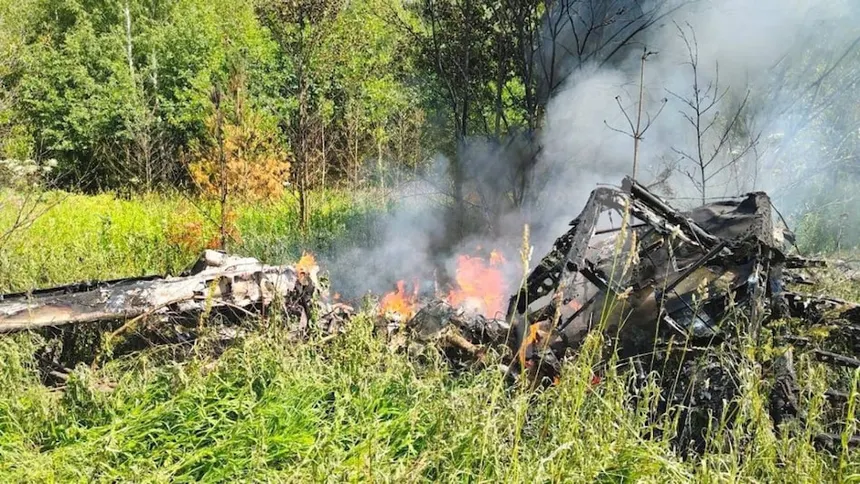
Investigators cite pilot error, outdated aircraft, and poor visibility as contributing factors, crash marks Russia’s deadliest in 2025.
By Namith DP | July 24, 2025
Introduction
A Soviet-era Antonov An-24 aircraft operated by Angara Airlines crashed during its second landing attempt at Tynda Airport in Russia’s Far East, killing all 49 on board. The disaster, now under criminal investigation, is Russia’s deadliest aviation accident this year and raises urgent questions about the country’s aging aircraft, adverse-weather operations, and air safety infrastructure.
What Investigators Know So Far
Russian authorities have launched a criminal case under Article 263 of the Russian Criminal Code (Violation of Safety Rules for Air Transport), focusing on the following preliminary findings:
1. Pilot Decision-Making in Hazardous Weather
- Tynda Airport was under Instrument Meteorological Conditions (IMC) due to persistent rain and low visibility.
- The pilot aborted the first landing attempt.
- During the second approach, the aircraft disappeared from radar.
- Investigators believe the flight crew did not properly align with the final approach path and may have deviated from standard procedures.
2. Absence of Terrain Awareness
- The aircraft struck a hillside at approximately 700 meters elevation. There was no distress call or emergency beacon activated prior to impact.
- It’s unclear whether the aircraft’s Terrain Awareness and Warning System (TAWS) was operational. Older models like the An-24 are not always equipped with such systems.
3. Crew Error at Radar Checkpoint
- TASS and Interfax reported that the crew failed to confirm position over the last radar waypoint before descent.
- This oversight is being treated as a serious breach of navigational procedure under VFR/IFR transitions.
Aircraft Profile: The Antonov An-24
- First flown in 1959, the An-24 is a twin turboprop designed for short-haul regional service.
- Russia, Ukraine, and some parts of Asia continue to use this model due to its ability to operate from short, unpaved runways.
- As of 2025, fewer than 20 An-24s remain in active commercial service in Russia.
- Angara Airlines’ An-24s have logged decades of continuous service and are frequently used in Siberian and Far East routes, where modern aircraft are rare due to infrastructure gaps.
The Airline: Angara’s Safety Record
- Based in Irkutsk, Angara Airlines primarily serves isolated regions in Siberia and the Russian Far East.
- Its small fleet includes Antonov An-24s, An-26s, and newer ATR aircraft.
- Angara suffered a previous runway overrun in 2019 (An-24RV, same model), which killed two crew members. That crash was attributed to left engine failure.
- The current crash may put pressure on Russia’s aviation authority (Rosaviatsia) to reconsider the certification of older Soviet-built aircraft still in passenger service.
Crash Response and Search Operations

- Emergency services located the wreckage 3 hours after last radar contact.
- A Mi-8 helicopter initially spotted the crash site, but ground teams required off-road transport to access the forested slope.
- All 49 bodies were recovered by late afternoon.
- Tynda Airport, which has limited navigational equipment and no precision instrument landing system (ILS), suspended all flights pending investigation.
Aviation Safety in 2025: A Deteriorating Trend?
The crash underscores a concerning trend: aviation fatalities are rising globally in 2025.
Recent Fatal Incidents:
- India (Jan 2025): 260 killed in an Airbus A321 crash near Ahmedabad.
- Bangladesh (July 2025): 22 killed in a Dash 8 accident in Chattogram.
- Russia (July 2025): 49 killed in Tynda crash.
Total fatalities YTD: Over 460 worldwide
10-year average: ~284 annual fatalities
The increase coincides with mounting air traffic post-COVID recovery, older aircraft returning to service, and more flights to remote locations with weak infrastructure.
Regulatory and Safety Gaps Highlighted
1. Weather Radar and Infrastructure
- Tynda Airport lacks advanced landing aids like ILS or even full ATC radar coverage.
- The crash occurred in controlled airspace with limited meteorological data and minimal automation.
2. Aging Fleet
- The An-24’s last production batch was in 1979.
- Rosaviatsia has not imposed retirement mandates but requires biannual inspections and periodic modernization audits.
- Over 60% of Russia’s regional fleet is 30+ years old.
3. Training & Human Factors
- Analysts suspect overconfidence during second approach.
- Crew resource management (CRM) and judgment under stress are being evaluated.
- Simulator training for complex weather and terrain is inconsistent in remote carriers.
Legal and Political Implications
- The Russian Prosecutor General’s Office confirmed it is considering criminal negligence charges against Angara’s flight operations division.
- Victims’ families have been offered compensation of 2 million rubles (~$22,000), per Russia’s aviation accident guidelines.
- The Russian Ministry of Transport has ordered a nationwide inspection of all remaining An-24s and similar legacy aircraft.
Broader Impact on Russian Aviation
- Fleet Review: Airlines will likely face higher insurance premiums and may phase out older aircraft.
- Public Confidence: Domestic travel on regional carriers may drop, prompting fare cuts or fleet consolidation.
- Infrastructure Investment: Airports in Amur, Yakutia, and Kamchatka may receive federal grants to upgrade ILS, radar coverage, and emergency response.
Global Reactions and Comparisons
- International Civil Aviation Organization (ICAO): Issued a safety bulletin advising airlines to evaluate terrain-based approach risks in poor weather.
- Boeing and Airbus: Renewed discussions with Russian carriers about leasing newer aircraft under deferred payment agreements.
- Neighboring countries like Kazakhstan and Mongolia temporarily grounded similar aircraft pending inspection.
Key Takeaways for the Industry

- Legacy airframes require modern avionics.
Without proper terrain awareness and weather radar, even skilled crews are exposed to avoidable risks. - Decentralized airport safety standards need centralization.
Airports with inconsistent equipment create variability that modern aviation cannot afford. - Mandatory second pilot reviews during IMC approaches must be enforced.
Fatigue, decision bias, and terrain unfamiliarity remain leading contributors in CFIT (controlled flight into terrain) incidents.
Summary of the Crash
- Aircraft: Antonov An-24RV (registration RA-47865)
- Age: 49 years (manufactured in 1976)
- Operator: Angara Airlines
- Flight Path: Blagoveshchensk to Tynda (via Khabarovsk)
- Occupants: 43 passengers, 6 crew
- Fatalities: 49
- Crash Location: Forested mountain slope 15 km from Tynda Airport
- Time of Incident: ~09:30 local time
- Weather Conditions: Heavy rainfall, low visibility, low cloud ceiling
Conclusion
The An-24 crash in Russia’s Far East has exposed persistent vulnerabilities in the nation’s aviation ecosystem: outdated aircraft, underdeveloped infrastructure, and human error under pressure. As investigators dig into the black boxes and cockpit logs, Russia and other countries relying on legacy aircraft face an inflection point. The choice is clear—either modernize or risk repeating tragedies that are no longer technologically inevitable.
For more news on aviation read –
About The Author





May all their souls rest in peace
[…] Russian An-24 Crashes Into Mountain Side: 49 Killed […]