
By Namith DP | June 24, 2025
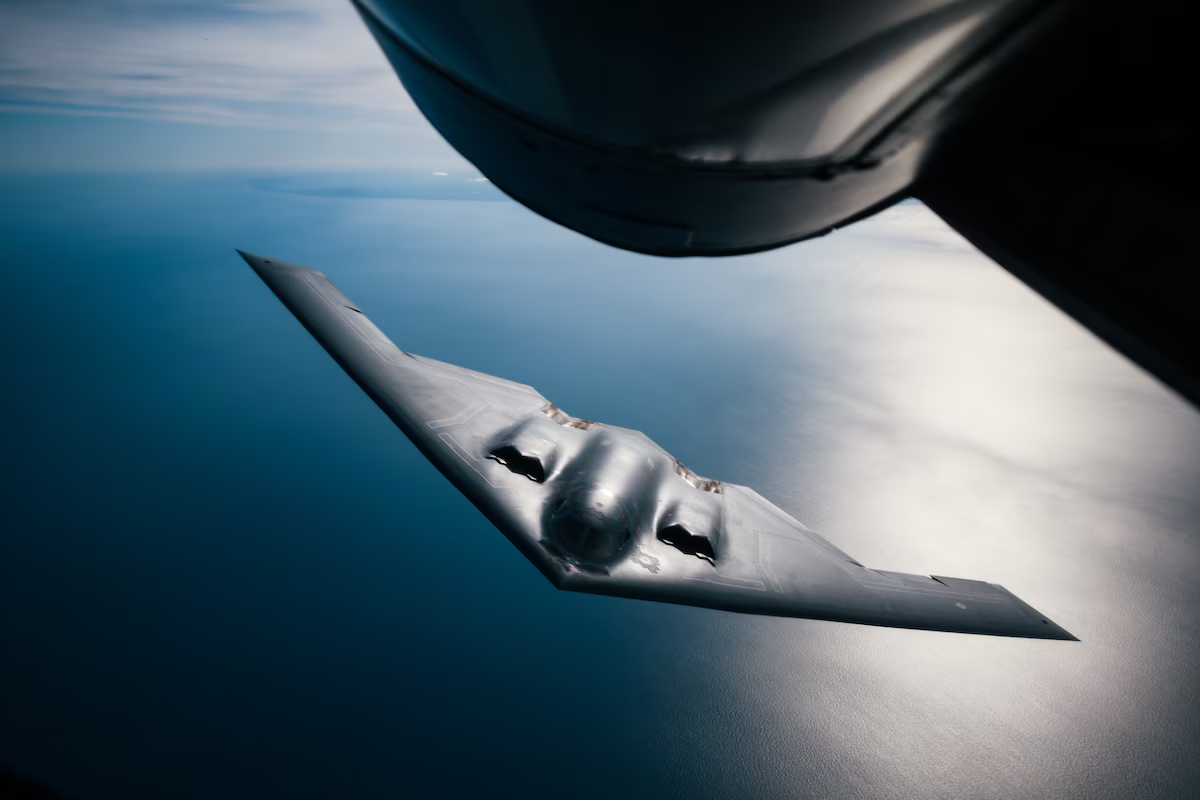
The B-2 Spirit, America’s most advanced long-range stealth bomber, has played a critical role in U.S. military operations since 1989. This three-part article offers a comprehensive account of its development, combat missions across five continents, major accidents, and its evolving legacy as it transitions to the next-generation B-21 Raider.
Introduction
The B-2 Spirit is the U.S. Air Force’s premier long-range stealth bomber, designed for deep-penetration missions with both conventional and nuclear payloads. Since entering service in 1997, it has executed precision strikes in Kosovo, Iraq, Afghanistan, Libya, Yemen, and Iran—often undetected. Despite its high cost and limited fleet size, the B-2 remains a key pillar of U.S. strategic airpower.
Part 1: Inception and Initial Combat Missions
1. Program Genesis & Development
- Origins & first flight: The U.S. Air Force launched the Advanced Technology Bomber program in the late 1970s. Northrop Grumman built the first prototype, which took its maiden flight on July 17, 1989, with operational service beginning in 1997.
- Production: Though initially planned at 132 aircraft, only 21 were produced due to cost overruns and geopolitical shifts; 19 remain operational today.
2. Combat Debut: Kosovo (1999)
- First mission: On March 23, 1999, two B‑2s flew nonstop from Missouri to Kosovo for Operation Allied Force.
- Effectiveness: Despite accounting for only 1% of sorties, B‑2s delivered approximately 11% of NATO’s munitions, showcasing their strategic precision.
- Milestone: Demonstrated global reach with powerful payload delivery and minimal support footprint from home base.
3. Afghanistan & Iraq Campaigns
- Longest combat mission: In October 2001, during Operation Enduring Freedom, a B‑2 mission lasted a record 44 hours, with crews rotating rest and refueling. It dropped 16 bombs on Taliban and Al-Qaeda positions.
- Iraq War (2003): B‑2s flew missions both from forward bases and Whiteman AFB, completing 49 sorties and deploying over 1.5 million pounds of munitions.
4. Libya & Continued Engagements
- Libya 2011: Under Operation Odyssey Dawn, B‑2s dropped 40 bombs on Libyan air defense sites.
- Libya 2017: Returned to strike training camps, releasing approximately 180,500 pounds of JDAMs, command and intelligence supported by escort UAVs.
- Yemen (2024): B‑2s launched Massive Ordnance Penetrator (MOP) strikes on Houthi targets from Australia, demonstrating global reach.
5. Accident Overview & Spirit of Kansas Crash (2008)
- First crash (Feb 23, 2008):
- The Spirit of Kansas (89-0127), crashed during takeoff at Andersen AFB, Guam. Both crew ejected safely; it was the only B‑2 lost in combat or operation.
- Cause: moisture in air-data sensors led to faulty speed/angle readings; plane stalled and pitched up steeply.
- Loss estimated at US$1.4 billion, making it the costliest aircraft crash in U.S. history.
- Fleet was grounded for 53 days during safety review.
Part 2: Expanded Combat Operations, 2017–2025 & Further Accidents

1. Renewed Combat Use (2017–2024)
A. Libya: Operation Timber Sycamore (2017)
- Target: ISIS training camps near Sabha, southern Libya.
- Details: Two B‑2s flew from Whiteman AFB and dropped 85–90 precision JDAMs on militant camps, guided by drone surveillance.
- Impact: U.S. AFRICOM confirmed over 80 enemy combatants killed. No civilian casualties were reported.
- Duration: 30-hour roundtrip including aerial refueling.
B. Yemen (2024)
- Context: In response to multiple Houthi ballistic missile attacks on Red Sea shipping routes and U.S. assets in Djibouti.
- Strike details: B‑2s launched GBU-57 Massive Ordnance Penetrators on underground weapons depots near Sa’dah.
- Significance: Demonstrated precision at range from a forward-deployed base in Darwin, Australia.
2. Operation Midnight Hammer (June 2025)
Overview
- Mission scope: Largest stealth strike in history against Iran’s nuclear facilities.
- Targets: Fordow Fuel Enrichment Plant, Natanz nuclear site, and Isfahan missile production complex.
Key Stats
- Sorties: 7 B‑2s, 145 total U.S. aircraft, including F-22 escorts, tankers, and ISR platforms.
- Ordnance: 14 GBU-57/B MOPs dropped with pinpoint accuracy.
- Duration: 36–37 hours per aircraft, with up to three aerial refuelings.
- Outcome: Iranian IADS (Integrated Air Defense Systems) failed to intercept; global intelligence assessed >70% of Iran’s HEU production was disabled.
Strategic Importance
- First use of live Massive Ordnance Penetrators in combat.
- Demonstrated the B‑2’s ability to penetrate a highly defended region undetected and return safely.
3. Accidents Post-2008
A. Hangar Fire (2010)
- Aircraft: “Spirit of Washington”
- Cause: Ground power unit short-circuited during a systems test at Whiteman AFB.
- Result: Damage estimated at $15 million; aircraft returned to service after 15 months.
B. Runway Skid (2015)
- Aircraft: “Spirit of Missouri”
- Event: Skidded off a wet runway in Guam due to software malfunction during braking calibration.
- Outcome: Nose gear damage; aircraft repaired and returned to operational status in 2016.
C. Emergency Landing Incident (2022)
- Aircraft: “Spirit of Alaska”
- Issue: Mid-air electrical system failure. Backup avionics remained functional.
- Protocol: Aircraft diverted and landed safely at RAF Fairford (UK). Incident led to a fleet-wide diagnostic audit of its Open Mission Systems (OMS).
4. Human Factors: Crew Protocol and Endurance
A. Crew Structure
- Two-pilot system: Mission commander and pilot. No navigator or electronic warfare officer (unlike B‑52 or B‑1).
- Roles:
- Pilot: flight controls, fuel management, takeoff/landing
- Commander: navigation, weapons delivery, tactical decisions
B. Endurance Management
- Rest cycles: B‑2s include a cot and portable microwave for missions exceeding 30 hours.
- Meals: No heavy food; preferred options include light sandwiches, trail mix, and electrolyte drinks.
- Physiological aids:
- Use of stimulants (“Go Pills”) in earlier years; now replaced with circadian-adjusted sleep scheduling and wearable alertness monitors.
C. Aerial Refueling
- Most B‑2 long-range missions require 2–3 refueling operations.
- Boom reception is conducted using heads-down instrument-only methods, requiring high skill under fatigue.
Part 3: Survivability, Upgrades, and Strategic Legacy
1. Survivability in Modern Threat Environments
A. Radar Advancements
- Threat evolution: Nations like China and Russia have developed AESA radars (e.g., Nebo-M, Rezonans-NE) capable of low-frequency detection.
- B‑2 response: Upgrades to the AN/APQ-181 radar in 2012 introduced AESA functionality with frequency-hopping to resist detection.
- Tactics: B‑2s operate at high altitudes and avoid prolonged exposure in radar sweep zones. Missions use strict radio silence, precise timing, and support from jammers or SEAD assets.
B. Cybersecurity & ECM
- Open Mission Systems (OMS) installed in 2021 enable rapid integration of updated countermeasures.
- Cyber hardening: All B‑2s received hardened networks post-2018 to defend against EW and satellite spoofing.
2. Avionics, Stealth Maintenance, and Upgrades
A. Stealth Coatings
- RAM integrity: The B‑2’s stealth relies heavily on radar-absorbent materials (RAM), which degrade in humidity or rain.
- Solution: By 2019, RAM technology had evolved to a more durable, field-replaceable formula reducing reapplication cycles by 40%.
B. Integrated Flight Systems
- Consolidation: The B‑2’s 1980s-era computers were replaced with modular digital avionics.
- OMS benefits:
- Software upgrades in weeks, not years
- Rapid integration of weapons like GBU-57, JASSM-ER, and possible hypersonic munitions
3. Strategic Relevance and Deployment Strategy
A. Strategic Presence
- Bomber Task Force missions: Since 2018, B‑2s have participated in rotational deployments across Europe, the Pacific, and the Middle East.
- Forward bases: RAF Fairford (UK), Diego Garcia, and Andersen AFB (Guam) regularly host B‑2 operations.
B. Deterrence role
- Part of the nuclear triad, capable of delivering B61 and B83 gravity bombs.
- Critical for low-observable nuclear strike capability under START treaty limits.
4. Transition to the B‑21 Raider
A. Why the B‑21?
- B‑2’s high maintenance costs, limited fleet size, and 1980s design prompted the Air Force to pursue a stealth successor.
- The B‑21 Raider, unveiled in 2022, is expected to:
- Cost under $750 million per unit
- Feature autonomous options
- Require less maintenance (40% less RAM upkeep projected)
B. Timeline
- Initial operational capability (IOC): Expected by 2027.
- Fleet target: At least 100 aircraft under current Air Force planning.
5. Historical Evaluation: The B‑2’s Strategic Legacy
A. Combat Metrics
- 1999–2025: over 150 operational sorties in six major combat theaters
- Total ordnance dropped: >5,000,000 pounds (estimated)
- Zero B‑2s lost to enemy fire
B. Cost vs. Impact
- Development + procurement: ~$44 billion
- Strategic impact: Delivered disproportionate effects with minimal exposure
C. Legacy
- Rewrote doctrines for stealth airpower
- Proved the viability of long-range precision strike
- Influenced development of next-gen platforms like the B‑21 and even China’s H‑20
Conclusion
Across its 36-year lifespan, the B‑2 Spirit transformed global strike warfare. From Kosovo to Iran, it struck hardened targets across continents with precision and stealth. Though marred by operational cost and RAM upkeep, its combat record remains untarnished by enemy fire. As the B‑21 Raider begins its ascent, the B‑2 will be remembered not only as a symbol of Cold War-era innovation but as the stealth aircraft that proved it could reshape modern air combat for nearly four decades.
About The Author




Good insight.