
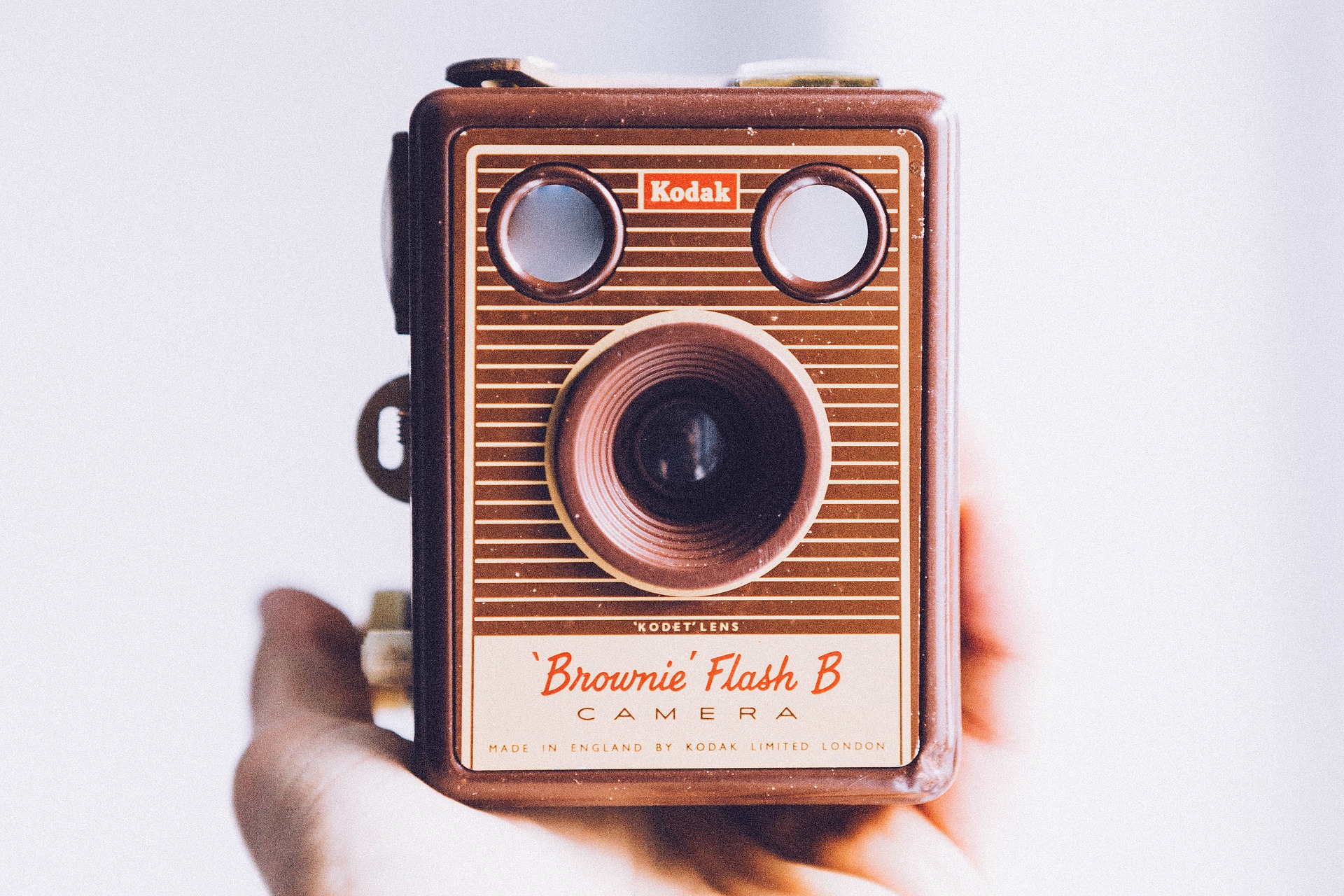

The history of photography remains closely tied to Kodak.
Enthusiasts agree that Eastman’s influence left an undeniable mark, even though he contributed little to the technical advancements of the craft.
Time for a bedtime story.
Many regarded Eastman as an average student. After leaving school, he took a job as an office boy at an insurance company, determined to build a career rather than simply pass the time.
A decade later, while preparing for a trip to the Caribbean, he sought a way to document his journey through photography.
Still, he quickly discovered that photography was an arduous process.
The camera he purchased was as large as a microwave oven. The supplies required for developing images were even more cumbersome. Frustrated by these limitations, Eastman experimented with chemicals and modified equipment to streamline the process.
His goal extended beyond personal convenience. Driven by a wish to help his siblings, who faced challenges due to the effects of polio, he worked tirelessly to develop a simpler, more user-friendly approach to capturing memories.

Eastman initially planned to use the wet collodion process but soon realized that a dry plate photographic method would be a superior alternative.
Although this technique had already been developed, he saw its potential for refinement and practical application.
First…
–> In 1871 Maddox, a pioneer of photomicrography, revolutionized the field by introducing coating plates with a gelatin-based emulsion that bound light-sensitive silver salts to glass plates. This innovation allowed photographers to prepare and store negative exposures for later development in a darkroom.
–> As a result, the cumbersome mobile darkrooms once required for wet plate photography became unnecessary, and commercial dry plates became widely available. This breakthrough also paved the way for smaller, hand-held cameras.
It means…
Eastman’s revolutionary Kodak camera would not have been possible without Maddox’s research.
Volume Two
After numerous advancements by other photographers to refine the technique, Eastman determined that the time had come to set up his own manufacturing business, fully equipped with machines designed from his patented innovations.
Through extensive research and experimentation, he developed a more efficient method for coating photographic plates, leading to his first patent, US 226,503, titled Method and Apparatus for Coating Plates for Use in Photography.

Recognizing the commercial potential, he joined forces with Henry Alvin Strong and together, they officially founded the Eastman Dry Plate Company in Rochester in 1881, but every story had its not-so-pretty twist.
Alvin Strong: A Silent Partner or a Hidden Liability?
Henry Alvah Strong, who began life as what today is considered a difficult child, dropped out of school at the age of 16. Like many of his peers back then, he traveled to New York, hoping to set up a career in banking.
After failing in that endeavor, he signed up to become a sailor, but the job couldn’t satisfy his expectations of adventure, drinking, and engaging with women at every port. The demanding nature of the work led him to abandon his ship in France.
With no money and no knowledge of the language, he reappeared in St. Louis in 1859, where he assisted his cousin in an illicit business. His plan to earn quick money collapsed almost instantly, leaving him free to ascend Pike’s Peak in the middle of winter, accompanied only by a team of his cows.
This solitude led him to service as a paymaster in the Navy during the Civil War, a position that conveniently shielded him from any direct combat.

After the war, Henry Alvah Strong settled down and married into the wealthy family of Buggy Whip founders. To avoid bringing shame to his new wife, he purchased a colonel title with the support of his in-laws.
He met George Eastman when Eastman’s widowed mother, struggling financially, took in Strong’s family as boarders. Seizing an opportunity, Strong invested money from his questionable enterprises, giving Eastman’s company the financial support it needed to survive.
In 1881, Eastman appointed Strong as the company’s first president. Still, his promotion has stemmed less from business acumen and more from reckless schemes he orchestrated on dry docks the prior year, serving as a cover for other dubious activities.
By 1901, Strong had outgrown his role as the company’s first president and stepped down, assuming the title of vice president. After his wife died in 1904, he married his long-time mistress and spent his retirement in the company of his friend, John D. Rockefeller. He continued to enjoy his wealth and influence until he died in 1919 at the age of 82.
So, a more precise description of his character would be that of a crook.
Strong’s influence raises doubts about Eastman’s role as the true innovator, yet Eastman’s contributions to photographic advancements stay undeniable. Questions linger about whether he developed his methods independently or if Strong’s backing played a larger role than acknowledged.
Even with these uncertainties, researchers agree that Eastman left more than a mark in history.
He devised a process that coated paper with a soluble, non-light-sensitive gelatin layer, followed by an insoluble, light-sensitive emulsion. This technique allowed the image-bearing layer to be stripped from the paper after exposure and development, transferred onto a sheet of clear gelatin, and sealed with a collodion overcoat.
Although effective, this approach wasn’t very popular among professional photographers, who continued to trust glass plates over paper-based film. Skepticism about Eastman’s leadership was derived from his decision to place a questionable figure like Strong in a position of power.
Even though Eastman’s ability to introduce groundbreaking products remains undisputed.
Final Destination
And time caught up with us; in 1888, Eastman launched the Kodak box camera, preloaded with strippable paper film. With a single press of a button, users capture an image, making photography more accessible.

Despite the commercial success of the Kodak camera and film, Eastman remained focused on improving the transparent support. Eliminating the need to strip the emulsion from its paper backing required a more effective solution.
By 1888, several companies had begun coating dry photographic emulsions on celluloid plates, yet the process presented significant challenges. The material proved too thick for Kodak’s roll film cameras, creating a technical obstacle that Eastman needed to resolve. Seeking expertise, he looked for someone capable of overcoming this limitation.
Prelude of William Walker, arriving in Rochester in 1880 as a supplier for amateur photographers, partnering with Forbes, a former associate of Eastman (blast from the past), and Eastman’s competitor was a considerable deal for Eastman himself.

Within three years, Walker successfully:
→ Marketed his dry plates
→ More notably, he successfully introduced interchangeable parts for his Walker’s Pocket Cameras
Fortunate for Eastman, Walker closed his business in 1883, leading to its reformation as the Rochester Optical Company, and accepted a position as Eastman’s partner. During their partnership, Eastman reconsidered his approach to photography.
Rather than relying on dry plates or an alternative rollable material, he and Walker collaborated to develop the roll holder.
The results, proved disappointing though. The paper exhibited excessive grain, and most photographers refused to adopt it. Frustrated with the failure, Eastman, not surprisingly, blamed Walker. Eastman replaced him with George Dickman, a relative of Josephine Dickman, Eastman’s mistress.
Despite the objectives of improving the photographic process to expand accessibility, it’s hard to not think why Walker became a scapegoat in the first place.
Volume Three
To fulfill his dream Eastman sought guidance from Dr. Samuel A. Lattimore, head of the chemistry department at the Baptist University of Rochester. Lattimore recommended Henry Reichenbach, a skilled researcher in the field of glass plate application, as a fresh pair of eyes.
Under his wings, Eastman developed a nitrocellulose solution in wood alcohol (methanol), which strengthened celluloid for casting into thin film. Two months later, they presented their findings to the board of directors, demonstrating how a precisely applied solution could evaporate on glass, forming a transparent, flexible film.
Originally, Eastman and Reichenbach planned to patent the process together. Later, Eastman unexpectedly chose to credit his former lab assistant, which greatly affected him. He was unaware of Reichenbach’s intentions of building his own business on Eastman’s back by pouching his employees and stealing some of his designs.
Verdict?
Admirers glorify Eastman for bringing Kodak to the masses, portraying him as a visionary who revolutionized photography.
The facts speak for themselves:
→ Eastman never established a new photographic genre as some proclaims. His methods relied on refining existing processes rather than pioneering original techniques.
→ The widely recognized roll holder was Walker’s invention, though he and Eastman shared the patent.
-> The concept of handheld cameras did not originate with Eastman but with his former associate, William Walker.
→ The photographic process often attributed to Eastman had already been established by Frederick Scott Archer in 1851 and later improved by Richard Maddox. Eastman merely experimented with existing techniques rather than introducing groundbreaking innovations.
-> Eastman’s legacy remains further tainted by his support for racist ideologies. His backing of blackface performances at the University of Rochester and his promotion of eugenics through lectures at his school reveal a deeply troubling perspective. While his advancements in photographic technology and industrial production helped to shape modern photography, his contributions to social progress remain none.
So, was Eastman a visionary or just a savvy businessman who knew how to repackage and sell existing products?
References:
Card, J. (1962). George Eastman House of Photography. Film Quarterly, [online] 16(2), pp.37–42. doi:https://doi.org/10.2307/1210481.
New York University (n.d.). Dry Plate/Gelatin Process Photography. [online] https://kimon.hosting.nyu.edu/physical-electrical-digital/exhibits/show/innovation-in-photography-thro/item/1112
National Film and Sound Archive of Australia (2011). Dry Plate Photographic Process | NFSA. [online] Nfsa.gov.au. Available at: https://www.nfsa.gov.au/preservation/preservation-glossary/dry-plate-photographic-process#:~:text=The%20Gelatin%20or%20Dry%20Plate
Fineman, M. (2004). Kodak and the Rise of Amateur Photography. [online] Metmuseum.org. Available at: https://www.metmuseum.org/toah/hd/kodk/hd_kodk.htm
About The Author


