
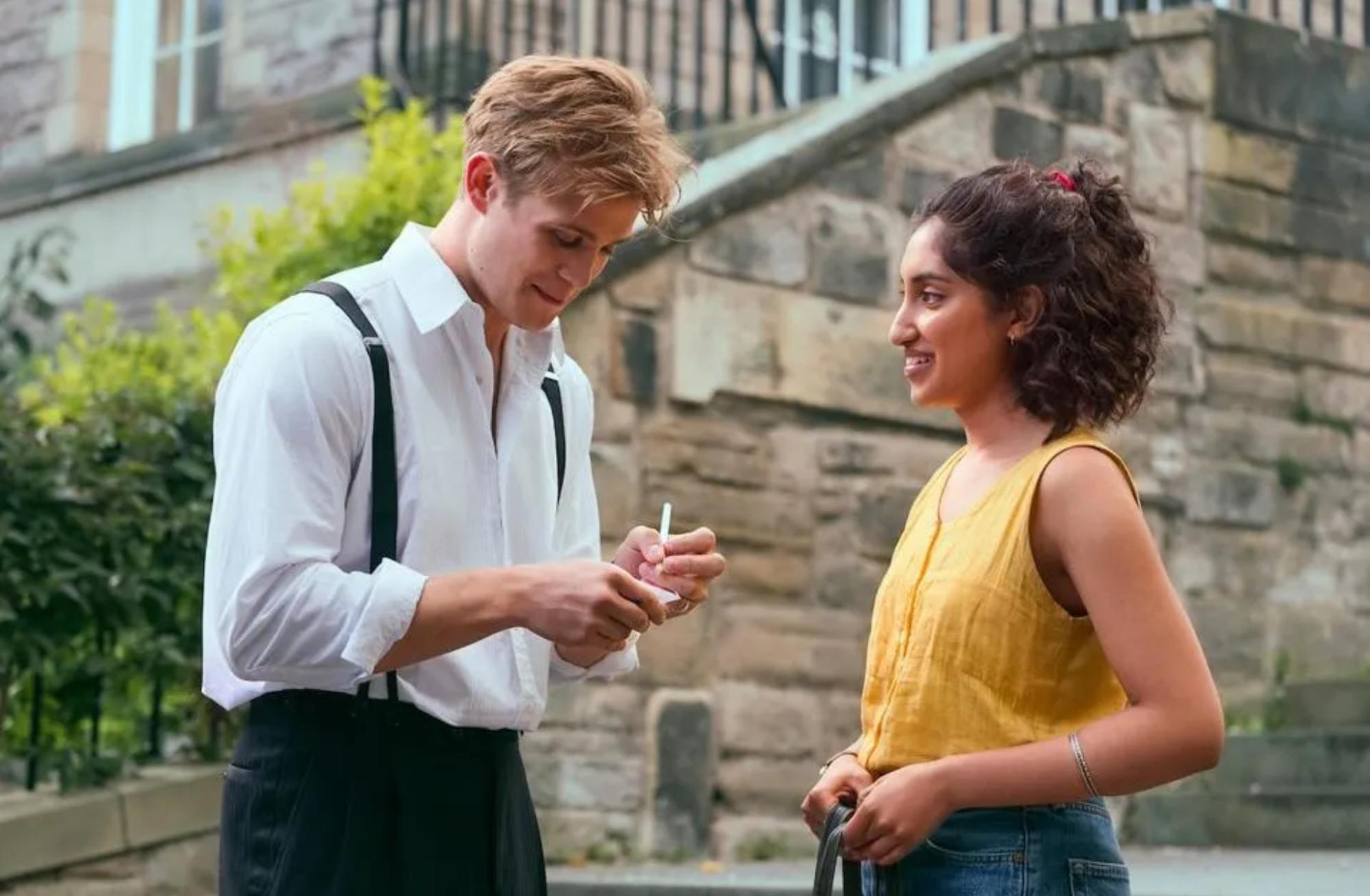
It’s hard to believe that a year has passed since One Day premiered on Netflix. Based on David Nicholls’ beloved best-selling 2009 novel, the miniseries follows the love story of Emma Morley (Ambika Mod) and Dexter Mayhew (Leo Woodall), anchored around the same day across 20 years. It is intimate, bittersweet, and uncomfortable, yet undeniably compelling, and has garnered praise for its emotionally resonant storytelling, beautiful cinematography, and stellar performances.
The series opens with Emma quoting Philip Larkin: ‘What are days for? Days are where we live.’ Her utterance seems reassuring in its simplicity, but, as we find out, is beautifully enigmatic. One Day explores the epic potentiality for love, loss and heartbreak within the quotidian: days are where we live, but also where we feel.
One year later, the series’ central motif of time seems even more poignant. The preoccupation isn’t just a background for the narrative, it becomes a lens through which we, as viewers, are invited to confront our own perceptions of time. What are days for? 365 of them later, we are reminded how easily moments can slip away.
Emma and Dexter meet in 1988 on their graduation night at Edinburgh University, and after a failed one-night stand, decide to spend the next day hiking Arthur’s Seat in what Emma describes as ‘the first day of our properly adult lives’. The day is July 15, St Swithin’s Day – a day which, according to folklore, denotes the weather for the rest of the summer. Though seemingly trivial, its associations with fate and future make it the perfect setting to explore the perennial relationship of our star-crossed lovers.
Nicholls himself is interested in the concept of time and the shocking, often cruel, way in which it accelerates: ‘I struggle to understand how there can be 15 years between Love Me Do and the Sex Pistols, but nearly 30 years since the release of Common People.’ He notes in One Day a Hardyesque fascination with time, a ‘certain morbid romanticism, momentary decisions that change a life’s course, for better or worse.’
Perhaps this is why the episodic nature of the series seems so fitting; each episode varies in length, encapsulating the momentary decisions of everyday life with beautiful authenticity. It is a narrative structure that draws attention to the passage of time in a way that feels almost tangible. Decisions that seem small at the time (a missed call, an unspoken word) gain weight as they accumulate over the years.
//www.instagram.com/embed.js
Time becomes elastic. The difference between the represented time versus the time experienced on screen means that quotidian decisions seem seismic, and leads to continually frustrating “what if?” moments. What if Dexter’s parents hadn’t arrived and quashed potential romance after their hike on Arthur’s Seat? What if Emma had answered the phone when Dexter emotionally called her from the train station? What if they had kissed on Primrose Hill? These moments of loss, of missed connections, are heartbreaking, and we, as viewers, feel the sting of time passing with every missed opportunity.
This sense of missed opportunity runs throughout Nicole Taylor’s beautifully written script. We realise Dex and Em are perfectly imperfect, relishing their moments of love but also their moments of confrontation, and we agonize over the fact that they keep missing each other. Emma, a working-class bookish northerner, is perfectly conveyed by Ambika Mod (This is Going to Hurt) as vulnerable, pithy, and relentlessly sardonic. Leo Woodall’s (White Lotus) Dexter, on the other hand, is effortlessly confident in his posh-boy mannerisms, achieves a 2.2 in anthropology, and is a well-known university Lothario. Despite their differences, both characters share the same hamartia; their fatal flaw is that they cannot recognise or admit their love for each other at the right time.
This is where the true tragedy of the series lies. One Day’s time is not just about love – it is about the painful reality that life moves forward regardless of our desires and regrets. The show captures this tragedy with profound sensitivity, reminding us how easy it is to become distant from the people we love, to miss opportunities, and to let time slip through our fingers without fully recognising its significance.
One Day constantly reminds us that time is tragic, a concept described by English professor David Kastan: ‘time, that like life itself to which it is inextricably tied, is directional, irreversible, and finite.’ Each episode conveys how a single decision or missed opportunity can alter the course of a life forever; from their initial meeting in 1988 to the final scenes of the last episode, Dexter and Emma’s relationship is defined and bound by the constraints of time. Nicholls describes their intimate and touching scene in episode ten where they share an illicit kiss in the shadowy maze: ‘I could watch Em and Dex walk round that maze forever.’ We all could, but the pain and tragedy is that time relentlessly continues.
‘Days are where we live.’ But days are also where we love, lose, reminisce and regret. Time is both a gift and a thief, and the series captures the beauty and heartbreak of that duality. As we reflect on the anniversary of One Day’s release, the series continues to stay with us – not just because of its characters, but because it asks us to reflect on our own relationship with time. How much time have we spent wondering about missed opportunities? How often do we fail to recognize the fleeting moments that define us?
For the audience, the series doesn’t just depict time; it invites us to engage with it. One Day is a meditation on how easily the years can slip by, how we often fail to appreciate the present, and how small decisions ripple through the timelines of our lives. As the one year anniversary of One Day passes, it offers poignant meditation on the elusive nature of time and the significance of each passing day. In many ways, February 8, the date that One Day premiered on Netflix, is as significant to the audience as July 15 is to Dex and Em.
The series’ reflection on time, and how it shapes us, stays with us long after the credits roll. Time may be relentlessly ticking, but through Emma and Dexter’s story, we’re reminded to cherish the moments we have – before they slip away. There is both beauty and tragedy in the quotidian, which is perhaps why One Day has stayed on all of our minds.
About The Author


