
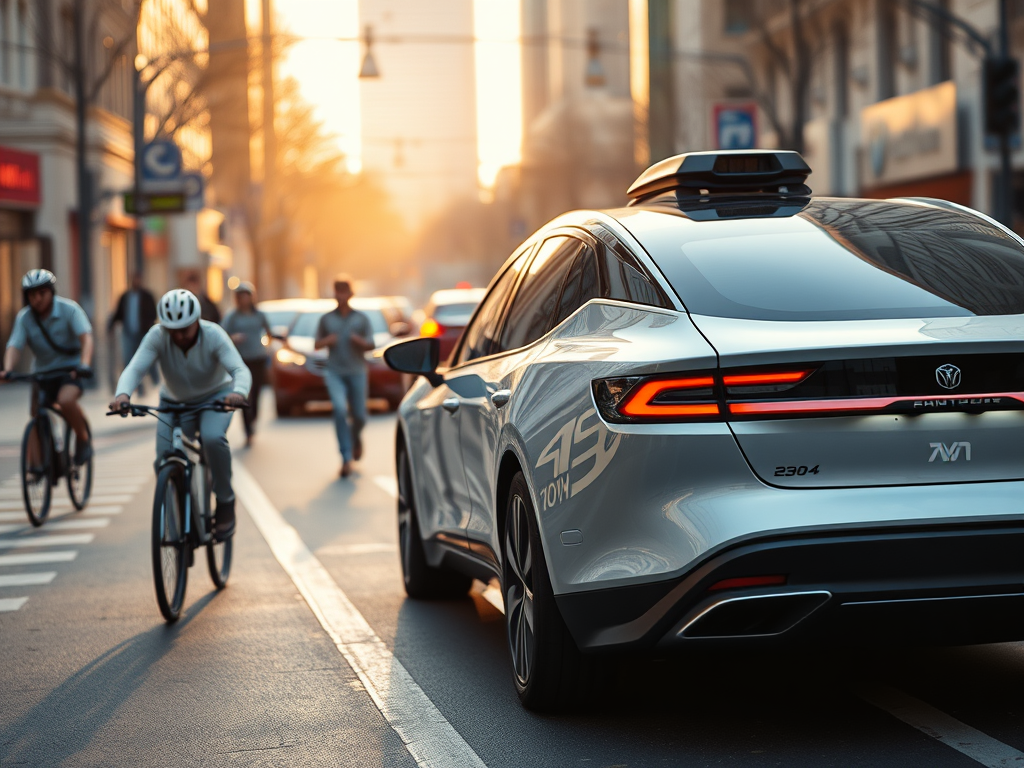
On March 18, 2018, in Tempe, Arizona, a pedestrian was killed after being struck by an autonomous vehicle operated by Uber. The incident was a watershed moment—not merely because it was the first pedestrian fatality caused by a self-driving car, but because it raised an unsettling question:
How should machines make life-and-death decisions?
As autonomous vehicles (AVs) become a commercial reality, these questions are no longer speculative. Self-driving cars are now being tested on public roads, interacting with human drivers, pedestrians, cyclists, and unpredictable environments. These systems are powered by complex artificial intelligence, capable of processing sensor data, planning routes, and executing driving maneuvers. However, navigating traffic is not just a technical challenge—it is a moral one.
Unlike traditional vehicles, where human drivers bear responsibility for ethical decisions in emergencies, autonomous vehicles must make those decisions algorithmically. The task of defining what is “ethical” cannot be outsourced to code without robust debate, regulation, and oversight. Developers are now expected to program ethical reasoning into systems that must function at machine speed, with zero margin for ambiguity.
The stakes are high. A 2021 study by AAA found that 71% of American drivers express fear of riding in fully autonomous vehicles. Public trust is directly linked to perceptions of safety, accountability, and fairness. If an AV must choose between swerving to avoid a child and risking the life of its passenger, who decides what the car should do—and how?
This article explores the intersection of artificial intelligence, ethics, and public policy as it applies to self-driving vehicles. Through a lens grounded in technical expertise and ethical accountability, we examine the current state of ethical AI in self-driving cars, the methodologies used to encode moral frameworks into decision-making systems, the regulatory landscape, and the real-world consequences of ethical lapses.
This is not just an academic concern. The deployment of AVs without ethically robust algorithms could undermine years of innovation. Conversely, successfully embedding ethical intelligence into autonomous systems could set a precedent for all AI-powered technologies going forward.
The Problem Statement: Why Ethics Matter in Autonomous Vehicles

Autonomous vehicles (AVs) are powered by advanced systems—integrating neural networks, sensor fusion, real-time object detection, and probabilistic decision-making. These machines interpret vast amounts of data from LiDAR, radar, GPS, and cameras to make driving decisions in milliseconds. However, their capability to analyze a situation does not imply they can resolve morally ambiguous scenarios with human sensitivity or social nuance.
Even the most sophisticated AI must occasionally confront moments of moral conflict, where legal rules and ethical principles diverge. These moments are not hypotheticals—they are inevitable in real-world environments. The inability to address such dilemmas transparently and fairly can result in tragic outcomes, legal ambiguity, and a loss of public trust.
Key Scenarios Highlighting Ethical Tensions
1. The Trolley Problem Reimagined
Originally a philosophical thought experiment, the trolley problem involves choosing between two harmful outcomes—diverting a train to kill one person instead of five. In the context of autonomous driving, this translates into decisions like:
- Should the car swerve and hit a barrier to avoid hitting multiple pedestrians?
- Should it protect its passenger at all costs?
In these cases, a self-driving car cannot hesitate. It must act instantly. Unlike human drivers who rely on instinct, AVs rely on preprogrammed logic. Therefore, ethical assumptions must be encoded into the algorithm before the vehicle hits the road. If an AV consistently prioritizes passengers, it may sacrifice pedestrians. If it favors pedestrians, it could lose consumer adoption due to perceived passenger risk.
2. Value-Based Decisions
Value-based decisions refer to scenarios where the AI must weigh personal characteristics or situational context in order to choose a course of action. Examples include:
- Should the system prioritize a child over an elderly person?
- Should it treat jaywalkers differently from those crossing lawfully?
- Should more lives always outweigh fewer?
These are not abstract questions. In practice, if the AI assigns priority based on age or adherence to rules, it might reflect or reinforce societal biases. More troublingly, who determines these priorities? Engineers? Policymakers? Corporate stakeholders?
A 2020 study from MIT’s Moral Machine project found striking global differences in ethical preferences. For instance:
- Respondents in France, Greece, and Canada were more likely to spare younger individuals.
- In countries like Japan and China, people placed more value on law-abiding pedestrians.
- Cultural, religious, and legal factors significantly influenced choices.
These findings highlight that there is no universal “ethical standard” for AV behavior—posing significant challenges for companies building globally deployed systems.
3. Predictive Biases
Artificial intelligence is only as fair as the data it learns from. If training datasets contain historical biases or demographic imbalances, the AV could internalize and perpetuate those patterns. This becomes especially problematic in predictive decision trees used for behavior modeling, such as:
- Anticipating whether a pedestrian will cross based on body language or clothing.
- Estimating risk profiles based on neighborhood characteristics.
- Prioritizing certain road users based on learned historical outcomes.
For example, if past data shows more jaywalking incidents in lower-income areas, the algorithm may assign a higher risk score to pedestrians in those zones—regardless of their actual behavior in a given moment. This raises the risk of algorithmic discrimination, which is not just unethical but potentially unlawful under data protection and anti-discrimination laws.
Real-World Relevance
The relevance of these issues extends far beyond the laboratory. In the aftermath of real accidents involving autonomous vehicles, questions of ethical judgment and accountability become central:
- Who programmed the logic?
- Were ethical decisions made transparent?
- Can the system’s reasoning be audited?
The MIT Moral Machine project, which gathered over 40 million decisions from people in 233 countries, showed that there is no “one-size-fits-all” solution to ethical AI. For example:
- In individualistic cultures (like the U.S. and Western Europe), responses leaned toward prioritizing more lives and younger individuals.
- In collectivist cultures (like East Asia), lawfulness and group-preservation were more influential.
This means companies cannot deploy a single ethical algorithm globally without accounting for regional moral values. It introduces a new challenge: How do you balance consistency with cultural sensitivity?
Summary of Core Ethical Challenges in AVs
| Ethical Conflict | Description | Real-World Impact |
|---|---|---|
| Passenger vs. Pedestrian | Protecting the occupant may harm others on the road. | Affects adoption, public trust, liability models. |
| Moral Value Encoding | Assigning weights to lives based on age, behavior, legality. | Risks reinforcing societal biases or injustice. |
| Predictive Bias | AI makes assumptions based on incomplete or biased data. | Leads to potential demographic discrimination. |
| Cultural Variability | Ethical norms differ by region and culture. | Prevents uniform global AV deployment. |
In short, ethics in autonomous vehicles is not a philosophical sidebar—it is a foundational pillar of design, deployment, and societal acceptance. Without carefully engineered ethical frameworks, AVs risk operating in ways that are unpredictable, unfair, or even dangerous.
The next section will address how experts are currently attempting to formalize ethics in AI through algorithms, policy, and stakeholder governance.
Frameworks Guiding Ethical AI Design

As autonomous vehicles grow in complexity and societal impact, developers face mounting pressure to ensure that the AI embedded within them adheres to rigorous ethical standards. Ethical lapses in algorithmic design can result in real-world harm, particularly in high-stakes environments like public roads. To support transparent and responsible development, various international bodies and research institutions have proposed structured frameworks that guide the ethical deployment of AI systems.
These frameworks serve as foundational principles to shape how ethical AI in self-driving cars is developed, tested, and regulated. They emphasize not only safety and efficiency but also fairness, explainability, and human rights.
1. IEEE’s Ethically Aligned Design
The Institute of Electrical and Electronics Engineers (IEEE), a leading global standards body in technology and engineering, has published a detailed report titled Ethically Aligned Design: A Vision for Prioritizing Human Well-being with Autonomous and Intelligent Systems. This document provides actionable guidance for developers working on AI systems, including those in the mobility and transportation sectors.
Core Principles of IEEE’s Framework:
- Human Well-being: AVs should prioritize human flourishing and dignity in their decision-making logic. Algorithms must be designed to enhance—not compromise—human welfare.
- Accountability: Systems must include mechanisms for auditability and traceability. If a decision leads to harm, it must be possible to determine how and why it occurred.
- Privacy and Data Governance: AVs gather extensive real-time data. The framework stresses the importance of limiting surveillance, ensuring data minimization, and protecting user identities.
- Algorithmic Bias Detection: Developers must proactively monitor and mitigate biases in training datasets, especially those that could result in discriminatory outcomes during edge-case scenarios.
📘 Reference: IEEE Global Initiative on Ethics of Autonomous and Intelligent Systems
IEEE’s approach is particularly relevant to AV design, where issues such as facial recognition, behavior prediction, and decision fairness intersect daily.
2. European Commission’s Ethics Guidelines for Trustworthy AI
The European Commission’s High-Level Expert Group on Artificial Intelligence released a widely cited set of guidelines in 2019 to support the ethical development of AI across sectors, including transportation. These guidelines define the criteria for Trustworthy AI, which must be lawful, ethical, and robust.
Seven Key Requirements from the EU Guidelines:
- Human Agency and Oversight:
AVs should empower human decision-making and allow for human override where feasible. Designers must avoid creating “black box” systems that operate without explainability or override options. - Technical Robustness and Safety:
Self-driving systems must be resilient against cybersecurity threats, sensor errors, and unpredictable behavior in urban or rural conditions. Fail-safe mechanisms and redundancy are critical for handling ethical conflicts. - Privacy and Data Governance:
Data collected from vehicle sensors, cameras, and passenger behavior must be handled with transparency and consent. Privacy by design is mandatory. - Transparency:
Developers should document how algorithms work, what data is used, and under what assumptions decisions are made. For AVs, this means ensuring explainability in event reconstructions or accident analysis. - Diversity, Non-Discrimination, and Fairness:
AVs must not reinforce societal inequalities. Algorithms must be audited for unintended bias that may impact pedestrians, cyclists, or users from minority demographics. - Societal and Environmental Well-being:
AV deployment should promote sustainability and reduce traffic fatalities, emissions, and congestion, contributing to broader public health and environmental goals. - Accountability:
Clear lines of responsibility must be established for decisions made by AVs, especially in ethical dilemmas or failure events.
📘 Reference: European Commission – Ethics Guidelines for Trustworthy AI
These guidelines serve as a legal and ethical benchmark within the European Union. For companies looking to deploy autonomous vehicles in Europe, compliance is not just optional—it is a regulatory imperative.
Real-World Impact of Ethical Frameworks on AV Design

Many AV developers are now beginning to adopt these ethical blueprints to guide their system architecture. For example:
- Waymo and Cruise include human-in-the-loop design features to allow remote intervention in ambiguous situations.
- Mercedes-Benz has publicly stated it would prioritize passenger safety—raising ethical scrutiny and regulatory concern.
- In Sweden, AV prototypes are undergoing compliance testing against both IEEE and EU ethical standards to validate trustworthiness before mass deployment.
These frameworks are not theoretical—they are reshaping the development pipelines of real-world AVs. Governments are starting to link market access and certification to adherence with these ethics standards, making them a crucial consideration for any company entering the space.
Summary Table: Comparative Overview
| Framework | Issued By | Focus Areas | Applicability to AVs |
|---|---|---|---|
| IEEE EAD | IEEE | Well-being, bias, accountability, privacy | Strong emphasis on systemic transparency and data fairness in AVs |
| EU Trustworthy AI | European Commission | Oversight, robustness, transparency, non-discrimination | Legal compliance required for deployment within EU markets |
How Companies Are Integrating Ethical AI in AV Systems
As autonomous vehicles (AVs) transition from testing to deployment, manufacturers and technology firms are under growing scrutiny to demonstrate that their AI systems are not only intelligent—but also ethical, transparent, and safe. To meet this demand, leading companies are embedding ethical considerations into every layer of AV system development—from data collection and model training to decision logic and public engagement.
This section highlights specific strategies used by companies to operationalize ethical AI in self-driving cars, backed by real-world case studies and policy commitments.
1. Waymo: Human-in-the-Loop Systems and Fail-Safe Protocols
Company: Waymo (subsidiary of Alphabet Inc.)
Focus: Decision auditability, transparency, human override mechanisms
Ethical Approach:
- Human-in-the-loop failover: Waymo integrates remote human operators capable of intervening in unusual or ambiguous driving situations.
- Explainability by design: Each decision made by the Waymo Driver is logged and traceable, allowing post-event analysis in the event of system failure or collisions.
- Data diversity: The company trains its models on vast datasets collected across multiple geographies and road types to minimize regional biases.
Waymo positions itself as a leader in ethical automation by embedding responsibility into the software architecture and decision-making stack, setting a reference standard for transparency.
2. Cruise: Ethical Simulation Testing and Predictive Modeling
Company: Cruise (a subsidiary of General Motors)
Focus: Simulation of ethical dilemmas, continuous learning, public transparency
Ethical Approach:
- Edge-case simulation: Cruise runs billions of simulations—including ethically ambiguous scenarios such as sudden jaywalking or unavoidable collisions.
- Proactive public disclosure: Cruise publishes monthly disengagement and collision reports, supporting external accountability.
- Bias prevention: The company uses synthetic data augmentation to correct for demographic and behavioral imbalances in its training datasets.
📘 Source: Cruise AV Safety Disclosure
By focusing on simulated moral dilemmas and proactive bias mitigation, Cruise addresses key challenges in ethical decision-making before the vehicles hit public roads.
3. Tesla: Ethical Concerns from Omission
Company: Tesla Inc.
Focus: Real-world testing via “Full Self-Driving” (FSD) Beta, minimal public disclosure
Ethical Criticism:
- Limited transparency: Tesla does not release detailed documentation on how its FSD system resolves ethical dilemmas.
- Unsupervised learning risk: Tesla relies heavily on over-the-air updates and real-time learning from human drivers, which raises questions about consent, informed data use, and algorithmic accountability.
- Inconsistent regulatory compliance: Tesla’s FSD system is not uniformly certified across jurisdictions, highlighting gaps in ethics-based validation.
Tesla’s approach underscores the risks of under-regulated ethical integration. It serves as a cautionary example of why ethics must be embedded proactively—not addressed retroactively.
4. Mercedes-Benz: Passenger Priority Declaration
Company: Mercedes-Benz (Daimler AG)
Focus: Passenger-first decision policy, public ethical stance
Ethical Approach:
- Passenger priority policy: In a 2016 statement, the company declared that its AVs would prioritize the safety of passengers over pedestrians in unavoidable crash scenarios.
- Public backlash: This stance drew significant criticism from ethicists and regulators who argued that it violated impartiality principles and public interest.
- Reassessment and consultation: Since the controversy, Mercedes has revised its ethical testing approach and partnered with interdisciplinary experts for recalibrated AV policies.
This case highlights the complexity of ethical communication: transparency matters, but so does the perception of fairness in risk distribution.
5. Aptiv and Motional: Shared Safety Models
Companies: Aptiv & Motional (a Hyundai-Aptiv joint venture)
Focus: Multi-stakeholder collaboration, open data-sharing
Ethical Approach:
- Cross-company alignment: Motional collaborates with academic researchers, regulators, and other tech firms to standardize ethical best practices in AV design.
- Open policy sharing: Safety strategies, including response to moral dilemmas, are shared with public stakeholders to invite feedback and build trust.
- Data transparency: Motional’s safety framework emphasizes “data-driven ethics,” using extensive logging to validate each AV response during real-world piloting.
Their strategy exemplifies collaborative ethics—recognizing that no single company should unilaterally define what is considered “ethical AI.”
The Business Case for Ethical Integration
Integrating ethical AI is no longer optional—it’s a market and legal necessity. Companies failing to build ethical frameworks risk:
- Consumer rejection due to loss of trust.
- Regulatory bans or delays in certification.
- Litigation in the aftermath of fatal AV incidents.
On the other hand, companies that lead in ethical integration stand to gain competitive advantage through:
- Faster market approval in regions like the EU.
- Higher consumer adoption rates.
- Lower long-term liability.
Future Innovations: Where Ethical AI in Self-Driving Cars Is Headed
As the deployment of autonomous vehicles (AVs) accelerates, the ethical dimension of artificial intelligence must evolve in lockstep with technical progress. Future innovations will not only enhance the decision-making accuracy of AV systems but also solidify public trust, legal robustness, and cross-border compatibility. The next wave of advancements aims to make ethical AI in self-driving cars not just a principle—but a predictable, measurable, and explainable reality.
Below are the most promising developments shaping the future landscape.
1. Explainable AI (XAI): Justifying Every Decision
Objective: Make AI decisions transparent, auditable, and legally defensible.
Traditional deep learning systems in AVs operate as “black boxes,” where decision logic is often too complex to decipher. This creates significant ethical concerns in the event of an accident—especially when stakeholders, from insurance firms to courts, demand clarity.
What XAI Brings:
- Traceability: Every maneuver (e.g., emergency brake, lane shift) is logged with a rationale, enabling forensic post-crash analysis.
- Debugging Efficiency: Engineers can identify flaws in decision pathways quickly, leading to safer iterations.
- Public Assurance: Users are more likely to trust AVs when the rationale for high-risk decisions (e.g., choosing to stop vs. swerve) is clearly documented.
📘 Reference: DARPA’s Explainable AI Program (XAI)
DARPA’s initiative has laid the groundwork for AV developers to embed explainability into real-time inference systems without sacrificing performance.
2. Federated Learning with Ethical Reinforcement
Objective: Enable multiple AV companies to collaboratively train AI models while preserving privacy and aligning on ethical norms.
Traditional machine learning requires centralizing vast amounts of driving data. This raises serious privacy, bias, and regional ethics concerns—especially in cross-border applications.
What Federated Learning Solves:
- Data Sovereignty: AVs can learn from diverse regional data (e.g., driving behavior in India vs. Germany) without moving data across borders.
- Ethical Uniformity: By training on edge devices and syncing only high-level model updates, developers can apply globally agreed-upon ethical constraints (e.g., prioritizing non-aggression).
- Bias Reduction: Reinforcement learning policies tuned for ethical dilemmas (e.g., choosing between hitting an animal vs. swerving dangerously) can be aligned across fleets.
📘 Emerging Research: Google’s Federated Learning Research
Though pioneered in mobile devices, federated learning is now being tested in AVs to share ethical constraints securely across OEMs.
3. Integration with Smart Cities and Ethical Infrastructure
Objective: Avoid ethical dilemmas altogether through real-time coordination between AVs and smart city infrastructure.
Many ethical issues in AVs—such as last-minute pedestrian crossings or blind-spot object detection—occur due to a lack of foresight. Smart cities are being designed to mitigate these limitations through networked intelligence.
How Integration Works:
- Connected Traffic Systems: AVs communicate with smart traffic lights, road sensors, and IoT-enabled pedestrian zones to receive early warnings of potential hazards.
- Predictive Conflict Avoidance: If sensors detect high pedestrian flow ahead, AVs slow down before the event requires a moral trade-off.
- Priority Management: Emergency vehicles or school zones can automatically signal AVs to adapt behavior, reducing reactive decision-making.
📘 Real-World Example: Barcelona and Helsinki’s Smart City AV Pilots
These cities have deployed pilot AV programs where ethical response mechanisms are hard-coded into smart urban environments.
Emerging Convergence: AI + Ethics + Infrastructure
As these innovations converge, we expect future AVs to embody not just safety and efficiency—but algorithmic morality embedded at every node. Key trends include:
- Interoperable ethical APIs between AVs and city systems.
- Global ethical benchmarking tools for auditing AV algorithms.
- Ethics sandbox testing integrated into AV simulators for pre-certification.
Driving Forward: The Next Imperative for Ethical AI
The road to full autonomy is no longer defined solely by how smart a vehicle can become—but by how responsibly it operates under uncertainty, risk, and social expectation. As autonomous vehicles enter public roads, boardrooms, and regulatory dockets, the integration of ethical AI in self-driving cars shifts from theoretical concern to operational priority.
What emerges is a global challenge that demands multidisciplinary collaboration. Governments must refine policy frameworks. Companies must embed transparency into design. Engineers must code with foresight, not just optimization. And consumers must stay informed, asking not only what AVs can do—but why they choose to do it.
Key takeaways for stakeholders:
- For developers: Build for explainability and fairness, not just efficiency.
- For regulators: Move toward harmonized international standards that reflect societal values.
- For consumers: Demand clarity on how decisions are made—not just what features are offered.
The promise of autonomous vehicles lies not in replacing the human driver, but in reflecting humanity’s best decision-making—at scale, and in milliseconds. Ethical AI isn’t an accessory; it’s the steering mechanism of public trust, legal viability, and technological legitimacy.
As innovation accelerates, the true test of leadership will not be who launches first, but who earns the right to stay on the road.
About The Author


