
Modern education suffers from a cognitive “bulimia” where students gorge on facts for a Friday exam and purge them by Monday morning. You see this failure in every corporate boardroom and laboratory where young professionals struggle to apply basic principles to complex, non-linear problems. Data from the Ebbinghaus Forgetting Curve shows that humans lose roughly 70 percent of new information within 24 hours if they only engage in shallow encoding. This systemic waste of human potential is not a failure of intelligence but a failure of methodology. You must recognize that the brain is an adaptive organ designed to prune away useless data. If you teach for the test, you are teaching for the trash bin.
You need to shift your focus from content volume to cognitive architecture. Deep understanding requires the formation of stable mental models that allow for the transfer of knowledge across disparate domains. Rote memorization relies on the hippocampus for short-term storage. Deep learning requires long-term potentiation in the neocortex where new information physically wires itself into existing neural networks. This transformation demands a radical departure from the passive lecture model. You must move toward “desirable difficulties” that force the brain to work for its knowledge.
The Neurobiology of Deep Encoding and Why Memorization Fails
You cannot understand deep learning without looking at the physical structure of the brain. When you ask a student to memorize a list of dates or formulas, you are engaging in shallow processing. This activity creates weak synaptic connections that the brain’s “waste management system” easily deletes. True mastery occurs through a process called consolidation. This is the physical transfer of memory from temporary storage to the long-term circuitry of the neocortex.
Deep understanding happens when you force a student to attach new concepts to prior knowledge. This is known as “hooking.” If you learn about the French Revolution in a vacuum, you will forget it. If you link it to the modern mechanics of social media echo chambers or current economic inequality, you create multiple retrieval paths. You are effectively building a spiderweb of knowledge rather than a single, fragile thread.
Research from the University of California shows that “synaptic pruning” is a constant reality. Your brain actively deletes information that it deems irrelevant to survival or immediate application. When you rely on rote memorization, you send the brain a signal that this information is temporary. When you use active application methods, you signal that this information is a vital tool for survival. This biological reality explains why medical students who learn via problem-based cases retain 30 percent more information after two years than those who learn via standard lectures.
The Socratic Method and the Power of Inquiry-Based Learning
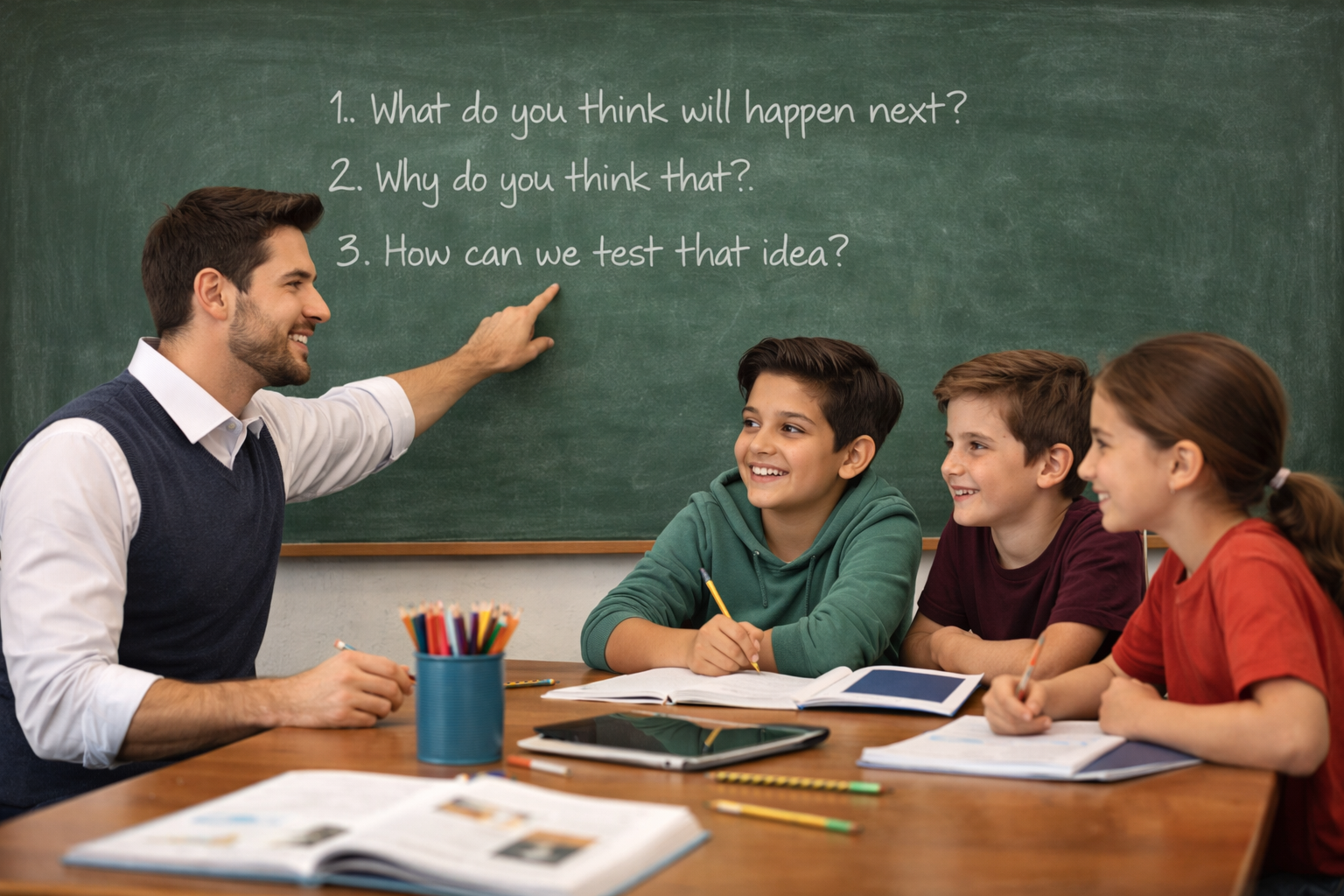
You must kill the lecture if you want to save the learner. The Socratic Method remains the most authoritative tool for deep understanding because it replaces the “sage on the stage” with a “guide on the side.” You do not provide answers. You provide questions that expose the gaps in a student’s logic. This method forces the student to engage in metacognition—the act of thinking about their own thinking.
Think about a physics class. You can tell a student that force equals mass times acceleration. They might memorize the equation. They likely do not understand it. Instead, you should ask them why it is harder to stop a slow-moving truck than a fast-moving bullet. This inquiry forces them to grapple with the concepts of momentum and inertia before they ever see the mathematical symbols.
Active inquiry triggers the release of dopamine, a neurotransmitter associated with curiosity and reward. This chemical state makes the brain more plastic and ready for encoding. When you give a student a solution, the brain goes into a “low-power” state. When you give them a puzzle, the brain lights up across multiple lobes. You are not just teaching physics. You are teaching the mechanics of reasoning.
Spaced Repetition and the End of the Cramming Culture
You have witnessed the “cram and forget” cycle throughout your career. It is the single most inefficient use of time in the history of human learning. The “Spacing Effect” is a phenomenon first documented in 1885 yet still ignored by most modern curricula. It proves that learning is vastly more durable when it is spread out over time.
If you study for ten hours in one night, you will likely pass the test the next morning. You will also forget almost everything within a week. If you study for one hour every three days for a month, your retention will last for years. This happens because the brain needs “incubation periods.” During sleep, the brain reprocesses information and strengthens the myelin sheath around neurons. Myelin is the “insulation” that allows electrical signals to travel faster. Deep understanding is, quite literally, a thickening of the brain’s wiring.
You should implement a “spiral curriculum” in your training or classroom. Never teach a concept once and move on. Revisit every core principle at increasing levels of complexity over the course of months. This forces the brain to re-retrieve the memory. Each retrieval event is a “re-encoding” event that makes the memory more resistant to interference.
Interleaving: The Secret to Pattern Recognition
Most educators use “blocked practice.” They teach Lesson A and then assign ten problems on Lesson A. This creates an illusion of competence. The student knows they are working on Lesson A, so they simply apply the formula without thinking. They are not learning how to solve a problem. They are learning how to repeat a pattern.
You must adopt “interleaving” to foster deep understanding. Mix up the problems. Give a student a worksheet that includes problems from Lesson A, Lesson B, and Lesson G. This forces the student to first identify the type of problem before they can solve it. This “discrimination task” is the essence of expertise.
A 2007 study of mathematics students found that those who used interleaved practice outperformed those who used blocked practice by a staggering 76 percent on long-term retention tests. Interleaving feels harder. It is more frustrating for the student. You must explain to them that this frustration is the sound of their brain actually growing. If the learning feels easy, it is likely shallow.
The Feynman Technique: Simple Language for Complex Mastery
Richard Feynman, the Nobel-winning physicist, developed a method that remains the gold standard for verifying deep understanding. He argued that if you cannot explain a concept to a child, you do not understand it yourself. This is the ultimate “BS detector” for the classroom.
You should require your students to write an explanation of a complex topic in plain English. They must avoid all jargon. Jargon is often a mask for a lack of understanding. If a student says “mitochondria is the powerhouse of the cell,” they are simply repeating a meme. If they must explain how a cell creates ATP without using the word “powerhouse,” they have to actually understand the chemical process.
This method exposes “knowledge fragments.” These are bits of information that a student has memorized but cannot connect to the larger whole. When you force them to simplify, you force them to find the “missing links” in their mental model. This is not just an exercise in communication. It is a diagnostic tool for the brain.
Retrieval Practice and the Testing Effect
You need to stop thinking of tests as assessment tools and start thinking of them as learning tools. The “Testing Effect” shows that the act of trying to remember something makes you more likely to remember it in the future. In fact, a study by Roediger and Karpicke in 2006 showed that students who spent more time testing themselves and less time studying performed significantly better on delayed exams.
When you read a textbook, you are engaging in “input.” This is a passive process. When you take a quiz or try to summarize a page from memory, you are engaging in “output.” Deep understanding is an output-driven process. The effort required to pull a memory from the recesses of your mind strengthens the retrieval cues.
You should implement low-stakes “no-grade” quizzes at the start of every session. Ask your students to write down the three most important things they learned in the previous week. Do not let them look at their notes. This “active recall” forces the brain to rebuild the neural pathways to that information. You are effectively “paving the road” to the data.
Concrete-Pictorial-Abstract: The Singapore Math Strategy
Singapore consistently ranks at the top of the PISA (Programme for International Student Assessment) rankings. Their secret is not more homework or longer school days. It is the CPA (Concrete-Pictorial-Abstract) method. Most western education systems jump straight to the “Abstract” stage. They give a child a variable like “x” or a formula before the child has a physical sense of the concept.
You must ground deep understanding in reality. First, the student must handle “Concrete” objects—actual blocks or physical items. Next, they move to the “Pictorial” stage where they represent those objects with drawings or bar models. Only then do they move to the “Abstract” stage of symbols and numbers.
This progression ensures that the symbol has meaning. Without this foundation, mathematics becomes a game of memorizing “magic spells” rather than understanding the logic of the universe. This method can be applied to any field. If you are teaching corporate strategy, start with a physical simulation of a supply chain before you ever show a spreadsheet. If you are teaching biology, start with a garden, not a diagram.
Elaborative Interrogation: Asking Why and How
Deep understanding is fueled by a relentless curiosity about causality. You should teach your students the method of “Elaborative Interrogation.” This involves asking “Why is this true?” for every fact they encounter.
If a student learns that the Titanic sank because it hit an iceberg, that is a surface fact. If you ask why the iceberg caused such catastrophic failure, they have to look into the brittle fracture of low-grade steel in freezing temperatures and the design of the “watertight” compartments.
By asking “why,” you force the brain to search for connections. This search process is what builds the mental schema. It moves the information from an isolated fact to a node in a larger network of understanding. This is especially vital in an age of misinformation. A student who understands “why” is much harder to manipulate than a student who only knows “what.”
Dual Coding: Leveraging the Brain’s Visual and Verbal Channels
The brain has two distinct channels for processing information—one for visual data and one for verbal data. This is known as Dual Coding Theory. Most teaching methods rely almost exclusively on the verbal channel. You talk, and the student listens or reads. You are leaving half of the brain’s processing power on the table.
Deep understanding happens when you provide both a verbal explanation and a visual representation. This is not about “learning styles,” which is a debunked myth. Every human brain is better at retaining information when it is encoded in two ways.
You should use infographics, timelines, and diagrams to complement your text. The visual should not be a decoration. It should be a structural map of the concept. When a student sees a visual relationship and hears a verbal explanation, the brain creates a “double-entry” memory. This makes the information twice as easy to find later.
Problem-Based Learning: The McMaster University Revolution
In 1969, McMaster University in Canada changed medical education forever by introducing Problem-Based Learning (PBL). They stopped giving lectures and started giving students “patient problems” from day one. This was a radical departure from the “learn the science first, see the patient later” model.
You should adopt this “challenge-first” approach. When you give a student a problem that they do not yet know how to solve, you create a “knowledge gap.” The brain hates knowledge gaps. It creates a state of cognitive tension that makes the student hungry for the information.
PBL teaches students how to “learn how to learn.” They have to identify what they don’t know, find the information, and apply it. This is exactly what they will have to do in their professional lives. Deep understanding is not about having a full head of facts. It is about having a functional toolkit for solving problems.
Collaborative Learning and the Protégé Effect
One of the most effective ways to deepen your own understanding is to teach someone else. This is known as the Protégé Effect. When you prepare to teach, your brain automatically organizes information more logically. You look for the “big picture” because you know you will have to explain it.
You should use peer-to-peer teaching in your environment. Ask your students to explain a concept to each other. When one student struggles to explain something, the other student often finds a new analogy that works. This social interaction adds an emotional layer to the memory, making it more durable.
Furthermore, collaborative learning teaches students how to navigate different perspectives. Deep understanding often comes from seeing the same concept from three different angles. If you only see it from your own perspective, your understanding is fragile. If you can explain it to someone who disagrees with you, your understanding is robust.
The Role of Metacognition: Thinking About Thinking
You cannot achieve deep understanding if you are a “blind” learner. You must be aware of your own cognitive state. Metacognition involves three phases: planning, monitoring, and evaluating.
Before a task, you ask: “What is my goal?” During the task, you ask: “Does this make sense?” After the task, you ask: “What would I do differently next time?” This constant self-monitoring prevents “mindless” learning. It ensures that the student is not just going through the motions.
Research shows that metacognitive skills are a better predictor of academic success than IQ. Why? Because a student with high metacognition knows when they don’t understand something. They don’t just keep reading the same paragraph over and over. They stop, identify the problem, and change their strategy. This is the difference between a student who “works hard” and a student who “works smart.”
Assessment Reform: Moving Beyond Multiple Choice
If you want deep understanding, you must stop using multiple-choice tests as your primary metric. Multiple-choice tests measure recognition, not recall. They encourage students to look for the “right answer” among a set of options rather than generating a solution from scratch.
You should use “authentic assessments.” These are tasks that mimic real-world applications of the knowledge. Instead of a test on history, ask the student to write a policy brief for a modern government based on historical precedents. Instead of a math test, ask them to design a functional object using the geometric principles they have learned.
Authentic assessment forces the student to “transfer” their knowledge. Transfer is the ultimate proof of deep understanding. If you can only use a concept in the classroom where you learned it, you don’t really know it. If you can take that concept and use it to solve a problem in a completely different context, you have achieved mastery.
Scaling Deep Learning in the 21st Century
You are living in an era where the total sum of human knowledge doubles every few years. In this environment, memorization is a dead end. You can never memorize enough to keep up. The only way to thrive is to possess a deep, flexible understanding of first principles.
This shift requires courage. It is faster and easier to give a lecture and a multiple-choice test. It is much harder to design a problem-based curriculum that allows for productive struggle. Yet, the cost of the easy path is a workforce that is technically proficient but intellectually hollow.
You have a choice. You can continue to treat education as a process of “filling a bucket,” or you can see it as “lighting a fire.” Deep understanding is the fire. It is the ability to take a spark of information and turn it into a blaze of innovation. This is not just a pedagogical choice. It is a moral imperative. You owe it to your students, your employees, and your society to teach for understanding.
The Future of Knowledge in an AI-Driven Society
Artificial Intelligence can memorize every book ever written. It can recite every formula and date in human history. If your value as a human is based on what you can remember, you are already obsolete. Your value now lies in your ability to synthesize, to ask the right questions, and to find connections that an algorithm cannot see.
Deep understanding is the human edge. It allows you to feel the “texture” of a problem. It allows for intuition, which is really just the subconscious application of deep-seated mental models. When you have deep understanding, you aren’t just a consumer of information. You are a creator of meaning.
You must embrace the urgency of this shift. The world is facing complex, existential threats that cannot be solved with rote answers. We need people who can think across boundaries. We need people who understand the “why” beneath the “what.” Start today. Change your questions. Change your methods. Give your students the gift of deep understanding.
References
The Ebbinghaus Forgetting Curve and the Science of Learning
Problem-Based Learning in Medical Education: A Review of the Literature
https://www.ncbi.nlm.nih.gov/pmc/articles/PMC4566331/
The Spacing Effect: A Case Study in the Reliability of Psychological Science
https://www.google.com/search?q=https://journals.sagepub.com/doi/abs/10.1177/0956797611429381
Interleaving as a Tool for Mathematical Learning
https://www.google.com/search?q=https://www.sciencedirect.com/science/article/pii/S0361476X1500007X
Richard Feynman and the Art of Simplification
https://fs.blog/feynman-technique/
The Testing Effect: Leveraging Memory for Learning
https://www.google.com/search?q=https://www.apa.org/science/about/psa/2006/06/roediger
Singapore Math: The CPA Approach and Its Global Impact
https://www.google.com/search?q=https://www.hmhco.com/blog/singapore-math-cpa-approach
The Role of Metacognition in Academic Performance
https://www.google.com/search?q=https://www.frontiersin.org/articles/10.3389/fpsyg.2019.01421/full
Dual Coding Theory and Education
https://www.learningscientists.org/dual-coding
The Protégé Effect: How Teaching Others Helps You Learn
https://www.google.com/search?q=https://effectiviology.com/protege-effect/
Author bio
Julian is a graduate of both mechanical engineering and the humanities. Passionate about frugality and minimalism, he believes that the written word empowers people to tackle major challenges by facilitating systematic collaborative progress in science, art, and technology. In his free time, he enjoys ornamental fish keeping, reading, writing, sports, and music. Connect with him here https://www.linkedin.com/in/juliannevillecorrea/
About The Author


