
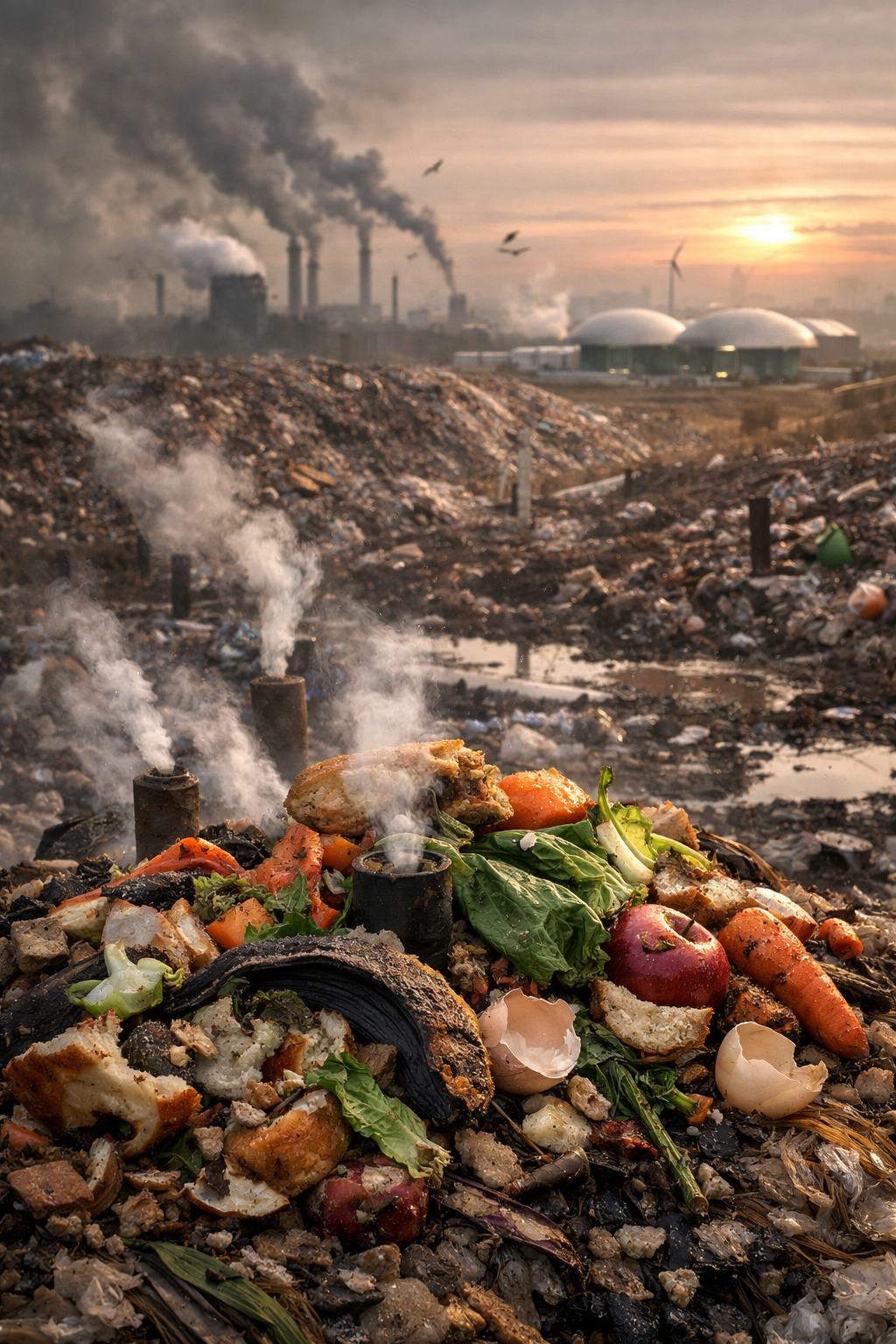
Your kitchen scraps are currently fueling a climate crisis that remains largely invisible to the average consumer. When you toss a half-eaten sandwich or a bunch of wilted spinach into the trash, you are not merely discarding organic matter. You are initiating a chemical reaction that produces methane, a greenhouse gas significantly more potent than carbon dioxide in the short term. The global food system currently accounts for roughly one-third of all human-caused greenhouse gas emissions. A massive portion of this environmental debt stems directly from the decomposition of organic matter in oxygen-deprived landfill environments.
The scale of this inefficiency is staggering. You likely assume that because food is biodegradable, it disappears harmlessly once buried. This assumption is false. Landfills are designed for storage, not decomposition. They are anaerobic environments, meaning they lack the oxygen necessary for aerobic bacteria to break down organic material into harmless compost. Instead, anaerobic microbes take over, producing methane as a byproduct. This gas traps heat in the atmosphere with eighty times the efficiency of carbon dioxide over a twenty-year period. You are essentially turning your leftovers into a slow-burning atmospheric furnace.
Why does the modern waste management system continue to rely on a model that actively accelerates climate change? The answer lies in historical infrastructure and a lack of legislative urgency. For decades, the primary goal of municipal waste management was sanitation and space. We optimized for getting trash out of sight as quickly as possible. We failed to account for the biochemical consequences of mixing organic waste with inorganic materials like plastics and metals. When food waste enters a landfill, it becomes a liability rather than the resource it should be.
Consider the sheer volume of this mismanagement. In the United States alone, food waste represents the single largest component of municipal solid waste reaching landfills and combustion facilities. You are looking at more than sixty-three million tons of food wasted annually. That represents nearly forty percent of the entire food supply. This is not just an environmental failure. It is a massive economic drain, costing billions of dollars in lost resources, labor, and energy. Every ton of food that rots in a landfill represents a failure in procurement, storage, and distribution.
How often do you consider the life cycle of the food on your plate? The journey from farm to landfill involves immense amounts of water, land, and energy. When that food is wasted, all those inputs are wasted as well. You are discarding the millions of gallons of water used for irrigation and the tons of fertilizer applied to the soil. You are also discarding the diesel fuel used for transport and the electricity used for refrigeration. The environmental footprint of food waste is cumulative. By the time a head of lettuce reaches a landfill, it has already accrued a massive carbon debt. The methane it releases upon decomposition is simply the final insult to the planet.
The timeline of food decomposition in a landfill is deceptively long. Because these sites are compacted to maximize space, very little air or water reaches the buried materials. Researchers have unearthed fifty-year-old newspapers that are still readable and hot dogs that look almost fresh. While food does eventually break down, the process takes decades. During that entire time, the landfill continues to vent methane into the atmosphere. Many modern landfills use gas capture systems, but these are never one hundred percent efficient. Significant amounts of gas escape before the capture systems are even installed or during the peak periods of decomposition.
You must also recognize the impact of leachate. This is the toxic liquid that forms as water trickles through the waste in a landfill. When food waste breaks down, it releases moisture that mixes with other chemicals in the trash. This creates a potent slurry that can contaminate local groundwater and soil if liners fail. Food waste accelerates the production of leachate, making landfill management more complex and expensive. You are paying for this through your taxes and utility fees, often without realizing the connection between your waste habits and municipal costs.
The societal cost of this waste is equally troubling. While millions of people face food insecurity, we continue to bury perfectly edible calories. The mismatch between supply and demand is a logistical embarrassment. Much of the food in landfills arrives there due to aesthetic standards or confusing date labels. You have been conditioned to reject a bruised apple or a slightly wilted carrot, even though their nutritional value remains intact. Retailers discard massive quantities of food because of “sell-by” dates that often have nothing to do with food safety. These labels are typically a manufacturer’s best guess at peak quality, not an expiration date.
What would happen if we treated food waste as a valuable commodity instead of trash? In a circular economy, organic waste becomes the input for the next cycle of production. Composting and anaerobic digestion are the two primary pathways for this transformation. Composting turns food scraps into nutrient-rich soil amendments that restore land health and sequester carbon. Anaerobic digestion captures methane in a controlled environment to produce renewable energy. Both methods prevent the release of uncontrolled greenhouse gases and return value to the local economy.
Why is adoption of these alternatives so slow? The primary barrier is infrastructure. Most cities lack the specialized collection services required for organic waste. You likely have a bin for trash and a bin for recycling, but do you have one for food scraps? Without a dedicated collection system, the burden falls on the individual to manage their own composting. While backyard composting is effective, it is not a viable solution for the millions of people living in high-density urban areas. We need systemic change at the municipal level to make organic waste diversion the default behavior.
Legislative pressure is beginning to mount in some regions. California and Vermont have passed laws that mandate the diversion of organic waste from landfills. These states recognize that meeting climate goals is impossible without addressing the food waste problem. These laws force businesses and residents to rethink their relationship with trash. They also create a market for composting facilities and bio-energy plants. You should look at these regions as a blueprint for the future of waste management. The transition is not without challenges, but the environmental and economic benefits are undeniable.
You can take immediate action to reduce your contribution to this problem. The most effective strategy is to prevent waste at the source. This requires a shift in how you shop, cook, and store food. Start by conducting a “waste audit” of your kitchen. For one week, keep track of every item you throw away. You will likely find patterns in your behavior. Perhaps you buy too much produce that spoils before you can eat it. Perhaps you cook portions that are too large for your household. Once you identify these patterns, you can adjust your habits accordingly.
Smart shopping is a powerful tool. Avoid the temptation of bulk purchases unless you have a clear plan for using the items. Meal planning is another effective strategy. By deciding what you will eat before you go to the store, you reduce the likelihood of impulse buys that end up in the trash. You should also learn the difference between “use by,” “sell by,” and “best if used by” labels. Trust your senses. If a food item looks, smells, and tastes fine, it is likely safe.
Proper storage is also critical. Many people store produce incorrectly, which leads to premature spoilage. For example, keeping onions and potatoes together causes them to rot faster. Storing greens in a damp paper towel can extend their life by several days. By mastering these simple techniques, you can significantly reduce the amount of food you discard. You are not just saving the planet. You are saving money. The average family of four loses nearly fifteen hundred dollars a year to wasted food.
What role do corporations play in this crisis? The retail and hospitality sectors are responsible for a massive share of food waste. Supermarkets often overstock shelves to create an illusion of abundance, knowing that a portion of the inventory will never be sold. Restaurants serve oversized portions that lead to significant plate waste. These businesses must be held accountable for their waste streams. Some forward-thinking companies are partnering with food recovery organizations to donate surplus food to those in need. This is a win-win scenario that reduces landfill waste while addressing hunger.
Technological innovation offers promising solutions as well. Startups are developing “smart” labels that change color when food actually spoils, providing a more accurate measure of safety than static date stamps. Other companies are using artificial intelligence to help grocery stores and commercial kitchens optimize their inventory management. By predicting demand more accurately, these tools can prevent waste before it happens. You should support the adoption of these technologies in the businesses you frequent.
The energy potential of food waste is another area ripe for development. Anaerobic digesters can process large volumes of organic matter to produce biogas, which can be used to generate electricity or fuel vehicles. The leftover solids, known as digestate, are an excellent fertilizer. This process turns a waste problem into an energy solution. If we scaled this technology globally, we could significantly reduce our reliance on fossil fuels while simultaneously solving the landfill methane problem.
You must also consider the geopolitical implications of food waste. As the global population grows, the demand for food will increase. We cannot afford to waste forty percent of what we produce while trying to feed ten billion people. Food waste is a luxury of the developed world that the planet can no longer sustain. By reducing waste, we can lower the pressure on global food prices and reduce the need for further deforestation to create new farmland.
How do we change the cultural narrative around food? We have lost our connection to the source of our nourishment. For most of human history, food was scarce and highly valued. In the modern era, food has become a cheap commodity that we treat as disposable. We need to rediscover the value of life and nature. Every piece of fruit is a product of months of biological labor. Every grain of rice is a miracle of photosynthesis and soil health. When you respect the food on your plate, you are less likely to throw it away.
Education is a key component of this cultural shift. We need to teach the next generation about the environmental impact of their choices. Schools should incorporate composting into their curriculum and encourage students to minimize waste in the cafeteria. By normalizing these behaviors at a young age, we can create a society that views landfilling food as an unacceptable practice. You have the power to influence this change in your own community.
The fight against food waste is also a fight for environmental justice. Landfills are disproportionately located in low-income communities and communities of color. These populations bear the brunt of the pollution, odors, and health risks associated with waste management. When you reduce your food waste, you are helping to alleviate the burden on these communities. This is a matter of equity as much as it is a matter of ecology.
Is the goal of “zero waste” realistic? While achieving absolute zero may be difficult, the pursuit of it is essential. Every ton of food diverted from a landfill is a victory. The transition requires a combination of individual responsibility, corporate accountability, and government intervention. You cannot rely on any single one of these factors to solve the problem in isolation. It must be a collaborative effort.
Think about the legacy you want to leave. Do you want to be remembered as part of a generation that buried its resources in the dirt while the atmosphere warmed? Or do you want to be part of the generation that recognized the value of the Earth’s bounty and built a system to preserve it? The choice is made every time you stand over your trash can.
The economics of food waste are shifting. As landfill fees rise and the cost of carbon emissions becomes clearer, the financial incentive to divert organic waste will grow. Businesses that ignore this trend will face higher operating costs and reputational damage. Those that lead the way will find new opportunities for efficiency and innovation. You can accelerate this transition by voting with your wallet and supporting companies that prioritize sustainability.
We must also address the issue of “greenwashing” in the waste industry. Many products are marketed as “compostable” or “biodegradable” but require industrial facilities to break down. If these items end up in a standard landfill, they produce the same methane as any other organic matter. You must be an informed consumer and understand the disposal requirements for the products you buy. True sustainability requires transparency and honesty throughout the supply chain.
The relationship between food waste and water scarcity is often overlooked. Agriculture accounts for seventy percent of global freshwater use. When you throw away a pound of beef, you are effectively throwing away eighteen hundred gallons of water. In a world facing increasing droughts and water shortages, this is an unconscionable waste of a vital resource. Your eating discipline and waste habits are directly linked to the global water crisis.
What can you do today? Start small but be consistent. Composting your coffee grounds and eggshells is a great first step. Supporting your local farmers market reduces the carbon footprint of your food and often results in fresher produce that lasts longer. Talk to your neighbors and local officials about starting a community composting program. The power of collective action is immense.
The sense of urgency cannot be overstated. We are reaching tipping points in our climate system that may be irreversible. Addressing the methane emissions from landfills is one of the fastest and most cost-effective ways to slow global warming. Unlike carbon dioxide, which stays in the atmosphere for centuries, methane breaks down relatively quickly. This means that reducing methane emissions today will have a near-immediate impact on the rate of warming. We have a narrow window of opportunity to make a difference.
You must challenge the assumption that waste is inevitable. Waste is a design flaw. It is a sign of an inefficient system that fails to account for the true cost of resources. By redesigning our food system to be more resilient and less wasteful, we can create a world that is more abundant and more sustainable for everyone. This is not just about trash. It is about how we value life and the planet that sustains us.
The food you eat is a gift from nature. It is the result of millions of years of evolution and the hard work of countless humans. To treat it as garbage is a profound lack of gratitude. We must move toward a future where every calorie is accounted for and every resource is respected. This transition requires a fundamental change in our mindset. It requires us to stop seeing ourselves as consumers and start seeing ourselves as stewards.
Your role in this transformation is vital. You are not just a passive observer of the climate crisis. You are an active participant whose daily choices have a global impact. Every time you save a piece of fruit from the landfill, you are making a statement. You are saying that you value the environment, you value your community, and you value the future.
The journey toward a waste-free world is long, but the path is clear. We have the technology, we have the knowledge, and we have the moral imperative. What we need now is the will to act. You can be the catalyst for this change. You can lead by example and inspire others to do the same. The time for excuses is over. The time for action is now.
Reflect on the environmental debt we are accumulating. Every landfill is a monument to our inefficiency. We are literally burying our future in the ground. But we can choose a different path. We can choose to build a world where waste is a thing of the past and sustainability is the foundation of our society. This is the great challenge of our time, and it is a challenge we must meet together.
The complexity of the global food chain often makes individuals feel powerless. You might think your small contribution doesn’t matter in the face of industrial-scale waste. This is a fallacy. Industry follows demand. When you change your habits, you shift the market. When enough people demand better waste management and more sustainable products, corporations and governments will respond. Your power as a citizen and a consumer is the ultimate driver of systemic change.
Consider the role of technology in monitoring waste. We now have the ability to track food from farm to fork with incredible precision. Blockchain technology can improve transparency in the supply chain, allowing you to see exactly where your food comes from and how it was produced. Sensors in transport containers can monitor temperature and humidity to prevent spoilage during transit. These tools are becoming increasingly affordable and accessible. By advocating for their use, you can help eliminate the “blind spots” where waste occurs.
We must also rethink our definition of “food.” In many cultures, parts of plants and animals that we currently discard are considered delicacies or essential ingredients. We have become picky eaters in the West, often ignoring the nutritional value of stems, skins, and offal. By expanding our culinary horizons and practicing “nose-to-tail” or “root-to-stem” cooking, we can significantly reduce the amount of organic matter that enters the waste stream. This is a form of eating discipline that honors the entire organism.
The impact of food waste on biodiversity is another critical concern. As we expand agricultural land to compensate for what we waste, we destroy natural habitats and drive species to extinction. Reducing food waste is one of the most effective ways to slow habitat loss and protect the Earth’s biological diversity. You are not just saving food; you are saving the complex web of life that supports us all.
Urgency is required because the infrastructure for a sustainable future takes time to build. We cannot wait until the climate crisis reaches a breaking point to start constructing composting facilities and anaerobic digesters. We must invest in these systems now. You can support this by advocating for green bonds and other financial instruments that fund sustainable infrastructure. Your voice in the local planning process is essential.
The connection between food waste and global health should not be ignored. Rotting food in landfills attracts pests and can spread disease. The air pollution from landfill gases contributes to respiratory problems in nearby communities. By diverting food waste, we improve public health and create cleaner, safer environments for everyone. This is a tangible benefit that you can see and breathe in your own community.
You are living in a pivotal moment in human history. We are the first generation to truly understand the environmental consequences of our actions and the last generation with the chance to prevent catastrophic climate change. Our relationship with food is a central part of this struggle. It is a reflection of our values, our priorities, and our vision for the future.
The hidden methane bomb in our landfills is ticking. But it is a bomb we can defuse. Through a combination of individual action, technological innovation, and aggressive policy changes, we can turn the tide on food waste. We can transform our landfills from sources of pollution into sites of recovery. We can build a food system that nourishes both people and the planet.
This is the work of a lifetime. It requires persistence, dedication, and a willingness to challenge the status quo. But the rewards are worth the effort. A world without food waste is a world that is more equitable, more resilient, and more beautiful. It is a world where we live in harmony with nature instead of in opposition to it.
Take a moment to appreciate the incredible complexity of the natural world. Think about the soil, the sun, and the water that produced the food in your pantry. Feel the weight of the responsibility we carry to protect these resources. Let that feeling drive you to make better choices. Let it give you the strength to demand change from those in power.
We are all in this together. The air we breathe, the water we drink, and the soil that grows our food are shared resources. When we waste food, we are stealing from ourselves and from future generations. It is time to stop the theft. It is time to start building a future where nothing is wasted and everything is valued.
The editorial voice of this analysis is meant to provoke you. It is meant to make you uncomfortable with the current state of affairs. But it is also meant to empower you. You have the knowledge and the tools to make a difference. The question is: will you use them?
The environmental impact of food waste in landfills is a clear and present danger. But it is also a solvable problem. We know what we need to do. We just need to do it. The path forward is through discipline, innovation, and a profound respect for the natural world.
Your journey toward a more sustainable lifestyle starts with your next meal. Think about where it came from. Think about how much of it you really need. And think about where it will go if you don’t finish it. These small moments of reflection are the seeds of a global revolution.
The transition to a circular food economy is not just a technical challenge; it is a moral one. It is an opportunity to redefine our relationship with the Earth and with each other. By choosing to reduce waste, you are choosing a more hopeful future. You are choosing life.
Maintain this sense of urgency in everything you do. The planet does not have time for half-measures or empty promises. It needs bold action and unwavering commitment. You are the one the planet has been waiting for.
References
Food Waste and its Environmental Impact: A Global Perspective
http://www.fao.org/food-loss-and-food-waste/en/
The Economic Cost of Food Waste in the United States
http://www.feedingamerica.org/our-work/reduce-food-waste
Methane Emissions from Landfills: Sources and Solutions
http://www.epa.gov/lmop/basic-information-about-landfill-gas
The Role of Anaerobic Digestion in a Circular Economy
http://www.epa.gov/agstar/benefits-anaerobic-digestion
California’s Organic Waste Methane Diversion Law (SB 1383)
http://www.calrecycle.ca.gov/organics/slcp
Global Biodiversity and the Food System
http://www.worldwildlife.org/threats/food-waste
Leachate Management and Environmental Risks
https://www.google.com/search?q=www.sciencedirect.com/topics/engineering/landfill-leachate
The Truth About Food Date Labels
http://www.nrdc.org/resources/truth-about-expired-food-labels
Smart Technology in the Fight Against Food Waste
http://www.refed.org/food-waste-solutions/
The Social Impact of Food Insecurity and Waste
http://www.worldfoodprogram.org/food-waste-and-hunger
Author bio
Julian is a graduate of both mechanical engineering and the humanities. Passionate about frugality and minimalism, he believes that the written word empowers people to tackle major challenges by facilitating systematic collaborative progress in science, art, and technology. In his free time, he enjoys ornamental fish keeping, reading, writing, sports, and music. Connect with him here https://www.linkedin.com/in/juliannevillecorrea/
About The Author


