
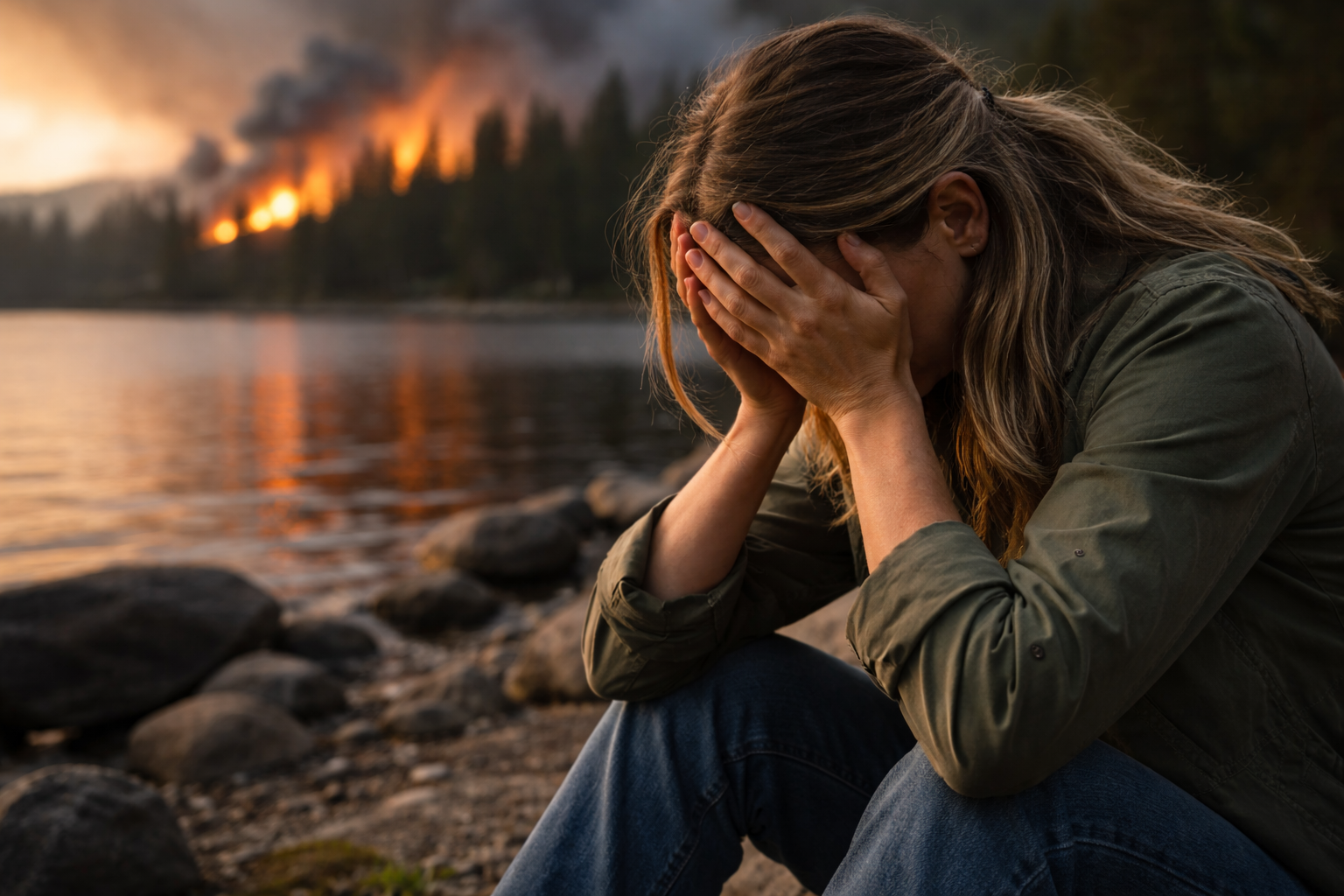
The Diagnostic and Statistical Manual of Mental Disorders does not yet list climate anxiety as a clinical condition, but the healthcare industry is already struggling to manage its fallout. You are witnessing a massive, uncatalogued psychological shift. For the first time in human history, a global environmental threat is overriding local survival instincts. If you feel a persistent sense of dread when you look at a clear blue sky or a late-season heatwave, you are not suffering from a malfunction. You are responding to a high-fidelity signal of systemic collapse.
Evidence suggests that this distress is not a peripheral issue for the worried well. A 2021 study involving 10,000 young people across ten countries found that 45 percent of respondents said their feelings about climate change negatively affected their daily functioning. You see this in the rising rates of “eco-anxiety” among urban professionals and rural farmers alike. The urgency is undeniable. We are past the point of discussing “awareness.” We are now in a period of psychological survival.
The Myth of the Rational Observer
You likely believe that you can remain objective about the environmental data you consume. This is a fallacy. Your brain is not built to process the concept of planetary boundaries while maintaining emotional equilibrium. When you read that the Earth recently breached the 1.5 degree Celsius warming threshold for a full year, your nervous system interprets that information as a direct threat to your immediate safety.
This creates a state of chronic hyper-vigilance. You find yourself scanning the horizon for the next disaster. You check weather reports not for convenience, but for confirmation of your fears. This cycle is exhausting. It drains your cognitive bandwidth and leaves you susceptible to burnout in other areas of your life. Why do we continue to treat this as a personal failing rather than a predictable outcome of our current industrial trajectory?
The Symptom Profile of the Anthropocene
You must identify the specific ways climate anxiety manifests to address it effectively. It rarely looks like a panic attack. Instead, it looks like a slow erosion of your future-oriented thinking.
- You experience “solastalgia,” a term for the distress caused by environmental change in your home area. You see your local landscape changing, and you feel like a stranger in your own town.
- You practice “doomscrolling” until late at night, seeking more data on melting permafrost or oceanic acidification, hoping that more information will somehow provide a sense of control.
- You feel a crushing sense of guilt for every consumer choice, from the coffee you buy to the car you drive, even though you know your individual impact is statistically insignificant.
- You experience intrusive thoughts about the viability of your long-term plans. You wonder if you should buy a house, start a family, or save for a retirement that might never happen in a recognizable world.
- You feel isolated from peers or family members who do not share your level of concern. This leads to social withdrawal and a sense of “otherness” that compounds your stress.
Does this sound like a disorder, or does it sound like an honest appraisal of the facts? The medical community is currently debating whether to pathologize these feelings. Some argue that labeling this as “anxiety” ignores the reality of the threat. They suggest that the absence of anxiety in the face of current climate data is the true pathology.
The Economic Consequences of Psychological Paralysis
Your mental state has a direct impact on the global economy. In the United States, mental health conditions already cost the economy over 200 billion dollars annually in lost productivity and healthcare expenses. As climate anxiety scales, these costs will skyrocket.
You see this in the “brain drain” occurring in industries that are high-emitters or climate-vulnerable. Young, talented professionals are increasingly refusing to work for companies that lack aggressive sustainability goals. This isn’t just a moral choice. It is a protective measure for their own mental health. They cannot reconcile their daily labor with the destruction of their future. If you are an employer, ignoring the climate anxiety of your workforce is a massive strategic risk.
Why the 24-Hour News Cycle is Your Greatest Enemy
The way you consume information is killing your resilience. Modern media is optimized for engagement, and fear is the most effective engagement tool. You are being fed a constant stream of “tipping points” and “final warnings” that trigger your amygdala without offering any path for action.
This creates a state of “learned helplessness.” When you are repeatedly exposed to a threat that you cannot escape or influence, your brain eventually gives up. You become paralyzed. You stop taking the small, meaningful actions that actually matter because they seem futile against the backdrop of global catastrophe. To cope, you must break this cycle. You must move from being a consumer of tragedy to a participant in solutions.
The Delusion of Individual Responsibility
For decades, the fossil fuel industry has funded marketing campaigns designed to make you feel responsible for climate change. They want you to focus on your “carbon footprint”—a term popularized by British Petroleum—so that you don’t focus on their regulatory lobbying.
This strategy has been incredibly successful. It has successfully shifted the burden of global systemic failure onto your shoulders. Your climate anxiety is often fueled by this misplaced sense of responsibility. You feel like a failure because you cannot live a perfectly sustainable life in an unsustainable system. You must reject this narrative. You are not the problem. The infrastructure you are forced to live in is the problem. Shifting your focus from individual purity to systemic advocacy is the single most important thing you can do for your mental health.
How to Build Psychological Resilience
Coping is not about making the fear go away. It is about building the capacity to hold the fear without being crushed by it. You need a strategy that addresses the cognitive, emotional, and physical aspects of climate distress.
First, you must limit your exposure to raw, uncontextualized data. Stop following every breaking news story about environmental disasters. Instead, subscribe to deep-dive investigative journalism and scientific journals that offer nuance and long-term perspectives. Seek out “solutions-based” reporting. This isn’t “toxic positivity.” It is a factual accounting of the progress being made in renewable energy, carbon capture, and regenerative agriculture. You need to see the whole picture, not just the parts that bleed.
Second, you must find your community. Isolation is where anxiety thrives. When you join a local climate action group or a therapy circle focused on environmental grief, you realize that your feelings are a shared social reality. This validation is powerful. It moves your anxiety from the private sphere into the public sphere, where it can be transformed into collective power.
Third, engage in “radical acceptance.” This does not mean giving up. It means accepting that the world is changing and that the future will look different than the past. When you stop fighting the reality of the situation, you can start preparing for it. This shift from denial to preparation is a major stress reducer. It gives you a sense of agency in an uncertain environment.
The Role of Nature in Recovery
It is a bitter irony that the very thing causing your distress—the changing environment—is also the best tool for your recovery. You must spend time in the natural world, even as it changes.
Studies show that spending time in “green spaces” lowers cortisol levels and improves heart rate variability. If you live in an urban environment, even small “pocket parks” can have a significant effect. Why do we prioritize digital connection over biological connection? Your body needs to remember that the Earth is still here, still breathing, and still worth fighting for.
The Decision to Have Children: An Existential Crisis
Perhaps the most profound sign of climate anxiety is the shifting attitude toward reproduction. You see a growing movement of people who are “BirthStrikers,” pledging not to have children because of the climate crisis.
This is a logical extension of the dread you feel. You are questioning whether it is ethical to bring a new life into a world that might be characterized by scarcity and instability. This is not a choice made lightly. It is a form of deep, existential grief. If you are struggling with this decision, know that you are part of a massive demographic shift that will reshape the 21st century. This is not a personal neurosis. It is a collective response to a perceived lack of safety.
Transforming Fear into Political Power
The most effective “coping mechanism” for climate anxiety is not found in a therapist’s office. It is found in the voting booth and on the picket line. When you take action that addresses the root cause of your fear, your anxiety naturally decreases.
You must move beyond lifestyle changes. Switching to an electric vehicle or eating less meat might make you feel better temporarily, but it won’t stop the underlying dread. You need to see systemic change. This means advocating for carbon taxes, ending fossil fuel subsidies, and demanding that your local government invest in resilient infrastructure. When you see your city building sea walls or expanding public transit, your brain receives a signal that the adults are in the room.
The Importance of Climate-Aware Therapy
The mental health profession is starting to catch up to the reality of the Anthropocene. A new field of “climate-aware therapy” is emerging. These practitioners do not try to “fix” your climate anxiety. They don’t suggest that your fears are irrational. Instead, they help you integrate your concerns into a functional life.
If you are seeking professional help, you must find a therapist who understands the systemic nature of your distress. If a therapist suggests that your climate grief is actually “displaced anger” toward your parents, find a new therapist. You need someone who can help you navigate the unique challenges of living in a warming world.
The False Promise of “Techno-Optimism”
You might be tempted to soothe your anxiety by believing that a “silver bullet” technology will save us at the last minute. This is a dangerous form of coping. It encourages passivity and prevents you from doing the hard work of adaptation and mitigation.
Reliance on unproven technologies like large-scale geoengineering or nuclear fusion “just around the corner” is a form of scientific gambling. It doesn’t reduce your anxiety. It just masks it with a thin layer of hope that can easily be shattered by the next negative news cycle. True resilience comes from facing the facts and acting anyway, not from waiting for a miracle.
Practical Steps for Your Daily Routine
You need a toolkit of immediate actions you can take when the dread becomes overwhelming.
- Practice “environmental grounding.” When you feel a panic attack coming on, step outside and identify five things you can see, four things you can touch, and three things you can hear in your local ecosystem.
- Set “worry windows.” Allow yourself 20 minutes a day to feel the full weight of the climate crisis. When the timer goes off, pivot to a task that requires your full attention.
- Curate your social media feeds. Unfollow accounts that only post “doom” and follow accounts that post about successful conservation projects and renewable energy breakthroughs.
- Engage in “active hope.” Identify one local environmental problem you can actually influence. Maybe it is the lack of bike lanes on your street or the use of pesticides in your local park. Focus your energy there.
- Focus on physical health. Anxiety is physically demanding. You cannot fight a global crisis if you are sleep-deprived and malnourished.
The Necessity of Intergenerational Dialogue
You see a massive divide in how different generations perceive and react to climate change. For Gen Z and Millennials, this is a life-defining crisis. For older generations, it can sometimes feel like a distant threat.
This disconnect causes immense stress in families. If you are a young person feeling dismissed by your parents, or an older person feeling blamed by your children, you must find a way to talk about the emotional reality of the situation. We need an intergenerational pact. The wisdom and resources of older generations must be combined with the urgency and innovation of younger generations. This collaboration is a form of social resilience that can buffer against individual anxiety.
Is Anxiety the Only Reasonable Response?
We must stop treating climate anxiety as something to be cured. It is a rational, appropriate, and even healthy response to a global emergency. Your anxiety is a sign that your values are in the right place. It means you are awake to the reality of the world.
The goal is not to eliminate the anxiety, but to prevent it from becoming a debilitating disorder. We need your anxiety. We need the energy it provides. If everyone felt a healthy level of climate anxiety, we would have solved this crisis decades ago. The challenge is to use that energy to build a world that is worth living in.
The Role of the Workplace in Climate Resilience
As you spend a significant portion of your life at work, your professional environment plays a massive role in your mental health. Companies that ignore the climate crisis are creating a toxic environment for their employees.
If you are a manager, you must recognize that your team is likely struggling with these issues. You need to create space for these conversations. You need to show that your organization is part of the solution. This might mean divesting the company’s pension fund from fossil fuels or implementing radical energy-saving measures in the office. These actions don’t just help the planet. They improve the mental health and productivity of your staff.
The Global South and the Inequity of Anxiety
You must recognize that climate anxiety is a luxury that many in the Global South cannot afford. In regions where the climate crisis is already causing famine, displacement, and conflict, the response is not “anxiety”—it is “survival.”
Your anxiety in the Global North is often a response to a future threat. For millions of people in the Global South, the threat is current and physical. This realization should not increase your guilt. It should increase your resolve. Your anxiety can be a bridge to solidarity. Use your platform and your resources to support those on the front lines of the crisis. This outward focus is a powerful antidote to self-centered dread.
Why We Need a New Language for Grief
Our current language for loss is inadequate for the scale of the climate crisis. We are used to grieving for individuals, not for biomes. We need to develop a new vocabulary for “ecological grief.”
When we name these feelings, we take away their power to haunt us in the dark. We turn a vague sense of unease into a specific, manageable emotion. If you feel like you are losing a part of yourself when a forest burns, acknowledge that. Don’t call it “stress.” Call it “loss.” This honesty is the first step toward healing.
The Resilience of the Human Spirit
Throughout history, humans have faced existential threats. We have survived ice ages, plagues, and world wars. While the climate crisis is unique in its scale and complexity, our capacity for resilience is also unique.
You come from a long line of survivors. Your ancestors navigated radical changes in their environment. You have that same capacity within you. Your climate anxiety is not a sign that you are broken. It is a sign that you are an active participant in the most important chapter of the human story. You are the generation that will decide the future of life on this planet. That is a heavy burden, but it is also a profound privilege.
Moving Beyond the “End of the World” Narrative
We must stop talking about the “end of the world.” The world will not end. It will change. Civilizations have risen and fallen before. What we are facing is the end of a specific, high-carbon way of life.
When you frame the crisis as the “end of the world,” you create a binary choice: either we fix everything, or we all die. This binary is a recipe for despair. The reality is much more complex. There are infinite shades of “better” and “worse” in our future. Every fraction of a degree of warming that we prevent matters. Every ecosystem we protect matters. When you realize that the future is a spectrum of possibilities, you find the motivation to keep fighting for the best possible outcome.
Actionable Takeaways for Long-Term Coping
- Audit your information intake. Choose quality over quantity.
- Focus on systemic change rather than individual perfection.
- Build a local support network of like-minded individuals.
- Spend time in nature to regulate your nervous system.
- Use your anxiety as fuel for political and community advocacy.
- Seek professional help from climate-aware therapists if your daily functioning is impaired.
- Advocate for climate resilience in your workplace.
- Engage in intergenerational dialogue to bridge the “concern gap.”
- Reframe your grief as a sign of your deep connection to the Earth.
- Focus on the tangible progress being made in your local community.
The climate crisis is a marathon. You cannot win it if you are exhausted before you even start. Prioritize your mental health not just for your own sake, but for the sake of the movement. A resilient person is a dangerous person to the status quo. By refusing to give in to despair, you are taking the most radical action possible.
References
The Lancet Planetary Health: Climate anxiety in children and young people and their beliefs about government responses to climate change: a global survey
https://www.thelancet.com/journals/lanplh/article/PIIS2542-5196(21)00278-3/fulltext
American Psychological Association: Mental Health and Our Changing Climate
https://www.apa.org/news/press/releases/2017/03/mental-health-climate.pdf
The Carbon Majors Database: CDP Carbon Majors Report 2017
Yale Program on Climate Change Communication: Climate Change in the American Mind
World Health Organization: Mental health and Climate Change: Policy Brief
https://www.who.int/publications/i/item/9789240045125
Harvard Health: 5 ways to cope with climate anxiety
Climate Psychology Alliance: Resources for Coping with Climate Distress
Nature: The mental health costs of climate change
https://www.google.com/search?q=https://www.nature.com/articles/s41558-018-0102-y
NASA: Global Climate Change Vital Signs of the Planet
IPCC: Summary for Policymakers of IPCC Special Report on Global Warming of 1.5 C
https://www.ipcc.ch/sr15/chapter/spm/
Author bio
Julian is a graduate of both mechanical engineering and the humanities. Passionate about frugality and minimalism, he believes that the written word empowers people to tackle major challenges by facilitating systematic collaborative progress in science, art, and technology. In his free time, he enjoys ornamental fish keeping, reading, writing, sports, and music. Connect with him here https://www.linkedin.com/in/juliannevillecorrea/
About The Author


