
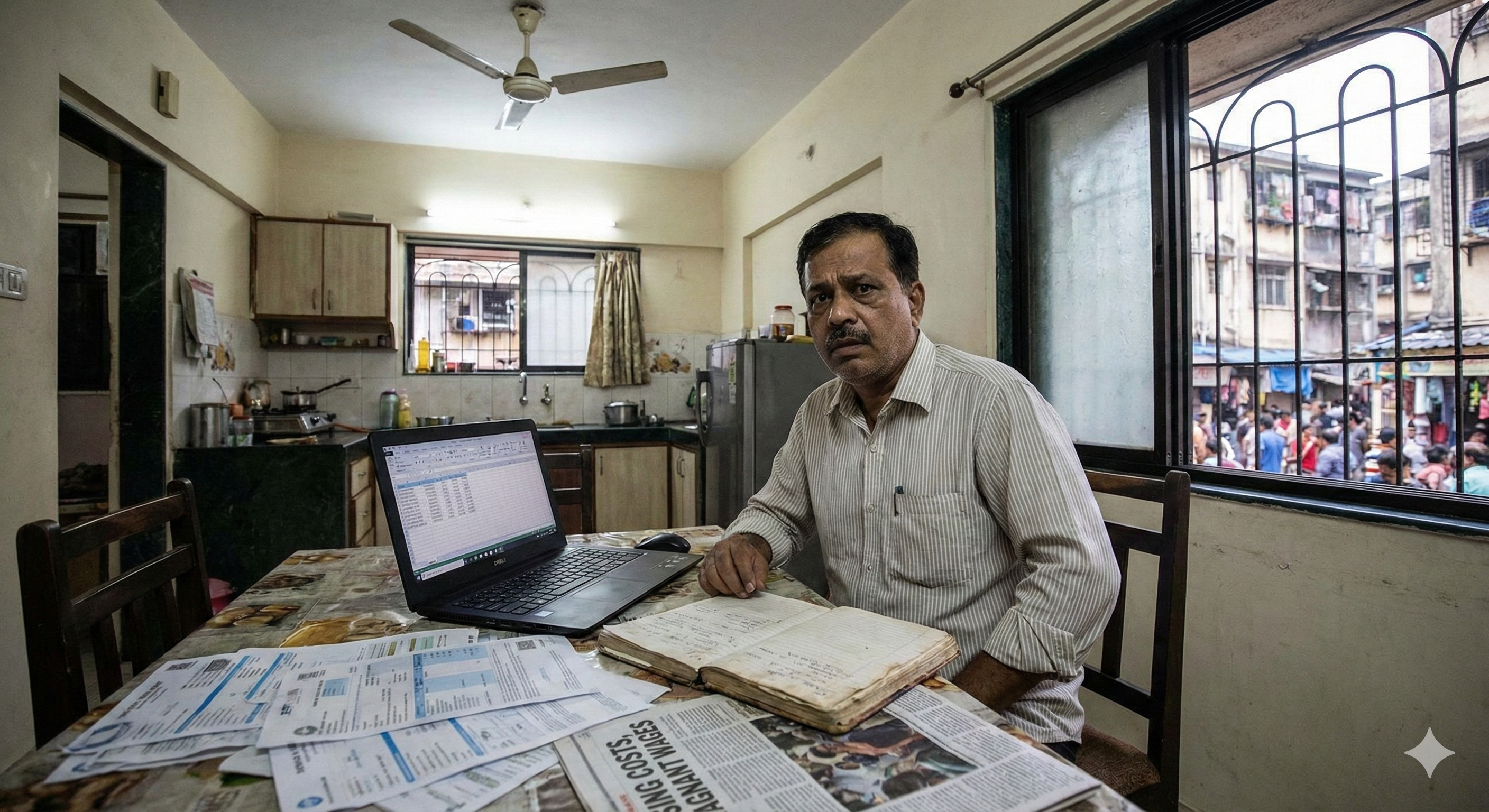
India’s GDP growth figures look strong on paper. Stock markets hit record highs. Startup valuations dominate headlines. Government infrastructure announcements project expansion and confidence.
Yet household savings rates have declined in recent years. Consumer credit usage has surged. Urban cost-of-living anxiety has become a recurring dinner-table theme.
You need to examine a tension that rarely receives sustained attention: India’s middle class appears aspirational and consumption-driven, yet financially strained beneath the surface.
The Shrinking Cushion
The Reserve Bank of India has flagged a steady rise in household debt levels relative to income in recent years. Credit card usage has expanded sharply across urban centers. Personal loan growth has accelerated. Buy-now-pay-later options have normalized installment living.
At the same time, household financial savings as a percentage of GDP have fluctuated downward compared to earlier peaks.
This combination signals a shift.
Middle-class households increasingly rely on credit to maintain lifestyle expectations. When credit substitutes for savings, vulnerability increases.
One unexpected medical expense, job loss, or business slowdown can destabilize financial planning.
The pressure remains quiet because consumption continues.
Lifestyle Inflation and Urban Realities
India’s metropolitan cities now rank among the most expensive in South Asia for housing relative to median incomes. Rental markets in Mumbai, Bengaluru, Delhi NCR, and Hyderabad have tightened significantly in recent years.
Add to that:
-
Rising school fees in private institutions
-
Escalating healthcare costs
-
Transportation expenses
-
Digital subscriptions and utility inflation
-
Social spending expectations around weddings and festivals
Urban middle-class households juggle multiple recurring costs. Salary increments often fail to match cumulative inflation in essential services.
When income growth lags lifestyle inflation, stress accumulates.
You might not see crisis headlines. You will see delayed home ownership, postponed child planning, and cautious discretionary spending.
The Education Burden
Education remains the primary mobility strategy for the middle class. Coaching fees, private school tuition, extracurricular activities, and international degree aspirations create sustained financial commitments.
Parents allocate a significant portion of annual income toward academic investment. In many families, education expenses rival housing EMIs.
The coaching economy you examined earlier intersects directly with middle-class anxiety. Families invest heavily in preparation because they perceive limited margin for failure.
When opportunity narrows, spending intensifies.
Education becomes both hope and burden.
Healthcare and Insurance Gaps
India’s public healthcare infrastructure remains uneven. Middle-class households often rely on private hospitals for perceived quality and speed of service.
Out-of-pocket health expenditure remains substantial. Insurance penetration has increased, yet coverage limits often fall short during major medical events.
A single hospitalization can erode years of savings.
This vulnerability influences financial behavior. Households maintain emergency funds. Many also rely on informal family networks for crisis support.
Economic pressure remains silent because extended families absorb shocks collectively.
The Credit Expansion Era
The proliferation of digital lending apps, fintech platforms, and easy credit approvals has reshaped consumption patterns.
Young professionals now access personal loans within minutes. Credit cards come with reward ecosystems that incentivize spending. EMIs fragment large purchases into manageable monthly commitments.
This environment creates illusionary affordability.
You may feel financially stable while carrying layered debt obligations across multiple instruments.
As long as employment remains stable, the system functions. Economic slowdown exposes fragility.
Job Market Uncertainty
White-collar job security no longer carries the predictability it once did. Layoffs in tech and startup sectors have affected urban professionals. Contractual employment models expand. Gig economy participation increases.
Middle-class planning traditionally relied on stable salaried growth. When career trajectories become nonlinear, long-term financial planning becomes complex.
You may hesitate to upgrade housing. You may delay major investments. You may accumulate precautionary savings while managing debt.
This behavioral shift influences macroeconomic demand patterns.
The Social Comparison Engine
Social media intensifies middle-class pressure.
Lifestyle visibility has expanded. Travel photos, property purchases, luxury consumption, and career announcements circulate constantly.
Comparison shapes aspiration. Aspiration shapes spending.
When you perceive peers advancing rapidly, you may accelerate consumption to maintain perceived parity.
Financial decisions increasingly intertwine with social signaling.
The Housing Dilemma
Home ownership remains a core middle-class milestone. Property prices in major cities have outpaced median income growth in many segments. Down payments require years of disciplined saving.
Mortgage tenures often extend twenty to thirty years.
You must ask whether home ownership remains feasible without dual incomes in metropolitan centers.
When housing consumes a disproportionate share of income, flexibility reduces. Career risk-taking declines. Entrepreneurship becomes harder.
Housing affordability shapes economic dynamism.
Taxation and Disposable Income
The middle class frequently expresses frustration over tax burden perceptions. Direct tax compliance rates remain relatively concentrated within formal salaried sectors.
While infrastructure improvements and welfare schemes expand nationally, the salaried middle class often feels squeezed between rising indirect taxes and limited subsidy eligibility.
Perception matters as much as data.
If taxpayers feel unsupported in health, education, and retirement security, economic anxiety deepens.
The Invisible Trade-Offs
The silent pressure manifests in subtle ways:
-
Couples postponing children
-
Families downsizing travel plans
-
Professionals delaying career switches
-
Reduced risk appetite for startups
-
Increased reliance on side hustles
These choices rarely make headlines. They shape generational mobility.
India’s middle class fuels consumption, taxation, and skilled labor supply. If sustained financial strain erodes confidence, broader economic implications follow.
The next question becomes urgent: is India’s growth story translating into durable financial security for its middle class, or is rising aspiration masking structural vulnerability?
That answer demands deeper examination.
India’s middle class has long been framed as the engine of consumption and stability. It pays taxes, buys homes, funds private education, and sustains urban demand. Yet beneath the surface, financial decision-making has become more defensive than expansive.
The pressure does not always erupt. It accumulates.
The Savings to Debt Shift
Household financial behavior offers an early warning signal. When savings decline and borrowing rises simultaneously, balance sheets tighten.
The Reserve Bank of India has noted growth in unsecured lending segments, including personal loans and credit cards. Urban consumption remains active, but much of it rides on EMI structures.
Installment culture spreads risk across months. It also locks future income into present commitments.
If salary growth slows or employment becomes unstable, repayment stress emerges quickly.
You must distinguish between healthy leverage and dependency.
Borrowing to invest in productive assets differs from borrowing to sustain lifestyle continuity.
The Dual-Income Dependency
Urban housing affordability has pushed many families toward dual-income reliance. In metropolitan cities, a single mid-level salary often struggles to cover:
- Rent or home loan EMI
- Childcare and schooling
- Insurance premiums
- Transportation costs
- Household utilities
Dual-income households increase earning power. They also reduce flexibility.
If one partner exits the workforce due to caregiving, illness, or job loss, financial equilibrium destabilizes.
The margin for error narrows.
Retirement Anxiety
India lacks universal pension coverage for private sector employees. The salaried middle class depends on provident funds, private savings, and market-linked instruments.
Longer life expectancy increases retirement horizon planning. Inflation erodes long-term purchasing power.
You may be earning more nominally than your parents did at the same age. You also face higher long-term financial planning complexity.
Without disciplined investing, retirement insecurity looms quietly.
The Healthcare Multiplier Effect
Middle-class families often maintain health insurance policies. Rising medical inflation complicates adequacy.
A major surgery in a private hospital can exceed standard policy caps. Out-of-pocket expenses persist even with coverage.
Chronic illness within a family alters financial projections drastically.
Healthcare vulnerability acts as a silent multiplier of economic anxiety.
Education as the Single Largest Line Item
Schooling costs in private institutions continue rising annually. Add coaching fees, extracurricular training, digital learning subscriptions, and potential overseas education plans.
Middle-class families rarely compromise on education expenditure.
They compromise elsewhere.
Vacations shorten. Luxury purchases delay. Emergency funds shrink.
Education becomes non-negotiable. Everything else adjusts.
Consumption Without Wealth Cushion
Visible consumption sometimes misleads.
Shopping malls remain crowded. Restaurants operate at capacity. Travel demand surges during peak seasons.
This does not necessarily signal wealth accumulation. It often signals income deployment.
True financial security depends on asset ownership and liquidity buffers. Many households maintain modest emergency reserves relative to monthly obligations.
Economic slowdown tests resilience.
The Psychological Burden of “Almost There”
India’s middle class frequently perceives itself as on the brink of breakthrough.
Promotion seems near. Property purchase seems achievable. Foreign travel feels within reach. Children’s elite education appears possible.
This “almost there” psychology drives sustained effort.
It also creates constant tension.
When growth slows or setbacks occur, disappointment sharpens because expectations remain high.
The emotional dimension of economic pressure often goes unmeasured.
Informal Safety Nets
Unlike Western economies with structured welfare states, India relies heavily on family networks.
Parents support adult children with down payments. Siblings pool resources during emergencies. Extended families provide childcare.
These informal systems reduce visible crisis.
They also distribute strain quietly across generations.
When multiple households within one family face economic pressure simultaneously, resilience weakens.
Inflation Perception vs Statistical Inflation
Official inflation rates capture average price movement. Middle-class households often experience “personal inflation” differently.
Education fees, healthcare, and housing may rise faster than general consumer price indices.
If your largest expenses inflate above average, your lived inflation exceeds reported inflation.
This gap fuels dissatisfaction.
Entrepreneurship Hesitation
India promotes startup culture aggressively. Risk-taking requires financial cushion.
If middle-class professionals feel stretched by EMIs and schooling commitments, appetite for entrepreneurial risk declines.
Economic dynamism depends on risk capacity. Silent financial strain can suppress it.
You cannot build an innovation economy if the median urban professional feels financially cornered.
Policy Implications
If middle-class pressure intensifies without relief, broader economic consequences follow:
- Reduced discretionary spending
- Slower housing market turnover
- Lower risk appetite
- Heightened political sensitivity to taxation
The middle class influences electoral narratives strongly.
Economic insecurity can reshape voting behavior, policy demands, and public discourse.
The Core Tension
India’s macroeconomic indicators signal expansion. The middle class experiences microeconomic compression.
Both can coexist temporarily.
Sustained divergence creates friction.
The final question demands clarity: is India building durable financial security for its middle class, or is it sustaining growth through credit-fueled consumption layered over fragile savings buffers?
The answer determines whether aspiration remains motivating or transforms into anxiety-driven survival planning.
Now the debate shifts toward sustainability and reform.
India’s middle class does not demand subsidy. It demands stability.
Growth without security creates volatility. When income expands but vulnerability remains high, households operate in defensive mode.
What Sustainable Relief Would Require
If policymakers want to reduce silent economic strain, reform must target structural cost centers.
Healthcare reform must expand affordable, high-quality public options so private hospitalization does not become default. Insurance coverage limits must align with real medical costs.
Education reform must address fee inflation and strengthen public school credibility. When families feel confident in public systems, private expenditure pressure decreases.
Urban housing policy must expand supply and rationalize rental markets. Affordable housing schemes must move beyond announcement to delivery.
Tax structure transparency and simplification can improve perception of fairness. Middle-class confidence rises when citizens see tangible service return for taxes paid.
Economic stability depends on trust.
The Long-Term Risk
If middle-class anxiety intensifies, three long-term risks emerge.
First, demographic hesitation. Couples delay children due to cost concerns. Fertility rates in urban India already trend downward. Family planning increasingly reflects economic calculation.
Second, consumption slowdown. When precautionary savings dominate, discretionary sectors feel contraction.
Third, political volatility. Economic pressure amplifies sensitivity to policy decisions around fuel prices, taxation, and welfare allocation.
The middle class does not protest loudly at first. It adjusts quietly. Prolonged adjustment can convert into sharp political reaction.
The Illusion of Prosperity
You can measure prosperity through asset ownership, debt sustainability, and intergenerational mobility.
If asset appreciation concentrates among upper-income brackets while the broader middle class relies on salary increments and EMIs, inequality widens.
A consumption-driven growth narrative may obscure asset concentration.
True prosperity means households accumulate wealth, not just manage expenses.
Intergenerational Shift
Today’s middle-class professionals face higher cost structures than their parents did at comparable career stages.
Property prices relative to income have expanded. Education competition has intensified. Private healthcare dependence has grown.
Previous generations often benefited from lower entry barriers into housing and stable public sector employment.
Current generations navigate more dynamic but less predictable environments.
This shift shapes financial behavior and political expectations.
Rebuilding the Cushion
For sustainable confidence, middle-class households require three buffers:
- Adequate emergency savings relative to monthly obligations
- Manageable debt-to-income ratios
- Accessible public services reducing private expenditure dependency
When these buffers exist, risk-taking increases. Entrepreneurship rises. Consumption becomes confident rather than cautious.
Without buffers, growth feels fragile.
The Broader Economic Stakes
India’s growth ambition depends on domestic demand. The middle class fuels housing, automobiles, education, insurance, and services sectors.
If financial strain suppresses confidence, domestic demand slows.
Policy must view middle-class stability not as entitlement politics but as macroeconomic strategy.
The Social Comparison Economy
Economic pressure does not operate in isolation. It interacts with visibility.
Urban India lives inside comparison loops.
Social media platforms amplify curated lifestyles—international vacations, new cars, upgraded apartments, luxury dining, destination weddings. Even when financed through EMIs or short-term liquidity, these experiences appear effortless.
Comparison accelerates aspiration.
The middle class no longer compares itself only to neighbors. It compares itself to influencers, founders, global professionals, and peer networks across cities and countries.
This visibility alters spending psychology.
You may feel financially stable by objective standards. But if your peer group upgrades homes, travels abroad annually, or enrolls children in elite private schools, your internal benchmark shifts.
The pressure becomes relative, not absolute.
Relative economic anxiety is harder to quantify, yet deeply powerful. It pushes households toward higher spending thresholds, sometimes ahead of actual wealth accumulation.
Consumption becomes signaling.
Signaling sustains social belonging. It also increases financial exposure.
The Prestige Trap
Certain expenditures carry symbolic weight in India’s middle class.
Home ownership remains a status marker. So does English-medium schooling. So does competitive exam success. So does international exposure.
When status and security intertwine, spending becomes non-negotiable.
Families stretch finances to secure “good” schools, coaching institutes, better localities, or branded lifestyles not purely for utility but for upward mobility signaling.
This prestige trap reinforces financial tightness.
Opting out feels risky. Participating feels expensive.
The result is constrained optionality.
The Taxed and Non-Subsidized Class
The middle class often perceives itself as squeezed between two policy priorities:
-
Direct welfare schemes targeted toward lower-income groups
-
Incentives and capital access favoring higher-income or corporate segments
While this perception may not always reflect full policy design, perception shapes sentiment.
When households feel they receive limited direct support yet shoulder consistent tax liability, dissatisfaction grows.
Fuel prices, GST structures, income tax slabs, and education cess—each small adjustment compounds into larger sentiment shifts.
Middle-class frustration rarely emerges in street mobilization first. It appears in conversations, digital discourse, and eventually voting patterns.
Economic policy must manage not only distribution but legitimacy.
The Global Exposure Factor
Unlike previous generations, today’s middle-class professionals operate in globally connected environments.
They see salary benchmarks in other countries. They compare infrastructure standards. They evaluate cost-of-living trade-offs across borders.
This global exposure recalibrates expectations.
If domestic salaries rise slower than living costs while global opportunities appear accessible, migration incentives strengthen.
Brain drain becomes partly economic psychology.
Retention of skilled professionals depends not just on job creation but on quality-of-life stability.
If economic pressure feels chronic, mobility becomes attractive.
Financial Literacy vs Financial Stress
India has seen growth in financial awareness—mutual funds, SIPs, equity participation, digital payments.
Investment participation has expanded among urban middle-class households.
However, financial product adoption does not automatically equal financial resilience.
If investment behavior coexists with high debt burdens, low emergency savings, and concentrated risk exposure, households remain vulnerable.
Financial literacy must translate into balance-sheet strength, not just portfolio diversification.
Otherwise, market volatility can intensify anxiety rather than build wealth.
The Core Question
You can now proceed with the conclusion section already written.
The Gendered Dimension of Middle-Class Pressure
Economic pressure inside middle-class households is not distributed evenly.
Women often absorb invisible financial shocks.
In dual-income families, women increasingly contribute equally to household income. Yet caregiving responsibilities—childcare, elder care, household management—continue to fall disproportionately on them. When financial strain increases, lifestyle adjustments often translate into unpaid labor adjustments.
If domestic help is reduced to cut costs, the time burden shifts internally. If childcare becomes expensive, career pauses are more likely for women.
Economic pressure thus reshapes career trajectories quietly.
There is also a wage gap dimension. Even within urban, educated sectors, women’s earnings often lag behind male counterparts at similar experience levels. When a household depends on dual income, income disparity creates structural vulnerability.
The psychological burden differs as well.
Men frequently internalize pressure as provider anxiety. Women internalize it as multi-role stress—professional performance, caregiving competence, financial contribution, and social expectation.
This layered strain rarely enters economic statistics.
Yet it influences fertility decisions, career continuity, long-term savings accumulation, and intergenerational wealth patterns.
If middle-class financial compression continues, it may deepen gender inequality in subtle ways:
-
Reduced female workforce participation
-
Interrupted career growth
-
Lower retirement savings for women
-
Greater unpaid labor absorption
Economic policy that ignores gendered impact risks reinforcing inequality under the surface of aggregate growth.
Middle-class stability, therefore, is not only a macroeconomic question.
It is also a gender equity question.
India’s middle class remains aspirational, hardworking, and consumption-active. It invests heavily in children’s futures, maintains tax compliance, and supports extended family networks.
Yet beneath visible prosperity, financial compression builds.
If structural costs outpace income growth and credit substitutes for savings, vulnerability deepens quietly.
The choice before policymakers and households is clear.
Will India convert headline growth into durable household security, or will it allow rising aspiration to rest on shrinking cushions?
Silent pressure does not stay silent forever.
References
Reserve Bank of India – Financial Stability Reports
https://www.rbi.org.in
Ministry of Statistics and Programme Implementation – Consumer Price Index Data
https://mospi.gov.in
National Health Accounts Estimates, Government of India
https://nhsrcindia.org
Periodic Labour Force Survey Reports
https://mospi.gov.in
National Sample Survey Office Data
https://www.mospi.gov.in
Author Profile
Astha Agrawal is a writer covering trends in India across politics, public policy, psychology, media, literature and culture. Her work focuses on clarity, relevance, and data-backed analysis of evolving narratives.
Connect with her on LinkedIn: http://www.linkedin.com/in/astha-agrawal-105255331
About The Author


