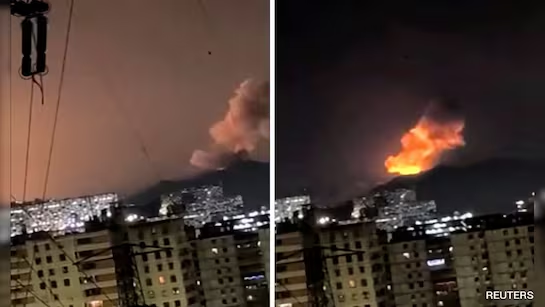
The explosions in Caracas did not surprise anyone who has been paying attention. What should alarm you is how predictable they were. When a state declares emergency powers after blasts in its capital and immediately points at Washington, it is not reacting to a single incident. It is activating a long-prepared narrative. Venezuela did not wake up unstable this week. It has been moving toward this moment for years, driven by economic collapse, institutional decay, and a geopolitical tug-of-war that now treats the country less as a nation and more as a pressure point.
The official line from President Nicolás Maduro is familiar: foreign aggression, US-backed sabotage, an attempt to destabilize the Bolivarian revolution. The counter-line from Washington circles around democracy, sanctions, narcotrafficking, and regional security. Neither side tells you the full story. If you want to understand what is really happening in Venezuela, you have to step away from the slogans and look at power, incentives, and timelines.
This is not about a blast. It is about control.
The Emergency Declaration Is a Signal, Not a Reaction
When Venezuela declared a state of emergency after explosions in Caracas, the legal implications mattered more than the physical damage. Emergency decrees in Venezuela suspend constitutional guarantees, expand military authority, and limit protest, media, and political movement. Maduro has used variations of this mechanism repeatedly since 2016.
You should read the declaration as a message to three audiences.
-
To domestic opponents, it signals zero tolerance. Any dissent can now be framed as collaboration with foreign aggression.
-
To the military, it reinforces their central role as guardians of the state, not neutral institutions.
-
To external actors, especially the US, it dares them to escalate.
The blasts serve as justification. The emergency is the objective.
Why Washington Is Always in the Script
Maduro blamed the US and former President Donald Trump within hours. This reflex is strategic, not emotional.
For two decades, Venezuelan leadership has framed internal failure as external siege. The US fits perfectly into that frame for historical and ideological reasons.
Here is what gets lost when the narrative turns into a shouting match.
-
Washington has not launched a military attack on Venezuela.
-
Washington has imposed severe economic sanctions that materially affect state revenue.
-
Those sanctions did not create corruption, mismanagement, or authoritarian drift. They amplified existing damage.
The US pressure campaign peaked between 2017 and 2020, targeting oil exports, financial transactions, and individuals tied to the regime. Venezuelan oil production fell from over 2 million barrels per day in 2015 to under 400,000 barrels per day by 2020. Mismanagement and underinvestment did most of the damage. Sanctions sealed the collapse.
Maduro needs the US as an antagonist because the alternative is admitting domestic responsibility.
Oil Is the Center of Gravity, Not Ideology
Venezuela’s crisis remains an oil story at its core. The state oil company PDVSA once funded schools, healthcare, subsidies, and regional diplomacy. Today it struggles to maintain basic output.
Consider the numbers.
-
Venezuela holds the world’s largest proven oil reserves.
-
Its production now ranks below countries with a fraction of its resource base.
-
Skilled engineers have emigrated. Infrastructure has decayed. Refineries operate at minimal capacity.
Control over oil revenue equals political survival. Every emergency decree, arrest, or accusation must be understood through this lens.
Recent US policy shifts quietly eased certain oil restrictions, allowing limited exports through intermediaries. This created a temporary lifeline for Maduro’s government. It also increased internal competition over who controls the cash flow.
The blasts in Caracas occurred in a context where money, not ideology, drives loyalty.
The Military Is Not a Monolith, and Maduro Knows It
Venezuela’s armed forces hold the regime together. They also pose its greatest internal risk.
Senior officers control:
-
Food distribution networks
-
Mining operations, especially gold
-
Ports and customs
-
Key state-owned enterprises
This economic role binds the military to the regime while creating factional rivalries. Emergency powers help Maduro manage these tensions by centralizing authority and reducing ambiguity.
Every time instability surfaces, Maduro reinforces the idea that the military’s fate is inseparable from his own. Blame the US. Invoke sovereignty. Close ranks.
This strategy has worked so far.
Opposition Weakness Is a Feature, Not an Accident
You might ask why Venezuela’s opposition has failed to capitalize on repeated crises. The answer lies in fragmentation, repression, and exhaustion.
Since 2019, opposition forces have faced:
-
Arrests and exile of senior leaders
-
Disqualification of candidates
-
Takeover of party structures by courts
-
Loss of international momentum
The brief recognition of an alternative government energized supporters and then collapsed without delivering change. That failure demoralized a population already struggling with survival.
Emergency rule deepens this dynamic. It narrows the political space until elections become rituals rather than contests.
The Population Is Adapting, Not Revolting
One of the most misunderstood aspects of Venezuela’s crisis is public behavior. You might expect mass uprising after years of hyperinflation, shortages, and migration. What you see instead is adaptation.
People survive through:
-
Dollarization of daily transactions
-
Informal remittances
-
Side businesses and gig work
-
Reduced expectations from the state
This coping mechanism reduces immediate pressure on the regime. Stability at subsistence level beats chaos. Fear of returning to acute crisis keeps many from mobilizing.
Blasts in the capital unsettle daily life, yet they rarely translate into sustained protest under emergency conditions.
External Players See Venezuela as a Chessboard
The US is not the only external actor shaping events.
Russia, China, Iran, and regional allies view Venezuela through strategic lenses.
-
Russia leverages military cooperation and debt restructuring.
-
China prioritizes loan recovery and resource access.
-
Iran collaborates on fuel supply and sanctions evasion.
These relationships do not rescue Venezuela’s economy. They help the regime endure isolation.
When Maduro accuses the US, he also reassures these partners that he remains defiant and aligned.
Narcotrafficking Accusations Are Political Weapons
Washington has accused senior Venezuelan officials of involvement in drug trafficking. These charges carry legal weight and symbolic power.
From a US perspective, they justify sanctions and delegitimize the regime. From Maduro’s perspective, they reinforce the siege narrative.
What matters is not whether every accusation sticks. What matters is that criminalization closes negotiation channels and hardens positions.
Emergency declarations fit neatly into this environment. They frame internal security as existential, not political.
Why the Timing Matters Now
The blasts and emergency declaration come at a sensitive moment.
-
Venezuela approaches another electoral cycle with limited credibility.
-
Sanctions relief discussions remain conditional and reversible.
-
Oil markets watch Venezuelan supply as geopolitical risks rise elsewhere.
Maduro signals strength before negotiations. He raises the cost of pressure. He tests how far external actors will push.
This is classic brinkmanship from a position of weakness disguised as defiance.
What This Means for the Region
Instability in Venezuela does not stay contained.
-
Migration pressures continue across Colombia, Peru, Chile, and beyond.
-
Criminal networks exploit weak border control.
-
Energy markets react to supply uncertainty.
Regional governments prefer managed stagnation over sudden collapse. That preference indirectly benefits Maduro.
Emergency rule reduces unpredictability. It also entrenches the status quo.
What You Should Watch Next
Ignore the rhetoric. Watch these indicators.
-
Changes in oil export volumes and payment channels
-
Shifts in military leadership or arrests within the ranks
-
Electoral rules and candidate eligibility decisions
-
Quiet diplomatic engagements behind public hostility
Blasts make headlines. These signals shape outcomes.
The Real Story in One Line
Venezuela is not descending into chaos. It is being tightly managed under the cover of crisis. Emergency powers, foreign blame, and selective confrontation form a system designed to preserve control while avoiding outright collapse.
You may hear talk of aggression and revolution. What you are witnessing is consolidation.
The tragedy is not that Venezuela declares emergencies. The tragedy is that emergencies have become its governing model.
Photo Credit: NDTV
References
NDTV. Venezuela Declares Emergency After Blasts in Capital Caracas, Slams US Military Aggression.
https://www.ndtv.com/world-news/venezuela-declares-emergency-after-blasts-in-capital-caracas-slams-us-donald-trumps-military-aggression-nicolas-maduro-drugs-10240514?pfrom=home-ndtv_topscroll
U.S. Energy Information Administration. Venezuela Country Analysis Brief.
https://www.eia.gov/international/analysis/country/VEN
Reuters. Timeline: Venezuela’s Political and Economic Crisis.
https://www.reuters.com/world/americas/venezuela-crisis-timeline-2023-01-10/
Brookings Institution. Venezuela’s Sanctions and Economic Collapse Explained.
https://www.brookings.edu/articles/venezuelas-sanctions-and-economic-collapse-explained/
International Crisis Group. Venezuela’s Political Deadlock.
https://www.crisisgroup.org/latin-america-caribbean/andes/venezuela/venezuelas-political-deadlock
About The Author