
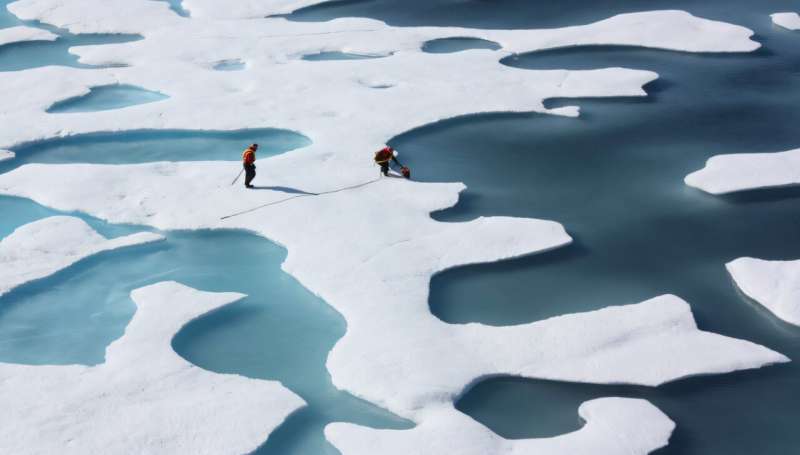
Arctic nations clash over territories as record ice melt exposes $240B in oil reserves. New shipping routes spark border disputes while military tensions rise ahead of ice-free Arctic by 2030.
By Namith DP | Aug 22, 2025
The frozen map of the Arctic is rapidly rewriting itself. As Arctic sea ice reached its lowest maximum on record on March 22, 2025, nations are scrambling to claim territories that were once buried beneath impenetrable ice sheets. This transformation represents one of the most significant geopolitical shifts of our time, with melting ice caps fundamentally altering how countries establish and defend their borders.
We lose Arctic sea ice at a rate of almost 13% per decade, and over the past 30 years, the oldest and thickest ice in the Arctic has declined by a stunning 95%. This dramatic ice loss has exposed new territories, opened shipping routes, and sparked territorial disputes that could reshape international relations for decades to come.
The Numbers Behind the Melt
The scale of Arctic ice loss defies easy comprehension. Between 1979 and 2024, sea ice cover at the end of summer shrank by 12.1 percent per decade relative to the 1981–2010 average. That’s a loss of 78,000 square kilometers (30,000 square miles)—an area almost the size of South Carolina—per year.
Current projections paint an even more dramatic picture. The Arctic Ocean may see its first ice-free day before 2030, earlier than scientists predicted, while scientists project that if emissions continue to rise unchecked, the Arctic could be ice free in the summer as soon as the year 2040.
These changes create immediate territorial implications:
• New Maritime Boundaries: As permanent ice disappears, nations must establish clear maritime borders in previously inaccessible waters • Resource Access: Melting ice exposes seabed minerals, oil reserves, and fishing grounds that were previously unreachable • Shipping Route Development: Ice-free passages reduce global shipping distances by thousands of miles, creating economic incentives for territorial control
Active Territorial Disputes in a Warming Arctic
There are four ongoing territorial disputes in the Arctic: the Northwest Passage (disputed since 1969), Beaufort Sea (disputed since 2004), Lomonosov Ridge (disputed since 2014), and Hans Island (disputed since 1973 and recently resolved).
The Lomonosov Ridge: Russia’s Bold Claim
Russia has notably claimed the Lomonosov Ridge, a geological feature under the Arctic Ocean, while Denmark and Canada have contested those claims. This underwater mountain range extends from Russia across the North Pole to Greenland and Canada, potentially giving Russia claim to vast Arctic territories.
The dispute centers on continental shelf extensions under the United Nations Convention on the Law of the Sea (UNCLOS). Russia ratified the UNCLOS in 1997 and had through 2007 to file a claim to an extended continental shelf. The Russian Federation is claiming a large extended continental shelf that could encompass significant portions of the Arctic Ocean.
The Northwest Passage: Canada vs. International Waters
Canada claims the Northwest Passage as internal waters, while the United States and other nations argue it constitutes international waters. As ice melts, this route becomes increasingly viable for commercial shipping, intensifying the dispute’s economic stakes.
Resolution Success Story: Hans Island
Canada and Denmark have resolved a 51-year long dispute over Hans Island, which falls between Greenland and Nunavut in the Arctic Sea. The agreed upon solution divides the island almost exactly in half, with the Greenland side getting slightly more land. This resolution demonstrates that diplomatic solutions remain possible even for long-standing Arctic disputes.
Economic Drivers of Border Reshaping

Shipping Route Revolution
Arctic shipping routes are the maritime paths used by vessels to navigate through parts or the entirety of the Arctic. There are three main routes that connect the Atlantic and the Pacific oceans: the Northeast Passage, the Northwest Passage, and the mostly unused Transpolar Sea Route.
The surging costs and fear of getting hit by Houthi drones and missiles have led some shippers to consider the Arctic as an alternative, as melting ice begins opening new potential on the so-called Northern Sea Route. This economic reality pushes nations to secure control over these emerging corridors.
The Northern Sea Route along Russia’s coast could reduce shipping time between Europe and Asia by 40%, representing billions in potential revenue for the controlling nation. Similarly, the Northwest Passage could cut 7,000 kilometers off the journey between Atlantic and Pacific ports.
Resource Extraction Opportunities
Melting ice exposes previously inaccessible mineral deposits, oil reserves, and fishing grounds that drive territorial competition. The USGS estimates that 90 billion barrels of oil, 1,669 trillion cubic feet of natural gas, and 44 billion barrels of natural gas liquids may remain to be found in the Arctic, of which approximately 84 percent is expected to occur in offshore areas.
These figures represent staggering economic potential. The Arctic’s reserves have the potential to produce 240 billion barrels of oil and natural gas across some 230 drilling operations. Recent assessments indicate that the likely remaining reserves will be 75% natural gas and 25% oil, highlighting the region’s significance for global energy markets.
Greenland exemplifies the strategic importance of Arctic resources. The island could hold hydrocarbons roughly equivalent to 28.43 billion barrels of oil, while its soils also contain graphite, lithium, and copper, three minerals defined by the International Energy Agency as critical for the energy transition. Greenland receives over DKK2.8 billion annually from Denmark, with an additional DKK320 million from the European Union for fishing rights, making resource development crucial for its economic independence.
Military and Strategic Considerations
The economic promise of the Arctic has also heightened military and security sensitivities. Nations view Arctic territories not just as economic assets but as strategic military positions that could prove crucial in future conflicts.
Russia has established new military bases across its Arctic coastline, while NATO members increase their northern presence. These military buildups reflect the understanding that territorial control in a melting Arctic carries enormous strategic value.
Legal Framework Challenges
United Nations Convention on the Law of the Sea
UNCLOS provides the primary legal framework for resolving Arctic territorial disputes, but its application faces unique challenges in a rapidly changing environment. The application of Article 234 is a subject of dispute between the U.S. and the other Arctic coastal States. Canada and Russia assert they have the right to exclude ships from their territorial sea or EEZ if States fail to comply with local regulations enacted pursuant to Article 234.
The complexity increases when ice-covered areas become ice-free waters, potentially changing their legal status under international law.
Continental Shelf Extensions
Nations can claim exclusive economic zones extending 200 nautical miles from their coastlines, but continental shelf extensions allow claims beyond these limits. The melting ice reveals geological features that support these extended claims, creating overlapping territorial assertions among Arctic nations.
Case Studies in Border Transformation
Svalbard’s Strategic Position
Norway’s Svalbard archipelago exemplifies how melting ice affects territorial dynamics. The 1920 Svalbard Treaty grants Norway sovereignty while allowing other signatory nations equal access to commercial activities. As ice retreats, competition intensifies for access to surrounding waters and resources.
The treaty’s provisions create unique jurisdictional challenges. While Norway maintains sovereignty over land areas, questions arise about maritime boundaries as ice-covered seas become navigable waters. This situation requires careful balance between Norwegian sovereignty and international access rights established under the century-old treaty.
Greenland’s Independence Aspirations
Greenland’s relationship with Denmark faces transformation as melting ice reveals vast resource deposits. The territory’s heavy dependence on Danish economic transfers creates incentives for resource development that could enable greater independence.
The discovery of critical energy transition minerals positions Greenland as a potential major player in global supply chains. Graphite, lithium, and copper deposits could provide the economic foundation for reduced dependence on Denmark, fundamentally altering Arctic political relationships.
Alaska’s Expanded Maritime Boundaries
The United States faces unique challenges managing Alaska’s expanded maritime access. As Arctic sea ice retreats, Alaska’s coastline extends its influence over previously inaccessible waters, creating new responsibilities for maritime security and environmental protection.
The expansion affects both resource extraction opportunities and environmental stewardship obligations. Alaska’s position as America’s Arctic frontier requires balancing economic development with ecosystem preservation in rapidly changing conditions.
Future Implications for Global Governance

Non-Arctic Nations Enter the Competition
The Arctic Council, comprising eight Arctic nations, expanded its observer status to include six new nations in 2013, with China emerging as the most active observer state. China became an observer to the Arctic Council in 2013 and has promoted a narrative of the Arctic as a “common heritage of mankind.”
China’s Arctic engagement extends beyond diplomatic observer status. China joined Russia’s naval and air exercise called Ocean 24 in the Arctic Ocean in September 2024, which reportedly deployed two nuclear submarines under the Arctic polar icecap. This military cooperation demonstrates how non-Arctic nations view the region as strategically important for their global ambitions.
The inclusion of non-Arctic observer states creates additional complexity in territorial disputes. While decisions at all levels in the Arctic Council remain the exclusive right and responsibility of the eight Arctic States, observer nations like China, Japan, and South Korea bring significant economic and political influence that affects regional dynamics.
Timeline for Change
At the end of July 2025, daily sea ice extent in both hemispheres ranked third lowest in the 47-year satellite record, indicating that dramatic changes continue to unfold rapidly. The accelerating pace of ice loss means that nations must adapt their territorial strategies in real-time.
Multilateral Cooperation Challenges
The Arctic Council’s effectiveness faces unprecedented challenges following Russia’s invasion of Ukraine in 2022. The Arctic Council issued a letter condemning Moscow’s actions, leading to a pause in the council’s activities by Arctic states. This disruption highlights how global geopolitical tensions affect Arctic governance mechanisms.
The council’s consensus-based approach struggles with contentious territorial issues even during normal diplomatic relations. The 2022 pause demonstrated that Arctic cooperation cannot remain insulated from broader international conflicts, requiring new governance frameworks that can operate during periods of political tension.
China’s position further complicates Arctic governance. Chinese diplomats indicated they would not support Norway’s Arctic Council chairship if Russia remained excluded, demonstrating how non-Arctic observer states can influence regional decision-making processes.
Global Trade Route Implications
As Arctic shipping routes become commercially viable year-round, global trade patterns will shift dramatically. Nations controlling these passages will wield significant influence over international commerce, potentially altering global economic power balances.
Conclusion
The melting of Arctic ice caps represents more than an environmental crisis—it constitutes a fundamental reshaping of global political geography. As permanent ice disappears, nations must navigate complex territorial disputes while adapting to rapidly changing physical realities.
The stakes extend far beyond Arctic nations. Control over new shipping routes, resource deposits, and strategic territories will influence global economic and security relationships for generations. The resolution of current disputes and the establishment of effective governance mechanisms for newly accessible Arctic territories will test the international community’s ability to manage peaceful transitions in an era of accelerating environmental change.
The frozen borders of yesterday are becoming the contested territories of tomorrow. How nations respond to this transformation will determine whether the melting Arctic becomes a source of cooperation or conflict in the decades ahead.
See also –
About The Author





Why does climate change need to be politicized?