
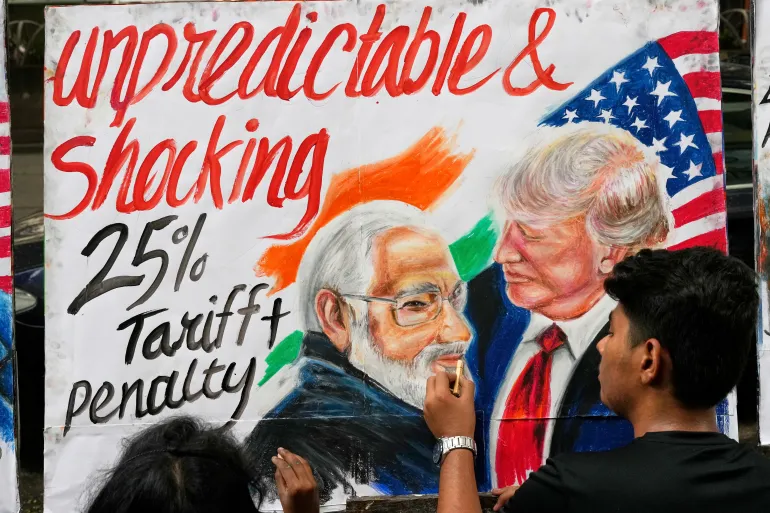
India has slapped retaliatory tariffs on 29 U.S. goods after Washington hiked duties on Indian steel and aluminum. With $200 billion in trade at stake, the tariff war threatens key sectors, strategic ties, and global supply chains.
By Namith DP | August 07, 2025
Introduction
On July 29, 2025, India imposed a fresh round of tariffs on select U.S. imports in direct response to Washington’s earlier hike on Indian steel and aluminum products. This tit-for-tat escalation marks the sharpest trade dispute between the two countries since the 2018-2019 mini trade war under the Trump administration. Both governments, while touting a commitment to free trade, have resorted to protectionist measures that now threaten $200 billion in bilateral commerce.
India’s move reflects growing frustration over the U.S.’s reluctance to grant India equitable market access and reinstatement of trade preferences. The Biden administration, on the other hand, cites national security and domestic manufacturing concerns.
This article breaks down the key elements of this tariff war, its economic consequences, political underpinnings, and potential impact on global trade alliances.
Background: Key Events Leading to the Dispute

- June 2025: U.S. announces a 20% tariff on Indian steel and 15% on aluminum, citing national security under Section 232 of the Trade Expansion Act of 1962.
- July 2025: India imposes retaliatory tariffs ranging from 10% to 30% on 29 U.S. products including almonds, apples, aircraft parts, and medical devices.
- Ongoing dialogue stalls after failed discussions during the 2025 Indo-U.S. Strategic Trade Dialogue held in New Delhi.
These developments echo past friction under the Generalized System of Preferences (GSP), which the U.S. revoked for India in 2019 over market access concerns.
What Are the Tariffs and Who’s Affected?
India’s response targets U.S. agricultural exports, technology products, and select industrial goods:
| Product | Tariff Imposed by India |
|---|---|
| California almonds | 20% |
| Washington apples | 30% |
| Aircraft parts | 15% |
| Orthopedic implants | 10% |
| Solar panel components | 25% |
Meanwhile, the U.S. tariffs on Indian metals affect over $1.4 billion in annual Indian exports.
Sectors most impacted:
- U.S. Farmers: Almond and apple growers in California and Washington, already dealing with falling prices and Chinese competition, face direct revenue losses.
- Indian Exporters: Metal, pharmaceutical, and solar component exporters to the U.S. report order cancellations and shipment delays.
- Tech Supply Chains: Indian firms relying on U.S. aviation and electronics parts face increased input costs.
Underlying Trade Issues
Despite being strategic allies, India and the U.S. have persistent friction on trade issues:
- Market Access:
- The U.S. accuses India of imposing non-tariff barriers on American medical devices and agriculture.
- India seeks duty-free access for its textiles and pharmaceuticals.
- Digital Trade and Data Localization:
- Washington opposes India’s 2022 data localization law requiring companies to store user data within India.
- The law affects major U.S. firms like Amazon, Meta, and Mastercard.
- Renewable Energy and Subsidies:
- The U.S. has raised WTO complaints about India’s subsidies to domestic solar manufacturers.
- India criticizes U.S. subsidies under the Inflation Reduction Act, which allegedly discriminate against foreign suppliers.
- Pharmaceuticals and IP:
- U.S. industry groups demand stronger enforcement of intellectual property rights.
- India defends its right to produce affordable generics under WTO’s TRIPS flexibilities.
Expert Opinions and Government Statements
Dr. Ajay Sahai, Director General of the Federation of Indian Export Organisations (FIEO):
“These tariffs threaten to derail momentum built during Modi’s 2023 state visit to Washington. We need calibrated diplomacy, not escalations.”
U.S. Trade Representative Office Statement (July 30, 2025):
“India’s retaliatory tariffs lack justification under WTO rules. We remain committed to defending American industries against unfair trade practices.”
Dr. Swati Dhingra, Associate Professor at LSE and UK Monetary Policy Committee member:
“The bigger concern is the global spillover. With U.S.–China and U.S.–EU disputes already active, this adds another front to an increasingly fractured global trade regime.”
Economic Fallout
For India
- Export loss potential: Over $2.5 billion in steel and aluminum revenue at risk.
- Increased input costs: Tariffs on aircraft parts and medical devices affect Make-in-India sectors.
- Currency pressure: Foreign exchange volatility linked to reduced investor confidence in India’s export outlook.
For the U.S.
- Agricultural revenue at risk: Almond and apple exports to India stood at $960 million in FY 2024.
- Increased lobbying pressure: U.S. farm and tech groups urge a negotiated settlement.
- Strategic friction: Tariff escalation undermines broader Indo-Pacific cooperation frameworks.
WTO and Legal Implications
India has signaled possible legal recourse via the World Trade Organization (WTO), arguing the U.S. tariffs violate multilateral commitments.
- In 2019, India filed a similar case when the Trump administration imposed Section 232 tariffs.
- WTO’s Appellate Body remains partially defunct due to U.S. blockage of judge appointments, making resolution difficult.
Trade analysts note that without a functioning dispute resolution system, countries are increasingly resorting to unilateral retaliation, weakening the global rules-based order.
Strategic and Geopolitical Consequences

While the trade war appears economic on the surface, it has clear geopolitical reverberations:
- Quad Tensions:
The India–U.S. tariff standoff undermines unity in the Quadrilateral Security Dialogue (Quad), which also includes Japan and Australia. - Shift Toward Global South:
India is increasing engagement with BRICS+ nations (Brazil, Russia, China, South Africa, and others), potentially rebalancing its trade alliances. - Alternative Alliances:
Reports suggest that India is pursuing expedited trade deals with the UK and UAE, while also enhancing rupee-based trade with Russia and Africa.
What’s at Stake?
The longer the tariff war continues, the more both nations stand to lose:
- $200 Billion Trade Target:
In 2023, India and the U.S. set a bilateral trade target of $200 billion by 2027. This escalation puts that goal in jeopardy. - Supply Chain Stability:
Key sectors such as defense, electronics, and pharmaceuticals rely on integrated supply chains now threatened by rising costs and uncertainty. - Investor Sentiment:
Market watchers cite increased political risk, deterring long-term investment in manufacturing and infrastructure sectors in both countries.
Path Forward: Can Diplomacy Prevail?
Both governments have left the door open to future talks:
- India’s Commerce Ministry confirmed that it is open to bilateral discussions if the U.S. retracts steel and aluminum tariffs.
- The U.S. Trade Representative is reportedly considering limited exemptions for Indian goods not produced domestically.
However, a meaningful breakthrough requires:
- WTO reforms: to restore binding dispute settlement mechanisms.
- Mutual tariff reductions: coupled with technology transfer agreements and market access reciprocity.
- A digital trade agreement: to harmonize e-commerce, privacy, and cross-border data flow regulations.
Conclusion
The 2025 India–U.S. tariff war underscores the fragility of even the most strategic bilateral relationships when commercial interests collide. With $200 billion in trade and critical strategic cooperation on the line, both nations must act swiftly to prevent economic fallout from deepening into diplomatic rupture.
A prolonged conflict risks damaging not only bilateral economic prospects but also the stability of the global trading system.
See also –
Sources & Further Reading
- U.S. Trade Representative (USTR) Statements
- Ministry of Commerce, Government of India
- World Trade Organization – Dispute Settlement Updates
- Economic Times – India, July 2025 Coverage
About The Author




India and the US need to compromise immediately