
By Namith DP | July 06, 2025
The Stakes Behind the Dalai Lama’s Future: An Introduction
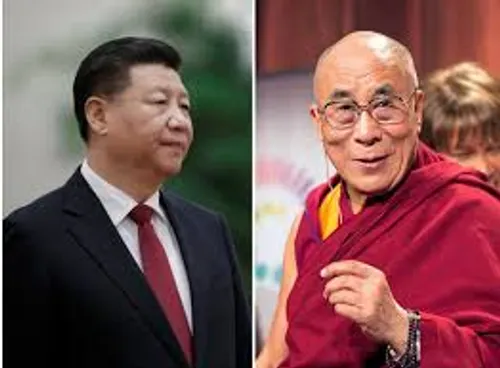
The geopolitical and spiritual significance of the 14th Dalai Lama extends far beyond the borders of Tibet. Revered as the highest spiritual leader of Tibetan Buddhism and once the temporal head of the Tibetan government-in-exile, His Holiness has shaped global discourse on religion, human rights, and sovereignty. However, his advancing age and the opaque future of his reincarnation have triggered a fierce political contest between the Tibetan people and the People’s Republic of China.
Beijing has made it clear: it intends to control the selection of the next Dalai Lama. The Chinese Communist Party (CCP) has institutionalized religious interference through legal and administrative means, disregarding centuries of Tibetan spiritual tradition. This conflict is no longer only about autonomy or human rights; it is about sovereignty over belief itself.
Part A – Historical Background, Religious Significance, and China’s Strategy
Understanding the Dalai Lama’s Role in Tibetan Politics
The position of the Dalai Lama is not symbolic. Historically, the Dalai Lamas held both religious and political power in Tibet, particularly from the 17th century until the Chinese invasion in 1950.
- 14th Dalai Lama’s Timeline:
- Born: July 6, 1935, in Taktser, Amdo (present-day Qinghai province, China).
- Recognized: 1939, at age 4, following Tibetan Buddhist traditions involving oracles and visions.
- Enthroned: 1940 in Lhasa.
- Assumed political power: 1950, after the Chinese military entered Tibet.
- Fled to India: 1959, following the failed Tibetan uprising against Chinese rule.
- Key Political Functions Historically Performed by Dalai Lamas:
- Governance of the Ganden Phodrang (Tibetan government from 1642 to 1959).
- Head of state and religion.
- Diplomacy with China, Mongolia, Britain, and later India.
- Significance in Exile:
- The Central Tibetan Administration (CTA), based in Dharamshala, India, was established under his leadership.
- Won the Nobel Peace Prize in 1989 for his nonviolent struggle for the liberation of Tibet.
China’s Historical Involvement in Tibetan Affairs
China’s interest in Tibet is both strategic and ideological. Beijing considers Tibet an integral part of its territory. However, its assertions often conflict with documented history and international legal standards.
- Key Events:
- 1950: PLA invades Tibet under the guise of “liberation.”
- 1951: Seventeen Point Agreement signed under duress, recognizing Chinese sovereignty but promising autonomy.
- 1959: Tibetan uprising crushed, and the Dalai Lama fled to India.
- Current Administrative Setup:
- Tibet Autonomous Region (TAR) was established in 1965.
- Governed by Chinese officials, with religious institutions tightly monitored by the United Front Work Department.
- Key Policies:
- Sinicization of Tibetan culture and religion.
- Re-education of monks and nuns.
- Heavy surveillance, including facial recognition in monasteries.
China’s Religious Strategy: Reincarnation Under State Control
Beijing’s main point of contention is its claim to control the reincarnation process of Tibetan spiritual leaders.
- 2007 State Religious Affairs Bureau Order No. 5:
- All “living Buddhas” (reincarnated lamas) must be approved by the government.
- Any unapproved reincarnations are deemed illegal and invalid.
- Why It Matters:
- Reincarnation is central to Tibetan Buddhism.
- The Dalai Lama has traditionally been identified by senior lamas and religious signs—not by the state.
- Dalai Lama’s Response:
- Has stated publicly that he may not reincarnate.
- If he does, it would be outside of Chinese control, possibly in exile.
- Quote: “If the situation remains as it is, I will reincarnate outside of China.”
Tibetan Buddhism and the Reincarnation Process
Understanding the religious mechanics behind reincarnation provides clarity on what’s at stake.
- Selection Criteria:
- Based on visions, dreams, and signs from the previous Dalai Lama.
- Oracle consultations, especially from Nechung Oracle.
- A search party locates the child believed to be the reincarnation.
- Verification:
- The child is tested on his ability to recognize belongings of the previous Dalai Lama.
- Senior lamas verify through a process grounded in centuries-old tradition.
- China’s Interference in the Panchen Lama Case:
- 1995: Dalai Lama recognized Gedhun Choekyi Nyima as the 11th Panchen Lama.
- Three days later: The child was abducted by Chinese authorities.
- Beijing’s response: Appointed their own Panchen Lama, Gyaincain Norbu.
- Outcome:
- The real Panchen Lama remains missing.
- The Chinese-backed Panchen Lama is widely rejected by Tibetan Buddhists.
International Concerns and Diplomatic Implications
Governments and international bodies increasingly view China’s interference as a violation of religious freedom.
- United States:
- 2018: Passed the Reciprocal Access to Tibet Act.
- 2020: Tibetan Policy and Support Act (TPSA) signed into law.
- States that only Tibetan Buddhists should decide on the Dalai Lama’s succession.
- Authorizes sanctions against Chinese officials who interfere in reincarnation matters.
- India’s Position:
- Hosts the Dalai Lama and the CTA.
- Strategically avoids direct involvement in reincarnation politics.
- United Nations and NGOs:
- Consistent reports on repression of religious freedom in Tibet.
- Calls for access to Tibet for independent observers.
Part B – Surveillance, Propaganda, and the Global Contest for Religious Sovereignty
Escalation Through Surveillance and Technological Suppression
Beijing’s efforts to control Tibetan religious life extend beyond doctrine. The Chinese Communist Party (CCP) has developed an expansive surveillance regime that operates throughout the Tibet Autonomous Region (TAR) and in Tibetan communities across China.
- Key Surveillance Practices:
- Installation of facial recognition systems in and around monasteries.
- Mandatory biometric data collection, including voice samples, from residents.
- Real-time monitoring of religious gatherings and online activities.
- Restrictions on travel for monks and laypeople alike.
- Relevant Data:
- A 2023 report by Human Rights Watch documented the use of mobile surveillance vans and AI-driven crowd monitoring in TAR monasteries.
- Citizen Lab identified targeted spyware campaigns against Tibetan diaspora members, including those associated with the Central Tibetan Administration (CTA).
- Legal and Institutional Tools:
- “Grid-style social management” divides neighborhoods into surveilled blocks.
- “Stability maintenance” funding in TAR exceeds national average per capita spending on public security by nearly 400% (Freedom House, 2023).
Impact:
The aim is not merely to police dissent, but to enforce ideological conformity, particularly among religious practitioners who might reject Beijing’s reincarnation narrative.
The Propaganda Arm: Shaping the Dalai Lama Narrative
The CCP has committed significant resources to controlling public perception of the Dalai Lama, both inside China and internationally.
- Internal Messaging:
- State media frequently refers to the Dalai Lama as a “separatist” and “splittist.”
- Tibetan students receive heavily censored historical curricula that exclude or vilify the Dalai Lama.
- External Campaigns:
- Government-funded Confucius Institutes abroad have hosted talks and seminars criticizing the Dalai Lama and promoting Chinese unity.
- Pro-China Tibetan organizations have been accused of conducting coordinated information campaigns to delegitimize the Dalai Lama’s reincarnation claims.
- Digital Influence:
- Facebook, Twitter (now X), and YouTube accounts linked to Chinese state-backed actors have been identified spreading anti-Dalai Lama content, according to reports from the Australian Strategic Policy Institute (ASPI).
Effectiveness:
These efforts remain limited in the free world, where access to accurate historical and religious information persists. However, in regions dependent on Chinese investment, such as parts of Africa and Southeast Asia, these narratives have gained traction.
Global Response: Laws, Sanctions, and Strategic Support
International actors are increasingly recognizing the implications of Beijing’s interference in Tibetan religious and political life. Many have responded through legislation, diplomatic backing, and public denouncements.
1. United States
- Tibetan Policy and Support Act (TPSA) of 2020:
- Mandates that only Tibetan Buddhists can determine their leaders, including the Dalai Lama.
- Imposes visa bans and asset freezes on Chinese officials who interfere with reincarnation processes.
- Reciprocal Access to Tibet Act of 2018:
- Restricts entry to U.S. for Chinese officials who block American journalists, diplomats, and citizens from visiting Tibet.
- Funding:
- Over $20 million annually in aid for Tibetan communities, including preservation of language and religion.
2. European Union
- European Parliament has passed multiple resolutions urging China to allow religious freedom in Tibet.
- European External Action Service (EEAS) has condemned the disappearance of the Panchen Lama and urged transparency in reincarnation procedures.
3. India
- India remains cautious. It provides safe haven to the Dalai Lama and Tibetan refugees but avoids formal statements on reincarnation.
- Analysts view this as a balancing act given its fragile border relations with China.
The Central Tibetan Administration’s Strategic Resistance
The CTA, headquartered in Dharamshala, India, continues to coordinate political, religious, and cultural initiatives to safeguard Tibetan identity. Their approach blends diplomacy with spiritual integrity.
- Key Actions:
- Continued emphasis on the Dalai Lama’s authority to determine his reincarnation.
- Outreach to governments and parliaments globally, urging support for religious freedom.
- Hosting annual international conferences on Tibet to build consensus on non-recognition of any CCP-appointed successor.
- Digital Countermeasures:
- Launch of secure communication platforms to protect diaspora communication from cyber intrusion.
- Global awareness campaigns under the “Let Tibet Choose” initiative.
- Youth Engagement:
- Tibetan Youth Congress and Students for a Free Tibet mobilize awareness through digital media, peaceful protests, and educational outreach.
The Coming Succession Crisis: Why It Matters Now
The Dalai Lama turned 89 in July 2024. While he remains active, the Buddhist cycle of reincarnation will inevitably follow his passing. Beijing is poised to announce its own successor, possibly within the TAR, while the exile community may recognize a child born outside Chinese jurisdiction.
- Scenario Analysis: Scenario Likely Outcome Risks China appoints a successor within Tibet Recognized within China, rejected globally Religious schism, further unrest Dalai Lama reincarnates in exile (e.g. India) Recognized by diaspora and many states Provocation of CCP, diplomatic friction Dalai Lama chooses not to reincarnate Breaks centuries-old tradition Creates leadership vacuum
- Key Insight:
China may attempt to use its appointee to assert legitimacy over Tibet globally, using state-controlled media, diplomatic leverage, and education.
Part C – Legal Implications, Global Norms, and Future Scenarios
The Legal Landscape: Reincarnation, Sovereignty, and Religious Freedom
At the core of the Dalai Lama succession crisis lies a legal paradox: how can a government—especially one that is officially atheist—claim the right to decide a spiritual reincarnation? International legal standards provide a framework to examine this interference.
1. Violation of Religious Freedom
- Universal Declaration of Human Rights (UDHR), Article 18:
Guarantees the right to freedom of thought, conscience, and religion—including the freedom to change religion or belief and manifest it in teaching and practice. - International Covenant on Civil and Political Rights (ICCPR), Article 18:
Recognizes religious autonomy without coercion. China has signed but not ratified this treaty. - UN Special Rapporteur on Freedom of Religion or Belief (2021):
Declared that religious communities must have the exclusive right to determine their leaders, rituals, and beliefs. - Violation:
China’s 2007 State Religious Affairs Bureau Order No. 5, which mandates government approval of reincarnated lamas, stands in direct opposition to these international norms.
2. Lack of Legal Recognition of the CTA
- The Central Tibetan Administration operates as a government-in-exile but lacks formal recognition from any United Nations member state.
- This legal vacuum limits its ability to file international claims, though it remains a key stakeholder in diplomatic discussions.
3. Sanctions and Accountability
- Global Magnitsky Act (U.S.):
Provides for targeted sanctions against individuals involved in religious persecution or human rights violations. - EU Global Human Rights Sanctions Regime:
Enables travel bans and asset freezes against actors responsible for religious repression, including in Tibet.
Implication:
While the international legal system cannot compel Beijing to cease interference, targeted sanctions and legal pressure offer tools to deter future violations.
International Norms and Precedents
China’s approach in Tibet is not isolated. Its tactics fit into a broader trend of state interference in religious affairs, raising the alarm among international policy circles.
Comparable Global Cases
| Country | Type of Interference | Legal Challenge |
|---|---|---|
| Russia | State-controlled Russian Orthodox Church as tool of foreign policy | Restrictions on minority religious groups |
| Iran | State vetting of Islamic scholars and clerics | Religious freedom concerns under ICCPR |
| Saudi Arabia | Government-approved clergy for public preaching | Violations of UN religious rights conventions |
China’s Distinction:
Unlike these cases, China asserts control over a reincarnation process, a claim unprecedented in modern geopolitics.
The Role of the United Nations and Multilateral Institutions
1. UN Human Rights Council (UNHRC)
- Although China is a member, it has faced increasing scrutiny through side events, special procedures, and joint statements.
- In 2022, over 40 countries issued a joint statement urging China to uphold religious and cultural rights in Tibet.
2. UNESCO
- Tibetan Buddhism, particularly the monastic institutions and language, is eligible for protection under intangible cultural heritage frameworks.
- Tibetans in exile are campaigning to preserve these traditions independently of Beijing’s narrative.
3. International Religious Freedom Roundtable
- A coalition of lawmakers, NGOs, and civil society leaders that has highlighted the Dalai Lama succession issue in global forums.
Obstacles:
China’s economic clout limits the ability of multilateral institutions to act decisively, but diplomatic pressure and soft law mechanisms remain active.
The Risk of Dual Dalai Lamas
The most likely scenario in the coming decade is the emergence of two Dalai Lamas—one appointed by the Chinese government within the Tibet Autonomous Region, and another chosen by Tibetan Buddhists in exile.
Consequences of a Dual Succession:
- Spiritual Schism:
- Divides Tibetan Buddhists between those within Chinese-controlled territories and those in the diaspora.
- Risks loss of unified leadership for the Tibetan cause.
- Diplomatic Strain:
- Countries will face pressure to recognize one over the other.
- China may threaten economic retaliation against governments that recognize the exiled successor.
- Increased Surveillance:
- Tibetans within China face elevated restrictions around the new state-appointed Dalai Lama.
- Re-education campaigns will likely intensify to enforce loyalty.
- Possibility of Unrest:
- The reincarnation controversy could reignite protests within Tibet, as seen during the 2008 uprising.
Historical Parallel:
The Panchen Lama episode has already demonstrated how spiritual legitimacy can be undermined by political interference. The Chinese-appointed Panchen Lama has failed to gain credibility among most Tibetans.
Preparing for the Post-Dalai Lama Era
The 14th Dalai Lama has taken measures to minimize the impact of a state-manipulated succession.
1. Public Declarations:
- He has clarified that any reincarnation recognized by China “should not be trusted.”
- In 2011, he signed a formal document stating that the decision on his reincarnation lies solely with Tibetan Buddhist tradition—not political authorities.
2. Potential for an Elected Spiritual Leader:
- The Dalai Lama has suggested that the tradition of reincarnation could end with him.
- Another possibility is the appointment of a democratically selected spiritual leader by the global Tibetan community.
3. Institutional Preparedness:
- The CTA has developed detailed plans for the selection, recognition, and global presentation of the next spiritual leader.
- These preparations include collaboration with senior Tibetan Buddhist lamas outside Chinese influence.
Global Religious Communities Respond
Faith-based organizations and religious scholars worldwide have begun voicing support for the Tibetan people.
- World Parliament of Religions (2023):
Adopted a resolution affirming the right of Tibetan Buddhists to manage their spiritual affairs independently. - Catholic Church Representatives:
While cautious, several cardinals have emphasized the need to protect religious integrity in Buddhist communities. - Buddhist Networks in Japan, South Korea, and the U.S.:
Have issued joint statements backing the Dalai Lama’s authority to determine his reincarnation.
Significance:
Such coalitions can reinforce international awareness and increase moral pressure on authoritarian efforts to control spiritual matters.
Future Scenarios and Strategic Outcomes
| Scenario | Global Alignment | Tibet’s Cultural Integrity | CCP’s Strategic Gain |
|---|---|---|---|
| Unified international rejection of China’s Dalai Lama | High | Strongly preserved | Low |
| Split recognition between West and China-aligned countries | Medium | Fragmented | Moderate |
| Widespread silence or acceptance of China’s appointee | Low | Severely damaged | High |
Geopolitical Tipping Point:
The Dalai Lama succession will likely become a flashpoint in future relations between China and liberal democracies. It may also set a precedent for how authoritarian regimes attempt to control religious institutions beyond their borders.
Conclusion
Beijing’s attempt to control the reincarnation of the Dalai Lama represents a direct challenge to global norms of religious freedom, legal sovereignty, and human dignity. This conflict is not just a Tibetan issue—it is a test for the international community’s resolve in defending spiritual independence from state coercion. As the succession crisis nears, the world must decide whether to yield to authoritarian interference or uphold the principles of freedom and tradition that the Dalai Lama has long represented.
About The Author





Good insight.