
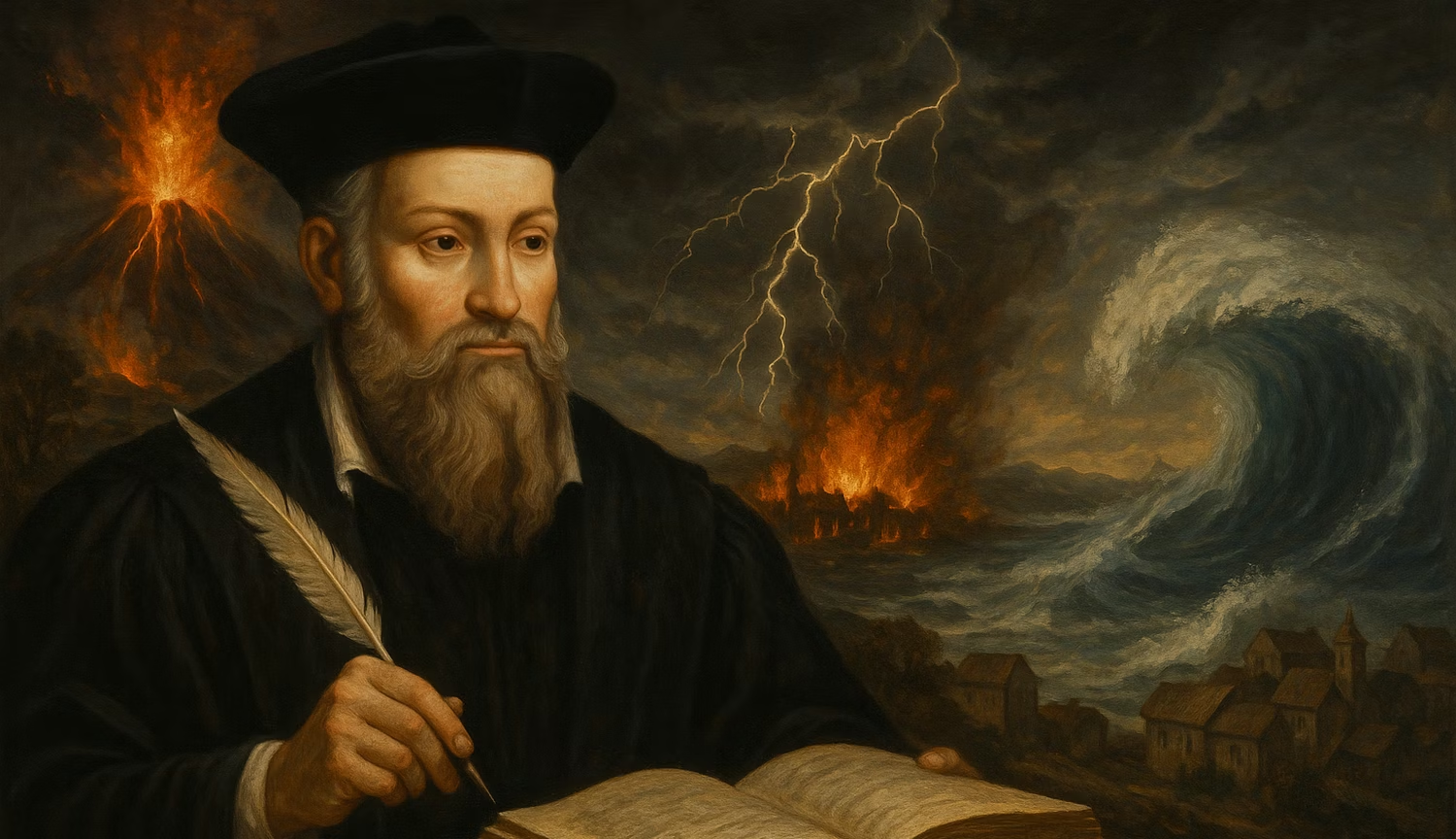
The past rarely knocks on your door politely. It tends to arrive disguised as coincidence, pattern, or myth. Every few years, the name Nostradamus resurfaces in public discourse, not because his verses suddenly became clearer, but because the world looks unstable enough for people to search for meaning in old warnings. The recent resurfacing of his so-called predictions for 2026, amplified by modern media, is not about bees, biblical wars, or coded quatrains. It is about you living through a period where uncertainty feels systemic rather than episodic.
If you read these predictions as literal forecasts, you miss the point. If you dismiss them outright, you also miss the point. The value lies in what they reveal about current anxieties, geopolitical stress, climate fatigue, and technological acceleration. Nostradamus becomes a mirror, not a map.
This piece does not decode prophecies. It interrogates why they resonate now, what facts support the underlying fears, and how you should interpret them without surrendering to mysticism or denial.
Why Nostradamus Returns During Periods of Global Stress
Nostradamus did not predict events in the modern sense. He wrote deliberately ambiguous quatrains between 1555 and 1558, using symbolic language to avoid persecution. The clarity people see today comes from hindsight, not foresight.
Historically, spikes in Nostradamus interest align with moments like:
-
World War I and II
-
The Cold War nuclear standoff
-
The 9/11 attacks
-
The COVID-19 pandemic
-
The Russia–Ukraine conflict
-
Escalation in the Middle East
Search trend data consistently shows that Nostradamus-related queries rise during global instability. This pattern tells you something important. People look for order when institutions feel fragile.
Ask yourself a direct question. Why does a 16th-century astrologer feel relevant in an age of satellites, AI models, and real-time intelligence?
The answer is not prophecy. It is trust erosion.
The “Seven Months of Great War” Claim and Modern Geopolitics
One of the most circulated claims tied to 2026 is the idea of a “seven-month great war.” The phrase does not appear verbatim in Nostradamus’s original texts. It comes from interpretative stitching done centuries later.
Still, the anxiety behind it deserves scrutiny.
What the Data Says About War Risk
You are living in the most conflict-dense decade since the 1940s.
-
The Uppsala Conflict Data Program recorded over 56 active state-based conflicts in 2023.
-
Global military spending crossed $2.2 trillion, the highest ever recorded.
-
NATO expansion, Russia’s prolonged engagement in Ukraine, Middle East instability, and Indo-Pacific tensions create overlapping risk zones rather than isolated flashpoints.
This matters because large-scale wars today do not start with formal declarations. They escalate through:
-
Cyber warfare
-
Economic sanctions
-
Proxy conflicts
-
Information operations
A seven-month timeline fits modern war logic more than traditional wars. Short, intense, economically disruptive conflicts now define the battlefield.
You do not need Nostradamus to see this pattern. You need to read defense budgets and trade data.
Biblical Bees, Ecological Collapse, and the Science Behind the Symbol
The “biblical bees” reference has gained traction because it aligns with a real ecological crisis. Pollinators are not mythology. They are infrastructure.
The Hard Numbers You Should Know
-
Bees pollinate roughly 75 percent of global food crops.
-
The UN Food and Agriculture Organization reports pollinator decline rates exceeding 40 percent in some regions.
-
Economic value of pollination services exceeds $500 billion annually.
When people frame this as prophecy, they avoid confronting accountability. Climate stress, pesticide use, monoculture farming, and habitat loss explain the decline without invoking scripture.
If bees vanish, food systems destabilize. Food inflation follows. Political unrest follows food inflation.
That sequence already exists in economic models. Nostradamus becomes shorthand for ecological consequence.
You should ask a practical question. If pollinators collapse within your lifetime, what does that mean for food security in urban India, Europe, or the Middle East?
Climate Extremes Are Not Predictions. They Are Statistical Trajectories.
Another recurring theme linked to 2026 interpretations involves floods, fires, and heat. Nostradamus did not understand carbon cycles, yet the symbolism fits modern data uncomfortably well.
Climate Indicators You Cannot Ignore
-
2023 and 2024 ranked among the hottest years on record globally.
-
India experienced record-breaking heat waves affecting productivity and public health.
-
Insurance losses from climate disasters crossed $100 billion annually on average over the past decade.
-
Water stress affects over 2 billion people worldwide.
Climate risk no longer belongs to environmental activists. It shapes migration patterns, insurance markets, and sovereign debt.
When people attribute floods to prophecy, they avoid confronting policy failure. Emissions targets get delayed. Urban planning remains reactive.
You should think in terms of exposure. Where do you live? How resilient is your city to heat, water stress, and supply chain disruption?
Technology, Artificial Intelligence, and the Fear of Losing Control
Some Nostradamus interpretations for 2026 reference mechanical dominance or human displacement. Translators stretch metaphors to fit AI narratives, yet the anxiety feels genuine.
What Is Actually Changing
-
AI adoption in white-collar roles accelerates faster than industrial automation did in the 20th century.
-
McKinsey estimates up to 30 percent of current work hours could be automated by 2030.
-
Regulation lags behind deployment in most countries.
The fear is not job loss alone. It is agency loss. People worry that systems no longer feel legible.
When prophecy language resurfaces, it signals a gap between technological capability and societal governance.
Ask yourself a grounded question. Do you understand how the systems shaping your work, news, and finances actually operate?
If the answer feels uncertain, you understand why symbolic warnings gain traction.
The Media’s Role in Amplifying Prophecy Narratives
The NDTV piece that triggered this renewed debate did not invent Nostradamus anxiety. It packaged it for a digital attention economy.
Media outlets face pressure to convert uncertainty into clickable narratives. Prophecy stories perform well because they offer:
-
Emotional clarity
-
Simple villains
-
Temporal anchors
The danger lies in treating symbolic commentary as forecast journalism.
You should not confuse engagement metrics with insight. When prophecy dominates headlines, it often crowds out policy analysis and data-driven accountability.
A useful exercise for you as a reader involves substitution. Replace the word prophecy with risk indicator. Does the story still hold relevance?
Often, it does.
Why Rational Societies Still Entertain Mystical Frameworks
Highly educated societies still turn to astrology, prophecy, and numerology during stress. This is not ignorance. It is psychological adaptation.
Research in behavioral economics shows that uncertainty increases pattern-seeking behavior. Humans prefer flawed narratives over ambiguity.
Nostradamus provides narrative closure where institutions fail to communicate clearly.
This raises an uncomfortable question. Are governments and experts explaining risk honestly enough, or are they leaving space for myth to fill?
How You Should Interpret Nostradamus in 2026
You gain nothing from treating Nostradamus as a prophet. You gain perspective by treating him as an early warning system for collective fear.
Use these interpretations as prompts:
-
War predictions point to geopolitical fragility
-
Ecological symbols point to environmental neglect
-
Mechanical dominance points to governance gaps in technology
This approach keeps you grounded in evidence while respecting why people search for meaning.
Practical Takeaways You Can Act On
You do not control global wars or climate systems. You control preparation and literacy.
Focus on actions that matter:
-
Stay informed through data-driven sources, not symbolic headlines.
-
Understand how geopolitical shifts affect energy, food, and employment.
-
Invest in skills that complement automation rather than compete with it.
-
Support policies and businesses that address ecological resilience.
-
Question narratives that offer certainty without accountability.
Prophecy becomes dangerous only when it replaces agency.
The Question That Matters More Than Any Prediction
Nostradamus does not decide what 2026 looks like. You do, collectively and individually.
The real question is not whether a war lasts seven months or whether bees disappear from verses written centuries ago.
The question you should sit with is simpler and harder.
Are you building your decisions on evidence, adaptability, and civic engagement, or are you outsourcing responsibility to myth because the present feels overwhelming?
History rewards the former. It archives the latter as curiosity.
About The Author


