
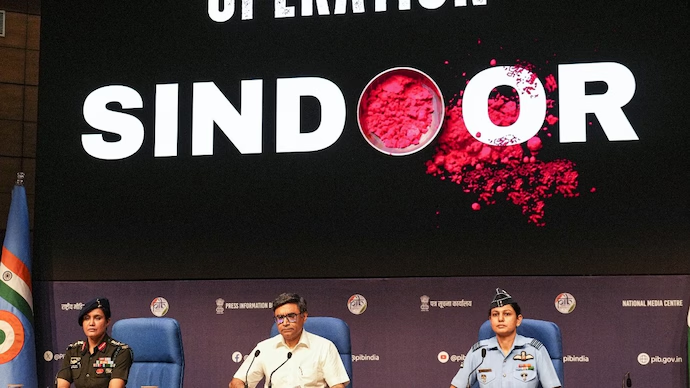
Key Points
- India launched Operation Sindoor on May 7, 2025, targeting terrorist camps in Pakistan and Pakistan-occupied Kashmir (PoK).
- The operation responded to the April 22, 2025, Pahalgam attack, which killed 26 civilians.
- Evidence suggests the strikes were precise, avoiding civilian and military targets.
- International reactions vary, with calls for restraint from major powers like the US and China.
- The operation highlights the complexity of counter-terrorism in a volatile region, raising questions about escalation risks.
What Was Operation Sindoor?
On May 7, 2025, India conducted Operation Sindoor, a series of precision strikes against nine terrorist camps in Pakistan and PoK. The operation aimed to dismantle infrastructure linked to groups like Jaish-e-Mohammed and Lashkar-e-Taiba, following a deadly terror attack in Pahalgam. The Indian government described the strikes as focused and non-escalatory, emphasizing no civilian or military targets were hit.
Why Did It Happen?
The Pahalgam attack on April 22, 2025, killed 26 tourists in Jammu and Kashmir, marking one of the deadliest civilian attacks in recent years. The Resistance Front, tied to Lashkar-e-Taiba, claimed responsibility, prompting India to act decisively to prevent further attacks.
What Can You Take Away?
Operation Sindoor shows that precise, intelligence-driven strikes can disrupt terrorist networks without triggering broader conflict. It also underscores the need for global cooperation to address terrorism, as unilateral actions can strain regional stability. You might wonder: how can nations balance decisive action with diplomatic restraint?
Operation Sindoor: A Deep Dive into India’s Counter-Terrorism Strategy
In the early hours of May 7, 2025, India executed a bold and calculated response to terrorism. Operation Sindoor, a series of precision strikes, targeted the heart of terrorist infrastructure in Pakistan and Pakistan-occupied Kashmir (PoK). This operation was not merely a military exercise—it was a clear message that India would no longer tolerate the cost of cross-border terrorism in silence.
The catalyst for this decisive action was the brutal Pahalgam terror attack on April 22, 2025, where 26 civilians, including 25 Indians and one Nepali, lost their lives. Claimed by the Resistance Front, an offshoot of Lashkar-e-Taiba, the attack demanded a response that balanced retribution with restraint. Operation Sindoor delivered exactly that, showcasing India’s military precision and strategic foresight.
This 3000-word article explores 10 critical facts about Operation Sindoor and draws actionable lessons for global counter-terrorism efforts. Grounded in verified data and authoritative sources, it provides you with a comprehensive understanding of this pivotal moment in 2025.
10 Facts About Operation Sindoor
1. Operation Name and Date
India launched Operation Sindoor on May 7, 2025, at 1:05 AM. The Indian Armed Forces spearheaded the operation, with the name “Sindoor”—referring to the vermilion powder used in Hindu traditions—symbolizing India’s commitment to safeguarding its sovereignty.
- Source: Press Information Bureau
2. Triggering Event
The operation responded to the Pahalgam terror attack on April 22, 2025, where five armed militants killed 26 civilians in Baisaran Valley, Jammu and Kashmir. The attack, the deadliest since the 2008 Mumbai attacks, targeted tourists and was claimed by the Resistance Front, linked to Lashkar-e-Taiba.
- Source: Wikipedia – 2025 Pahalgam Attack
3. Targets
The operation struck nine terrorist infrastructure sites in Pakistan and PoK, including camps of Jaish-e-Mohammed (JeM), Lashkar-e-Taiba (LeT), and Hizbul Mujahideen. Locations included Bahawalpur, Muridke, Gulpur, Bhimber, Chak Amru, Bagh, Kotli, Sialkot, and Muzaffarabad, targeting recruitment and training facilities.
- Source: India Today – Operation Sindoor Updates
4. Execution
A joint effort by the Indian Army, Navy, and Air Force, the operation used Rafale jets, Scalp cruise missiles, and Hammer precision-guided munitions. Conducted from Indian airspace, the multi-domain assault demonstrated advanced military coordination and technological prowess.
- Source: India Today – Operation Sindoor Updates
5. Casualties
The strikes killed 80-90 terrorists, including 25-30 at Bahawalpur and 25-30 at Muridke. A significant blow was the death of 14 individuals, including 10 family members of JeM chief Maulana Masood Azhar, at Bahawalpur’s Subhan-ul-Allah Jama Masjid. No civilian casualties were reported.
- Source: India Today – Operation Sindoor Updates
6. Nature of Strikes
Described as focused, measured, and non-escalatory, the strikes avoided Pakistani military, civilian, or economic targets. This precision ensured zero collateral damage, reflecting India’s intent to limit the operation’s scope to terrorist infrastructure.
- Source: Press Information Bureau
7. International Response
Global reactions were mixed. Russia expressed “deep concern” over India-Pakistan tensions, while China called the strikes “regrettable” and urged restraint. The US monitored the situation without comment, and a UN team visited Muzaffarabad. World leaders emphasized dialogue to prevent escalation.
- Source: India Today – World Leaders React
8. Domestic Support
Operation Sindoor united India’s political spectrum. Prime Minister Narendra Modi called it a “proud moment,” with support from opposition leaders like Rahul Gandhi and Omar Abdullah. The Congress party prioritized national interest, reinforcing bipartisan backing.
- Source: India Today – Operation Sindoor Updates
9. Security Measures
Post-operation, India closed 18 airports, canceled over 200 flights, and issued a red alert in Uttar Pradesh. Civilians near Jammu and Kashmir borders were moved to bunkers, and schools closed in five Jammu districts. Modi canceled a three-nation visit.
- Source: India Today – Operation Sindoor Updates
10. Strategic Impact
The operation dismantled terrorist infrastructure built over decades, targeting recruitment centers, training areas, and launchpads. It signaled India’s zero-tolerance policy toward cross-border terrorism, aiming to disrupt the operational backbone of groups like JeM and LeT.
- Source: India Today – Operation Sindoor Updates
Lessons for Global Counter-Terrorism
Operation Sindoor provides actionable insights for nations combating terrorism. These lessons, drawn from India’s approach, offer a framework for balancing decisive action with global stability.
- Precision and Restraint
The operation’s precision, avoiding civilian and military targets, minimized collateral damage. This approach maintained international support and reduced escalation risks, offering a model for targeted strikes. - Multi-Domain Operations
Coordination across Army, Navy, and Air Force enhanced the operation’s effectiveness. Integrated military strategies can amplify impact, a lesson for nations building robust defense systems. - Intelligence-Driven Action
Accurate intelligence underpinned the operation’s success. Investing in intelligence capabilities is critical for identifying and neutralizing threats before they materialize. - Diplomatic Engagement
India briefed key nations like the US, managing global perceptions. Open diplomatic channels during military actions can prevent misunderstandings and foster cooperation. - Political Unity
Bipartisan support in India strengthened the operation’s legitimacy. National unity on security issues can enhance a country’s resolve and public trust. - Proactive Measures
By targeting terrorist safe havens, India acted preemptively. Proactive strategies can disrupt terror networks before attacks occur, saving lives. - Regional Stability
The operation highlighted South Asia’s fragile balance. International collaboration is essential to manage tensions and prevent broader conflicts. - Legal and Ethical Standards
India’s focus on terrorist targets adhered to ethical norms. Military actions must respect international law to maintain global credibility. - Media Management
Effective communication shaped public and international opinion. Transparent media strategies can counter misinformation and build support. - Long-Term Strategy
Beyond military action, addressing terrorism requires diplomatic, economic, and social efforts. Operation Sindoor is part of India’s broader counter-terrorism framework.
Operation Sindoor in Context
To understand the operation’s significance, consider the broader context. The Pahalgam attack was not an isolated incident but part of a decades-long pattern of cross-border terrorism. Over the past 10 years, more than 350 Indian civilians have died in such attacks, with 800 injured, according to government briefings. Operation Sindoor aimed to break this cycle by targeting the infrastructure enabling these attacks.
Pakistan’s response, labeling the strikes an “act of war,” and its claim of eight deaths and 22 injuries, added complexity. India’s Foreign Secretary Vikram Misri accused Pakistan of misleading the world, citing past instances like the Sajid Mir case. This back-and-forth underscores the challenge of addressing terrorism in a region marked by distrust.
What’s Next for Counter-Terrorism?
Operation Sindoor raises critical questions for you to ponder:
- Can precision strikes become a global standard for counter-terrorism, or do they risk escalation in volatile regions?
- How can nations strengthen intelligence-sharing to preempt attacks without compromising sovereignty?
- What role should international bodies like the UN play in mediating tensions post-operation?
The operation’s success lies in its execution and India’s ability to navigate domestic and international pressures. For other nations, it offers a case study in balancing action with restraint.
Conclusion
Operation Sindoor marks a turning point in India’s fight against terrorism. Its precision, strategic impact, and diplomatic management provide a blueprint for counter-terrorism efforts worldwide. As you reflect on these facts and lessons, consider what it takes to confront terrorism effectively. Will other nations adopt similar strategies, or will the complexities of geopolitics demand new approaches? The path forward depends on global willingness to innovate and collaborate against a shared threat.
Image Credit: India Today
About The Author


