
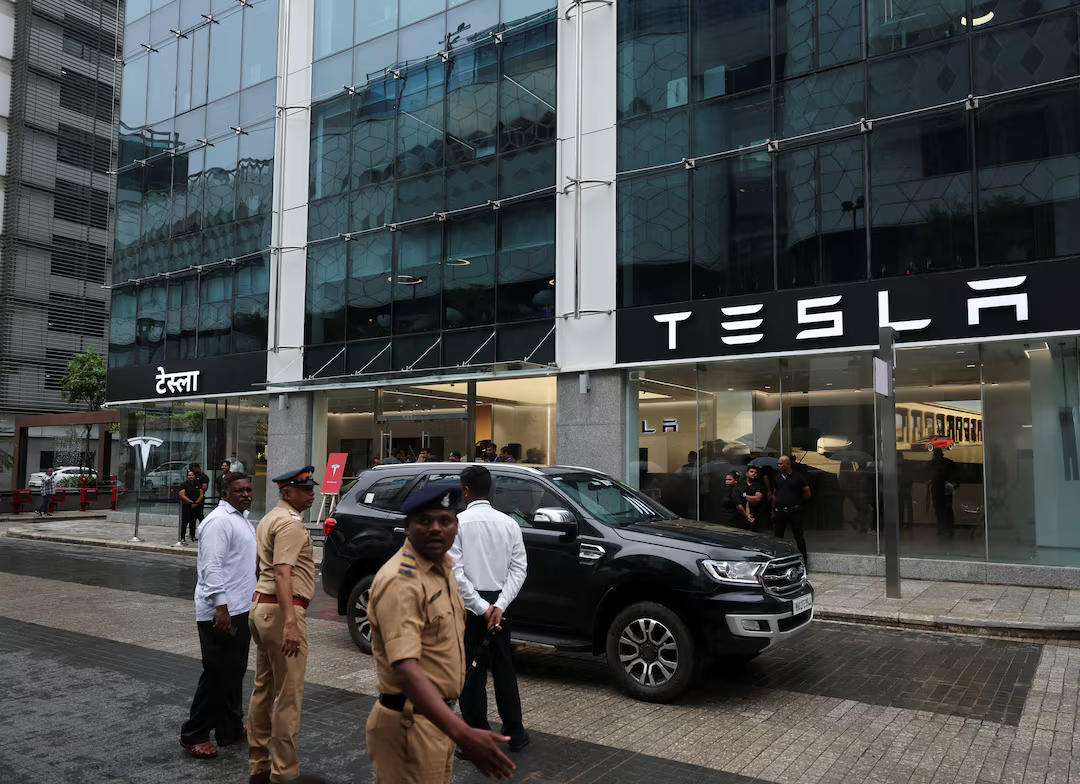
Tesla’s long-awaited launch in India begins with a ₹60 lakh Model Y and rising regulatory scrutiny. This in-depth investigation breaks down pricing controversies, import duty strategies, policy compliance, and whether Tesla will truly build in India—or just sell.
By Namith DP | July 16, 2025
Opening: A Market Entry Under the Microscope
Tesla’s formal launch in India on July 15, 2025, drew global attention. After extensive negotiation and policy back-and-forth, the electric-vehicle icon inaugurated its first showroom in Mumbai’s Bandra Kurla Complex. With bookings for the Model Y now active, the company signaled a turning point—but not without scrutiny.
Officials, automakers, analysts, and independent investigators have begun probing several key dimensions of this entry. They focus on whether Tesla’s path respects India’s trade norms, aligns with its EV ambitions, and stands to benefit consumers, local industry, and national interests.
1. Entry Timeline & Strategic Milestones

- 2016–2017: Tesla accepted refundable bookings (~₹85k) for the Model 3 in India; Musk cited import duties—up to 100%—as barriers.
- 2021: Tesla formed Tesla India Motors and Energy Private Limited in Bengaluru; Musk petitioned central ministries to reduce import tariffs.
- 2022–2023: Negotiated potential ₹4,150 crore investment under India’s new EV policy; Musk rumored plans for factory shifted to China visit instead.
- July 15, 2025: Tesla launched its Model Y in Mumbai, with prices starting at ₹60 lakh (~US $70k).
- Vehicles are Chinese-made CBUs.
- Tesla begins acceptance of orders and installs Superchargers in Mumbai and Delhi-NCR.
2. Regulatory Landscape & Duty-Evasion Probes
• Import Tariffs and Relief Schemes
- India imposes 60–100% tariffs on fully built EVs; new policy offers a limited 15% duty on imports up to 8,000 EVs/year for firms investing ≥₹4,150 crore and setting up local manufacturing facilities within three years.
- Tesla likely utilizes this transitional scheme for initial imports; regulators will verify compliance with investment and production commitments.
• Investigation Priorities
- Scheme Enrollment and Fulfillment: Authorities will confirm Tesla’s application under the reduced-duty policy, investment levels, and manufacturing timelines.
- Pricing Transparency: Regulators will check that import duties, state levies, and road taxes appear clearly in consumer-facing pricing—aligned with India’s consumer protection framework.
- Classification Audits: Tesla may undergo scrutiny to ensure correct tariff classifications; misclassification could constitute duty evasion.
• Bilateral Trade Negotiations
- Ongoing India–US trade talks include EV tariff reductions. Tesla reportedly lobbied via political channels—through PM Modi during U.S. visits—and remains hopeful of further tariff relief .
3. Pricing, Positioning & Market Fit
• Price Comparison
- Indian Model Y pricing stands at ₹60 lakh (~US $70k) for RWD and ₹68 lakh (~US $79k) for Long Range RWD.
- This contrasts with:
- US: ~$44,990
- China: ¥263,500 (~US $36,700)
- Germany: €45,970 (~US $53,700)
• Market Positioning
- Tesla targets a luxury segment constituting ~4–5% of India’s auto market, competing with BMW, Mercedes‑Benz, and Kia—not domestic mass-market EVs from Tata or Mahindra.
- Citi and Morgan Stanley observe Tesla’s strategy as brand-building focused, not volume-oriented, with minimal immediate impact on mass-market players.
4. Competitive & Policy Stakeholder Response
• BYD, Local EV Makers, and National Security
- Karnataka denies BYD factory plans due to security concerns; Tesla’s applications may be reviewed for similar issues, though no bans currently exist .
- Domestic EV makers (Tata, Mahindra) face minimal immediate threat, but could be disrupted if Tesla expands manufacturing or global price drops occur .
• Strategic Manufacturing Requirements
- India’s EV policy mandates overseas companies to establish local manufacturing and incrementally source 50% of components to maintain duty benefits .
- Tesla’s absence of local production yet clears a path for regulators to revoke policy benefits post initial imports.
5. Infrastructure, Technologies & Consumer Considerations
• Charging Network and Autonomy Claims
- Tesla plans Supercharger installations in Mumbai and Delhi. Authorities will audit these installations for quality and safety standard compliance .
- FSD (Full Self-Driving) remains saleable at ₹6 lakh extra; Indian traffic, especially multi-modal road discipline, does not suit autonomous claims .
• Consumer Support & Regulatory Safety Net
- With current showroom-only presence, Tesla faces scrutiny over documentation, delivery disclosures, pricing clarity, service network, and warranty terms.
- Online reactions highlight caution over pricing, infrastructure gaps, and doubts about FSD in India’s driving environment.
6. Long-Term Strategic Stakes & Market Outlook

• Market Potential
- India ranks third globally in vehicle sales and targets 30% EV penetration by 2030; luxury EV segment remains modest at <5% .
- Analysts (e.g., Frost & Sullivan’s Vivek Vaidya) view Tesla as luxury-focused, with aspirational potential but limited mainstream shift.
• Investment and Manufacturing Commitments
- The reduced-tariff scheme requires a ₹4,150 crore investment and facility setup. Manufacturing in India may unlock up to 500,000 annual units for export focus .
- Without fulfillment, Tesla risks duty loss and regulatory penalties.
• Political and Trade Strategy
- Tesla awaits outcomes of U.S.–India trade negotiations; Tesla’s leverage may weaken amid shifting U.S. Administration sentiments .
- Strategic growth may pivot on bilateral agreements or on-ground local production.
7. Influencer and Industry Sentiment
- Maharashtra CM Devendra Fadnavis hopes for R&D and manufacturing by Tesla in India to cement long-term presence.
- Anand Mahindra celebrated the showroom launch but recommended local production to drive down costs.
- NDTV quotes broking houses that Tesla’s current move poses limited disruption to Tata/Mahindra but offers competitive pressure if tariffs drop.
8. Core Investigative Areas
- Scheme Enrollment Validation
- Did Tesla formally apply and qualify, and has it actually committed to the ₹4,150 crore investment?
- Local Manufacturing Timeline
- Has Tesla secured land, permits, or vendor engagement to meet the three-year commitment for local assembly?
- Duty Pass-Through Transparency
- Are import duties and state-level levies fully itemized in consumer-facing invoices?
- Supercharger & Safety Audits
- Do charging stations meet Bureau of Indian Standards (BIS) requirements and traffic safety preventivess?
- FSD Claims Assessment
- Does Tesla overstate autonomous features, given India’s infrastructure constraints?
- Competition, Dumping & Consumer Rights Compliance
- Will regulators assess antitrust or unfair trade claims? Are warranties and consumer redress systems adequate?
Conclusion & Progress Indicators
Tesla’s July 15 showroom launch embodies a high‑stakes calculated entry—an aspirational luxury gambit under intense regulatory, market, and policy scrutiny. The company tests India’s high-end appetite while seeking duties saviors via reduced‑tariff schemes. Watch the following yardsticks:
- Regulatory confirmations on scheme credentials and investment levels.
- Formal announcements on manufacturing site selection or vendor sourcing.
- Pricing transparency through customer invoicing.
- Supercharger rollout speed and official safety sign-offs.
- Consumer satisfaction and delivery volume in Q3–Q4 2025.
- Developments in U.S.–India trade negotiations that might alter future pricing.
A full evaluation of Tesla’s India strategy will rest on its ability to convert showroom interest into deliveries, full tariff compliance, infrastructure reliability, and eventual manufacturing presence. Its success hinges not just on brand cachet, but on operational transparency, market adaptation, and policy alignment.
For more news on Elon Musk read –
About The Author




Great news
[…] Tesla Enters India: Challenges and Market Implications […]