
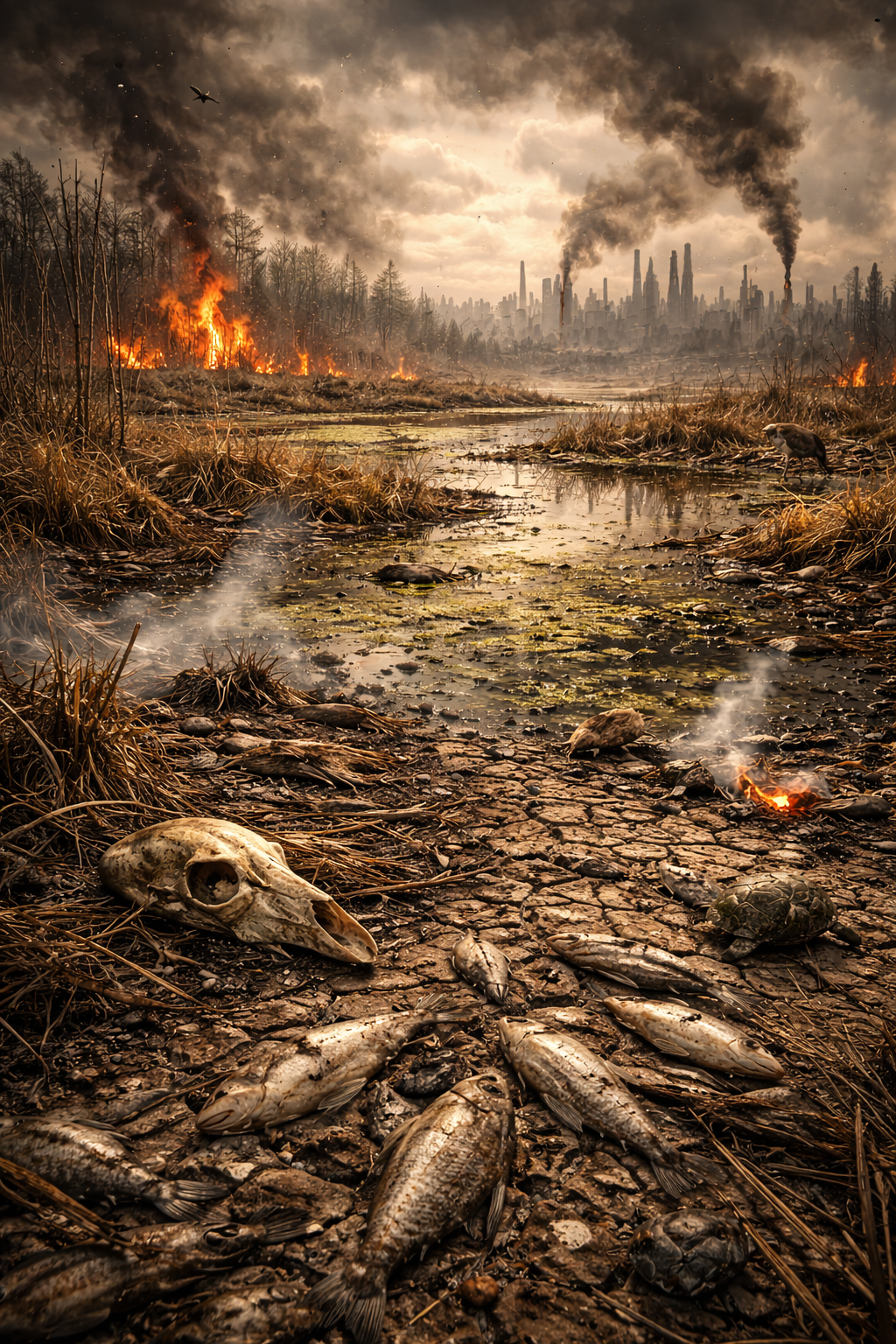
The standard assumption that nature declines in a predictable, linear fashion is a dangerous professional fallacy. You likely view environmental degradation as a slow fade—a gradual reduction in species or a slight uptick in temperature. This perspective ignores the reality of regime shifts. Ecosystems do not always bend before they break. They often maintain a facade of stability until they reach a mathematical tipping point, after which they collapse into an entirely different, often degraded, state. You are living through a period where the warning signs are no longer subtle. They are flashing in the data of every major biological survey conducted in the last decade.
The 1.5-degree Celsius threshold frequently discussed in policy circles is a political convenience, not a biological reality. Many ecosystems are already failing at current levels of warming and exploitation. To understand the true health of the planet, you must look past the headlines and examine the structural integrity of the systems that support global commerce, food security, and human health. You are seeing the disintegration of the infrastructure of life itself.
The Loss of Biological Redundancy and the Insurance Species
A healthy ecosystem functions like a well-diversified investment portfolio. It contains multiple species that perform the same roles. If one species fails, another steps in to maintain the nutrient cycle or the pollination chain. When you see a reduction in “functional redundancy,” the ecosystem is under extreme stress.
Scientists call this the “rivet popper” hypothesis. Imagine an airplane wing. You can lose a few rivets and the plane continues to fly. You do not know which specific rivet is the one that causes the wing to detach. Ecosystems operate under the same logic. In the grasslands of the American Midwest and the savannas of the Sahel, the loss of minor plant species often precedes the collapse of the entire vegetation structure.
You must monitor the “insurance species” within an environment. These are the organisms that seem redundant during stable times but prove essential during a drought or a heatwave. When these species disappear, the system loses its ability to bounce back from shocks. You are then left with a brittle environment that is one weather event away from total transformation. Data from David Tilman’s long-term grassland experiments at Cedar Creek shows that plots with higher species richness are significantly more stable over decades. When richness drops, biomass production becomes erratic. This volatility is the first sign of a coming crash.
Trophic Downgrading and the Predator Void
The removal of apex predators is perhaps the most visible sign of an ecosystem in distress. This process, known as trophic downgrading, triggers a cascade of negative effects that reorganize the entire environment. You see this clearly in the oceans. When commercial fishing depletes shark populations, the mid-level predators they once controlled explode in number. These smaller fish then overconsume the herbivorous species that keep coral reefs clean of algae. The result is a reef smothered in slime, unable to support the biodiversity that once fueled local economies.
On land, the absence of large carnivores leads to the overgrazing of saplings by herbivores like deer or elk. This prevents forest regeneration. You are looking at a “zombie forest”—a collection of old trees with no young generation to replace them. This lack of age diversity in plant life is a ticking time bomb for carbon sequestration and timber industries. Ask yourself if a forest is truly healthy if it has lost its ability to reproduce.
In the North Pacific, the loss of sea otters led to an explosion of sea urchins. These urchins decimated the kelp forests, turning productive coastal waters into “urchin barrens.” These barrens support almost no life and sequester almost no carbon. This shift can happen in a matter of months once the predator threshold is crossed. You are watching a vibrant economy of scales turn into a desert of spines.
Phenological Mismatches and the Calendar of Ruin
Nature relies on perfect timing. The lifecycle of a pollinator must align with the blooming of its host plant. The migration of birds must coincide with the peak abundance of the insects they eat. Climate change is now shattering these ancient synchronizations. This is called phenological mismatch.
In the Dutch countryside, great tits are now hatching their chicks after the peak of the caterpillar season because the trees are leafing out earlier due to warm springs. The birds cannot change their genetic clocks as fast as the climate is changing the local flora. You see the results in declining bird populations across Europe.
This mismatch extends to agriculture. Your food security depends on the synchronized dance of bees and blossoms. If the flowers bloom too early due to a false spring, and the bees remain dormant, the crop fails. You are witnessing a breakdown in the fundamental logistics of the natural world. These timing errors are the early warning sirens of a system that can no longer coordinate its own survival. By 2050, researchers estimate that nearly 25 percent of all migratory species will face significant timing mismatches that threaten their population viability.
Critical Slowing Down: The Recovery Lag
One of the most mathematically robust signs of an ecosystem near a tipping point is “critical slowing down.” This refers to a situation where a system takes longer and longer to recover from a small disturbance.
Think of a lake. Historically, if a nutrient spike from agricultural runoff caused an algae bloom, the lake would clear itself within a season. As the lake approaches a state of permanent eutrophication—where it becomes a toxic green soup—it takes much longer to return to clarity after each bloom. Eventually, it does not return at all.
You can observe this in the Amazon rainforest. Data from the last three decades shows that the forest is losing its resilience. After a drought, the vegetation takes longer to regain its greenness and its water-cycling capacity. This lag is a signal that the Amazon is shifting from a carbon sink to a carbon source. It is moving toward a savanna-like state. Once this transition begins in earnest, no amount of local conservation will stop it because the forest will have lost its ability to create its own rainfall. Scientists monitoring satellite vegetation indices have noted a 15 percent increase in recovery time across 75 percent of the Amazon basin since the early 2000s.
Microbiome Erosion and Soil Fatigue
You often ignore the most important part of the ecosystem because it is invisible. The soil microbiome is the engine of terrestrial life. Healthy soil is a living matrix of fungi, bacteria, and protozoa. Industrial agriculture and chemical saturation are killing this matrix.
A sign of extreme stress is the loss of mycorrhizal fungi. These fungi form symbiotic networks with tree roots, trading nutrients for sugars. They are the “internet of the forest.” When these networks break down, trees become more susceptible to disease and drought.
In the Great Plains of the United States, soil organic matter has dropped by over 50 percent in many areas. You are seeing the “fatigue” of the land. The soil is no longer a self-sustaining system. It is a dead substrate that requires constant infusions of synthetic fertilizers to remain productive. This is not sustainable. It is a biological Ponzi scheme that will eventually collapse when the input costs exceed the yield value. Dust Bowl conditions are not a historical relic. They are a logical outcome of soil death.
Chemical Saturation and the Nitrogen Paradox
The Earth has a natural nitrogen cycle. Human activity has doubled the amount of reactive nitrogen in the environment through fertilizer use and fossil fuel combustion. This excess nitrogen is a major stressor.
You might think more nitrogen means more growth. It actually leads to a loss of diversity. High nitrogen levels favor a few fast-growing, “weedy” species that outcompete everything else. This leads to the homogenization of the landscape. In the heathlands of the United Kingdom and the prairies of North America, nitrogen deposition is turning complex, multi-species environments into monotonous grass mats.
This nitrogen eventually washes into the water, creating “dead zones” in the Gulf of Mexico and the Baltic Sea. These are areas where oxygen levels are so low that no fish can survive. When you see a dead zone, you are looking at the end-stage of an ecosystemic failure that started hundreds of miles away on a farm. Are you prepared for the economic fallout when the world’s most productive fisheries become permanent aquatic deserts? The Gulf of Mexico dead zone now averages 5,000 square miles annually. That is an area the size of Connecticut where the ocean has essentially been turned off.
Acoustic Silence: The Sound of Stress
A healthy ecosystem is loud. The field of ecoacoustics uses sound to measure biodiversity. In a thriving rainforest or coral reef, every species occupies a specific “acoustic niche” to ensure its calls are heard.
A sign of an ecosystem under stress is a simplified soundscape. When you record the sounds of a forest and hear only a few species of insects instead of a complex orchestra of birds, primates, and amphibians, you know the system is hollowed out. In the “quieting” of the world’s forests, you are hearing the sound of extinction.
Research in the underwater environments around the Great Barrier Reef shows that healthy reefs have a distinct “crackle” produced by snapping shrimp and fish. Larval fish use this sound to find their way to the reef. When a reef dies, it goes silent. The larvae can no longer find it, preventing any chance of natural recovery. The silence is not peaceful. It is a sign of a biological vacuum. Acoustic monitoring in the Amazon has shown a 40 percent reduction in sound complexity in fragmented forest patches compared to contiguous primary forest.
The Expansion of Generalists and the Homogenization of Life
As ecosystems fail, “specialist” species die off first. These are organisms that require specific conditions or food sources. They are replaced by “generalists”—species that can survive anywhere and eat anything.
You are seeing a global shift toward a more boring world. Rats, crows, cockroaches, and certain invasive grasses are the winners in a stressed environment. While these species are resilient, they do not provide the same ecosystem services as the specialists they replace. A landscape dominated by three or four generalist species is incredibly vulnerable to a single disease or a single weather event.
The loss of unique, localized life forms is a sign that the global biological system is losing its complexity. Complexity is what provides stability. By simplifying the world, you are making it more prone to catastrophic failure. We call this the “Homogecene.” It is a period where the unique signatures of different biomes are being erased and replaced by a globalized, low-value biological monoculture.
The Amazon Basin: A Case Study in Transpiration Failure
The Amazon is the world’s largest tropical rainforest, but it is also a massive hydraulic pump. The trees pull moisture from the ground and release it into the atmosphere through transpiration. This creates “aerial rivers” that provide rain for the soy and cattle industries in Southern Brazil and Argentina.
You are now seeing the signs of this pump failing. Deforestation has reached a point where the remaining forest cannot generate enough moisture to sustain itself during the dry season. The dry seasons are getting longer. Fire, which was once rare in a rainforest, is now common.
This is a feedback loop. Fewer trees lead to less rain, which leads to more tree death, which leads to even less rain. This is not a local problem. If the Amazon tips into a savanna state, the global climate will shift. The moisture that used to fall as rain in South America will stay in the atmosphere, altering the jet stream and potentially causing droughts in the American Midwest. Your food prices in Chicago are directly linked to the health of the trees in Manaus. The tipping point for this transition is estimated at 20 to 25 percent deforestation. We are currently at 17 percent. You have very little runway left.
The Great Barrier Reef and Thermal Inertia
The Great Barrier Reef is often cited as the “canary in the coal mine” for climate change. It has suffered multiple mass bleaching events in the last decade. Bleaching occurs when the water gets too warm and the corals expel the colorful algae that live in their tissues. Without the algae, the corals starve.
The stress signal here is the lack of recovery time. Corals need about a decade to fully recover from a bleaching event. We are now seeing bleaching events every two or three years. The system is being hit again before it can heal.
Moreover, the “composition” of the reef is changing. The fast-growing branch corals are being replaced by slower-growing, boulder-like corals. This reduces the three-dimensional complexity of the reef, providing fewer hiding places for fish. Even if the reef “looks” like it is still there, its functional capacity to support a diverse fish population is crashing. You are looking at a skeletal version of what was once a vibrant city. Since 1995, the Great Barrier Reef has lost more than half of its coral cover.
The Aral Sea: The Cost of Ignored Signals
If you want to see the end-state of an ecosystem that ignored every warning sign, look at the Aral Sea in Central Asia. Once the fourth-largest lake in the world, it is now a toxic dust bowl. The Soviet Union diverted the rivers that fed the sea to grow cotton in the desert.
The signs were there for decades. The water level dropped. The salinity increased. The fish started dying. The local climate became more extreme because the large body of water was no longer there to moderate the temperature.
Instead of stopping the diversions, the authorities pushed for more cotton. Today, the fishing industry is gone. The local population suffers from high rates of respiratory illness because the wind blows toxic salt and pesticide dust from the dry seabed into their lungs. The Aral Sea is a monument to the human ability to ignore the obvious until it is too late to act. This is what an absolute ecosystemic zero looks like.
The Arctic Boreal Shift and the Greening of the Tundra
The Arctic is warming four times faster than the rest of the planet. You might hear people talk about the “greening of the Arctic” as if it were a positive development. It is a sign of profound stress. As the permafrost thaws, shrubs and trees move north into the tundra.
This change alters the “albedo” of the Earth. Dark shrubs absorb more sunlight than white snow, creating another feedback loop that accelerates warming. Furthermore, the thawing permafrost releases methane—a greenhouse gas much more potent than carbon dioxide. You are witnessing a transition where the Arctic is moving from a global cooling fan to a global heating element.
In the boreal forests of Canada and Siberia, “zombie fires” are now smoldering underground in the peat throughout the winter and reigniting in the spring. This phenomenon was almost unheard of twenty years ago. These fires are a signal that the very ground beneath our feet has become a fuel source. This is not a forest under stress. This is a biome in the process of self-immolation.
Invasive Species and the Collapse of Border Integrity
Ecosystems have natural borders maintained by climate and geography. When an ecosystem is stressed, these borders become porous. Invasive species act as biological wildfires. They enter a system that has lost its resilience and quickly dominate the landscape.
In the Florida Everglades, the invasion of Burmese pythons has led to a 90 percent decline in small mammal populations. The pythons are not just another species. They are a systemic shock that the local food web cannot absorb. When you see an invasive species taking over, you are seeing the failure of the native species to occupy their niches.
In the Great Lakes, zebra mussels have transformed the water chemistry and pushed out native mollusks. This has cost the regional economy billions in damage to infrastructure and lost revenue from fisheries. You must realize that an invasive species is often a symptom of a weakened system, not just the cause of its decline. A healthy, diverse ecosystem can usually repel invaders. A stressed one is an open door.
The Hidden Signal: Chemical Communication Failure
Plants and animals communicate through chemical signals called semiochemicals. These signals coordinate everything from defense against pests to mating. Air pollution and soil contamination are “jamming” these signals.
When a plant is attacked by a caterpillar, it releases volatile organic compounds that attract predatory wasps to kill the caterpillar. High levels of ozone and other pollutants break down these compounds before they can reach their target. The communication lines are cut. The plant is left defenseless, and the wasps go hungry.
This invisible disruption is happening on a global scale. It is the biological equivalent of shutting down the internet. You cannot see it, but you can see the results: massive insect die-offs and unexplained crop failures. If the organisms in an ecosystem cannot talk to each other, they cannot function as a system. They become a collection of isolated individuals, and isolated individuals are easy to pick off.
Nature as a Balance Sheet: The Economic Reality
You must stop viewing environmental health as a “green” issue and start viewing it as a “solvency” issue. The World Economic Forum estimates that $44 trillion of economic value generation—more than half of the world’s total GDP—is moderately or highly dependent on nature.
When an ecosystem fails, the services it provided for free must be replaced by expensive human engineering. When a wetland is drained, you must build multi-billion dollar levee systems to manage floods. When pollinators die, you must pay humans to hand-pollinate fruit trees, as is already happening in parts of China. When forests are lost, you must build mechanical carbon capture plants that are far less efficient than a single oak tree.
The “signs of stress” are essentially indicators of upcoming tax hikes, insurance premium increases, and supply chain disruptions. If you ignore the health of the ecosystem, you are ignoring the fundamental capital of your business. The Taskforce on Nature-related Financial Disclosures (TNFD) is now moving toward requiring companies to report these risks. The era of nature being an “externality” is over. It is now a line item on your P&L.
The Social Cost of Ecological Stress: Migration and Conflict
Ecosystemic stress does not stay in the woods. It moves into the cities. When a local environment can no longer provide water or food, the people living there move. We are entering an era of “ecological refugees.”
The Syrian civil war was preceded by the worst drought in the region’s recorded history, which caused a mass migration from rural areas to overcrowded cities. This created the social pressure that ignited the conflict. You see similar patterns in the dry corridor of Central America and the shrinking Lake Chad basin in Africa.
When you ignore the signs of stress in an ecosystem, you are ignoring the early warning signs of political instability and mass migration. The Pentagon now refers to climate change as a “threat multiplier.” It takes existing tensions and turns them into crises. An ecosystem in stress is a society in waiting for a catastrophe.
The Failure of Current Conservation Models
You must accept that our current approach to conservation is failing. Setting aside small “islands” of protected land is not enough when the global systems—the air, the water, the climate—are in flux. We are managing nature as if it were a static museum piece rather than a dynamic, living system.
The “Protected Area” model often ignores the connectivity required for species to migrate as the climate shifts. If a species is trapped in a park and its food source moves north, that species dies. We need to think about “ecological corridors” and “landscape-scale” restoration.
We also need to rethink our obsession with “charismatic megafauna.” Protecting tigers and pandas is important, but if we ignore the insects, the fungi, and the bacteria, the tigers will have nothing to eat and no world to live in. We must shift our focus from individual species to “functional integrity.” Are the cycles working? Is the energy flowing? Is the system recovering from shocks? These are the questions that matter.
The Need for Real-Time Monitoring and Actionable Intelligence
How do you act on this? You move away from static reports and toward real-time biological monitoring.
You must invest in remote sensing technology that tracks “Critical Slowing Down” in forests and grasslands. You must support the deployment of autonomous underwater vehicles to monitor the acoustic health of our oceans. You must demand that corporations include “Nature-Related Financial Disclosures” in their annual reports.
The most important step is to recognize that we cannot “manage” nature like a machine. We can only protect its ability to manage itself. This means protecting the “Insurance Species,” restoring the “Trophic Cascades,” and respecting the “Phenological Calendars” that have worked for millions of years.
Are you waiting for the total collapse to take action, or will you listen to the signals that the Earth is sending right now? The data is clear. The silence is growing. The lag is increasing. The rivets are popping. You have the expertise to see these signs. You must now find the will to respond with the urgency that a failing life-support system demands.
The window for intervention is closing. This is not a prediction of a distant future. It is an observation of the present. Every day that you ignore the signals of a stressed ecosystem is a day that the cost of restoration doubles and the probability of success drops. The choice is yours, but the results are written in the biology of the world around you.
References
The Living Planet Report 2024
The Economics of Biodiversity: The Dasgupta Review
IPBES Global Assessment Report on Biodiversity and Ecosystem Services
https://www.ipbes.net/global-assessment
Nature Risk Rising: Why the Crisis Engulfing Nature Matters for Business and the Economy
Amazon Tipping Point: Last Chance for Action
https://www.science.org/doi/10.1126/sciadv.aat2340
Trophic Downgrading of Planet Earth
https://www.science.org/doi/10.1126/science.1205106
Critical Slowing Down as a Biomarker of Marine Ecosystem Collapse
https://www.google.com/search?q=https://www.nature.com/articles/s41586-019-1520-y
The Aral Sea Disaster: Environmental and Social Consequences
The Taskforce on Nature-related Financial Disclosures (TNFD) Recommendations
https://tnfd.global/recommendations/
Author bio
Julian is a graduate of both mechanical engineering and the humanities. Passionate about frugality and minimalism, he believes that the written word empowers people to tackle major challenges by facilitating systematic collaborative progress in science, art, and technology. In his free time, he enjoys ornamental fish keeping, reading, writing, sports, and music. Connect with him here https://www.linkedin.com/in/juliannevillecorrea/
About The Author


