
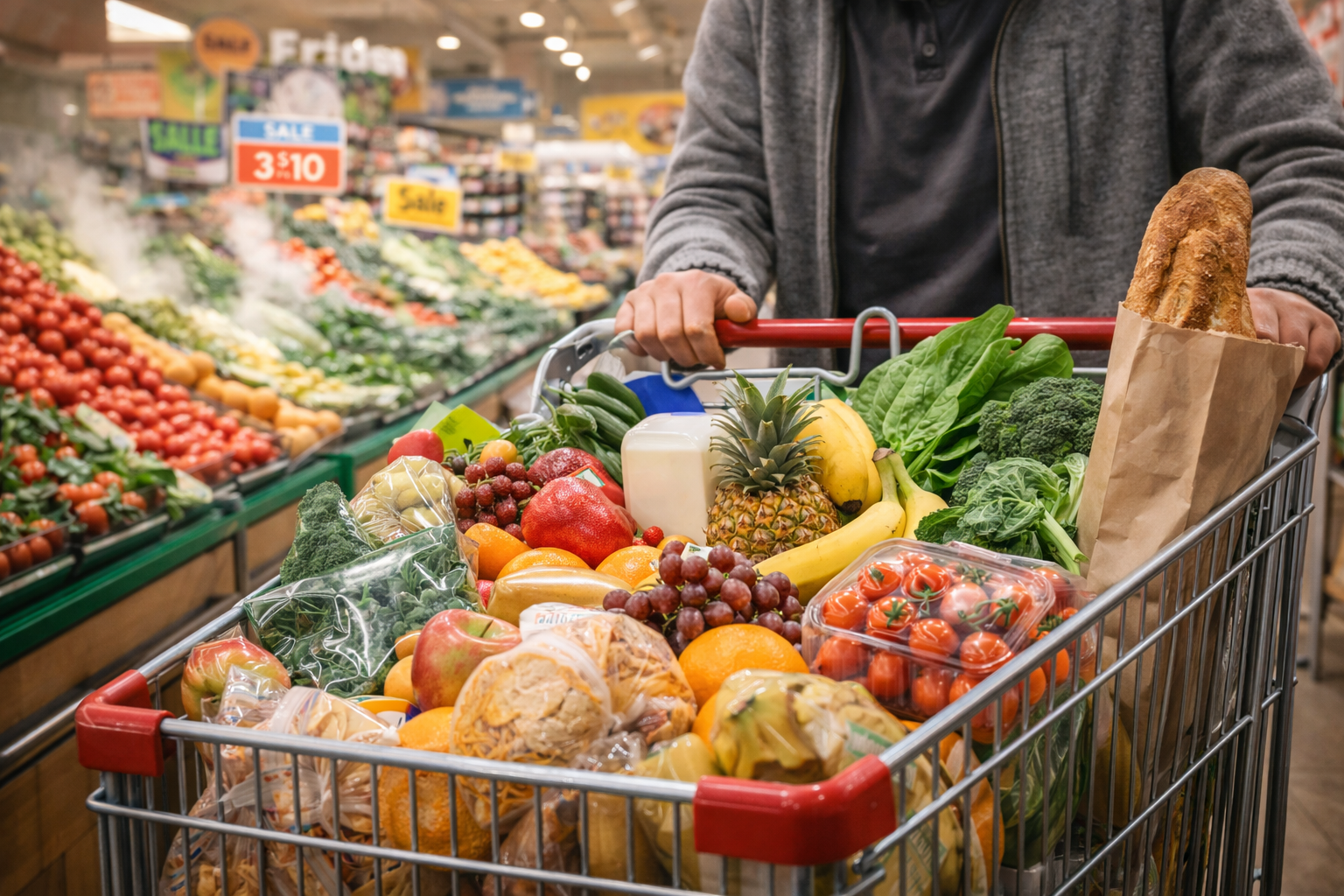
The average household discards nearly a third of the food it purchases. This is not a failure of character. It is a calculated outcome of a multibillion dollar retail environment designed to decouple your logic from your utility. While you believe you are practicing responsible provisioning, you are likely participating in a cycle of over-acquisition that serves the grocer’s bottom line at the expense of your financial health and the planet’s resources. When you treat the grocery store as a pantry rather than a distribution point, you lose the battle of attrition against perishability.
The modern supermarket operates on the principle of sensory dominance. From the misting of produce that actually accelerates rot to the strategic placement of high-margin items at eye level, every square inch of the floor plan aims to increase your basket size. If your refrigerator remains packed yet you struggle to decide what to eat, you are overbuying. If you find yourself throwing away “aspirational” greens every Sunday, you are overbuying. The signs are often subtle, masked by the cultural narrative that a full fridge equals a successful life.
The Myth of the Bulk Discount
Retailers rely on your inability to calculate price-per-unit utility in real-time. You see a “three for ten dollars” tag and assume a victory for your budget. In reality, unless you possess a plan to consume all three units before they degrade, you are merely paying the retailer to store their inventory in your home until you eventually move it to the trash. This is the bulk discount trap. It creates a false sense of security that leads to “consumption creep,” where you eat more because there is more available, or “waste creep,” where the excess simply expires.
Data from the Bureau of Labor Statistics indicates that food at home prices have risen significantly over the last decade. Yet, waste levels remain stagnant. You are paying more for the privilege of wasting more. Ask yourself when you last audited your pantry for duplicates. If you own four half-used bags of flour or three jars of the same spice, your shopping process lacks a feedback loop. You are buying based on a feeling of lack rather than an assessment of stock.
Your Fridge Is a Graveyard for Aspirational Health
The produce aisle is where your ideal self goes to shop. You buy kale, radishes, and organic microgreens with the intention of becoming a person who eats those things daily. By Wednesday, your actual self wants toast and a quick protein. By Friday, those greens are a liquifying mess in the bottom drawer. This disconnect between your “planning self” and your “executing self” is a primary driver of overbuying.
A crowded refrigerator is actually a sign of poor management. Air needs to circulate to keep food at the correct temperature. When you jam every shelf with items “just in case,” you create warm pockets that shorten the shelf life of everything inside. You think you are being prepared. You are actually creating a high-speed decay chamber. If you cannot see the back wall of your refrigerator, you have exceeded your household’s manageable capacity.
The Psychological Cost of Choice Overload
The “paradox of choice” is a well-documented phenomenon where an abundance of options leads to paralysis and poor decision-making. When you overbuy, you create this same paradox within your own kitchen. You look at a pantry overflowing with cans, boxes, and bags, and you feel overwhelmed. This often leads to “revenge ordering” takeout because the mental labor of sorting through your excess feels too high.
You are paying for food twice: once at the register and again when you order a meal because you cannot face your cluttered kitchen. True food security comes from a lean, high-turnover inventory. A minimalist approach to groceries ensures that every item has a dedicated purpose and a clear timeline for consumption. If an item does not have a “job” for the next 72 hours, it does not belong in your cart.
Biological Impulses and the Scarcity Brain
Your DNA is working against you. Evolution programmed your ancestors to seek out and store calories whenever they were available because the next meal was never guaranteed. In 2026, where ultra-processed calories are available at every street corner, that biological drive is a liability. You buy extra food because your “scarcity brain” fears an empty shelf, even though the modern supply chain makes that fear irrational for most urban dwellers.
Do you notice a spike in your purchasing volume when you feel stressed or tired? This is emotional provisioning. You are trying to buy a sense of safety that a bag of oranges cannot provide. When you acknowledge that your urge to overbuy is a primitive reflex, you can begin to override it with rational systems. You are not a hunter-gatherer anymore. You are a manager of assets. Act like one.
Retail Engineering and the Decoy Effect
Supermarkets utilize the “decoy effect” to nudge you toward larger, more expensive quantities. You might see a small jar of sauce for five dollars and a large one for seven. The small jar exists only to make the large jar look like a bargain. You buy the large jar, use half of it, and the rest sits in the fridge until it grows mold. The retailer successfully moved a larger volume of product, and you feel like you won, even though you spent two dollars more than necessary for the amount you actually consumed.
You must recognize that your local grocery store is a finely tuned machine built to exploit human cognitive biases. The music is slow to keep you in the aisles longer. The most profitable items sit at the end of the aisles (endcaps) where you are most likely to grab them impulsively. If your shopping trip takes more than forty minutes, your probability of making an impulse purchase increases by nearly 30 percent. Speed is your best defense against overbuying.
The Impact of Shrinkflation on Your Purchasing Logic
The phenomenon of shrinkflation—where manufacturers reduce the size of a product while maintaining the price—creates a subtle panic in the consumer mind. You see a familiar box of cereal that looks thinner than it did six months ago. Your response is often to buy two boxes to “make up for it.” This is exactly what the retailer wants. They have successfully triggered a volume-based response to a price-based problem.
You must audit your volume requirements based on weight, not on the number of packages. If you used to buy one box a week, and now you find yourself buying two, you are likely overbuying relative to your actual nutritional needs. The visual cue of a smaller package tricks you into thinking you are starving when you are actually just being charged more for the same amount. Discipline requires looking past the cardboard and into the raw metrics of the product.
The Trap of the Weekly Routine
The concept of the “big weekly shop” is an outdated relic of a different economic era. It assumes that you can accurately predict your hunger, your schedule, and your energy levels seven days in advance. You cannot. Life is volatile. Late meetings, social invitations, or simple exhaustion will inevitably disrupt your meal plan.
When you buy for a full week, you are gambling on a perfect version of your life that rarely manifests. Transitioning to a “just-in-time” model where you buy for two or three days at a time drastically reduces waste. It allows you to adjust your purchases based on your actual reality. If you find yourself “topping off” your groceries mid-week while the original haul is still sitting there, your weekly routine is failing you.
High-Volume Purchases and the Illusion of Preparedness
The “prepper” mentality has seeped into the average household. You buy five boxes of pasta because they were on sale, telling yourself that you are being “smart” and “prepared.” This is a fallacy. Unless you are facing an actual supply chain collapse, those five boxes represent stagnant capital. That money could be earning interest or paying down debt. Instead, it is sitting on a shelf, taking up space and potentially attracting pests.
Inventory management is a professional discipline for a reason. Businesses strive for high turnover because sitting inventory is a liability. Your home should be no different. If you have enough food to last a month but you still go to the store every week for “fresh items,” you are overinvesting in your pantry. You are treating your home like a warehouse, but you aren’t getting the wholesale margins that justify it.
Kitchen Ergonomics: Designing for Waste
The way you organize your kitchen often encourages you to overbuy. Deep cabinets and dark pantry corners are where ingredients go to die. If you cannot see an item, it effectively does not exist. You go to the store and buy a new bag of lentils because you didn’t see the one hidden behind the oversized stockpot. This is “accidental duplication.”
You must treat your kitchen like a professional galley. Use transparent containers. Label everything with a “purchased on” date. Arrange your shelves so that the oldest items are at the front. This “First-In, First-Out” (FIFO) method is standard in the restaurant industry, and it is the only way to prevent your pantry from becoming an archaeological site of expired goods. If your kitchen layout requires you to move three things to find one, your ergonomics are driving your overspending.
The Hidden Impact of Unit Bias
Humans have a natural tendency to want to complete a unit. If a recipe calls for two stalks of celery, you buy the whole head because that is the unit offered. If you need a tablespoon of fresh ginger, you buy a massive root. You then feel a psychological burden to use the rest, or more commonly, you ignore it until it shrivels.
You must learn to break the unit. Many stores allow you to snap off exactly what you need in the produce section. If they do not, you must weigh the cost of the wasted portion against the convenience of the store. Buying a pre-cut, smaller portion for a higher unit price is often cheaper in total than buying a large “bargain” unit and throwing 80 percent of it away. Your goal is the lowest total cost of consumption, not the lowest unit price.
Marketing Narratives and the “Organic” Premium
The “health halo” effect leads many consumers to overbuy items labeled as organic, non-GMO, or artisanal. You perceive these items as more valuable, which subconsciously justifies buying more of them. However, organic produce often has a shorter shelf life because it lacks synthetic preservatives. When you overbuy expensive organic berries, you are significantly increasing the financial impact of your waste.
If you are going to pay a premium for quality, you must be twice as disciplined about quantity. Buying high-quality food in small, manageable amounts is a mark of expertise. Buying it in bulk because you feel “virtuous” is a mark of a marketing victim. True health comes from the consistency of your intake, not the volume of your purchases.
The Subscription Economy: Why Auto-Ship is Killing Your Discipline
In 2026, grocery subscriptions and automated refills have become the norm. While these services promise convenience, they actually remove the critical “decision moment” from your shopping process. You receive a new shipment of coffee or olive oil because a computer decided it was time, not because you actually ran out. This leads to a slow accumulation of surplus that clutters your mind and your shelves.
Automation is the enemy of mindfulness. When you stop looking at your supplies, you stop valuing them. You start to view food as an infinite stream rather than a precious resource. Cancel your auto-shipments. Force yourself to make a conscious choice every time you buy a product. If the effort of clicking a button is too much, you probably didn’t need the item that badly in the first place.
The Role of Digital Convenience in Overconsumption
Grocery delivery apps and “click and collect” services have removed the physical friction of shopping. While this saves time, it also removes the physical weight of the items from your hands. When you don’t have to push a heavy cart or carry bags, you lose the sensory feedback that tells you that you have bought enough. Digital interfaces are designed to suggest “frequently bought together” items, further inflating your basket.
If you use these services, you must be clinical. Use a strict list. Ignore the “recommendations.” Before you hit “checkout,” go to your kitchen and verify that you don’t already have the items in your digital cart. The convenience of the app is a tool for the retailer to bypass your natural “enough” sensors. You must re-establish those boundaries through manual verification.
Environmental Degradation and the Ethics of Excess
Overbuying is not just a personal financial issue. It is a systemic environmental disaster. Food waste in landfills produces methane, a greenhouse gas significantly more potent than carbon dioxide. When you overbuy and discard, you are wasting the water, land, fuel, and labor required to produce that food. This is an ethical failure that we often sanitize by calling it “clutter” or “unfortunate waste.”
Your shopping habits are a direct reflection of your respect for the natural world. A minimalist, disciplined approach to food is an act of environmental stewardship. By buying only what you can reasonably consume, you reduce the demand for overproduction and the resulting strain on ecosystems. This is where altruism meets personal finance. Eating with discipline is not about deprivation. It is about alignment with reality. Every time you throw away a withered apple, you are throwing away the gallons of water and the months of sunshine that brought it into existence.
The Social Pressure of the “Bountiful Table”
Cultural narratives often equate a full pantry and a loaded dinner table with hospitality and success. We are taught that running out of an ingredient is a “failure” as a host or a provider. This fear of scarcity drives us to overbuy “buffer” items that we never actually need. We buy extra bags of chips, extra sodas, and extra dips for guests who never arrive or who don’t eat them.
You must challenge the assumption that “more is better.” A well-curated, simple meal made with fresh, high-quality ingredients is superior to a chaotic spread of processed excess. True hospitality is about the quality of the interaction, not the volume of the buffet. When you stop overbuying for “potential” social scenarios, you free up resources for actual experiences.
The Timeline of Degradation: A Reality Check
Most consumers have a poor understanding of how fast food actually loses its nutritional value. Fresh spinach loses half of its folate and carotenoids within eight days of harvest when kept at room temperature, and even when refrigerated, the decline is steady. When you overbuy “fresh” produce and let it sit for a week, you are eating a nutritionally depleted version of what you paid for.
You are effectively paying for premium nutrients but consuming low-grade starch and fiber by the time you get around to it. If you want the health benefits of the food you buy, you must consume it as close to the purchase date as possible. This requires a high-frequency, low-volume shopping strategy. Anything else is just expensive decoration for your refrigerator shelves.
The “Freshness” Fallacy: Frozen vs. Perishable Supply Chains
We are conditioned to believe that “fresh” is always superior. This belief drives us to overbuy perishable items that we cannot possibly consume in time. In reality, modern flash-freezing technology preserves nutrients far more effectively than a week in your refrigerator. Buying frozen vegetables is often a more disciplined choice than buying fresh ones that will inevitably wilt.
If you find yourself throwing away fresh produce, you are falling for the freshness fallacy. You are prioritizing the image of fresh food over the utility of nutrition. A disciplined minimalist uses the freezer as a tool for stabilization. Buy fresh only for the next 48 hours. Use frozen for everything else. This simple shift can reduce your household food waste by up to 50 percent overnight.
Strategies for Immediate Correction
How do you break the cycle? Start by implementing a “reverse shopping list.” Before you go to the store, write down what you already have that needs to be used. Build your meals around those items. This shifts your mindset from “what do I want?” to “what must I use?”
Next, commit to a “zero-waste week” once a month. During this week, you are forbidden from buying anything except essential perishables like milk or eggs. You must eat through your pantry and freezer. This exercise will reveal exactly how much excess you have been carrying. You will likely find “hidden” meals you forgot existed. This is the fastest way to recalibrate your internal sense of inventory.
The Fallacy of the Emergency Stash
Many people overbuy canned goods and dry grains under the guise of emergency preparedness. While having a three-day supply of food is prudent, having a three-month supply of random beans you don’t actually like is a waste. True preparedness is “rotating” your stock. If you aren’t eating your “emergency” food regularly, it isn’t a stash. It is just a collection of slowly expiring dust-collectors.
If you want to be prepared, buy what you eat and eat what you buy. Double your normal purchase of a staple you use every week. That way, your “backup” is always fresh. Buying a “survival bucket” while your fridge is full of rotting kale is a sign of a fragmented strategy. Integration is the key to a lean, resilient household.
Data Points and Industry Observations
Market research from firms like Nielsen and Kantar consistently shows that promotions drive volume, not value for the consumer. When a store offers “Buy One Get One Free,” their internal data shows that a significant percentage of the “free” items end up in the trash. The store wins because they cleared their inventory and likely charged a slightly higher price for the first item anyway.
The grocery industry operates on thin margins, usually between 1 percent and 3 percent. They rely on “shrink”—the industry term for waste—being factored into their pricing. When you waste food, you are paying for the store’s shrink and then adding your own on top of it. You are subsidizing the inefficiency of the entire global food system with your household budget.
The Impact of Packaging on Perception
The way food is packaged can trick your brain into misjudging volume. A large bag with a small amount of “settled” contents creates a visual expectation of abundance. Multi-packs of snacks or yogurts make you feel like you are getting a deal, but they also encourage you to consume them faster than you would if you had to portion them out yourself.
You must develop the habit of looking at the weight (grams or ounces) rather than the size of the container. Retailers spend millions on “structural packaging” designed to take up more space on the shelf and in your mind. By focusing on the raw numbers, you strip away the marketing layer and see the product for what it is: a finite resource that you must manage.
Institutional Waste: A Mirror to Your Own Household
Observe the way restaurants and hotels manage their inventory. They use sophisticated software to predict demand down to the gram. Why? Because waste is the enemy of profit. Your household is a small-scale institution. If you do not have a system for predicting your “demand,” you are essentially running a failing business.
When you overbuy, you are mimicking the inefficiency of failing institutions. You are choosing chaos over order. A disciplined home is one where the “supply chain” is tight, the “inventory” is visible, and the “waste” is zero. This level of precision is not a burden. It is a liberation from the mental weight of excess.
Redefining the “Successful” Shop
A successful grocery trip is not one where you come home with a trunk full of bags. A successful trip is one where you come home with exactly what you need for the next 48 to 72 hours, having spent the minimum amount of money to achieve that goal. It is a surgical strike, not a wandering expedition.
If you feel a sense of “shame” when your fridge is empty, you need to interrogate that feeling. An empty fridge on a Sunday night is a sign of a perfectly executed weekly plan. It means you used everything you bought. It means you are in total control of your consumption. It means you are ready to start the next week with a clean slate and no “inventory debt.”
The 2026 Economic Shift: Food as an Asset Class
In the current economic climate, food is no longer a simple consumable. It is an asset class. Prices are volatile, and supply chains are fragile. Overbuying in this environment is the equivalent of buying a stock at its peak and then watching the value evaporate as it rots in your drawer. You must protect your capital by only purchasing what you can liquidate (consume).
When you view your grocery budget as an investment portfolio, your perspective changes. You stop buying high-risk perishables in large quantities. You start looking for high-yield staples that offer long-term utility. This shift in mindset is what separates the impulsive consumer from the disciplined minimalist.
The Economic Reality of Food Inflation
As we move through 2026, the cost of labor and logistics continues to put upward pressure on food prices. The era of cheap, disposable calories is ending. Overbuying is no longer just a bad habit. It is an unsustainable financial leak. If you are struggling with your monthly budget, the first place to look is your trash can.
Every discarded item is a literal pile of cash you are throwing away. If you saw five dollars lying on the sidewalk, you would pick it up. Yet, we routinely throw away the equivalent in half-eaten leftovers or bruised fruit without a second thought. This cognitive dissonance is the only thing keeping the current retail model alive. Once you see the waste for what it is—lost labor and lost time—you can never go back to “business as usual” shopping.
Final Assessment of Shopping Behaviors
Are you a victim of the retail machine, or are you a disciplined consumer? The answer lies in your trash. If your waste bin is full of organic material every week, you are overbuying. If your pantry is a maze of duplicates, you are overbuying. If you feel overwhelmed by the choices in your own kitchen, you are overbuying.
The solution is a radical return to simplicity. Buy less. Buy more often. Buy with intent. Respect the life that was sacrificed to bring that food to your table by ensuring it actually fulfills its purpose of nourishing you. Food is a living thing, even when it is harvested. Treating it as a disposable commodity is a mistake of the highest order. It is time to audit your habits, challenge your assumptions, and take back control of your kitchen. The urgency of this moment cannot be overstated. Your financial future and your environmental legacy are determined by what you put in your cart today.
References
Food Waste: The Global Cost 2025 Report
World Resources Institute
wri.org/food-waste-report
The Psychology of the Supermarket: 2024 Consumer Behavior Study
Journal of Retailing and Consumer Services
https://www.google.com/search?q=sciencedirect.com/journal/journal-of-retailing-and-consumer-services
Consumer Expenditure Survey 2024
U.S. Bureau of Labor Statistics
bls.gov/cex
The Impact of Food Waste on Climate Change
United Nations Environment Programme
unep.org/resources/report/unep-food-waste-index-report-2024
Retail Engineering and Impulse Purchase Data
Harvard Business Review
hbr.org/2023/retail-psychology-and-consumer-choice
Nutrient Degradation in Post-Harvest Produce
Journal of Agricultural and Food Chemistry
pubs.acs.org/journal/jafcau
The Paradox of Choice in Modern Grocery Retail
American Psychological Association
apa.org/monitor/paradox-of-choice
Global Food Logistics and Inflation Trends 2026 International Food Policy Research Institute ifpri.org/publication/global-food-policy-report-2026
The Gruen Effect and Retail Spatial Design Journal of Environmental Psychology https://www.google.com/search?q=sciencedirect.com/journal/journal-of-environmental-psychology
Biological Scarcity and Modern Overconsumption The Lancet Diabetes & Endocrinology https://www.google.com/search?q=thelancet.com/journals/landia/home
Author bio
Julian is a graduate of both mechanical engineering and the humanities. Passionate about frugality and minimalism, he believes that the written word empowers people to tackle major challenges by facilitating systematic collaborative progress in science, art, and technology. In his free time, he enjoys ornamental fish keeping, reading, writing, sports, and music. Connect with him here https://www.linkedin.com/in/juliannevillecorrea/
About The Author


