
Within four hours of Ayatollah Ali Khamenei’s confirmed death on February 28, 2026, Iranian missiles were already in the air over Dubai. That fact alone dismantles the dominant Western assumption that Iran would absorb a decapitation strike and respond cautiously, symmetrically, or not at all. Tehran did not calibrate. It detonated — across nine countries simultaneously, hitting civilian airports, U.S. naval headquarters, luxury hotel facades, commercial ports, and active oil infrastructure within a single operational window. What you are watching unfold is not improvised rage. It is a pre-planned, regionally distributed retaliatory doctrine that Iran had clearly prepared and war-gamed long before Operation Epic Fury dropped its first bomb.
Understanding where Iran has struck, why it chose each target, and what the pattern reveals about the next phase of this war is now one of the most consequential strategic questions in the world.
The Triggering Event: What the United States and Israel Did First
To understand Iran’s strikes, you must start with what provoked them. On the morning of Saturday, February 28, 2026, at 8:10 am local time in Tehran, U.S. and Israeli forces launched a joint operation named “Operation Roaring Lion” by Israel and “Operation Epic Fury” by the United States. Israeli jets dropped 30 bombs on Khamenei’s compound in a daylight strike while he was meeting senior advisors. At least five of those advisors were killed alongside him.
Simultaneously, the operation struck the Iranian military’s top leadership. The IDF stated it killed 40 senior commanders in coordinated strikes on two sites. Among the confirmed dead were Iranian Chief of Staff Lieutenant General Abdolrahim Mousavi, the Defense Minister, the IRGC commander, and the Secretary of the Iranian National Security Council. The operation also targeted nuclear and missile infrastructure across Iran, with the stated U.S. objectives being destruction of Iran’s missile capabilities, elimination of its nuclear program, and the initiation of regime change.
Iran’s internet connectivity fell to 4 percent of normal levels within hours of the strikes beginning, according to the independent monitoring group NetBlocks. The Iranian Foreign Ministry called the attack a gross violation of national sovereignty. President Masoud Pezeshkian, whose own fate was reportedly targeted in the opening wave alongside Khamenei, declared the killing a “great crime” that would not go unanswered.
It was not.
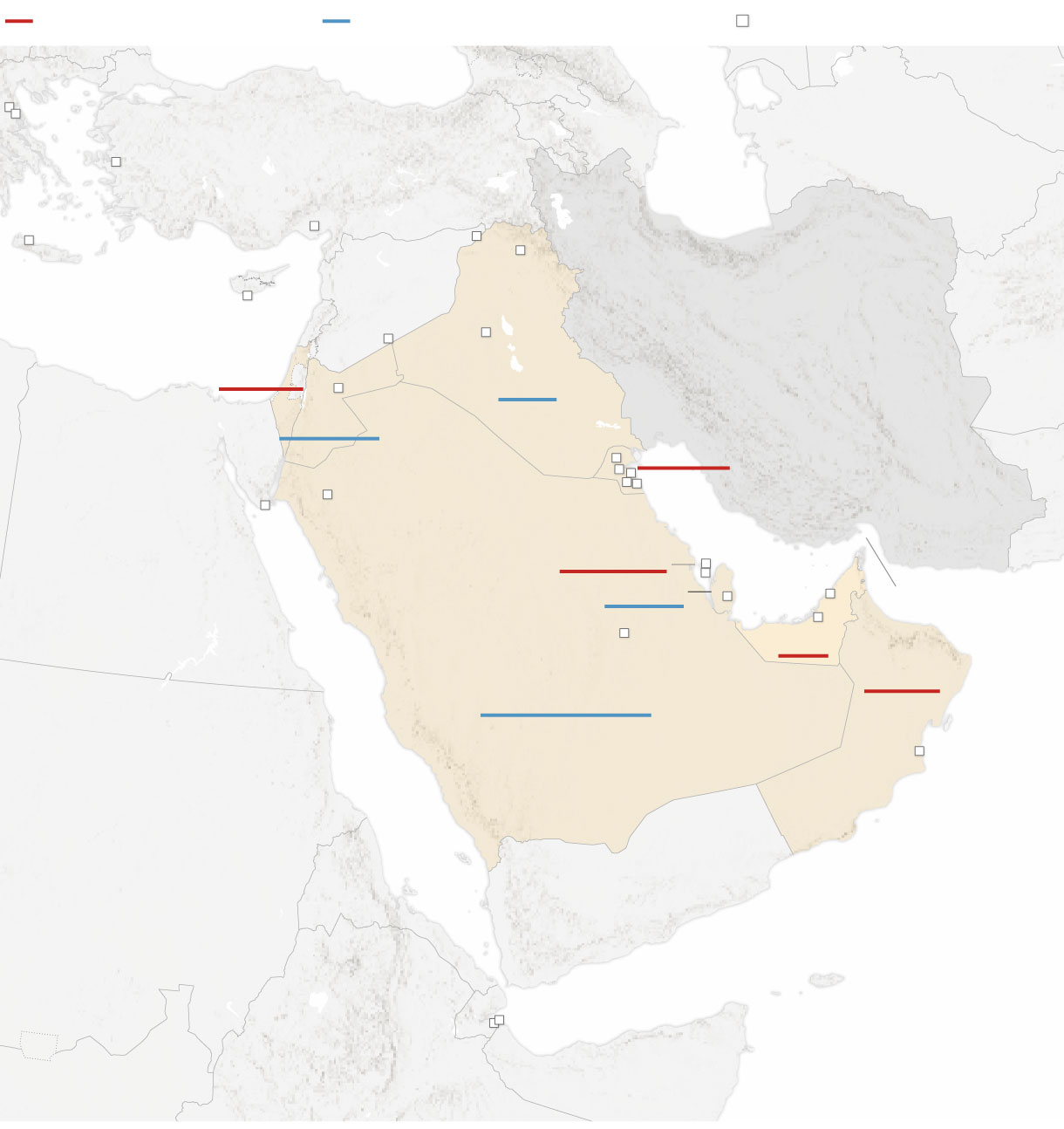
Iran’s Retaliatory Strike Map: Country by Country
Israel
Israel was the first and most sustained target of Iranian retaliation. The IRGC explicitly named its strike objectives as the Tel Nof Air Base, the Israeli military’s command headquarters at HaKirya in Tel Aviv, and a major defense industrial complex within the city. Air raid sirens sounded repeatedly across Israel, including Tel Aviv, beginning shortly after 6:00 am local time on March 1. A nine-story building was struck in northern Israel. Strikes were confirmed in Haifa and Tel Aviv. An Iranian ballistic missile hit a residential area in Beit Shemesh in central Israel on March 1, killing eight people and injuring approximately 20. One woman in the Tel Aviv area was killed earlier by falling shrapnel. Hezbollah also fired rockets into northern Israel on March 1 for the first time since the November 2024 ceasefire, reopening the Lebanon front as a secondary theater. The IRGC stated it targeted 27 military bases housing U.S. soldiers and multiple Israeli military installations.
United Arab Emirates
The UAE absorbed the heaviest volume of Iranian munitions of any single country. The UAE’s Ministry of Defense confirmed that Iran fired 165 ballistic missiles, two cruise missiles, and 541 drones at the country. The specific targets struck or closely targeted included Al Dhafra Air Base in Abu Dhabi, where a person of Asian origin was killed in the strike. The port of Jebel Ali, the largest port in the Middle East and a critical global trade hub, was hit, causing fires visible from sea. The Fairmont The Palm hotel on Palm Jumeirah caught fire, injuring four people. Dubai’s iconic Burj Al Arab hotel sustained fire damage to its outer facade from an intercepted drone. Abu Dhabi’s international airport was struck, killing one person and wounding seven. Dubai International Airport, the world’s busiest airport for international passengers, was hit and suspended operations. A mall in Sharjah was struck, and a residential building in Dubai was hit on March 1. In Sharjah specifically, three people were killed and 58 were injured. Though most munitions were intercepted, 21 drones hit civilian targets, according to UAE defense authorities.
Bahrain
Bahrain’s most strategically significant target was the headquarters of the U.S. Navy’s 5th Fleet in Manama, which Iran struck directly with ballistic missiles. Satellite imagery published by Planet Labs showed visible smoke rising from the naval base. The Bahraini government described the attack as a “treacherous attack” and a “blatant violation of the kingdom’s sovereignty and security.” Civilian infrastructure was also struck, including residential buildings and the Crowne Plaza hotel in Manama. Bahrain temporarily closed its airspace.
Qatar
Iran fired 65 missiles and 12 drones at Qatar on the opening day alone, according to Qatari officials. The primary military target was Al Udeid Air Base, the largest U.S. military installation in the entire Middle East, hosting approximately 10,000 U.S. personnel and the forward headquarters of U.S. Central Command. An American radar system near Al Udeid was also targeted. Qatar’s international airport was struck, disrupting regional aviation. Industrial districts in Doha sustained confirmed hits, with witnesses reporting thick black smoke on the southern horizon of the capital. Sixteen people were injured in Qatar from the first day of strikes.
Kuwait
Ali Al Salem Air Base in Kuwait, a major U.S. air hub that has hosted American aircraft for decades, was targeted with multiple ballistic missiles, all of which Kuwait’s air defense claimed to intercept. Kuwait International Airport was also struck by Iranian munitions, causing flight suspensions. Kuwait temporarily closed its airspace.
Saudi Arabia
Explosions were heard in Riyadh, Saudi Arabia’s capital, though Saudi air defenses responded. Saudi Arabia officially confirmed Iranian attacks targeting its capital and eastern region, both of which were described as repelled. The eastern region of Saudi Arabia is home to the Aramco oil complex at Abqaiq, the world’s largest oil processing facility, and the massive Ras Tanura export terminal. Whether those facilities were specifically targeted or whether the strikes were aimed at U.S. military personnel in the region remained unclear from official statements at the time of publication. Saudi Arabia issued a statement of solidarity with the other Gulf Cooperation Council (GCC) states that were struck.
Jordan
Jordan confirmed it “dealt with” 49 Iranian drones and ballistic missiles targeting its territory. The Jordanian armed forces said they shot down two Iranian ballistic missiles that were on trajectories targeting Jordanian soil. Reports confirmed missiles hit Jordanian territory, though Jordan stated the damage was material rather than causing casualties. Given Jordan’s geography as a transit corridor between Iran and Israel, and the presence of U.S. military personnel at bases including Al Tanf and Muwaffaq Salti Air Base, Jordan represented both a direct target and a flyover zone.
Iraq and Kurdistan Region
Iraqi militia group Kataib Hezbollah confirmed a strike in the Jurf al-Nasr area of Babylon Governorate, killing two people and wounding three others. A drone attack targeted Erbil International Airport and, separately, the U.S. Consulate General in Erbil in Iraqi Kurdistan, according to a senior Peshmerga commander who stated his forces were on alert. Kataib Hezbollah issued a statement warning that it would “soon begin attacking American bases in response to their aggression,” signaling additional Iraqi proxy operations were in preparation.
Oman and the Maritime Theater
On March 1, Iran extended its strikes to Oman’s Duqm Port, hitting it with two UAVs and injuring one expatriate worker. Separately, the oil tanker Skylight, sailing under a Palau flag, was attacked approximately five nautical miles north of Omani waters in the Strait of Hormuz. Four of the twenty crew members were injured and the full crew was subsequently evacuated. This maritime strike was accompanied by closure of the Strait of Hormuz to commercial vessel traffic, a development with direct consequences for global energy markets, as a third of worldwide oil exports transported by sea passed through the strait in 2025.
British Bases in Cyprus
UK Defense Secretary John Healey confirmed that Iran fired two missiles towards British military bases on Cyprus, though he stated he did not believe the bases were under active attack at the time. Cyprus defense officials subsequently disputed the characterization. The incident illustrated the geographic scope of Iran’s targeting envelope.
The Targeting Logic: Why These Locations Were Chosen
When you step back from the individual country reports and look at the overall strike pattern, Iran’s doctrine becomes legible. This was not indiscriminate retaliation. It was a structured campaign designed to achieve multiple simultaneous objectives.
U.S. forward military infrastructure was the primary declared target. Every Gulf state strike was anchored around a specific American military installation. Al Udeid in Qatar, the 5th Fleet headquarters in Bahrain, Ali Al Salem in Kuwait, Al Dhafra in Abu Dhabi, and numerous named bases in Israel and Iraq all appeared on the IRGC’s confirmed target list. Iran had promised for years that any attack on its soil would be met with strikes on all U.S. bases within range. It delivered on that promise within hours.
Economic chokepoints and civilian confidence were the secondary objectives. The targeting of Jebel Ali Port, Dubai International Airport, Abu Dhabi Airport, Kuwait International Airport, and Doha Airport was designed to inflict maximum economic disruption, generate civilian panic in states that host American forces, and impose political costs on GCC governments that allowed their territory to serve as U.S. bases. Iran’s calculation was that civilian populations in the UAE and Qatar would pressure their own governments to expel American military presence.
The Strait of Hormuz closure and maritime strikes were the third instrument. By attacking the Skylight tanker and the Port of Duqm, and by signaling closure of the strait, Iran targeted the one variable that the entire world economy depends on regardless of political alignment: the free flow of Gulf oil. The announcement of Houthi resumption of Red Sea attacks on the same day multiplied this pressure on global shipping routes.
Symbolic and prestigious civilian targets — the Burj Al Arab, the Fairmont Palm, Dubai Marina — were struck or narrowly hit in ways that are functionally impossible to attribute to pure military precision. Whether these were intentional or the result of interceptor debris and near-misses, the visual output achieved an effect: the world’s most photographed urban skyline was on fire.
What the Next Targets Will Be: Reading the Escalation Trajectory
If you apply the same pattern analysis to the coming days and weeks of Operation Epic Fury and Iran’s ongoing “Operation Roaring Lion” response, the most likely next targets fall into clear categories.
Aramco’s Abqaiq and Ras Tanura represent the single most consequential unconfirmed target in the theater. If Iran directly and successfully strikes these Saudi facilities — which were partially attacked by Houthi missiles in 2019 — it could remove between 5 and 6 percent of global daily oil supply from the market instantly. Saudi Arabia confirmed explosions in both its capital and eastern region, and the eastern region is where these facilities sit. A confirmed, successful strike on Abqaiq would send oil prices above $130 to $150 per barrel within hours and force OPEC+ emergency sessions.
USS Abraham Lincoln and USS Gerald R Ford carrier strike groups represent two of the most symbolic possible targets in the U.S. arsenal. The Abraham Lincoln is currently stationed in the Arabian Sea and the Gerald R Ford is operating off Israel’s coast. Iran possesses anti-ship ballistic missiles including the Khalij Fars variant that was specifically designed to target aircraft carriers. Iran has never successfully struck a U.S. carrier. Attempting to do so would represent the single most dramatic escalation possible and would likely trigger a level of American response that threatens the Iranian state’s existence. The risk-reward calculus makes a direct carrier strike less probable in the near term, but the IRGC has referenced carrier-killing doctrine in official military doctrine for over a decade.
Nuclear fallback sites and IRGC command continuity positions are a two-way target. Iran may attempt to protect or reconstitute nuclear infrastructure that survived the initial strikes, while the U.S. and Israel are certainly working to locate and eliminate any reconstitution efforts. Satellite imagery analysts flagged new activity at two Iranian nuclear sites after the June 2025 strikes, a factor explicitly cited in the Trump administration’s decision to escalate. Any confirmed Iranian nuclear activity will trigger additional U.S. and Israeli strikes, likely deeper into the country.
The Red Sea and Gulf of Aden are now formally re-opened as a Houthi operational theater. The resumption of attacks on shipping, combined with the Strait of Hormuz closure, means the two critical maritime chokepoints connecting Gulf energy to global markets are simultaneously contested. Expect tanker insurance rates to spike, expect major shipping lines to halt Gulf of Aden transits, and expect the Houthis to target vessels with renewed operational scope under cover of the larger war.
Iraqi militia mass mobilization is the near-term ground threat. Kataib Hezbollah’s explicit warning that it would begin attacking American bases represents an imminent escalation timeline. The bases at Ain al-Assad in Anbar Province and U.S. positions in Deir ez-Zor and eastern Syria are the most exposed. A coordinated militia attack on those positions, combined with Hezbollah’s resumed rocket campaign in northern Israel and Houthi maritime operations, would stretch American and Israeli defensive capacity across five simultaneous fronts.
The Larger Stakes: What This War Has Already Changed
Ask yourself what the Middle East looked like 72 hours ago. Dubai was the world’s safest, most glamorous transit hub. The Gulf states were the model of pragmatic authoritarianism producing stability and wealth. The 5th Fleet sat in Bahrain with essentially no serious threat to its physical security. The Strait of Hormuz carried a third of the world’s seaborne oil exports without interruption.
All of that has changed. Within 36 hours of Operation Epic Fury’s launch, Iran struck every single member of the Gulf Cooperation Council, hit three international airports, reached the world’s busiest passenger aviation hub, set fire to an iconic luxury hotel, struck a U.S. naval headquarters, killed civilians in four countries, and closed the world’s most important oil transit waterway. It did all of this while simultaneously absorbing American and Israeli strikes that killed its supreme leader of 36 years, most of its senior military command, and hundreds of its citizens.
The assumption that Iranian retaliation would be calibrated, symbolic, or easily absorbed is now demonstrably wrong. The assumption that Gulf Arab states could host American military power without becoming targets in an Iran-U.S. confrontation is wrong. The assumption that Operation Epic Fury would produce a quick, clean outcome on a four-week timeline, as Trump projected, needs to be examined against the reality of a regime that has not collapsed, a military that is still firing, and a proxy network that is mobilizing from Lebanon to Iraq to Yemen simultaneously.
The war map is still being drawn. The targeting logic Iran has demonstrated in the past 48 hours tells you that it will continue hitting what it can reach, at scale, until either a ceasefire is brokered or the Islamic Republic runs out of the capacity to fire. Given its pre-positioned missile stockpiles, the second outcome is not as close as anyone in Washington publicly claims.
Photo Credit: CNN
References
Al Jazeera — “More blasts rock Dubai, Doha and Manama as Iran targets US assets in Gulf” https://www.aljazeera.com/news/2026/3/1/more-blasts-rock-dubai-doha-and-manama-as-iran-targets-us-assets-in-gulf
Al Jazeera — “Mapping US and Israeli attacks on Iran and Tehran’s retaliatory strikes” https://www.aljazeera.com/news/2026/2/28/mapping-us-and-israeli-attacks-on-iran-and-tehrans-retaliatory-strikes
Al Jazeera — “Multiple Arab states that host US assets targeted in Iran retaliation” https://www.aljazeera.com/news/2026/2/28/multiple-gulf-arab-states-that-host-us-assets-targeted-in-iran-retaliation
Alma Research and Education Center — “Iran’s Multi-Front Missile and UAV Offensive Across the Middle East (Feb 28–Mar 1, 2026)” https://israel-alma.org/irans-multi-front-missile-and-uav-offensive-across-the-middle-east-feb-28-mar-1-2026/
Axios — “Iran retaliates after U.S.–Israel strikes, triggering regional fallout across Middle East” https://www.axios.com/2026/02/28/us-israel-strikes-iran-middle-east-dubai-airports
CNBC — “Ayatollah Ali Khamenei is dead, state news media confirms” https://www.cnbc.com/2026/02/28/trump-iran-strikes-live-updates.html
CNBC — “Trump vows to avenge deaths of U.S. service members, says combat operations continue” https://www.cnbc.com/2026/03/01/us-iran-live-updates-khamenei-death-trump-gulf-strikes.html
CNN — “February 28, 2026 — US-Israeli strikes on Iran live coverage” https://www.cnn.com/world/live-news/israel-iran-attack-02-28-26-hnk-intl
CNN — “What we know about the death of Iranian supreme leader Khamenei” https://edition.cnn.com/2026/02/28/middleeast/ayatollah-khamenei-iran-killed-airstrike-intl-latam
NPR — “Iran’s supreme leader is killed. What happens now?” https://www.npr.org/2026/02/28/nx-s1-5730637/irans-supreme-leader-is-killed-what-happens-now
NPR — “Iran’s supreme leader, Ayatollah Ali Khamenei, has been killed” https://www.npr.org/2026/02/28/nx-s1-5730158/israel-iran-strikes-trump-us
NPR — “Explosion rocks Iran’s capital as Israel says it is targeting the city” https://www.npr.org/2026/03/01/g-s1-112062/iran-fires-missiles
NPR — “Iran’s Supreme Leader Ayatollah Ali Khamenei killed by Israel at 86” https://www.npr.org/2026/02/28/1123499337/iran-israel-ayatollah-ali-khamenei-killed
TIME — “Iran’s Retaliatory Strikes Challenge Image of Gulf Stability” https://time.com/7381884/iran-missiles-dubai-palm-gulf/
The Times of Israel — “March 1: Hezbollah fires rockets at northern Israel liveblog” https://www.timesofisrael.com/liveblog-march-01-2026/
The Washington Post — “Iran’s supreme leader killed in U.S.-Israeli attack; Tehran strikes Israel, Arab states” https://www.washingtonpost.com/world/2026/02/28/israel-strikes-iran-live-updates/
The Washington Post — “Iran’s retaliatory strikes in the Middle East in photos and video” https://www.washingtonpost.com/investigations/2026/03/01/where-iran-strikes-middle-east-images-video/
Wikipedia — “Assassination of Ali Khamenei” https://en.wikipedia.org/wiki/Assassination_of_Ali_Khamenei
Wikipedia — “2026 Israeli–United States strikes on Iran” https://en.wikipedia.org/wiki/2026_Israeli%E2%80%93United_States_strikes_on_Iran
About The Author


