
Conservation is currently failing because we have outsourced our environmental conscience to the recurring credit card transaction. The global biodiversity finance gap requires an estimated $700 billion in annual funding by 2030, yet the fixation on “buying” a better planet has created a passive class of environmentalists who believe a monthly donation to a massive non-governmental organization provides a moral offset for ecological destruction. You cannot simply finance your way out of a mass extinction event. Money is a tool, but it is not a strategy. True impact requires a shift from financial patronage to structural participation.
If you want to move the needle on species loss and habitat fragmentation, you must stop looking at your wallet and start looking at your calendar, your data, and your local zoning boards. Direct action, civic engagement, and the strategic application of professional skills often yield a higher return on investment for the planet than a tax-deductible gift to a nonprofit with 20% overhead costs. Are you satisfied with being a donor, or do you want to be a catalyst? The urgency of the current climate and biodiversity crisis demands that you move beyond the “click-to-donate” model of activism and into the realm of radical, hands-on contribution.
Weaponize Your Professional Skill Set
Large-scale conservation efforts often stall not for lack of funds, but for lack of specialized infrastructure. A marine biologist knows how to track shark migration patterns but might struggle to build a secure, scalable database to manage that telemetry data. A grassroots reforestation group might have the land and the saplings but lacks the legal expertise to navigate complex land-tenure laws. You possess high-value skills that these organizations would otherwise have to pay market rates for. When you provide pro bono professional services, you provide a direct injection of capacity that far exceeds the value of a cash gift.
Consider the impact of a software engineer who builds an automated satellite imagery analysis tool for a rainforest watchdog. That single piece of code does more for long-term monitoring than a decade of small-scale donations. Ask yourself which part of your resume could become a frontline defense for a local ecosystem. Are you a marketing strategist who can rebrand a failing local park? Are you an accountant who can audit a small land trust to ensure every cent of their existing budget goes toward land acquisition? This is skill-based volunteering, and it represents the most efficient transfer of wealth to the conservation sector.
In the corporate world, “consulting hours” are billed at hundreds of dollars per hour. If you donate forty hours of your time to help a wildlife sanctuary streamline its operations, you have essentially donated several thousand dollars of value. Moreover, your professional expertise ensures that the work is done correctly the first time, preventing the waste of existing resources. We see this in the “data for good” movement, where data scientists use machine learning to predict poaching hotspots. These are not tasks that can be solved by throwing money at a problem; they require the precise application of human intellect.
Become a Human Sensor via Community Science
The scientific community is currently drowning in a data deficit. There are not enough PhDs in the world to monitor every migratory bird, every blooming wildflower, or every invasive insect species across the globe. This is where you become an essential part of the scientific apparatus. Community science has moved beyond a hobbyist pastime into a rigorous data-gathering powerhouse. Global databases like iNaturalist and eBird provide the foundational data for peer-reviewed research on climate change and range shifts. By documenting the species in your immediate vicinity, you provide the “ground truth” that validates satellite models.
When you record a sighting of a rare bumblebee or an out-of-season orchid, you are not just taking a photo. You are providing a timestamped, geo-located data point that informs policy. State and federal agencies use this data to designate critical habitats and determine which species require protection under the Endangered Species Act. Your smartphone is a more powerful conservation tool than your checkbook. The sheer volume of data produced by millions of people globally allows scientists to see patterns that were previously invisible. For instance, the “Great Backyard Bird Count” has provided decades of data that now proves the dramatic decline of North American bird populations.
Participation in these programs requires no specialized training, only a commitment to accuracy and consistency. By becoming a regular observer of your local patch of woods or even your urban garden, you contribute to a global early-warning system for ecological collapse. This data is used by land managers to decide where to focus restoration efforts and by legislators to justify environmental protections. You are not just a spectator in the natural world; you are its eyes and ears.
Reform Your Local Land Use Policy
Conservation is ultimately a battle over geography. If you are not showing up to your local planning and zoning meetings, you are letting the future of your local ecosystem be decided by developers and industrial interests. This is the most unglamorous, yet most vital, form of activism. Municipalities make decisions every day regarding “setbacks,” “wildlife corridors,” and “impervious surface ratios.” These technical terms dictate whether a new housing development will bifurcate a vital deer migration path or if a new parking lot will dump toxic runoff into a local trout stream.
You must become a fixture at these meetings. Demand that your city council adopts “Dark Sky” ordinances to protect migratory birds from light pollution. Push for the integration of native plantings in all public landscaping contracts. Question why your tax dollars fund the mowing of vast, ecologically dead roadside verges when they could be converted into pollinator highways. Real conservation starts with the soil beneath your feet and the laws that govern it. Local government often operates in a vacuum of public attention; a single informed citizen speaking up during a public comment period can alter the trajectory of a development project.
Think about the “urban canopy” in your neighborhood. Is it shrinking? If so, why? Is the city prioritizing pavement over shade? By advocating for “Green Infrastructure” at the municipal level, you are protecting biodiversity and mitigating the urban heat island effect simultaneously. This does not require a donation; it requires your presence and your voice in the rooms where decisions are made.
Audit Your Digital Footprint and Data Usage
The internet is not an ethereal cloud. It is a physical infrastructure of heat-spewing data centers that consume massive amounts of water and electricity. Your digital behavior has a direct ecological footprint that contributes to habitat loss through climate change. You can support conservation by optimizing your digital life. Transition to search engines like Ecosia, which uses ad revenue to fund global reforestation projects. More importantly, practice digital hygiene by reducing unnecessary data storage. Every gigabyte of “trash” data stored in a cloud server requires energy to maintain.
Think about the physical reality of the hardware you use. The mining of rare earth minerals for smartphones and laptops often occurs in high-biodiversity regions. By extending the life of your devices and refusing the annual upgrade cycle, you decrease the demand for destructive mining operations that wipe out critical habitats. The “Right to Repair” movement is essentially a conservation movement. When you choose to fix an old laptop rather than buy a new one, you are preventing the extraction of lithium and cobalt from sensitive ecosystems in the Global South.
Furthermore, consider the energy source of your digital service providers. Are you using platforms that commit to 100% renewable energy? By switching your digital business to companies with transparent environmental records, you use your market power to influence the global energy transition. This is a form of conservation that takes place in the server rooms and fiber-optic cables that connect our world.
Influence the Supply Chain through Radical Transparency
Every product you consume represents a choice about land use somewhere else on the planet. You do not need to donate to a rainforest alliance if you stop buying products that contain unsustainable palm oil. The global supply chain is sensitive to consumer pressure, but only when that pressure is specific and sustained. Use your voice to demand radical transparency from the brands you frequent. Write to companies and ask for the specific GPS coordinates of the farms where they source their raw materials.
When a corporation knows its customer base is tracking its impact on specific ecosystems, it moves from “greenwashing” marketing to actual supply chain reform. This extends to your diet. The livestock industry is a leading driver of deforestation in the Amazon. Reducing meat consumption is not just a health choice; it is a land-management strategy. By shifting your caloric intake toward lower-impact foods, you effectively “retire” acres of land that would otherwise be cleared for grazing or soy production.
The power of the consumer is often underestimated because it is fragmented. However, when you participate in organized boycotts or support certification programs like the Forest Stewardship Council (FSC) or the Marine Stewardship Council (MSC), you are voting for the survival of those ecosystems. You must move beyond being a passive consumer and become an active auditor of the things you bring into your home. Ask hard questions: Where was this cotton grown? Was this fish caught using methods that kill sea turtles? If the company cannot answer, find one that can.
Volunteer for Physical Restoration Labors
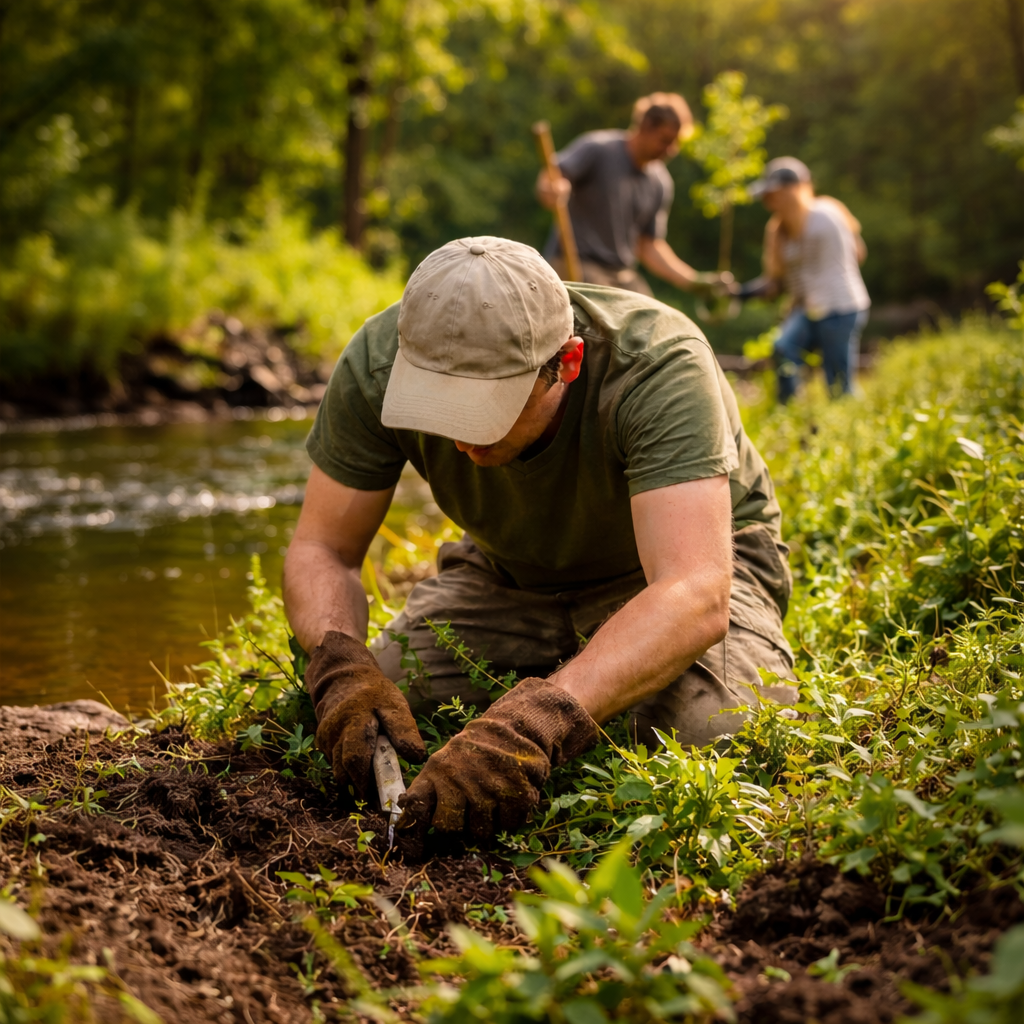
There is no substitute for human labor in ecosystem restoration. Removing invasive species like kudzu, buckthorn, or garlic mustard is a labor-intensive process that machines cannot do with precision. A single weekend of manual labor pulling invasive weeds can do more for local plant diversity than a thousand-dollar grant. Join a local “Friends of the Park” group or a watershed association. These organizations often struggle to find the physical bodies needed for “trash booms” in rivers or the planting of riparian buffers.
This work is visceral, exhausting, and immediate. You see the results of your labor in the return of native fish to a cleared stream or the resurgence of native wildflowers in a managed woodland. Beyond the physical impact, this labor connects you to the land in a way that a financial donation never could. You begin to understand the seasonal cycles of your local ecosystem, the specific threats it faces, and the resilience of nature when given a helping hand.
Physical volunteering also builds a community of practice. You meet other people who care about the same patch of earth, creating a network of advocates who can mobilize quickly when that land is threatened by development or pollution. It is the transition from “not in my backyard” (NIMBY) to “this is my backyard, and I am protecting it” (TIMBY).
Engage in Intellectual Conservation
Conservation is as much a battle of ideas as it is a battle of biology. We live in an era of profound “ecological amnesia,” where each generation accepts a degraded environment as the new normal. You must combat this by becoming an educator within your own social and professional circles. Challenge the “manicured lawn” aesthetic in your neighborhood. Explain to your neighbors why a “messy” yard with leaf mulch and standing stalks provides vital overwintering habitat for beneficial insects.
Share data on the decline of local bird populations and link it to the loss of native shrubs. When you change the cultural value of an ecosystem, you create a permanent shift in how that land is treated. Advocacy does not require a podium; it requires a consistent, fact-based dialogue with the people around you. Are you willing to be the person who speaks up for the insects when everyone else is complaining about “pests”?
Intellectual conservation also involves the preservation of indigenous and local knowledge. This information is often passed down through oral tradition and is highly specific to a particular place. By supporting programs that document and revitalize these ways of knowing, you are supporting a form of conservation that has been effective for millennia. You can do this by attending workshops, listening to elders, and ensuring that traditional ecological knowledge is respected in local land-use decisions.
Monitor and Report Environmental Crimes
Regulatory agencies are perennially underfunded and understaffed. They cannot be everywhere at once. You serve as an auxiliary force for environmental law enforcement. Learn to identify common environmental violations. Is a local construction site allowing silt to run off into a storm drain without a silt fence? That is a violation of the Clean Water Act. Is a neighbor clearing trees in a protected wetland? That is a state-level offense.
Document these incidents with photos and timestamps. File formal complaints with your state Department of Natural Resources or the Environmental Protection Agency. By holding bad actors accountable to existing laws, you protect the integrity of the conservation legal framework. This “civic monitoring” is essential for the rule of law in the environmental sector. Without citizen oversight, many regulations are essentially suggestions that are ignored by those looking to cut costs.
You can also use digital tools to monitor remote areas. Platforms like Global Forest Watch allow anyone to see near-real-time deforestation alerts via satellite data. If you see a suspicious patch of forest disappearing in a protected area, you can alert international advocacy groups who can then pressure local governments to investigate. You are a digital ranger on a global scale.
Reclaim the Commons
The privatization of nature is a major hurdle for conservation. When land is locked away in private hands, it is often managed for short-term profit rather than long-term ecological health. You can support the “commons” by advocating for and utilizing public lands. The more people who use national forests, state parks, and local preserves, the harder it is for those lands to be sold off or exploited for resource extraction.
Your presence on the trail is a vote for the continued existence of that space. Furthermore, you can participate in “land-sharing” initiatives where you allow your own private property to be used as a research site or a waypoint for wildlife movement. For instance, the “Homegrown National Park” movement encourages private landowners to convert their lawns into native habitat, effectively creating a massive, decentralized national park.
Reclaiming the commons also means fighting for “public access” to waterways and forests. In many places, historic access routes are being fenced off by private owners. By supporting organizations that fight for these access rights, you ensure that the public remains connected to the natural world. A disconnected public will not fight for conservation; a public that swims in the rivers and hikes in the woods will.
Strategic Professional Pro Bono: Case Studies
In 2023, a group of data scientists volunteered their time to help a marine conservation group analyze ten years of sonar data. Their work identified previously unknown nursery grounds for an endangered ray species. This project, completed in three months of weekend work, led to a new marine protected area designation. The cost of hiring a private data firm for this work would have been over $150,000. This is the “force multiplier” effect of skilled volunteering.
In another instance, a retired urban planner worked with a small town in Oregon to rewrite their municipal code to prioritize green infrastructure. The new code reduced storm water runoff by 40% over three years, saving the town millions in water treatment costs and protecting a local salmon run. This was achieved without a single private donation. These cases prove that your intellectual capital is the most valuable asset in the conservation market.
We must also look at the legal sector. Pro bono legal teams have successfully sued major polluters to clean up industrial sites that had been abandoned for decades. These lawyers did not donate money; they donated their specialized knowledge of environmental law to force a resolution that benefited the entire community. What is the equivalent in your industry? How can your specific knowledge be turned into a weapon for nature?
The Case for Radical Localism
We often focus on global conservation icons like the Amazon or the Great Barrier Reef, yet we ignore the degradation of the woodlot at the end of the street. Global ecosystems are comprised of local ones. When you focus on your immediate geography, you engage in a form of radical localism that is more resilient to political and economic shifts. Local conservation is more accountable. You can see the results of a zoning change in the health of a local pond within a single season.
You can verify that a restored meadow is hosting more pollinators with a simple visual check. This immediate feedback loop sustains your motivation far better than an annual report from a global NGO. Do you know the names of the three most threatened species in your county? Do you know the source of your city’s drinking water and the threats facing that watershed? If the answer is no, your first step in conservation is to educate yourself about the specific patch of earth you inhabit.
Radical localism also builds social capital. When you work with your neighbors to protect a local stream, you are building the “social fabric” that is necessary for any long-term political change. You are moving from a society of isolated consumers to a community of active stewards. This shift is the foundation of a sustainable future.
Overcoming the Perfection Trap
Many people refrain from conservation action because they feel they cannot do enough. They believe that unless they are living a carbon-neutral life in a cob house, they have no right to advocate for the planet. This “perfection trap” is a gift to the industries that profit from environmental degradation. Conservation does not require saints; it requires a massive number of people making better strategic decisions.
You do not need to be a biologist to contribute to biology. You do not need to be a politician to influence policy. You simply need to recognize that your agency extends far beyond your bank account. Ask yourself: If every person in your city committed to just one of these non-monetary actions, what would your local environment look like in five years? The cumulative impact of thousands of individual strategic choices is the only force capable of matching the scale of the current ecological crisis.
The urgency of our situation means we cannot wait for the perfect solution or the perfect leader. We must act with the tools we have, where we are, right now. This is the “messy middle” of conservation, where the real work gets done. It is not always beautiful, and it is rarely easy, but it is the only way forward.
The Power of the Policy Lever
Individual lifestyle changes are necessary, but they are insufficient without policy shifts. We often ignore the power of the administrative state in conservation. You can influence the Bureau of Land Management or the Forest Service by participating in public comment periods for federal land use plans. These agencies are legally required to review and respond to substantive public comments.
A well-researched, data-backed letter from a citizen carries significant weight in the administrative record and can be used as the basis for legal challenges by conservation groups. This is conservation through bureaucracy. It is slow, it is tedious, and it is incredibly effective. By mastering the rules of engagement in public policy, you can protect millions of acres of public land without spending a dime.
Think about the “Environmental Impact Statements” (EIS) that are required for major federal projects. These documents are often thousands of pages long. You can volunteer your time to help a local group review a specific section of an EIS related to your expertise. Did they miss a critical aquifer? Did they underestimate the impact on a specific migratory bird? Your technical review can provide the evidence needed to stop a destructive project in its tracks.
Redefining Support in an Age of Crisis
The era of passive conservation is over. We can no longer afford the luxury of believing that our responsibility ends at the donation box. The scale of the biodiversity crisis demands a mobilized, skilled, and politically active citizenry. Support for conservation must be redefined as the active management of our social, professional, and civic lives to favor ecological health.
It is the decision to keep a phone for five years instead of two. It is the decision to spend a Saturday in a swamp pulling weeds. It is the decision to speak up at a town hall meeting against an ill-conceived development. You have the tools, the technology, and the expertise to change the trajectory of our planet’s health. The only question remaining is whether you have the will to use them.
As we look toward the 2030 targets for the “Global Biodiversity Framework,” it is clear that state and philanthropic funding will not be enough. We need a “whole-of-society” approach. This means that every profession, every neighborhood, and every individual must find their specific point of leverage. Conservation is not a charity; it is a survival strategy for the 21st century.
The Ethics of Action Over Avoidance
The traditional environmental narrative focuses on what we should not do: don’t use plastic, don’t drive, don’t eat meat. While these avoidances are helpful, they are inherently negative and often lead to “activism fatigue.” We need to shift toward a narrative of action. What can you do with your unique talents?
When you spend your time actively restoring an ecosystem or influencing a policy, you are engaging in a positive ethical framework. You are creating something new—a healthier forest, a cleaner river, a more just law. This is psychologically more sustainable and politically more powerful. It transforms the environmental movement from a list of restrictions into a vision of a flourishing future.
Furthermore, action is contagious. When your neighbors see you planting a native pollinator garden or speaking up at a council meeting, it normalizes that behavior. You are creating a new cultural standard for what it means to be a “good citizen” in an age of ecological crisis. This cultural shift is the ultimate goal of all conservation efforts.
Harnessing Social Capital for Conservation
Your social networks—both online and in the real world—are powerful conduits for change. You can use these networks to amplify conservation messages and mobilize collective action. This is not about sharing “slacktivist” memes; it is about providing your network with actionable, high-quality information.
For example, you can host a “native plant swap” in your neighborhood, encouraging others to replace invasive ornamentals with local species. You can organize a “community bioblitz” where people work together to document the biodiversity of a local park using iNaturalist. These events build social capital and ecological knowledge simultaneously.
In your professional network, you can advocate for “Corporate Social Responsibility” (CSR) programs that focus on local ecological restoration rather than just carbon offsets. You can push your company to adopt “Green Procurement” policies that favor suppliers with strong environmental credentials. Your influence within your professional sphere is a resource that the planet desperately needs.
The Long Game: Mentorship and Legacy
True conservation is a multi-generational project. You can support the movement by mentoring the next generation of environmental stewards. This doesn’t require a specialized program; it can be as simple as taking a child into the woods and teaching them how to identify different trees or explaining why the river is important.
By fostering a sense of “biophilia”—the innate love for nature—in young people, you are ensuring that the movement continues long after you are gone. You are building the “human infrastructure” of the future. This is a form of legacy that cannot be bought.
Think about the mentors who influenced your own view of the world. What did they teach you? How can you pass that knowledge on? In an increasingly digital and disconnected world, the simple act of sharing a direct experience of nature with someone else is a radical act of conservation.
Final Thoughts on Strategic Participation
We have spent decades treating conservation as a niche interest for scientists and “nature lovers.” We have treated it as a luxury that we fund with our spare change. Both of these assumptions are false. Conservation is the foundational work of maintaining the life-support systems of our planet. It is the most important task facing humanity today.
By moving beyond donations and into the realm of strategic participation, you are reclaiming your power as a citizen of the Earth. You are refusing to be a passive witness to the destruction of the natural world. You are choosing to be an active participant in its restoration and protection.
The path forward is clear. Use your skills. Use your voice. Use your time. The planet does not need your money as much as it needs your agency. The 30 by 30 goal—protecting 30% of the Earth’s land and sea by 2030—is achievable, but only if we all stop waiting for someone else to do the work. The work is yours. The time is now.
References
The State of Finance for Nature 2023 – United Nations Environment Programme
unep.org/resources/report/state-finance-nature-2023
iNaturalist Annual Report and Data Trends
inaturalist.org/stats
The Economic Case for Nature – World Bank Group
worldbank.org/en/topic/environment/publication/the-economic-case-for-nature
Global Forest Watch – Interactive Monitoring and Data
globalforestwatch.org
The Cornell Lab of Ornithology – eBird Status and Trends
ebird.org/science/status-and-trends
Halfway to 2030: What the Biodiversity Finance Dashboard Reveals
nature.org/en-us/about-us/where-we-work/europe/stories-in-europe/biodiversity-finance-dashboard-2025
Exploration of the biodiversity finance landscape – Convention on Biological Diversity
cbd.int/doc/c/8d7f/55df/1d2dbb096d00be743f006a05/rm-ac-2024-01-02-en.pdf
Biodiversity Finance Trends Dashboard 2025
gov.uk/government/publications/biodiversity-finance-trends-2025/biodiversity-finance-trends-dashboard-2025-accessible-version
Volunteering Vs Donating: Which Has The Bigger Impact On Conservation?
southernnevadaconservancy.org/volunteering-vs-donating-which-bigger-impact-conservation/
5 Examples Of The Power Of Citizen Science
faunalytics.org/5-examples-power-citizen-science/
How Can We Do Citizen Science Better? Grizzly Bear Case Study
pmc.ncbi.nlm.nih.gov/articles/PMC9102148/
Case Studies in Conservation Standards
conservationstandards.org/case-studies/
Pro Bono Consulting Services for Environmental Stewardship
https://www.google.com/search?q=us.anteagroup.com/pro-bono-consulting-services
Innovations for environmental compliance: emerging evidence and opportunities
siepr.stanford.edu/publications/policy-brief/innovations-environmental-compliance-emerging-evidence-and-opportunities
Global Environmental Crime Tracker
eia-international.org/global-environmental-crime-tracker/
Author bio
Julian is a graduate of both mechanical engineering and the humanities. Passionate about frugality and minimalism, he believes that the written word empowers people to tackle major challenges by facilitating systematic collaborative progress in science, art, and technology. In his free time, he enjoys ornamental fish keeping, reading, writing, sports, and music. Connect with him here https://www.linkedin.com/in/juliannevillecorrea/
About The Author


