
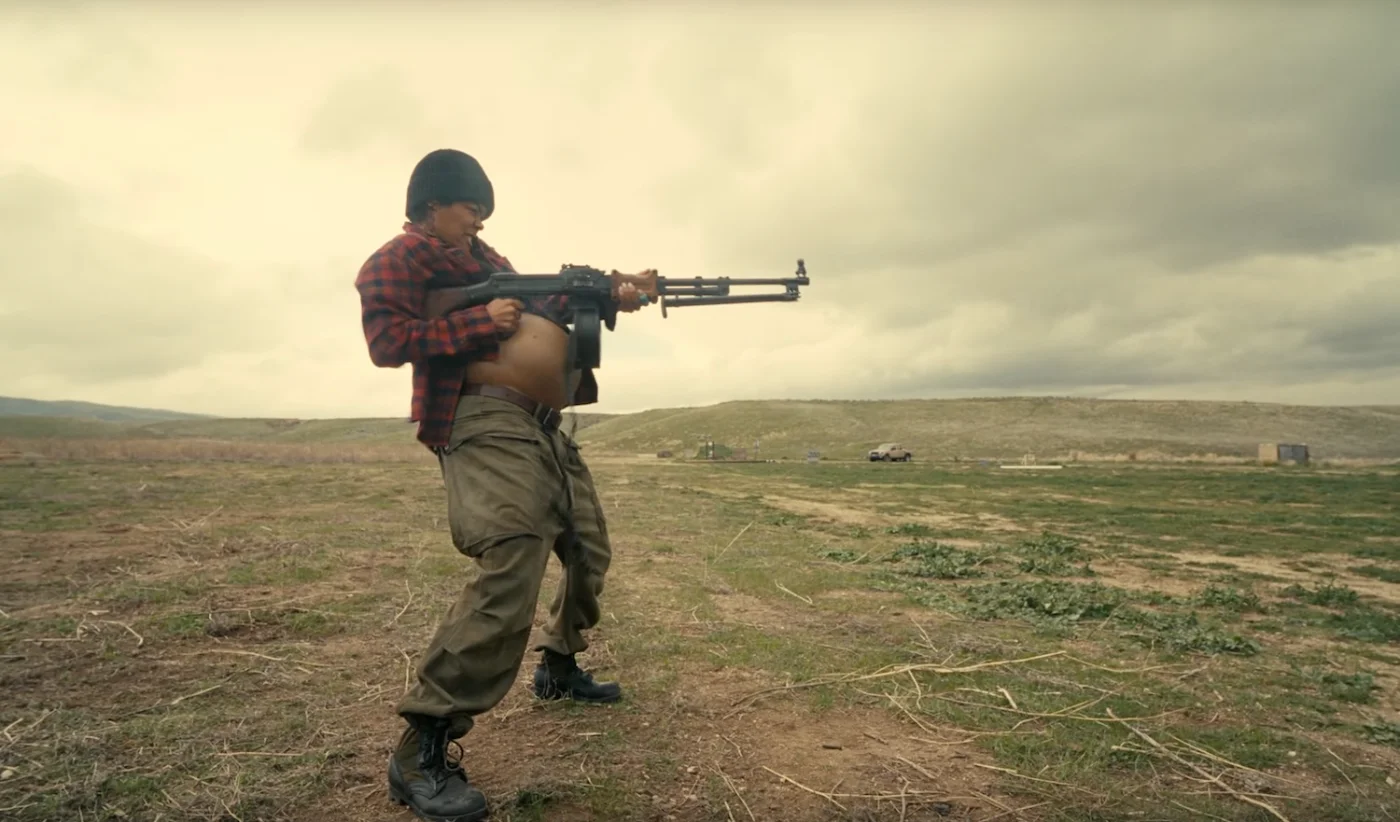
Photo Credit: Scraps From The Loft
Paul Thomas Anderson’s One Battle After Another doesn’t seek applause. It demands reflection. The film dismantles the comfortable moral binaries that modern America often hides behind. It’s a cinematic dissection of identity, resistance, and the uneasy compromise between personal conviction and collective fatigue.
The movie’s title itself—One Battle After Another—isn’t just about war. It’s about endurance. It’s about how individuals, institutions, and entire nations never stop fighting battles—external and internal, ideological and emotional.
Below are ten practical life lessons drawn from the film—lessons that are relevant whether you’re a leader, an entrepreneur, a policymaker, or simply someone navigating modern chaos. Each insight mirrors a deeper commentary on America’s current moral and cultural landscape.
1. Battles Don’t End — They Transform
In the opening act, Bob Ferguson (Leonardo DiCaprio) is portrayed as a man exhausted by struggle—both political and personal. Once a radical idealist, he’s now retreating into cynicism. Yet when his daughter disappears, he’s pulled back into the arena he thought he’d escaped.
That’s life. You may think a struggle is behind you, but it often just changes shape.
Practical takeaways:
- Every victory carries the seed of the next challenge. Don’t expect peace to last; expect evolution.
- Resilience isn’t about eliminating conflict—it’s about sustaining purpose through it.
- In business and life, when a chapter closes, a new one begins almost instantly. Prepare for it, don’t resist it.
This mirrors Anderson’s portrayal of America itself—a nation that never truly exits one conflict before stumbling into another.
2. You Carry Every Choice You’ve Made
One of the film’s most resonant motifs is consequence. Bob’s earlier revolutionary acts shadow every relationship he has. His decisions—noble or reckless—become the architecture of his life.
You can’t detach from your past. You integrate it.
Practical takeaways:
- Decisions compound. Treat each one as if you’ll live with it for decades—because you will.
- Accountability outlasts ambition. The latter fades; the former defines.
- Guilt and regret aren’t weaknesses—they’re reminders that conscience still exists.
America, as portrayed in the film, faces the same reckoning. Every policy, war, and social compromise is an unburied ghost. The movie uses personal guilt as a metaphor for national responsibility.
3. Your Cause Must Be Rooted in Human Connection
Willa, Bob’s estranged daughter, is more symbol than character—she represents the future he’s failed to protect. His renewed activism isn’t ideological; it’s personal. The film’s emotional center is simple: revolutions collapse without relationships.
Practical takeaways:
- Every mission must have a face and a name. Without empathy, even noble ideas lose impact.
- Build human anchors. They’ll sustain you when the cause itself feels distant.
- Measure success not by attention, but by connection.
This isn’t just about activism—it’s a statement on America’s fading sense of community. In an era of digital outrage, One Battle After Another reminds viewers that real change begins where compassion meets proximity.
4. Consistency Outperforms Heroics
Benicio del Toro’s character, Sergio, contrasts sharply with Bob. He isn’t loud, idealistic, or dramatic. He’s steady. He organizes quietly, acts deliberately, and persists when others lose focus.
Practical takeaways:
- Grand gestures fade; consistent effort compounds.
- You don’t need a stage to make an impact—just endurance.
- In leadership, dependability builds credibility faster than charisma.
The film elevates quiet persistence over explosive rebellion. It’s a subtle jab at America’s obsession with spectacle—where activism too often becomes performance instead of sustained work.
5. Failure Is Not the Endgame; It’s Data
When Bob’s rebellion falters, Anderson doesn’t treat it as defeat. Instead, the film reframes failure as learning—a recalibration of priorities.
Practical takeaways:
- Failure clarifies. It exposes what matters.
- Treat mistakes as feedback, not verdicts.
- Progress without failure isn’t evolution—it’s stagnation.
America’s own journey has been one long sequence of “failed” experiments—socially, economically, politically. Anderson’s lens suggests that the nation’s strength lies not in avoiding error, but in adapting through it.
6. Oversight Is More Dangerous Than Oppression
One Battle After Another reframes authoritarianism. It doesn’t depict tyranny as an overt dictatorship—it shows it as systemic oversight. Cameras. Data. Bureaucracy. The slow suffocation of freedom, not its dramatic execution.
Practical takeaways:
- Real control doesn’t announce itself—it embeds itself in everyday systems.
- Question processes, not just personalities.
- Freedom dies in the paperwork before it dies in the street.
The America of this film is familiar—where surveillance is justified as safety, and conformity masquerades as stability. It’s a quiet indictment of a nation that traded vigilance for convenience.
7. Your Contradictions Are Part of Your Power
Bob is neither a hero nor a villain. He’s deeply human—flawed, impulsive, inconsistent. That’s what makes him believable.
Anderson reminds you that conviction and confusion can coexist.
Practical takeaways:
- Don’t chase purity; chase alignment.
- Accept that conflicting emotions can guide, not paralyze, decision-making.
- Your imperfections give you texture—they make your purpose real.
America, too, is a contradiction—a democracy built on dissent, a land of freedom with systemic inequities. The film doesn’t solve that paradox; it embraces it as identity.
8. Systems Resist Change — Plan for Resistance
Every act of rebellion in the film meets equal and opposite resistance. Institutions don’t crumble easily; they absorb. That’s the point.
Practical takeaways:
- Expect pushback as validation, not deterrence.
- Build coalitions; movements survive individuals.
- Change management—whether social or corporate—requires patience, not fury.
In portraying this, Anderson touches a nerve about American institutions—from corporations to Congress—that have mastered self-preservation. The system’s genius isn’t in its ideals—it’s in its ability to endure critique without transformation.
9. You Can’t Outsource Moral Urgency
Midway through the film, Bob tries to delegate his mission to younger activists. They decline. His avoidance becomes cowardice. Eventually, personal tragedy forces him to lead.
Moral urgency can’t be subcontracted.
Practical takeaways:
- If something feels wrong, you’re likely meant to act on it.
- Leadership begins where blame ends.
- Waiting for “someone else” is the first form of surrender.
This resonates in the American political landscape, where responsibility is often diffused across parties, departments, or generations. The film’s realism lies in showing that change begins when ownership replaces outrage.
10. Think in Generations, Not Campaigns
The film’s final act spans decades. One generation fights; another inherits the aftermath. Willa’s story, though unresolved, signals continuity.
Change is slow, cyclical, and cumulative.
Practical takeaways:
- Every long-term goal requires a multi-decade mindset.
- Measure legacy, not noise.
- Plant ideas that outlive you.
Anderson’s America isn’t dying—it’s molting. Progress isn’t linear; it’s layered. The film’s generational lens echoes the real American story: from civil rights to climate reform, transformation always takes longer than outrage allows.
How One Battle After Another Portrays America
Beyond individual lessons, Anderson constructs a mosaic of a nation struggling with its own myths. The film’s America is both recognizable and uncomfortable—a place where freedom coexists with fatigue, and progress feels perpetually unfinished.
1. America’s Hidden Fractures
The movie begins with the raid on a migrant detention center—a direct echo of real-world controversies around U.S. border enforcement and ICE facilities. The setting reflects a divided America, torn between empathy and enforcement.
The subtext: modern America doesn’t just fight external enemies; it fights over its conscience.
The film refuses to identify a single villain. Instead, it shows how systems built on fear perpetuate themselves, regardless of who leads them.
2. The Normalization of Surveillance
There are no grand speeches about fascism or freedom. Instead, the movie shows silent surveillance—cameras, data feeds, voice recognition—all justified under “national security.”
That’s the point. Modern control doesn’t look tyrannical; it looks efficient.
It mirrors America’s post-9/11 normalization of surveillance: mass data collection, predictive policing, corporate monitoring. The audience is left to ask—how much liberty can a nation trade before it forgets what it lost?
3. The Cult of Efficiency
Anderson portrays bureaucratic America as obsessed with optimization. Even moral questions are measured in ROI. That critique extends beyond politics—it mirrors corporate America, where empathy is often a liability.
The film’s depiction of “Lockjaw,” a military-industrial antagonist, feels allegorical. He’s not power-hungry—he’s simply efficient. His cruelty is procedural, not emotional. That’s scarier.
4. The Exhaustion of Idealism
Perhaps the most honest portrayal of America in the film is fatigue. Everyone is tired—of fighting, caring, pretending. The revolutionaries are weary, the oppressors are mechanical, and the civilians are detached.
This exhaustion reflects real American sentiment—a nation stretched between crises, headlines, and the endless churn of outrage. It’s a portrait of emotional burnout.
Yet Anderson finds a sliver of hope: fatigue doesn’t kill conviction; it tests its authenticity. What remains after exhaustion is what truly matters.
5. The Economics of Dissent
The irony is that One Battle After Another—a film critiquing capitalism—was itself a $130–175 million production that grossed roughly $138 million globally. That paradox isn’t accidental. It’s commentary.
Anderson uses the film’s own commercial nature as self-critique. America, he implies, can even monetize its dissent. Every rebellion becomes a product eventually.
It’s a reflection of how social movements in the U.S. often get commodified—turned into slogans, merchandise, and media cycles before they produce lasting reform.
6. The Myth of Unity
The movie dismantles the notion of “one America.” It portrays parallel nations—those who govern and those who survive governance. Race, class, and geography divide its characters more than ideology does.
Anderson doesn’t judge; he observes. His America is plural, restless, and self-interested. That’s not pessimism—it’s accuracy.
7. The Generational Reckoning
By its final scenes, the torch passes to Willa’s generation—uncertain, pragmatic, less ideological. They inherit a fractured world but seem less naive about fixing it.
The message is clear: each American generation inherits not progress, but unfinished work. Whether it’s civil rights, equality, or climate policy, every generation starts mid-battle.
The Film’s Broader Message for You
You’re not just watching characters; you’re watching archetypes of modern struggle. The lessons from One Battle After Another apply far beyond cinema.
Ask yourself:
- Which battles are worth fighting repeatedly?
- Where have you mistaken exhaustion for completion?
- What systems in your life resist change—and why do you tolerate them?
America, in Anderson’s vision, isn’t a hero’s journey. It’s a feedback loop of confrontation, reflection, and renewal. And that’s what makes it real.
One Battle After Another doesn’t offer closure—it offers perspective. It reminds you that progress, whether personal or national, isn’t a victory march. It’s a relay—one battle after another.
Reference Links (Plain URLs)
- https://en.wikipedia.org/wiki/One_Battle_After_Another
- https://www.rogerebert.com/reviews/one-battle-after-another-movie-review-2025
- https://www.theringer.com/2025/09/29/movies/one-battle-after-another-movie-themes-explained-analysis
- https://www.newyorker.com/culture/the-front-row/the-real-battle-of-one-battle-after-another
- https://variety.com/2025/film/reviews/one-battle-after-another-review-leonardo-dicaprio-sean-penn-1236520520
- https://filmcolossus.com/one-battle-after-another-explained
- https://www.theeagleonline.com/article/2025/10/review-one-battle-after-another-is-hilarious-hard-hitting-and-just-the-movie-we-need
About The Author


