


		<div class="wpcnt">
			<div class="wpa">
				<span class="wpa-about">Advertisements</span>
				<div class="u top_amp">
							<amp-ad width="300" height="265"
		 type="pubmine"
		 data-siteid="173035871"
		 data-section="1">
		</amp-ad>
				</div>
			</div>
		</div>
<p class="wp-block-paragraph">Headlines compete for your attention every day. What often rises to the surface depends not just on the severity of suffering but also on politics, media framing, and the narratives global institutions choose to elevate. In 2025, two stories demand attention yet receive strikingly different coverage: the relentless killings of Christians in Nigeria and the fragile survival of Christians in Gaza. Both raise difficult questions about religious freedom, global responsibility, and the cost of neglect.</p>


<p class="wp-block-paragraph">When you place these crises side by side, the contrasts are as important as the similarities. One is a case of systemic, targeted elimination of Christians over decades. The other involves a small, shrinking community caught in the crossfire of a larger geopolitical conflict. Yet both matter, and both reveal something about how the world selectively responds to persecution.</p>


<hr class="wp-block-separator has-alpha-channel-opacity"/>


<h2 class="wp-block-heading">Nigeria: A Nation Where Faith Turns Fatal</h2>


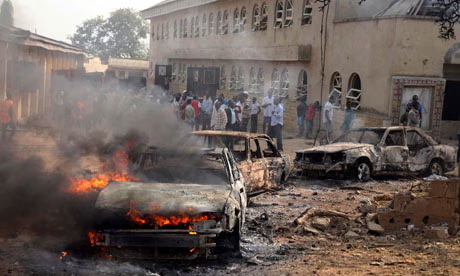
<p class="wp-block-paragraph">In Nigeria, violence against Christians has been a recurring reality for more than a decade. Communities in the Middle Belt and northern states face raids that leave homes torched, churches flattened, and families displaced. The actors vary—Boko Haram insurgents, Islamic State West Africa Province fighters, and armed herder militias—but the outcome is consistent: Christian populations bear a disproportionate share of the killings.</p>


<p class="wp-block-paragraph">Estimates indicate that more than 50,000 Christians have been killed in Nigeria since 2009. By 2025, some reports suggest that an average of 30 Christians are killed every single day. These are not isolated crimes; they form a pattern of targeted violence, often motivated by religion but intertwined with land disputes, climate stress, and governance failures.</p>


<p class="wp-block-paragraph">Consider the attack on Yelwata in June 2025. Gunmen stormed villages, leaving more than 100 people dead, many burned beyond recognition. In Benue State, raids in May left at least 42 dead across four communities. And in 2022, the Owo church massacre shocked even seasoned observers: worshippers gunned down inside St. Francis Xavier Catholic Church during Sunday Mass.</p>


<p class="wp-block-paragraph">Nigeria’s government response has been weak at best. Perpetrators are rarely prosecuted, security forces often arrive too late, and entire regions live in fear with little trust in the state’s ability to protect them. This failure of governance fuels cycles of reprisal and displacement. More than 12 million Christians have been forced from their homes since the insurgency began. Villages are abandoned, farmlands deserted, and schools closed.</p>


<p class="wp-block-paragraph">For converts from Islam to Christianity, the risk is even higher. In certain parts of northern Nigeria, leaving Islam is considered a betrayal punishable by ostracism or even death. Women face abduction and forced marriages. Young girls are kidnapped, converted, and denied return to their families.</p>


<p class="wp-block-paragraph">The story in Nigeria is one of scale, persistence, and structural impunity. It raises the uncomfortable question: Why does the world treat such mass killings as a routine headline instead of a humanitarian emergency?</p>


<hr class="wp-block-separator has-alpha-channel-opacity"/>


<h2 class="wp-block-heading">Gaza: A Community on the Edge of Extinction</h2>


<p class="wp-block-paragraph">While Nigeria’s Christian population is vast, Gaza’s Christian community is tiny—numbering only in the low thousands. Their struggle is not one of mass killings but of survival in a conflict zone where religion compounds vulnerability.</p>


<p class="wp-block-paragraph">Christianity in Gaza traces its history back centuries. Yet decades of war, blockade, and economic collapse have reduced the community to a fraction of its former size. In areas under Hamas and Palestinian Authority control, the Christian population has reportedly declined by as much as 80 to 90 percent over recent decades. Families who once anchored Gaza’s civic life have steadily emigrated, seeking safety and opportunity elsewhere.</p>


<p class="wp-block-paragraph">The wars of 2023 to 2025 intensified this decline. All three churches in Gaza sustained damage during Israeli airstrikes. At least 30 Christians died, some while sheltering in church compounds that were thought to be sanctuaries. In July 2025, an Israeli shell struck the Holy Family Catholic Church compound, killing civilians, including elderly caretakers, and injuring the priest.</p>


<p class="wp-block-paragraph">For Christians who remain, the danger is not limited to bombs. Converts from Islam to Christianity face rejection from their families and communities. Harassment, vandalism, and bureaucratic pressure make church institutions vulnerable. Younger Christians see little future and often dream of leaving. Surveys suggest that nearly half of Christians under the age of 30 in Gaza want to emigrate.</p>


<p class="wp-block-paragraph">Unlike Nigeria, the violence in Gaza is less about systematic targeting of Christians and more about collateral exposure in a larger war. Still, the result is no less devastating for a community at risk of disappearing. When the next generation leaves, centuries of Christian presence in Gaza may vanish with them.</p>


<hr class="wp-block-separator has-alpha-channel-opacity"/>


<h2 class="wp-block-heading">What the Comparisons Reveal</h2>


<p class="wp-block-paragraph">When you juxtapose Nigeria and Gaza, the temptation is to equate them under the broad label of “Christian persecution.” But doing so risks obscuring key differences.</p>


<ul class="wp-block-list">
<li><strong>Scale</strong>: Nigeria’s killings reach thousands annually, while Gaza’s Christian deaths remain in the dozens.</li>


<li><strong>Motivation</strong>: In Nigeria, Christians are often explicit targets. In Gaza, casualties are largely a byproduct of warfare, though social discrimination adds pressure.</li>


<li><strong>Demographics</strong>: Nigeria has tens of millions of Christians living under threat. Gaza’s Christians are a tiny minority on the verge of disappearance.</li>


<li><strong>State role</strong>: Nigeria’s government fails to protect its citizens from non-state actors. Gaza’s Christian survival is shaped by both internal authorities and external military campaigns.</li>
</ul>


<p class="wp-block-paragraph">These differences matter. Conflating the two ignores the unique drivers of violence and weakens efforts to address them effectively. At the same time, both contexts highlight how religious minorities suffer disproportionately when governance breaks down or when larger political struggles overshadow their plight.</p>


<hr class="wp-block-separator has-alpha-channel-opacity"/>


<h2 class="wp-block-heading">The Politics of Narrative</h2>


<p class="wp-block-paragraph">How these crises are discussed is almost as important as the facts themselves. Advocacy groups often frame Nigeria’s crisis as a Christian genocide, while others argue the narrative simplifies a complex conflict involving ethnicity, land, and resource competition. In Gaza, Christian suffering is sometimes used rhetorically to bolster one side of the Israeli-Palestinian debate, reducing lived experiences to talking points.</p>


<p class="wp-block-paragraph">The danger lies in selective outrage. When persecution in one region is amplified and another ignored, victims are turned into tools of political argument rather than subjects of justice. As a reader and citizen, you should ask: Who benefits from the way these stories are told? Which voices are being amplified, and which are being erased?</p>


<hr class="wp-block-separator has-alpha-channel-opacity"/>


<h2 class="wp-block-heading">What Needs to Happen</h2>


<p class="wp-block-paragraph">Addressing these crises requires clarity and action tailored to each context.</p>


<h3 class="wp-block-heading">For Nigeria</h3>


<ul class="wp-block-list">
<li>Strengthen accountability: International pressure should focus on prosecutions, not just condemnations.</li>


<li>Empower local resilience: Early warning systems, community defense mechanisms, and secure relocation channels are vital.</li>


<li>Integrate climate and land policies: Resource conflicts that fuel violence must be addressed alongside religious dimensions.</li>
</ul>


<h3 class="wp-block-heading">For Gaza</h3>


<ul class="wp-block-list">
<li>Safeguard religious sites: International monitoring of churches and monasteries could prevent further damage.</li>


<li>Support emigration or protection: Families seeking to leave should have legal pathways; those staying need security guarantees.</li>


<li>Challenge discrimination: Civil society must address the social hostility that pushes Christians to the margins.</li>
</ul>


<h3 class="wp-block-heading">For Global Institutions and You</h3>


<ul class="wp-block-list">
<li>Verify before amplifying: Ensure the narratives you share are based on credible data, not political spin.</li>


<li>Support organizations working directly in the field.</li>


<li>Push policymakers to treat religious persecution as a core human rights issue, not an afterthought.</li>


<li>Resist false equivalence but recognize shared humanity across contexts.</li>
</ul>


<hr class="wp-block-separator has-alpha-channel-opacity"/>


<h2 class="wp-block-heading">Questions You Should Be Asking</h2>


<ul class="wp-block-list">
<li>Why do mass killings of Nigerian Christians remain underreported while Gaza’s smaller community garners outsized symbolic attention?</li>


<li>Should persecution be defined by numbers alone, or by the existential threat it poses to a community’s survival?</li>


<li>How do you ensure empathy is consistent, not selective, based on political alignment or media cycles?</li>


<li>What role should your government play in pushing for accountability in both Nigeria and Gaza?</li>
</ul>


<hr class="wp-block-separator has-alpha-channel-opacity"/>


<h2 class="wp-block-heading">Closing Thoughts</h2>


<p class="wp-block-paragraph">Comparing Nigeria and Gaza is not about ranking suffering. It is about understanding how persecution operates differently depending on context and how global attention is distributed unequally. Nigerians endure relentless attacks that resemble a slow-moving genocide. Gazan Christians struggle against demographic extinction amid endless war. Both deserve your attention.</p>


<p class="wp-block-paragraph">As debates grow louder, resist the easy temptation of reduction. Instead, focus on clarity: who suffers, why they suffer, and what can be done to protect them. Your responsibility as a reader, citizen, and global participant is not to choose one story over another but to demand that both are addressed with urgency and fairness.</p>


<p class="wp-block-paragraph">Photo Credit: <a href="https://www.theguardian.com/world/2011/dec/29/church-bombings-nigerian-christians">The Guardian</a></p>

Christians Under Fire: Comparing Persecution in Nigeria and Gaza in 2025
Christians Under Fire: Comparing Persecution in Nigeria and Gaza in 2025