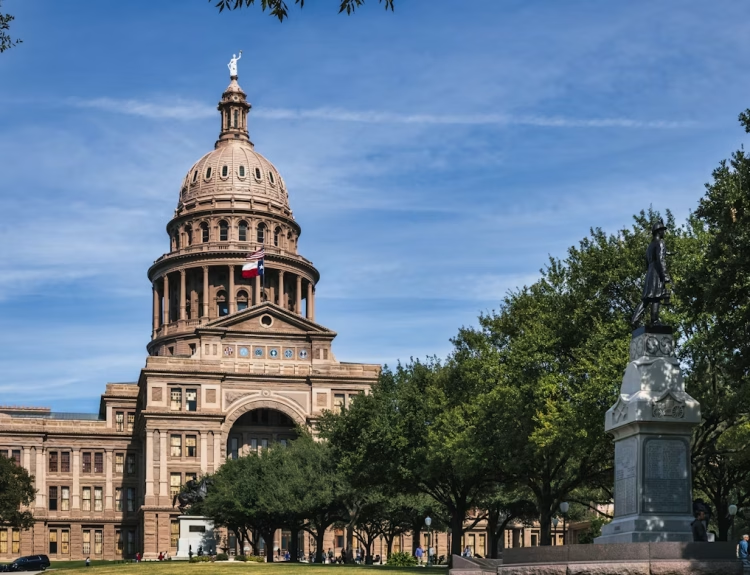
The United States remains the most influential power in the international system. Its foreign policy strategies define not only its own security and prosperity but also the structure of global politics, impacting economies, military alliances, and diplomatic relations across various regions. In 2025, U.S. policymakers confront intensifying competition with China, as both nations vie for technological supremacy and economic dominance, while also addressing persistent tensions with Russia that threaten stability in Europe and beyond. Additionally, technological disruptions reshape industries and create new challenges, necessitating agile responses to cyber threats and misinformation campaigns. Amid these complexities, shifting alliances illustrate the dynamic nature of global partnerships, compelling the U.S. to reassess its commitments and strategies. At the same time, Washington must balance domestic political divisions, which often hinder cohesive action, with the demands of global leadership that require a unified front to tackle pressing issues such as climate change, human rights, and global health crises. The ability to navigate these multifaceted challenges will be crucial for the U.S. to maintain its position as a leading force in an increasingly multipolar world.
The Core Pillars of U.S. Foreign Policy
1. Strengthening Alliances and Partnerships
- The North Atlantic Treaty Organization (NATO) remains central to U.S. defense commitments. Washington has increased its defense spending to maintain credibility within the alliance.
- The U.S. Indo-Pacific strategy emphasizes partnerships with Japan, South Korea, Australia, the Philippines, and India to counterbalance China’s influence.
- Bilateral security agreements, such as the AUKUS pact with the United Kingdom and Australia, reinforce technology sharing and deterrence.
- The U.S. has strengthened alliances with European nations, conducting joint military exercises to enhance interoperability.
- Ongoing dialogues with NATO allies focus on emerging threats, including cybersecurity and hybrid warfare.
- The Enhanced Forward Presence in Eastern Europe serves to deter potential aggression from Russia.
- The U.S. continues to support international coalitions to combat terrorism and promote stability in conflict regions.
- Military aid packages are provided to allies to bolster their defense capabilities against regional threats.
2. Strategic Competition with China
- The U.S. identifies China as its “pacing challenge,” focusing on military modernization, supply chain security, and advanced technologies such as semiconductors and AI.
- Export controls on advanced chips and sanctions against Chinese firms are tools to restrict Beijing’s access to sensitive technologies.
- Washington expands cooperation with regional partners in the South China Sea to ensure freedom of navigation and challenge Beijing’s maritime claims.
- The U.S. engages in diplomatic dialogues with allies to coordinate strategies against Chinese influence.
- Military exercises in the Indo-Pacific region are conducted to demonstrate U.S. commitment to regional security.
- Increased funding for research and development in critical technologies aims to maintain a competitive edge over China.
- Economic measures are implemented to reduce dependency on Chinese manufacturing and promote domestic production.

3. Containing Russian Aggression
- Following Russia’s invasion of Ukraine, the U.S. continues to provide military, financial, and intelligence support to Kyiv.
- Washington leads sanctions coalitions targeting Russia’s energy exports, financial systems, and defense industry.
- The U.S. reinforces NATO’s eastern flank, deploying additional troops to Poland, the Baltic states, and Romania.
- American diplomats work to rally international support for Ukraine’s sovereignty and territorial integrity.
- The U.S. increases humanitarian aid to assist civilians affected by the conflict.
- American military equipment, including advanced weaponry, is sent to Ukraine to bolster its defense capabilities.
- The U.S. engages in regular military exercises with NATO allies to deter further Russian aggression.
4. Promoting Economic Security
- The Biden administration prioritizes secure supply chains for semiconductors, rare earth elements, and pharmaceuticals.
- The Inflation Reduction Act and CHIPS Act have global implications, attracting investment while reducing dependency on foreign suppliers.
- U.S. trade diplomacy integrates digital trade, clean energy, and labor standards into negotiations with allies.
- The administration promotes domestic production to strengthen resilience against global supply chain disruptions.
- Partnerships are being forged with key international allies to ensure fair and sustainable trade practices.
- Investments in emerging technologies are encouraged to maintain U.S. leadership in innovation.
- Environmental considerations are increasingly factored into trade agreements to promote sustainability.
- The administration aims to eliminate unfair trade practices and protect American jobs through enforcement measures.
5. Advancing Democratic Values
- Washington frames the competition with authoritarian states as a contest of governance models.
- Programs supporting press freedom, civil society, and democratic institutions receive significant funding.
- The U.S. integrates democracy promotion into initiatives such as the Summit for Democracy and targeted sanctions against human rights violators.
- Partnerships with international organizations strengthen global democratic norms.
- Investment in educational programs promotes democratic values and civic engagement.
- Support for grassroots movements enhances local capacities for political participation.
6. Leveraging Technology and Cyber Strategy
- The U.S. invests in artificial intelligence, quantum computing, and biotechnology to sustain technological leadership.
- Cyber Command expands cooperation with allies to respond to state-backed cyberattacks.
- Washington promotes international digital standards to prevent fragmentation of the internet into competing blocs.
- Federal funding supports research in space exploration and satellite technology to enhance global positioning capabilities.
- Partnerships with private sector companies drive innovation in cybersecurity solutions.
- The government seeks to bolster its supply chain resilience in critical technology sectors to reduce dependency on foreign suppliers.
- Initiatives are launched to enhance workforce training in emerging technologies to maintain a competitive edge.
- Diplomatic efforts are strengthened to build coalitions around shared technology values and ethical guidelines.
7. Climate and Energy Diplomacy
- The U.S. rejoined the Paris Agreement and leads coalitions on clean energy investment.
- Washington partners with emerging economies to finance renewable energy projects and reduce global emissions.
- Energy security remains critical, as the U.S. balances fossil fuel exports with renewable energy commitments.
- The Biden Administration promotes electric vehicle adoption and infrastructure expansion.
- Federal incentives support solar panel installations on homes and businesses.
- Public-private partnerships aim to accelerate innovations in battery technology.
- The U.S. commits to cutting greenhouse gas emissions by 50-52% by 2030.
- Climate resilience initiatives are developed to protect vulnerable communities.
- International collaboration focuses on addressing climate change challenges globally.
- Renewable energy jobs are projected to grow significantly in the coming years.
- The U.S. participates in global climate finance initiatives to aid developing nations.
- Research and development funding for clean technologies has increased.
- Wildfire management practices are enhanced to mitigate climate-related disasters.
- Urban planning incorporates green infrastructure to promote sustainability.
- The U.S. is exploring nuclear energy as a low-carbon energy source.

8. Middle East Balancing
- U.S. policy in the Middle East focuses on maintaining stability while reducing military footprints.
- Washington supports normalization agreements between Israel and Arab states while managing tensions with Iran.
- Counterterrorism cooperation continues, though broader regional focus shifts to great power competition.
- The United States engages in diplomatic efforts to foster peace talks between Israel and Palestine.
- Military aid to Israel remains a cornerstone of U.S. foreign policy in the region.
- Economic partnerships are pursued to boost development and reduce dependence on foreign aid.
- The U.S. seeks to counteract the influence of Russia and China in the Middle East.
- Human rights concerns are occasionally raised but often sidelined in favor of strategic interests.
- Efforts to address the humanitarian crisis in Syria are part of U.S. engagement in the region.
- Arms sales to ally nations are used as a tool to strengthen partnerships.
- The U.S. works with local partners to combat extremist groups across the region.
- Environmental concerns, including water scarcity, are increasingly influential in policy discussions.
- Cultural and educational exchanges are promoted to enhance mutual understanding with regional partners.
9. Africa and Latin America Engagement
- In Africa, U.S. policy emphasizes countering Chinese and Russian influence through trade, infrastructure investment, and security cooperation.
- This includes enhancing military partnerships and strengthening alliances with key African nations.
- Promoting regional stability through diplomatic efforts and conflict resolution initiatives.
- In Latin America, Washington prioritizes migration management, anti-narcotics initiatives, and trade integration.
- Collaborating with local governments to address root causes of migration and violence.
- Supporting education and job creation to reduce poverty and improve economic opportunities.
- The U.S. supports democratic transitions and economic development in both regions to maintain influence.
- Providing assistance for electoral processes and civil society engagement.
- Investing in sustainable development projects to foster long-term growth and stability.
10. Multilateral Leadership
- The U.S. leads within the G7, G20, and World Trade Organization to shape global economic rules.
- Washington maintains veto power in the International Monetary Fund and World Bank, steering global financial priorities.
- Engagement with the United Nations focuses on security, humanitarian aid, and sanctions enforcement.
- The U.S. promotes free trade agreements to enhance economic partnerships worldwide.
- Advocacy for democratic governance is central to American foreign policy efforts.
- American technological innovation influences global standards in various industries.
- The U.S. actively participates in climate change discussions, seeking international collaboration.
- Strategic alliances within NATO are reinforced to address global security challenges.
- The U.S. provides humanitarian assistance to countries affected by natural disasters and conflicts.
- American military presence in various regions aims to deter aggression and promote stability.
- The U.S. invests in global health initiatives to combat pandemics and infectious diseases.
- Cybersecurity collaboration with allies seeks to protect critical infrastructure from threats.
- Cultural diplomacy efforts promote American values and foster mutual understanding globally.
Challenges to U.S. Foreign Policy
- Domestic Divisions: Political polarization undermines long-term consistency in foreign policy.
- Resource Competition: Rising national debt pressures U.S. defense and aid budgets.
- Global Skepticism: Some allies question Washington’s reliability after rapid policy shifts across administrations.
- Technological Disruption: Fast-moving advances in AI and quantum computing create new security risks.
- Multipolar Order: Emerging powers such as India, Brazil, and Turkey pursue independent foreign policies, complicating U.S. influence.
- Climate Change: Environmental challenges necessitate international cooperation, shifting focus away from traditional security concerns.
- Disinformation Campaigns: State and non-state actors use disinformation to undermine U.S. credibility and influence abroad.
- Human Rights Concerns: Global scrutiny over human rights practices can impact diplomatic relationships and foreign aid.
- Economic Sanctions: The effectiveness of sanctions can vary, leading to unintended consequences on global stability.
- Cybersecurity Threats: Increased cyberattacks on critical infrastructure require enhanced international collaboration for protection.
Conclusion
U.S. foreign policy strategies in 2025 reflect a balance of deterrence, economic security, and value promotion, highlighting the nation’s commitment to both protecting its interests and advocating for democratic principles globally. Washington leverages alliances with traditional partners and emerging allies, technology leadership in sectors such as cybersecurity and aerospace, and its substantial financial power to sustain global influence and foster stability in key regions. Yet, challenges from China and Russia, along with the complexities of a multipolar order, demand not just reactive measures but also innovative and adaptive strategies that can respond to an evolving geopolitical landscape. Additionally, the rise of non-state actors and transnational issues such as climate change and cybersecurity threats further complicate the dynamics of international relations. The effectiveness of U.S. foreign policy will depend not only on its ability to combine domestic resilience with consistent international engagement but also on fostering partnerships that enhance collective security and promote shared values in the face of authoritarian challenges.
Sources
- https://www.nato.int
- https://www.whitehouse.gov/briefing-room/statements-releases
- https://www.state.gov
- https://www.csis.org
- https://www.brookings.edu
- https://www.cfr.org
- https://www.imf.org
- https://www.worldbank.org
About The Author