
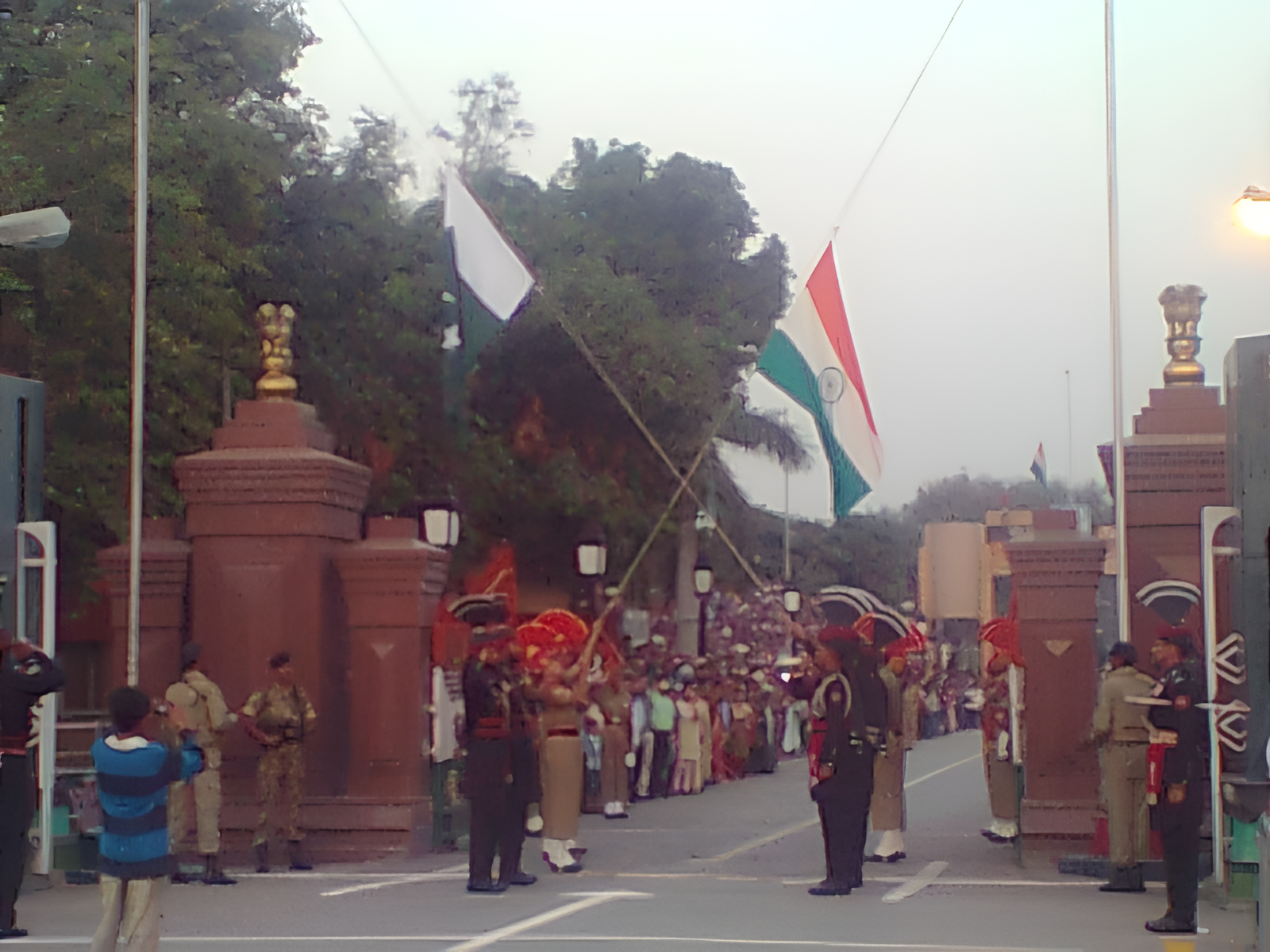
India and Pakistan occupy one of the most consequential geopolitical fault lines in the world. Since the 1947 partition, bilateral relations triggered multiple wars, shaped by conflict over Kashmir, nuclear deterrence dynamics, and enduring cross-border tensions. By 2025, both nations operate with nuclear capability, active conventional forces, and assertive diplomatic strategies. India advances infrastructure and trade ties across South Asia and the Indo-Pacific; Pakistan pursues deep partnerships with China, Gulf states, and multilateral forums. Strategic flashpoints such as Kashmir governance, LoC ceasefire violations, water-sharing disputes, and terrorism shape policy continuity in both nations. Economic interactions remain minimal—bilateral trade under US $5 billion despite shared institutional frameworks. Cross-border terror incidents in 2024 prompted temporary suspension of diplomatic engagement.
1. Military Posture and Nuclear Deterrence
- India fields ~1.5 million active military personnel; Pakistan fields ~650,000.
- India deploys Agni and Prithvi missile systems with dual-use credentials. Pakistan maintains cruise missile modernization and air defense upgrades.
- Indian nuclear doctrine retains “no first use”; Pakistan preserves “full-spectrum deterrence” including battlefield nuclear force.
- The two countries conduct cold-start readiness and maintain a high-alert status along the western border.
- Ceasefire violations at the Line of Control average ~1,200 per annum.
- Military budgets in 2024–25: India ~US $75 billion, Pakistan ~US $12 billion.
- India invests in UAVs, AI-driven surveillance, and satellite-linked early warning systems; Pakistan upgrades radar networks and missile defenses.
- Military exercises and patrol patterns reinforce strategic deterrence messages. The 2024 Balakot escalation exemplifies limited deep-strike posturing without full conflict.
- Command-control communications and logistics nodes remain key nodes of readiness and escalation-retardation strategy.

2. Kashmir Dispute and Territorial Governance
- India revoked Jammu & Kashmir’s constitutional autonomy in August 2019; Pakistan downgraded diplomatic ties over the decision.
- In 2025, Pakistan modernized infrastructure and governance frameworks in Azad Kashmir; India expanded security and civil programs across Kashmir.
- Cross-LoC trade and civil dialogues remain suspended since 2021.
- India constructed integrated checkpoints and surveillance installations; Pakistan improved connectivity for strategic access to rural areas.
- India introduced digital ID platforms for Kashmiri residents; Pakistan expanded civic space within its administered territories.
- The territorial dispute remains a driver for troop deployment, public sentiment, and policy-making.
- Each government invests in mapping, cadastral revisions, and border technologies.
- Education and healthcare investments compete with security spending in projecting governance legitimacy.
- Disputed territory continues to define strategic rivalry in diplomatic negotiations and regional prestige.
3. Cross‑Border Terrorism and Insurgency
- India accuses Pakistan of harboring designated terrorist organizations; Pakistan denies institutional links but enforces sanction designations.
- The 2023–24 period saw five major terror-linked incidents within India traced to cross-border actors.
- Pakistan launched drone surveillance and defensive upgrades along Kashmir sectors in response.
- Joint intelligence mechanisms came under strain as evidence-sharing protocols broke down intermittently.
- Both states issued public advisories on threats near LoC, degrading trust between communities.
- International pressure led Pakistan to list terror groups under domestic law; India presented evidence to UN and FATF forums.
- Terror-related threats influence investor confidence and bilateral trade planning.
- Civil casualties and disruption drive public policy discourse and raise militarization thresholds in disputed zones.
- Tactical escalation risk remains high in face of unilateral actions or miscommunication.
4. Economic Engagement and Trade Dynamics
- Bilateral trade value held at US $3.8 billion in 2023–24—far below SAARC potential.
- India exports pharmaceuticals, machinery, textiles; Pakistan exports rice and leather goods, often restricted by trade barriers.
- Non-tariff measures—customs delays, visa restrictions, trade limits—persist as major deterrents.
- Minor infrastructure engagement: India’s involvement in select cross-border projects stalled in early 2025.
- Pakistan shifted infrastructure focus toward CPEC-related corridors and Chinese-linked development.
- India directs exports toward Europe and African markets via free trade agreements.
- Trade barriers include sudden license revocations, sector-specific restrictions, and documentation complexity.
- Industrial lobbying pushes for expanded bilateral dialogue to reduce trade anomalies.
- Economic friction contributes to broader strategic divergence and risk assessment for corporate stakeholding.
5. Water Security and Indus Water Treaty
- The Indus River system supports ~90% of Pakistan’s irrigated land and ~25% of India’s agriculture.
- India completed two hydropower projects under treaty-allowable run-of-river frameworks in 2024.
- Pakistan filed formal objections via World Bank intervention and international arbitration.
- India deployed Himalayan storage and gauging stations; Pakistan increased reservoir construction and river flow transparency projects.
- Officials exchange river flow data under bilateral river commissions.
- Both militaries retain riverine engineering brigades poised for disaster response or escalation scenarios.
- Water politics remain central to national planning: losses in agriculture or flood risk serve as triggers for mobilization.
- Diplomatic dialogue continues through structured water forums, sustained by treaty enforcement mechanisms.
- Bound water remains both a wedge issue and stabilizer if treaty structures hold.

6. Internal Politics and Leadership Impact
- India undertakes infrastructure expansion and governance modernization in Kashmir aligned with statements of national integration.
- Pakistan’s leadership prioritizes economic liberalization, debt restructuring, and regional connectivity amidst IMF and Chinese funding scrutiny.
- Election-year rhetoric magnifies border issues, as opposition parties in both countries brand engagement as either appeasement or risk-prone.
- Officials suspend track-two diplomacy initiatives—academic exchange, university programs—when tensions spike along the LoC.
- Political turnover drives narrative shifts, not strategic redirection: India reaffirms Indo-Pacific partnerships, Pakistan redefines civil-military coordination to expand economic zones in Azad Kashmir.
- Bureaucracies enforce continuity through institutional mandates, even when political leadership changes.
- Leadership statements in Princely Kashmir or Gwadar convey strategic priority without altering fundamental posture.
- Public outreach includes townhalls and civic consultations in front-line states, reinforcing macro-political messaging.
- Media narratives often amplify leadership posture; government briefings control the tone and direction of bilateral engagement.
7. Media, Perception, and Information Strategy
- Government-owned media frame the other side as a permanent threat. Official outlets release daily reports on LoC violations or troop deployments.
- Ministries present detailed intelligence briefings to international media, seeking global understanding of asymmetric threats.
- Viral social media content—highlighting incidents or defense posturing—undermines narrative control and escalates perception.
- Both governments implement digital policies restricting foreign journalists during military drills or border incidents.
- Digital disinformation campaigns surge during elections. National agencies deploy deepfake detection tools to counter online manipulation.
- Private think tanks and policy institutes publish contingency reports forecasting escalation, which feed into investor risk models and foreign policy planning.
- Social media platforms flag content identified as misinformation by government-aligned fact-checkers, increasing regulation complexity.
- Information campaigns form a strategic dimension of bilateral leverage—shaping international opinion and influencing allied actors.
8. Regional Power Alignments and Strategic Partnerships
- India strengthens strategic alignment with the U.S., Japan, Australia, and EU via trade and defense frameworks.
- Pakistan deepens partnership with China through CPEC, naval enhancement, and participation in Shanghai Cooperation Organization missions.
- In 2025, India and EU finalized trade-defense cooperation; Pakistan strengthened arms procurement channels with Russia and Turkey.
- China’s Gwadar port and involvement in regional infrastructure challenge India’s maritime positioning.
- India invests in island-state infrastructure in Maldives, Seychelles, and Seychelles-led naval drills; Pakistan counters via naval exercises in Gwadar and Chabahar.
- Defense and economic alliances divide regional strategic space: corridor access, trade rights, energy pipeline routing, and maritime security glide into alignment.
- Energy platforms, digital partnerships, and investor access rule sets connect directly to bilateral alignment with either Indo-Pacific or Belt‑Road groupings.
- India and Pakistan use alliance structures to reinforce bilateral narratives and constrain each other’s strategic options.
9. Fragmentation of Multilateral Institutions
- Protectionist legal behavior and treaty abstention weaken the WTO’s dispute enforcement mechanism.
- SAARC loses cohesion as member states follow divergent trade and investment alignments with China or India.
- Alternative groupings emerge: BIMSTEC, I2U2, and Quad-affiliated frameworks sometimes bypass bilateral disputes.
- Differing regulatory standards on data, pharmaceuticals, and trade certification create compliance complexities.
- Climate finance, technology cooperation, and mineral markets align along bloc-based servicing trajectories.
- Corporates face regulatory burdens across multiple trade regimes and standard jurisdictions.
- International forums fragment into faction-based coalitions; collective policy positions diverge on cross-border terrorism and water governance.
- International negotiation now occurs in ad-hoc track-two dialogues rather than unified multilateral institutions.
10. Strategic Foresight and Policy Recommendations
- Implement structured bilateral channels to manage crises, including consular and military hotlines, legal regulatory coordination, and civil society engagement forums.
- Use Indus Water Treaty enforcement mechanisms to reduce escalation risk and promote transparent hydrological data exchange.
- Reopen trade corridors with phased access, paired with customs and regulatory alignment, while insulating sensitive sectors using security vetting.
- Encourage multilateral energy and infrastructure corridors across shared geography to reinforce economic interdependence.
- Support third-party mediation via UN or regional bodies for conflict-sensitive domains: Kashmir, terrorism, or water disputes.
- Promote shared governance dashboards for climate and health indicators in affected provinces to build civil trust regardless of political rhetoric.
- Expand cyber collaboration between energy, water, telecom regulators across borders to manage digital dependency and response protocols.
- Build aligned industrial corridors with shared safety and compliance standards to improve investment confidence and stability in border regions.
Conclusion
India‑Pakistan relations in 2025 reflect layered geopolitics shaped by history, conflict, and strategic competition. Core points—border control, nuclear deterrence, resource governance, and leadership narratives—remain in tension. Territorial disputes continue to command attention, even as leadership and media strategies shift across election cycles. Military posture remains consistent, while economic ties stay restrained. Strategic alignments reinforce friction: India’s partnership with global democratic powers; Pakistan’s strong ties via CPEC and aligned alliances. Internal political considerations and controlled media narratives amplify tension or suggest engagement. Despite minimal trade, both nations wield influence through corridor diplomacy, water governance, and digital policy influence. Observers recommend confidence building, data transparency, trade corridor projects, cyber coordination, and issue‑specific dispute channels. Stakeholders who integrate alignment into their policy architectures and adjust for protectionist or security-centric regulation retain durability. Nations that adopt segmentation, resilience planning, and transparent institutional frameworks navigate bilateral complexity with strategic agility.
Sources
- https://www.csis.org
- https://www.reuters.com
- https://ec.europa.eu
- https://www.brookings.edu
- https://asean.org
- https://www.un.org
- https://www.scmp.com
- https://www.iea.org
- https://www.whitehouse.gov
About The Author


