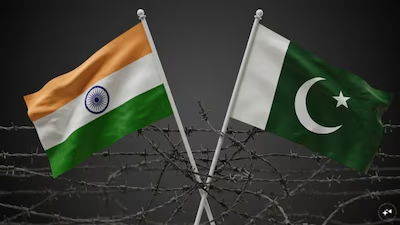
Tensions between India and Pakistan, two nuclear-armed neighbors, have gripped global attention for decades. On May 10, 2025, a ceasefire agreement halted weeks of intense military escalation sparked by a deadly terrorist attack in Kashmir. This development, brokered through international diplomacy, raises critical questions about its durability and the path forward. You might wonder: Is this a genuine step toward peace, or a fleeting pause before deeper conflict? Below, I unpack 10 essential facts about the ceasefire, analyze its implications, and explore what could happen next, drawing on verified data and firsthand reporting.
Fact 1: Ceasefire Took Effect at 5:00 PM IST on May 10, 2025
The ceasefire began at 17:00 Indian Standard Time, following a direct call between the Directors General of Military Operations (DGMOs) of India and Pakistan at 15:35. Both sides agreed to halt all military actions—land, air, and sea—immediately. India’s Foreign Secretary Vikram Misri confirmed the agreement in a New Delhi press briefing, noting that instructions were issued to enforce the truce. The DGMOs scheduled a follow-up call for May 12 at 12:00 IST to monitor compliance. The Hindu
Why does this matter? The precise timing and direct communication signal a structured effort to de-escalate, but the short interval before the next call suggests both sides remain cautious.
Fact 2: U.S. Mediation Played a Pivotal Role
U.S. President Donald Trump announced the ceasefire on his Truth Social platform, claiming credit for brokering it after “a long night of talks.” U.S. Secretary of State Marco Rubio and Vice President JD Vance engaged with Indian Prime Minister Narendra Modi, Pakistani Prime Minister Shehbaz Sharif, and other senior officials over 48 hours. While India and Pakistan later clarified they directly negotiated the cessation of hostilities, U.S. involvement lent diplomatic weight. Reuters
Ask yourself: Does U.S. mediation strengthen the ceasefire’s credibility, or does it risk entangling external powers in South Asian geopolitics?
Fact 3: Triggered by the April 2025 Pahalgam Attack
The ceasefire follows a deadly terrorist attack on April 23, 2025, in Pahalgam, Jammu and Kashmir, where 27 people—25 Hindu tourists, one Christian tourist, and one local Muslim—were killed, and over 20 injured. The Resistance Front (TRF), an offshoot of Lashkar-e-Taiba, claimed responsibility. India accused Pakistan of sponsoring the attack, escalating tensions through diplomatic expulsions, border closures, and military strikes. Wikipedia
This attack underscores the volatility of Kashmir, a region both nations claim in full. Could unresolved grievances over such incidents unravel the ceasefire?
Fact 4: Intense Military Escalation Preceded the Truce
From April 24 to May 10, 2025, both nations engaged in heavy skirmishes along the Line of Control (LoC) and International Border. India launched “Operation Sindoor” on May 7, striking six Pakistani airbases—Rafiqui, Murid, Chaklala, Rahim Yar Khan, Sukkur, and Chunian—and terror launchpads in Pakistan-administered Kashmir. Pakistan retaliated with drone attacks, missile strikes, and shelling, injuring eight Indian Border Security Force personnel in Jammu on May 10. India Today
The scale of these actions highlights the risk of rapid escalation. Will both militaries fully adhere to the ceasefire, or could isolated violations reignite conflict?
Fact 5: Civilian Toll Fueled Urgency
The conflict claimed significant civilian lives. In Jammu and Kashmir, Pakistani shelling killed 19 villagers and an Additional District Development Commissioner in Poonch, Rajouri, Jammu, and Baramulla sectors. India’s strikes damaged civilian infrastructure in Pakistan-administered Kashmir, though exact casualty figures remain unverified. These losses, combined with mass evacuations—evident at Jammu Tawi railway station—pressured both governments to act. India TV
You might ask: Can leaders prioritize civilian safety over nationalist rhetoric to sustain this truce?
Fact 6: International Diplomacy Bolstered the Agreement
Beyond the U.S., Saudi Arabia and Turkey facilitated dialogue, with Saudi Foreign Minister Faisal bin Farhan contacting Indian and Pakistani counterparts. Pakistan’s Foreign Minister Ishaq Dar noted that 36 countries supported the diplomatic push for a “full-fledged” ceasefire. China, while expressing concern, urged restraint and offered to mediate, reflecting its strategic ties with Pakistan. The Guardian
This global involvement raises a question: Does broad international backing ensure compliance, or does it complicate bilateral negotiations?
Fact 7: Fragile History of Ceasefires
The 2021 ceasefire, reaffirmed on February 25, 2021, reduced LoC violence significantly, with only one violation in 2022, none in 2023, and two in 2024. However, the Pahalgam attack shattered this calm, leading to sustained cross-border firing. Historical ceasefires—1949, 1965, 2003—often faltered due to terrorist attacks or political shifts. Deccan Herald USIP
Given this track record, can both nations institutionalize mechanisms to prevent future breakdowns?
Fact 8: Economic and Social Disruptions
The conflict disrupted civilian life extensively. India closed 32 airports in northern and western regions from May 9 to May 14, citing “operational reasons.” Pakistan restored its airspace for normal flights post-ceasefire. In India, a red alert in Ludhiana and blackouts in Gujarat, Rajasthan, Punjab, and Jammu and Kashmir heightened public anxiety. Train services in border areas operated under strict coordination with local authorities. The Hindu BBC
How will these disruptions shape public support for peace efforts?
Fact 9: Both Nations Signal Conditional Peace
Pakistan’s Ishaq Dar emphasized that the ceasefire aligns with Pakistan’s pursuit of regional peace “without compromising sovereignty.” India warned that future terror attacks would be treated as acts of war, signaling a hardline stance. Both nations’ militaries remain on high alert, with India’s Chief of Defence Staff General Anil Chauhan briefing Defence Minister Rajnath Singh on May 10. The Telegraph
This conditional rhetoric begs the question: Are both sides committed to de-escalation, or preparing for the next flashpoint?
Fact 10: Kashmir Remains the Core Issue
Kashmir, divided since 1947, drives India-Pakistan tensions. India’s revocation of Jammu and Kashmir’s special status in 2019 and Pakistan’s support for Kashmiri separatists have fueled recurring clashes. The Pahalgam attack, the deadliest since the 2008 Mumbai attacks, reignited accusations of Pakistan harboring militants. CBS News
Can dialogue address Kashmir’s root causes, or will it remain a perpetual trigger?
What Happens Next?
The ceasefire offers a critical window, but its success hinges on actionable steps. Here’s what to watch:
- Military Compliance: Both armies must adhere strictly to the truce. The DGMOs’ May 12 call will assess early compliance. Past violations, like Pakistan’s shelling in Uri and Gurez on May 10, show how quickly trust erodes. Rediff
- Diplomatic Engagement: U.S.-proposed talks at a neutral site could address terrorism and Kashmir. However, India’s insistence on bilateral dialogue and Pakistan’s reliance on international mediators may clash. The Guardian
- Domestic Pressures: In India, nationalist media and Modi’s strongman image demand a tough stance. In Pakistan, military influence and public sentiment limit concessions. Balancing these pressures will test leadership. CNN
- Counterterrorism Measures: India’s demand for Pakistan to dismantle terror networks is non-negotiable. Pakistan denies harboring militants, but TRF’s claim of the Pahalgam attack complicates its position. Joint mechanisms to monitor cross-border terrorism could build trust.
- Economic Stabilization: Restoring air and rail services, reopening borders, and lifting alerts will signal confidence in the ceasefire. Economic cooperation, like the 2008 gas pipeline framework, could incentivize peace. Al Jazeera
Is This a Lull Before the Storm?
The ceasefire’s fragility is undeniable. Several risks loom:
- Terrorist Attacks: A single incident, like Pahalgam, could derail progress. India’s vow to treat future attacks as acts of war raises the stakes. The Telegraph
- Military Posturing: Both nations’ forward troop movements, observed during Operation Sindoor, suggest readiness for escalation. De-escalation requires pulling back forces. The Hindu
- Political Instability: Domestic unrest or leadership changes could undermine commitments. Pakistan’s military-civilian power dynamics and India’s electoral pressures add uncertainty. USIP
Yet, opportunities exist. The 2021 ceasefire’s relative success shows that sustained dialogue and third-party facilitation can work. International pressure, coupled with economic incentives, could push both nations toward talks. For you, the question is: Will leaders prioritize long-term stability over short-term political gains?
Practical Steps for Stakeholders
If you’re tracking this conflict, consider these actions:
- Monitor Official Channels: Follow India’s Ministry of Defence and Pakistan’s Inter-Services Public Relations for verified updates. Social media, while timely, often spreads unverified claims. India TV
- Engage with Diplomacy: Support initiatives like Saudi Arabia’s mediation offer. Regional stability benefits global markets and security.
- Advocate for Civilian Safety: Push for humanitarian measures, like safe evacuation routes and compensation for victims, as seen with Jammu and Kashmir’s Rs 10 lakh ex-gratia payments. India TV
The India-Pakistan ceasefire on May 10, 2025, is a fragile but significant step. Its success depends on disciplined military restraint, robust diplomacy, and addressing Kashmir’s underlying tensions. You must ask: Can both nations seize this moment, or will history repeat itself? The world watches, and the stakes—nuclear arsenals, civilian lives, regional stability—could not be higher.
Photo Credit: CNBCTV18
About The Author