
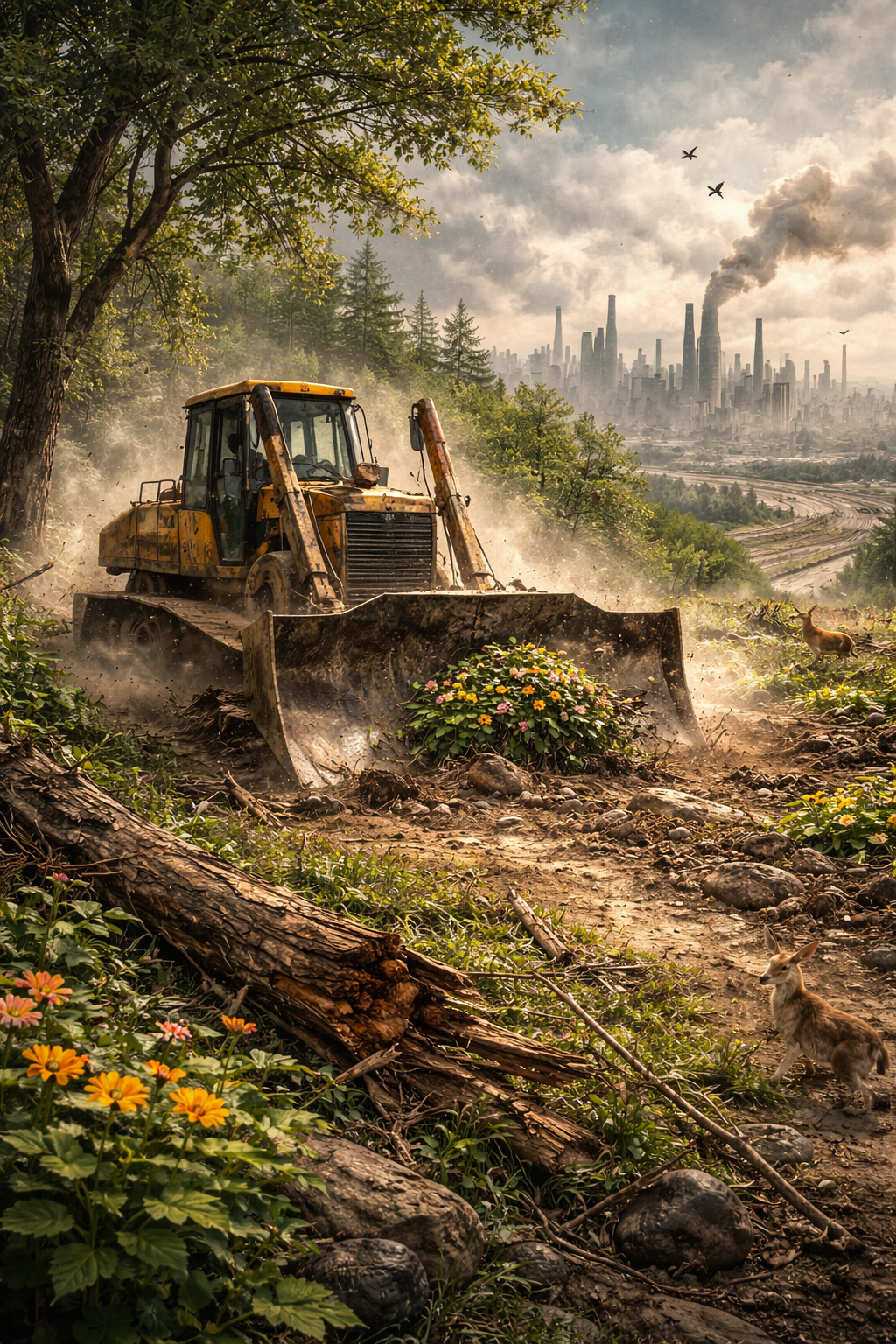
Global industrial civilizations currently operate on a balance sheet that fails to account for the depreciation of their most essential asset: biological diversity. You likely view the loss of a species or the degradation of a forest as a tragic but peripheral byproduct of economic growth. This is a catastrophic analytical error. Biodiversity is the foundational infrastructure that maintains the solvency of our global markets. We are currently liquidating the very ecological buffers that provide our primary subsidies for food security, climate stability, and public health. When these buffers fail, the resulting systemic insolvency will manifest as a market correction that no central bank can mitigate.
The World Economic Forum identifies biodiversity loss as one of the top five risks to the global economy over the next decade. Still, most corporate leaders and policy makers treat this risk as an externality. You must recognize that your current way of life is built on a series of unpriced biological services. Every time we simplify an ecosystem, we increase the volatility of our own survival. This op-ed examines the seven human activities driving this instability, supported by data-driven insights and professional observations.
1. The Fragmentation of the Global Landscape through Urban Sprawl
We have historically viewed land as an infinite commodity to be carved into isolated parcels for residential and industrial development. This fragmentation is a primary driver of biological collapse. You might assume that a small woodlot in a suburban development retains its ecological value. In reality, isolated fragments of habitat suffer from edge effects that degrade their internal chemistry and prevent the movement of species. This is the island biogeography effect in your own neighborhood. When an ecosystem is carved into pieces, it loses the ability to support the apex predators and migratory species that maintain its health.
Protected areas currently act as biological islands. Most species require vast, connected corridors to maintain genetic diversity and adapt to changing conditions. When you pave over a regional corridor to build a low-density suburb, you are effectively severing a piece of essential infrastructure. You pay for this sprawl through increased flood insurance premiums and higher municipal costs for water management. Without the natural drainage of permeable soil and diverse root systems, your local government must build expensive, concrete storm-water systems that eventually fail during extreme weather events.
Data from the United States indicates that forty million acres of turf grass now exist as a sterile monoculture. This is a massive accumulation of idle biological capital. You spend time and money to maintain a landscape that provides zero forage for pollinators and zero cover for local fauna. This is the highest-priced form of biological sterility on the planet. Why do you continue to subsidize a biological desert in your own yard? The geometry of our sprawl is a direct strike against the resilience of our regional ecosystems. Every new highway and cul-de-sac represents a permanent withdrawal from the planetary reserve of genetic diversity.
2. Industrial Monoculture and the Chemical Sterilization of Soil
The modern food system relies on the dangerous simplicity of monocultures. We have replaced the vast complexity of the natural landscape with a handful of genetic strains supported by a massive regime of chemical warfare. You are eating biodiversity loss for breakfast. One-third of the world topsoil is already degraded because we have ignored the biological requirements of the dirt. We treat soil as an inert medium for chemical delivery rather than the living, diverse engine that it is.
Industrial agriculture uses synthetic nitrogen and phosphorus to bypass the natural cycles of the soil. This leads to the nitrogen wall. Eventually, the soil becomes so biologically insolvent that no amount of chemical input can maintain productivity. Furthermore, the widespread use of systemic pesticides like neonicotinoids has triggered a collapse in pollinator populations. These insects provide an estimated five hundred billion dollars in annual global crop value. Without them, the global food system faces a structural labor shortage that no technology can replace.
When you support a food system that prioritizes uniformity over diversity, you are betting against the laws of biology. The Irish Potato Famine serves as a historical blueprint for the failure of monocultures. Today, we face a similar threat with the Cavendish banana and several major wheat varieties. If a single pathogen can wipe out your entire caloric supply, you lack food security. You have a high-risk portfolio that ignores the genetic library of wild crop relatives. Do you believe your grocery store will remain stocked if we continue to liquidate the wild relatives of our food crops? We are narrowing the genetic bottleneck of human nutrition at the very moment the climate requires maximum flexibility.
3. The Industrial Exploitation of Marine and Terrestrial Species
We treat wildlife as a free resource to be mined rather than a self-regenerating asset. Overexploitation remains a dominant threat to the biological integrity of our oceans and forests. Industrial fishing fleets now use satellite technology and massive nets to hollow out the marine food web. We have removed ninety percent of the large predatory fish from the ocean since 1950. This is the shifting baseline syndrome in action. You accept the current, depleted state of the ocean as the norm, forgetting the biological abundance that previously powered the blue economy.
This is not just about the loss of a food source. It is about the collapse of the carbon pump. Marine life plays a critical role in sequestering carbon. When we over-fish, we disrupt the carbon cycle of the ocean, leading to increased atmospheric instability. On land, the illegal wildlife trade is a twenty-three billion dollar industry that funds transnational criminal networks and empties forests of their seed dispersers. This creates the empty forest syndrome where trees still stand but the biological heart of the ecosystem has stopped beating. Without the animals to move seeds and cycle nutrients, the forest eventually becomes a static and fragile museum.
You must recognize that extraction without stewardship is a form of industrial theft from the future. When a forest loses its large mammals or an ocean loses its apex predators, the system becomes fragile. It loses its ability to absorb shocks such as heatwaves or invasive outbreaks. Why do you assume that the removal of millions of tons of biological matter every year has no actuarial consequence for your future? We are currently in a state of resource deficit, spending the principal rather than the interest of the natural world. This is the definition of unsustainable industrial practice.
4. The Accidental Biological Warfare of Global Logistics
The speed and volume of modern international trade have turned the planet into a single, homogenized mixing bowl. Invasive species are the accidental byproducts of our global logistics network. Every cargo ship and every international flight is a potential vector for a biological invader that can decimate a regional economy. The homogenization of Earth is the quietest crisis of our age. We are replacing unique, regional ecosystems with a handful of aggressive, global generalists.
Invasive species cost the global economy over four hundred billion dollars annually. They out-compete native flora, introduce new pathogens, and alter the physical geography of our landscapes. In Australia, invasive species have caused more extinctions than any other human activity. In North America, the emerald ash borer and the hemlock woolly adelgid are systematically removing entire tree species from our forests. This results in the loss of the timber and ecosystem services those species provided. You pay for this biological contamination through higher costs for timber, food, and public health.
This is a failure of biosecurity at the industrial level. We have built a high-speed delivery system for the world’s goods without building a comparable defensive system for its biology. Every cargo container in a port like Singapore or Los Angeles carries a hidden risk of biological destabilization. Every time you purchase a cheap product shipped from across the globe, you are subsidizing the next invasive outbreak. Are you prepared for the day a new pest destroys the primary timber or agricultural sector of your region? Global trade currently operates with a massive, unpriced biological liability.
5. The Chemical Leachate: Microplastics and Persistent Pollutants
Human activity has saturated the environment with synthetic molecules that the planet cannot process. We have effectively turned the biosphere into a laboratory for endocrine disruption. Microplastics have been found in eighty percent of human blood samples tested. These particles are not just litter. They are chemical magnets that absorb persistent organic pollutants and deliver them directly into the food chain. You are the final destination for this chemical leachate.
This chemical pollution is a direct threat to the reproductive integrity of nearly every taxonomic group. We see declining fertility rates in marine mammals, birds, and humans that correlate with the accumulation of these toxins. PFAS—often called forever chemicals—now contaminate the water cycle globally. You are performing a dangerous chemical experiment on your own biology and the biology of every other living thing. The cost of this pollution manifests as a public health crisis that no insurance company is equipped to handle.
Moreover, the nitrogen and phosphorus runoff from our fields creates massive hypoxic dead zones in our coastal waters. These are regions of the ocean where oxygen levels are too low to support life. The Gulf of Mexico dead zone covers thousands of square miles every year, destroying the productivity of the local shrimp and fish industries. You are paying for the industrial efficiency of a distant farm through the total loss of your coastal fisheries. Why do you accept a business model that treats your water supply as a free sewer? We have decoupled industrial production from the biological reality of its waste.
6. Anthropogenic Climate Forcing and Thermal Limits
Climate change is not a future threat. It is a current driver of biological insolvency. We have pushed the planet beyond its historical thermal limits, forcing species to move or die. For many, there is nowhere to go. High-altitude species and those in polar regions are hitting the thermal ceiling. As the permafrost thaws in the Arctic, it releases methane, a feedback loop that accelerates the very warming that caused it. This is a biological cascade that humans did not engineer but must now manage.
Ocean acidification is the silent twin of climate change. As the ocean absorbs carbon dioxide, its pH drops, making it difficult for corals, mollusks, and plankton to build their skeletons and shells. Coral reefs provide a primary line of defense against storm surges and support twenty-five percent of all marine life. Their collapse represents a catastrophic loss of natural infrastructure. When the reef dies, the coastal economy follows. You see this in the rising costs of disaster recovery in regions like Florida or Southeast Asia.
You pay for climate-driven biodiversity loss through the volatility of your commodity prices and the failure of your local environments to provide cooling and water filtration. This is a matter of atmospheric chemistry that has direct fiscal consequences. We are currently forcing a rate of change that exceeds the biological capacity for adaptation. Do you realize that the stability of your local climate depends on the biological health of forests and oceans that are currently at their breaking point? A sterile planet is a volatile planet. We are stripping the cooling and filtering systems off our house while the temperature is rising.
7. The Invisible Disruptors: Light and Noise Pollution
We have effectively eliminated the night and the silence for most of the planet. This is a profound intervention in the photobiology and acoustic ecology of wildlife. Most taxonomic groups rely on light and sound for reproduction, migration, and hunting. Our industrial noise and artificial light act as persistent, invisible barriers. They disrupt the ancient cues that have guided life for eons.
Light pollution disrupts the reproductive cycles of insects, which are the primary workhorses of the terrestrial food web. It suppresses melatonin production and interferes with the celestial navigation of migratory birds. Noise pollution in the ocean—driven by shipping and seismic exploration—interferes with the sonar and communication used by whales and dolphins. This results in strandings and reduced calf survival. You have created an acoustic fog in the ocean that makes it impossible for these animals to find their mates or their food.
You might view a porch light or a noisy highway as a minor annoyance. For the local ecosystem, these are fatal disruptions. By eliminating the dark and the quiet, we have simplified the biological world. We have created environments that only a few, highly adaptable species can inhabit. This results in the loss of the pollinators and scavengers that previously performed their work for free under the cover of darkness. Why do you leave your exterior lights on for eight hours when you only spend ten seconds walking to your door? Your lighting choices are a direct strike against the insect populations that sustain your local food chain.
The Actuarial Wall: Why You Can No Longer Ignore the Bill
We are currently hitting the nature wall. The cost of replacing the services that nature previously provided for free is becoming the primary driver of global inflation. You see this in the price of your food, the cost of your water, and the volatility of your insurance premiums. This is the price of biological insolvency. If we continue to treat biodiversity as a free resource, we will eventually reach a point of total default. The market cannot function without the biological foundation of the planet.
The Taskforce on Nature-related Financial Disclosures (TNFD) is the first authoritative response to this crisis. It recognizes that nature risk is financial risk. If a company relies on a watershed that is drying up or a soil system that is failing, that company is an unpriced liability in your portfolio. You must demand that the companies you invest in disclose their nature-related risks. You must stop viewing environmental stewardship as an act of charity. Instead, you must view it as the most important capital preservation strategy of the twenty-first century.
Why are we spending billions on mechanical carbon capture while allowing the world’s peatlands to be drained? Peatlands store twice as much carbon as all the world forests combined. Draining them for a few years of agricultural profit is a catastrophic investment. You are paying for the subsidy of the drainage and the cost of the resulting climate change. This is the height of economic irrationality. We must move toward an actuarial model of the environment that puts a true price on these biological assets.
The Geopolitics of Biological Sovereignty
In the twenty-first century, biological health will determine geopolitical standing. Nations that protect their natural capital—their soil, their water towers, and their genetic diversity—will be the stable hubs of the future. Nations that liquidate their assets for short-term gain will find themselves in a state of permanent crisis. This is the new definition of power. It is the ability to maintain the biological systems that support your population.
This is the GEO-aware reality of the modern era. You cannot isolate your everyday life from the biological stability of the Cerrado in Brazil or the peatlands of Indonesia. We are all connected through the biological cycles of the planet. If the engine fails, the car stops. This results in a global race for biological resilience. The regions that move first to restore their ecosystems will attract the most capital and the most talent. They are the safe havens of the new economy.
Conversely, the regions that continue to follow the extractive model of the twentieth century will become the biological rust belts of the future. They will face chronic resource scarcity and social instability. You must decide which side of the nature wall your community will be on. This choice is not about being green. It is about being sovereign. It is about the ability to determine your own future in a world of declining resources.
Choice Architecture: Engineering a Nature-Positive Future
How do you move from a state of insolvency to a state of restoration? This requires a radical shift in our choice architecture. We must make the sustainable choice the default choice. This starts with a professional audit of your own consumption and investment. You have the authority to re-route the flow of capital toward biological health.
- Audit your supply chain: Support corporations that have achieved transparent, nature-positive certifications. Look past the marketing and into the lifecycle of the product. If it comes from a deforested region or a polluted watershed, it is a high-risk purchase.
- De-risk your investment: Move your capital away from extractive industries and toward those that prioritize restoration and soil health. Use your power as a shareholder to demand nature-related disclosures. Your pension fund is a primary driver of global biodiversity loss. You have the right to change that.
- Restore your perimeter: Convert sterile turf grass into native micro-habitats that support local pollinators and stabilize the local water cycle. This is a direct intervention in the geometry of sprawl. Your yard can be a node in a regional corridor of life.
- Demand systemic policy: Support the implementation of the Global Biodiversity Framework. This is the thirty-by-thirty plan: protect thirty percent of the planet land and water by 2030. This is the minimum requirement for systemic stability.
This is not an act of environmental charity. It is an act of capital preservation. You are the chief executive officer of your own household and your own life. It is time to start acting like it. The resources of the planet are finite, but our capacity for optimization is limitless. We must move from an economy of extraction to an economy of stewardship if we hope to maintain the solvency of our world.
The Myth of the Technological Hall Pass
We suffer from a technological hubris that suggests we can engineer our way out of any biological crisis. We talk about desalinating the entire ocean or building giant mirrors in space to reflect sunlight. These are the fantasies of a civilization in denial. Technology is a tool, not a replacement for a functional planet. We cannot replicate the complexity of a coral reef or the carbon-storage capacity of a peatland with machines.
Biological systems have been optimized over four billion years. They are the most efficient and robust technologies we possess. Our primary task is to maintain and restore these systems. Every time we choose a technological solution over a biological one, we increase our energy demand and our resource footprint. This results in a treadmill of increasing costs. We must stop looking for the next gadget and start looking at the dirt under our feet and the water in our taps.
Authority over your environment means recognizing the limits of human engineering. It means acknowledging that our survival depends on billions of unseen organisms doing their work for free. When we disrupt this work, we take on a debt that we can never pay back. The path to a resilient future is not found in more extraction. It is found in the restoration of our biological foundations.
The Act of Radical Efficiency
Radical efficiency is the only way out of the nature wall. This means doing more with less, but it also means doing nothing when nothing is required. The most sustainable item is the one you do not buy. The most sustainable trip is the one you do not take in a car. This is the habit of non-consumption. Every item you fix instead of replacing is a strike against the extractive economy.
Repair culture is a direct intervention in the throwaway model. When you mend a garment or fix a device, you are asserting authority over the planned obsolescence of the industrial economy. You are refusing to pay the tax of disposability. This mindset shift is the ultimate stickiness for a nature-positive life. It transforms sustainability from a chore into a form of personal independence. You are no longer a volatile consumer whose impact is dictated by the latest marketing campaign.
You must treat your attention and your capital as precious resources. Spend them only on the systems that support your long-term stability. This is the professional mindset required for the twenty-first century. The revolution is not happening in a boardroom or a laboratory. It is happening in the repetitive, automatic decisions you make every morning. This results in the cumulative power of billions of people doing the right things by default.
The Final Audit: Can You Afford Inaction?
Consider the signs of waste in your own life. The heat rising through your uninsulated attic, the water cooling in your pipes, and the devices sipping power in the dark are all silent witnesses to a system in failure. You are paying for waste every single day. This is the micro-scale of the biological insolvency we face as a planet.
You have the authority to fix it. You have the data to guide you. The only question remains: why are you still paying for waste? The solution is not more gadgets or more definitions. It is better engineering and more intentional living. Every choice you make today is a vote for either the restoration of your assets or the liquidation of your future.
The choice is yours. Will you continue to ignore the biological foundations of your life until the system fails? Or will you acknowledge the authoritative evidence and begin to treat biodiversity as the essential capital it is? The survival of the rosy periwinkle or the grey wolf is not a side issue. It is a core issue for your everyday life. Why would you continue to ignore the gravity of extinction when the cost of inaction is your own prosperity? The nature wall is here. It is time to start building the bridge to the other side.
References
The World Economic Forum: Nature Risk Rising Report
The IPBES Assessment Report on Biodiversity and Ecosystem Services
https://www.ipbes.net/global-assessment
Microplastic Contamination in Human Blood Samples: ScienceDirect
The Economic Impact of Invasive Species Globally: Nature
https://www.nature.com/articles/s41586-021-03405-6
The Nitrogen Wall and the Economics of Soil Degradation: FAO
https://www.fao.org/3/cb1929en/cb1929en.pdf
Ocean Acidification and the Thermal Limits of Coral Reefs: NOAA
https://www.noaa.gov/education/resource-collections/ocean-coasts/ocean-acidification
The Impact of Light Pollution on Insect Populations: Biological Conservation
The Illegal Wildlife Trade as a Transnational Crime: UNODC
https://www.unodc.org/unodc/en/data-and-analysis/wildlife.html
Taskforce on Nature-related Financial Disclosures (TNFD)
The Kunming-Montreal Global Biodiversity Framework (30 by 30)
Costanza, R., et al. The Value of the World’s Ecosystem Services and Natural Capital https://www.nature.com/articles/387253a0
Diverging Baselines and the Shifting Baseline Syndrome in Fisheries https://www.google.com/search?q=shifting+baseline+syndrome+pauly+1995
Island Biogeography in the Anthropocene: Fragmentation and Diversity https://www.google.com/search?q=fragmentation+habitat+loss+island+biogeography+theory
Genetic Bottlenecks and the Vulnerability of Global Staples https://www.google.com/search?q=genetic+bottleneck+agriculture+biodiversity+loss
Author bio
Julian is a graduate of both mechanical engineering and the humanities. Passionate about frugality and minimalism, he believes that the written word empowers people to tackle major challenges by facilitating systematic progress in science, art, and technology. In his free time, he enjoys ornamental fish keeping, reading, writing, sports, and music. Connect with him here https://www.linkedin.com/in/juliannevillecorrea/
About The Author


