
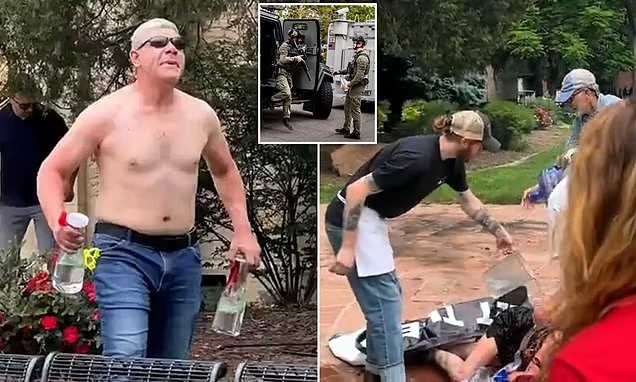
On a sunny Sunday afternoon, June 1, 2025, the vibrant Pearl Street Mall in Boulder, Colorado, transformed from a place of community and celebration into a scene of terror. A peaceful gathering, organized to advocate for the release of Israeli hostages held in Gaza, became the target of a violent attack. Mohamed Sabry Soliman, a 45-year-old man from El Paso County, allegedly wielded a makeshift flamethrower and hurled Molotov cocktails into the crowd, shouting “Free Palestine” and other antisemitic slogans. This act, now under investigation by the FBI as a targeted terror attack, injured eight people and left a community grappling with fear and outrage.
This incident forces you to confront uncomfortable questions: What drives someone to commit such a violent act against a peaceful assembly? How does this attack reflect broader trends of antisemitism in America? This article explores the who, what, when, where, and why of the Boulder attack, offering a detailed look at Soliman’s actions, the victims, and the broader implications for society.
The Attack: A Timeline of Terror
The attack unfolded rapidly on June 1, 2025, at approximately 1:26 PM local time at Boulder’s Pearl Street Mall, a popular pedestrian area known for its lively atmosphere. The “Run for Their Lives” walk, a weekly event organized by the Jewish community to raise awareness for Israeli hostages held by Hamas since the October 7, 2023, attacks, was underway when Soliman struck. Witnesses reported that he approached the group, shouting antisemitic and anti-Zionist phrases such as “Free Palestine” and “End Zionists,” before igniting a homemade flamethrower and throwing incendiary devices into the crowd (CNN).
The following timeline captures the sequence of events:
- 1:26 PM: Boulder police receive emergency calls reporting a man with a weapon near the Pearl Street Mall, with reports of people being set on fire.
- 1:30 PM: First responders arrive to find multiple victims with burn injuries, some severe.
- 1:45 PM: Soliman, the suspect, is apprehended after a brief struggle. He sustains injuries, though details remain undisclosed.
- 2:00 PM: Eight victims, aged 52 to 88, are transported to hospitals in the Denver metropolitan area. Two are airlifted to a specialized burn unit due to critical injuries (The Guardian).
Eyewitness accounts describe a scene of chaos, with people running for cover as flames engulfed participants. Videos circulating on X show individuals attempting to aid the injured, some with severe burns (X Post). The attack’s timing, on the eve of Shavuot, a Jewish holiday celebrating the giving of the Torah, added a layer of symbolic weight to the tragedy (Chabad).
The Suspect: Mohamed Sabry Soliman
Mohamed Sabry Soliman, a 45-year-old Egyptian national residing in El Paso County, Colorado, is the sole suspect in this attack. Limited information is available about his personal background, but reports indicate he applied for asylum in the U.S. in 2005, which was denied. Claims suggest he overstayed a tourist visa and later received a work permit, though these details remain unverified by some sources (Reuters).
During the attack, Soliman’s actions and words provided insight into his motives. He allegedly shouted “Free Palestine,” “End Zionists,” and “They are killers!” while spraying alcohol and throwing Molotov cocktails (CNN). These statements suggest an ideological motivation rooted in anti-Zionist and antisemitic sentiments, though the FBI is still investigating whether he acted alone or was influenced by broader networks.
| Category | Details |
|---|---|
| Name | Mohamed Sabry Soliman |
| Age | 45 |
| Nationality | Egyptian |
| Residence | El Paso County, Colorado |
| Immigration Status | Applied for asylum (denied in 2005); overstayed tourist visa (unverified) |
| Actions | Used flamethrower and Molotov cocktails; shouted antisemitic slogans |
| Investigation | FBI probing mental health, online presence, and potential extremist ties |
The FBI has classified the incident as a targeted terror attack, with ongoing efforts to examine Soliman’s mental health and digital footprint to uncover what drove him to this act of violence (POLITICO).
The Victims: A Community Targeted
The attack injured eight individuals, four women and four men, ranging in age from 52 to 88. Among them was a Holocaust survivor, whose presence at the event underscores the historical resonance of this act of hatred. The victims were attending the “Run for Their Lives” walk, a peaceful demonstration advocating for the release of hostages held in Gaza.
| Category | Details |
|---|---|
| Number of Victims | 8 (4 women, 4 men) |
| Age Range | 52 to 88 |
| Injuries | Burns (minor to severe); two airlifted to burn unit |
| Notable Victim | Holocaust survivor |
| Event Targeted | “Run for Their Lives” walk for Israeli hostages |
All victims were transported to hospitals in the Denver area, with two requiring airlifting to a burn unit due to critical injuries (The Washington Post). Witnesses reported severe burns, with some describing “skin melting off” victims, highlighting the brutality of the attack (CNN). The Boulder Jewish community has rallied around the victims, offering support and prayers for their recovery.
Law Enforcement Response: Swift and Decisive
Boulder police responded promptly to the attack, arriving at the scene within minutes of the first emergency calls. They encountered multiple victims with burn injuries and quickly apprehended Soliman, who was also injured and taken to a hospital for treatment. Boulder Police Chief Stephen Redfearn initially hesitated to label the incident as terrorism, citing the need for further investigation into the suspect’s motives (The Guardian).
However, the FBI, led by Director Kash Patel, immediately classified the attack as a “targeted terror attack.” Special Agent in Charge Mark Michalek, from the FBI’s Denver field office, confirmed that federal and local law enforcement are working together to investigate the incident, with a focus on Soliman’s ideological motivations and potential connections to extremist groups (POLITICO). Federal charges are expected, reflecting the severity of the attack and its implications for national security.
Context: A Rising Tide of Antisemitism
The “Run for Their Lives” walk is part of a nationwide effort by Jewish communities to advocate for the release of hostages taken during the October 7, 2023, Hamas attacks in Israel. These events have become symbols of solidarity but also flashpoints for those harboring antisemitic or anti-Zionist sentiments. The Boulder attack occurred against a backdrop of increasing antisemitic incidents in the U.S., including the recent shooting of two Israeli embassy employees in Washington, D.C. (Reuters).
The Anti-Defamation League (ADL) has noted a “disturbing national and global trend of antisemitic violence,” linking the Boulder attack to extremist rhetoric such as calls to “globalize the Intifada” (ADL). This incident raises questions about the intersection of geopolitical tensions and local acts of violence, prompting you to consider: How can communities address the spread of extremist ideologies without stifling free speech?
Community and Political Reactions
The attack has drawn widespread condemnation from political leaders and community organizations. Colorado Governor Jared Polis called it a “blatant act of antisemitism” and vowed to stand with the Jewish community (Colorado Governor). President Donald Trump was briefed on the incident, with his administration pledging strong action against domestic terrorism (CNN).
Jewish organizations, including the ADL and the American Jewish Committee (AJC), have called for enhanced security measures for Jewish institutions and greater efforts to combat antisemitism (Jewish Federations). Israel’s Foreign Minister Gideon Saar labeled the attack a “terrible antisemitic terror attack,” urging global action against such violence (Al Jazeera).
The Boulder Jewish community issued a joint statement, declaring, “We will not be intimidated. We will continue to walk, to speak out, and to demand the release of the hostages until they are all home” (CNN). This resilience reflects the community’s determination to continue their advocacy despite the threat of violence.
Analysis: Addressing the Root Causes
The Boulder attack underscores the urgent need to address antisemitism and ideological extremism. While law enforcement focuses on holding Soliman accountable, broader questions remain about preventing such incidents. Education, community engagement, and policies targeting online radicalization are critical steps. The attack also highlights the vulnerability of peaceful demonstrations, raising the question: How can you ensure the safety of minority groups exercising their right to assemble?
The incident’s connection to the Israeli-Palestinian conflict illustrates the complexity of addressing global issues in local contexts. Soliman’s actions, while extreme, reflect a broader trend of individuals acting on ideological grievances, often amplified by online echo chambers. This prompts you to ask: What role does social media play in fueling such attacks, and how can platforms balance free expression with the need to curb harmful rhetoric?
Moving Forward
The Boulder attack is a stark reminder of the challenges facing Jewish communities and the broader fight against hate-driven violence. The resilience of the victims, particularly the Holocaust survivor among them, serves as a testament to the strength of the human spirit. Yet, it also calls on you to act—whether by supporting community initiatives, advocating for policy changes, or fostering dialogue to bridge divides.
As the investigation unfolds, the focus remains on justice for the victims and prevention of future attacks. The Boulder Jewish community’s resolve to continue their advocacy offers a powerful message: hatred will not silence their voices. What steps will you take to stand against antisemitism and ensure such tragedies do not define our future?
Photo Credit: Daily Mail
Key Citations
X Post: StandWithUs on Boulder antisemitic attack
CNN: Boulder attack suspect used a flamethrower and yelled ‘Free Palestine’
CNN: Live updates on Boulder antisemitic attack June 1, 2025
The New York Times: Police Respond to Terror Attack on Colorado Event
Al Jazeera: Boulder attack details, suspect, and victims
Reuters: FBI investigates targeted terror attack in Boulder
POLITICO: Six injured in Colorado terror attack
The Guardian: Eight injured in Boulder attack on rally
The Washington Post: FBI investigating targeted attack on Jews
ADL: Statement on violent antisemitic attack in Boulder
Jewish Federations: Statement on Boulder attack
Colorado Governor: Polis condemns act of terror in Boulder
Chabad: Information on Shavuot holiday
About The Author


