


		<div class="wpcnt">
			<div class="wpa">
				<span class="wpa-about">Advertisements</span>
				<div class="u top_amp">
							<amp-ad width="300" height="265"
		 type="pubmine"
		 data-siteid="173035871"
		 data-section="1">
		</amp-ad>
				</div>
			</div>
		</div>
<p class="wp-block-paragraph">The Axiom Mission 4 showcases the next era of international spaceflight, with astronauts from India, Poland, and Hungary completing a landmark commercial research mission aboard SpaceX’s Crew Dragon. Amid technical delays and scientific breakthroughs, the mission validates commercial low Earth orbit operations and reshapes global access to space.</p>


<p class="is-style-success wp-block-paragraph"><strong>By Namith DP | July 15, 2025</strong></p>


<hr class="wp-block-separator has-alpha-channel-opacity" />


<h2 class="wp-block-heading">Introduction</h2>


<p class="wp-block-paragraph">Axiomâ¯Missionâ¯4 (<strong>Axâ4</strong>) launched on June 25, 2025, aboard SpaceX’s <strong>Falconâ¯9 Blockâ¯5</strong> and <strong>Crew Dragon “Grace”</strong>, carrying a four-member crew commanded by <strong>Peggy Whitson</strong>. The mission featured astronauts from India, Poland, and Hungary and included intensive scientific research, diplomatic engagement, and outreach. It encountered pre-launch delays caused by a <strong>liquid-oxygen (LOX) leak</strong> in the Falconâ¯9 and a <strong>pressure anomaly</strong> in the ISS’s Zvezda module. After an 18-day stay, the mission concluded with a controlled return splashdown on July 15. The mission highlighted commercial robustness, international collaboration, and scientific breadth in low Earth orbit.</p>


<hr class="wp-block-separator has-alpha-channel-opacity" />


<h2 class="wp-block-heading">1. Pre-Launch Investigation &; Delays</h2>


<h3 class="wp-block-heading">1.1 LOX Leak on Falconâ¯9</h3>


<div class="wp-block-image">
<figure data-amp-lightbox="true" class="aligncenter is-resized"><img src="https://theword360.com/wp-content/uploads/2025/07/blog-ax4-dragon-071425.jpg" alt="The SpaceX Dragon spacecraft with the Axiom Mission 4 crew inside is pictured docked to the International Space Station's space-facing port on the Harmony module." class="wp-image-23259" style="width:611px" /><figcaption class="wp-element-caption">The SpaceX Dragon spacecraft with the Axiom Mission 4 crew inside is pictured docked to the International Space Station’s space-facing port on the Harmony module. In the foreground, is the Canadarm2 robotic arm and its latching end effector.<br>NASA+</figcaption></figure>
</div>


<ul class="wp-block-list">
<li>The initial launch attempt, scheduled for <strong>June 8</strong>, was aborted following a post–static-fire detection of a <strong>liquidâoxygen leak</strong> on the Falconâ¯9 first stage.</li>


<li>SpaceX pulled the stack, conducted repairs, introduced a new purge protocol, and delayed launch first to <strong>June 11</strong>, then to <strong>June 19</strong>, ultimately clearing for <strong>June 25</strong> .</li>


<li>UPI and other outlets confirmed this was a <strong>recurrent issue</strong> requiring multiple days of testing before clearance .</li>
</ul>


<h3 class="wp-block-heading">1.2 ISS Zvezda Module Pressure Anomaly</h3>


<ul class="wp-block-list">
<li>Following the LOX fix, NASA postponed Axâ4 again on <strong>June 12</strong>, after identifying a “new pressure signature” in the Zvezda segment, despite stabilization in prior weeks.</li>


<li>Engineers tested tunnel seals, monitored potential flow from crew compartments, and restricted station access to ensure crew safety .</li>


<li>NASA reiterated that <strong>ISS operations remained safe</strong> while investigations continued, and they postponed Axâ4 “to ensure seal integrity” .</li>
</ul>


<h3 class="wp-block-heading">1.3 Prolonged Crew Quarantine</h3>


<ul class="wp-block-list">
<li>The crew underwent an extended quarantine, exceeding the standard two-week period to safeguard against latent threats, marking one of the longest pre-flight isolations in recent history.</li>


<li>Comparing quarantine to Apollo-era standards, their isolation was comparable to or longer than some historical measures.</li>
</ul>


<hr class="wp-block-separator has-alpha-channel-opacity" />


<h2 class="wp-block-heading">2. Launch Execution</h2>


<h3 class="wp-block-heading">2.1 Liftoff Profile</h3>


<ul class="wp-block-list">
<li>Axiom Mission 4 launched on <strong>June 25, 2025</strong> at <strong>06:31:52 UTC (2:31â¯a.m. EDT)</strong> from <strong>LCâ39A, KSC</strong> aboard Falconâ¯9 B1094â2 carrying Crew Dragon “Grace”.</li>


<li>This was <strong>SpaceX’s 18th crewed flight</strong> and <strong>Axiom’s fourth</strong> private astronaut mission.</li>


<li>It marked the <strong>maiden flight of Dragon capsule Grace (C213)</strong>, completing the final iteration of SpaceX’s Crew Dragon fleet.</li>
</ul>


<h3 class="wp-block-heading">2.2 Docking to the ISS</h3>


<ul class="wp-block-list">
<li>Grace docked with the ISS <strong>June 26 at 10:31â¯UTC (4:30â¯a.m. EDT)</strong> to the Harmony zenith port.</li>


<li>Joint operations with the <strong>Expedition 73 crew</strong> included welcome ceremonies, safety briefings, and transfer of personal and scientific cargo.</li>
</ul>


<hr class="wp-block-separator has-alpha-channel-opacity" />


<h2 class="wp-block-heading">3. Crew &; Mission Profile</h2>


<h3 class="wp-block-heading">3.1 Crew Composition</h3>


<div class="wp-block-image">
<figure class="aligncenter is-resized"><img src="https://theword360.com/wp-content/uploads/2025/07/iss073e0249461large.jpg" alt="The Axiom Mission 4 (Ax-4) and Expedition 73 crews join each other for a group portrait inside the International Space Station's Harmony module. In the front row (from left) are, Ax-4 crewmates Tibor Kapu, Peggy Whitson, Shubhanshu Shukla, and Sławosz Uznański-Wiśniewski with Expedition 73 crewmates Anne McClain and Takuya Onishi. In the rear are, Expedition 73 crewmates Alexey Zubritskiy, Kirill Peskov, Sergey Ryzhikov, Jonny Kim, and Nichole Ayers." class="wp-image-23260" style="width:611px" /><figcaption class="wp-element-caption">The Axiom Mission 4 (Ax-4) and Expedition 73 crews join each other for a group portrait on June 26, 2025. In the front row (from left) are, Ax-4 crewmates Tibor Kapu, Peggy Whitson, Shubhanshu Shukla, and Sławosz Uznański-Wiśniewski.<br>NASA</figcaption></figure>
</div>


<figure class="wp-block-table"><table class="has-fixed-layout"><thead><tr><th>Name</th><th>Role</th><th>Nationality</th><th>Notes</th></tr></thead><tbody><tr><td>Peggy Whitson</td><td>Commander</td><td>USA</td><td>Ex-NASA chief astronaut; total flight time ~700 days</td></tr><tr><td>Shubhanshu Shukla</td><td>Pilot</td><td>India</td><td>IAF pilot; second Indian in space; precursor to Gaganyaan</td></tr><tr><td>Sławosz UznanskiâWiśniewski</td><td>Mission Specialist</td><td>Poland</td><td>ESA astronaut; second Polish in space</td></tr><tr><td>Tibor Kapu</td><td>Mission Specialist</td><td>Hungary</td><td>Part of HUNOR; second Hungarian astronaut</td></tr></tbody></table></figure>


<h3 class="wp-block-heading">3.2 Mission’s Historical Significance</h3>


<ul class="wp-block-list">
<li>Shukla’s flight marks India’s <strong>first ISS mission</strong> in 41 years (after Rakesh Sharma, 1984).</li>


<li>Uznanski became Poland’s <strong>second astronaut since 1978</strong>.</li>


<li>Kapu represents a significant step for Hungary’s HUNOR program.</li>


<li>Whitson launched her fifth mission, continuing her record for <strong>total cumulative days in orbit</strong>.</li>
</ul>


<hr class="wp-block-separator has-alpha-channel-opacity" />


<h2 class="wp-block-heading">4. Mission Science &; Engagement</h2>


<h3 class="wp-block-heading">4.1 Scientific Portfolio Overview</h3>


<div class="wp-block-image">
<figure class="aligncenter is-resized"><img src="https://www.isro.gov.in/media_isro/image/index/Latest/Sprouts_Experiment.jpg" alt="Sprouts Experiment" style="width:611px" title="Sprouts Experiment" /><figcaption class="wp-element-caption">Astronaut Shubhanshu Shukla conducts an experiment involving sprouting of Fenugreek and Mung Bean seeds on the International Space Station. ISRO</figcaption></figure>
</div>


<ul class="wp-block-list">
<li>The mission included <strong>60+ experiments</strong> from <strong>31 countries</strong>, conducted in life sciences, materials, technology, behavioral, and Earth observation domains.</li>


<li>The payload included 580â¯lb of NASA hardware and experiment samples for terrestrial analysis.</li>
</ul>


<h3 class="wp-block-heading">4.2 India-Led Experiments (ISRO)</h3>


<ul class="wp-block-list">
<li><strong>Microalgae growth</strong>: Studied radiation and microgravity impacts on edible microalgae (ICGEB &; NIPGR).</li>


<li><strong>Myogenesis</strong>: Explored muscle stem cell regeneration under microgravity (InStem).</li>


<li><strong>Crop science</strong>: Investigated sprouting seeds in orbit (Karnataka institutions).</li>


<li><strong>Tardigrade experiments</strong>: Studied extremophile resilience via “Voyager Tardigrade” (IISc) .</li>


<li><strong>Cyanobacteria proteomics</strong> and <strong>electronic display usage studies</strong>.</li>
</ul>


<h3 class="wp-block-heading">4.3 European &; Global Studies</h3>


<ul class="wp-block-list">
<li><strong>Ignis program (Poland)</strong>: Technology and lifeâscience research.</li>


<li><strong>HUNOR program (Hungary)</strong>: Engineering and educational payloads.</li>


<li><strong>CancerâinâLEOâ3</strong>: Advanced cancer cell studies in microgravity.</li>


<li>Wearable health monitoring, virtual reality for mental health, and fabric temperature testing.</li>
</ul>


<h3 class="wp-block-heading">4.4 Outreach &; Diplomatic Moments</h3>


<ul class="wp-block-list">
<li>Shukla conducted a live conversation with <strong>ISRO Chief</strong> on July 6, highlighting bone health and radiation studies.</li>


<li>He spoke with <strong>Prime Minister Modi</strong>, evoking national pride.</li>


<li>Uznanski connected with <strong>Hungarian PM Orbán</strong>.</li>


<li>Crew shared video messages and livestreamed Earth imagery to schools internationally.</li>
</ul>


<hr class="wp-block-separator has-alpha-channel-opacity" />


<h2 class="wp-block-heading">5. In-Orbit Operations: Weekly Breakdown</h2>


<h3 class="wp-block-heading">Week 1 – Acclimation &; Setup</h3>


<ul class="wp-block-list">
<li>Crew settled into ISS routines: meal cycles, exercise regimens, life-support checks.</li>


<li>Conducted inaugural experiments: microalgae setup, health sensor activations, CancerâinâLEOâ3 initial sampling.</li>


<li>Live radio sessions with ISRO and social media engagement.</li>
</ul>


<h3 class="wp-block-heading">Week 2 – Peak Research Phase</h3>


<ul class="wp-block-list">
<li>By July 11, they completed major experiments in microgravity biology, nanotech wearables, fabric testing, and virtual reality sessions .</li>


<li>NASA labeled the mission “go for departure,” confirming readiness.</li>


<li>Crew performed a <strong>farewell ceremony</strong> onboard with Expedition 73 on <strong>July 13</strong>.</li>
</ul>


<hr class="wp-block-separator has-alpha-channel-opacity" />


<h2 class="wp-block-heading">6. Undocking &; Return</h2>


<h3 class="wp-block-heading">6.1 Pre-Undocking Preparations</h3>


<ul class="wp-block-list">
<li>Final cargo stowage: sample racks, NASA equipment, and personal items.</li>


<li>Blood draws and medical experiment wrap-up.</li>


<li>Hatch closure timeline: 4:30â¯a.m. EDT coverage start; hatch sealed ~4:55â¯a.m. EDT.</li>
</ul>


<h3 class="wp-block-heading">6.2 Dragon Departs ISS</h3>


<ul class="wp-block-list">
<li>Undocking occurred <strong>July 14 at 7:05â¯a.m. EDT (11:05â¯GMT)</strong>.</li>


<li>Dragon maneuvered onto Earthâreturn trajectory; NASA coverage ceased ~30â¯min postâundocking, Axiom/SpaceX continued.</li>
</ul>


<h3 class="wp-block-heading">6.3 Re-Entry &; Splashdown</h3>


<ul class="wp-block-list">
<li>Deorbit burn executed ~22 hours pre-splashdown.</li>


<li>Crew traveled ~288 orbits (~7.6â¯million miles / 12.3â¯million km).</li>


<li>Splashdown occurred July 15 around <strong>09:30â¯UTC (3â¯p.m. IST; ~2:30â¯a.m. PDT)</strong> off California’s coast.</li>


<li>NASA confirmed recovery of <strong>580 lb of cargo</strong> and science samples for terrestrial analysis.</li>
</ul>


<hr class="wp-block-separator has-alpha-channel-opacity" />


<h2 class="wp-block-heading">7. Mission Outcomes &; Impact</h2>


<h3 class="wp-block-heading">7.1 Leak Resolutions Validated</h3>


<ul class="wp-block-list">
<li>Final reports confirmed <strong>LOX leak repairs</strong> in Falcon 9 held in flight.</li>


<li>ISS Zvezda module integrity restored; NASA continues structured monitoring.</li>
</ul>


<h3 class="wp-block-heading">7.2 Commercial Spaceflight Credibility</h3>


<ul class="wp-block-list">
<li>Axâ4 displayed private-sector ability to manage launch delays, global coordination, and no safety compromises.</li>


<li>Reinforced NASA’s <strong>Commercial Low Earth Orbit (LEO)</strong> strategy, helping privatize orbital operations and accelerate station replacement.</li>
</ul>


<h3 class="wp-block-heading">7.3 Global Space Program Milestones</h3>


<ul class="wp-block-list">
<li><strong>India</strong>: Shukla’s mission parallels Gaganyaan planning and astronaut training, providing real-world telemetry, crew coordination, and operations data.</li>


<li><strong>Poland</strong>: Uznanski’s flight advances Ignis, enabling ESA access to private missions; strong impetus for national STEM initiatives .</li>


<li><strong>Hungary</strong>: Kapu’s mission under HUNOR demonstrates capacity for non-ESA countries to engage in ISS research via commercial routes.</li>
</ul>


<h3 class="wp-block-heading">7.4 Axiom Station Portfolio</h3>


<ul class="wp-block-list">
<li>Axâ4 contributes to Axiom’s plan to build a <strong>commercial successor to ISS by 2030</strong>. Data from this mission informs station infrastructure, human factors, and research pathways.</li>
</ul>


<hr class="wp-block-separator has-alpha-channel-opacity" />


<h2 class="wp-block-heading">9. Key Takeaways</h2>


<ul class="wp-block-list">
<li><strong>Safety insistence</strong>: Multiple technical delays reflect rigorous oversight and robust response to anomalies.</li>


<li><strong>Scientific breadth</strong>: 60+ international experiments across life sciences, materials, and health.</li>


<li><strong>Diplomacy in orbit</strong>: Crew interactions with global leaders signal growing soft-power space influence.</li>


<li><strong>Commercial validation</strong>: Private mission executed to ISS and back, reinforcing NASA’s commercial strategy.</li>


<li><strong>Global reach</strong>: Mission strengthens India, Poland, Hungary&#8217;s human spaceflight, supporting future independent programs.</li>
</ul>


<hr class="wp-block-separator has-alpha-channel-opacity" />


<h2 class="wp-block-heading">10. Timeline Overview</h2>


<figure class="wp-block-table"><table class="has-pale-cyan-blue-background-color has-background has-fixed-layout"><thead><tr><th>Phase</th><th>Date(s)</th><th>Highlights</th></tr></thead><tbody><tr><td>Static-fire LOX leak</td><td>June 8–17</td><td>Leak detected and repaired, multiple launch delays</td></tr><tr><td>ISS pressure anomaly</td><td>June 12–19</td><td>ISS tunnel monitored; launch paused</td></tr><tr><td>Launch</td><td>June ;25</td><td>Liftoff at 06:31:52 UTC, Falconâ¯9 B1094â2 visits ISS</td></tr><tr><td>Docking</td><td>June ;26</td><td>Harmony zenith port, joint ceremony</td></tr><tr><td>Science &; outreach</td><td>June 26–July 13</td><td>60+ experiments, global live engagement</td></tr><tr><td>Undocking</td><td>July ;14</td><td>Dragon departs ISS at 11:15â¯UTC</td></tr><tr><td>Reâentry &; splashdown</td><td>July ;15</td><td>Successful return over Pacific, cargo recovered</td></tr></tbody></table></figure>


<hr class="wp-block-separator has-alpha-channel-opacity" />


<h2 class="wp-block-heading">11. Commercial Viability Modeling of Axiom Missions</h2>


<p class="wp-block-paragraph">Axiom Space’s approach to human spaceflight operates within a <strong>public–private ecosystem</strong>, targeting commercial growth through modular access to LEO. The Axâ4 mission acts as a demonstrator for business model scalability in space-based R&;D, national astronaut missions, and media-driven brand equity. Below is an in-depth analysis of the business model and commercial feasibility metrics.</p>


<h3 class="wp-block-heading">11.1 Revenue Streams</h3>


<p class="wp-block-paragraph"><strong>Primary Revenue Channels:</strong></p>


<ul class="wp-block-list">
<li><strong>Seat Sales</strong>: Each seat on Crew Dragon is priced between <strong>$55 million and $70 million</strong> per astronaut (estimate based on prior NASA-SpaceX pricing).</li>


<li><strong>Research Partnerships</strong>: Experiments from 31 countries included payloads from ISRO, ESA, commercial labs, and universities, priced via Axiom’s science-access packages.</li>


<li><strong>Outreach/Media Rights</strong>: National media syndication (India, Poland, Hungary) and in-orbit content licensing generate downstream media returns.</li>


<li><strong>Branding &; Sponsorship</strong>: Private companies fund VR trials, health wearables, and biotech branding via on-orbit demos.</li>
</ul>


<p class="wp-block-paragraph"><strong>Estimated Mission Value:</strong></p>


<blockquote class="wp-block-quote is-layout-flow wp-block-quote-is-layout-flow">
<p class="wp-block-paragraph">Total estimated revenue per mission ranges from <strong>$300–350 million</strong>, based on seat allocation (4 seats), research payload integration (~$5M per payload suite), and media licensing.</p>
</blockquote>


<h3 class="wp-block-heading">11.2 Operational Cost Structure</h3>


<ul class="wp-block-list">
<li><strong>SpaceX Launch Contract</strong>: ~<strong>$150–200 million</strong> per mission including Dragon capsule, Falcon 9 launch, recovery operations.</li>


<li><strong>Training &; Preflight Ops</strong>: Estimated <strong>$20–25 million</strong> per crew, including NASA facility access.</li>


<li><strong>ISS Lease Fee</strong>: NASA charges <strong>$35,000/day/astronaut</strong> for ISS accommodations, consumables, life-support, etc. For 18 days and 4 crew: ~$2.5M</li>


<li><strong>Insurance &; Recovery</strong>: ~$5M–$10M per mission.</li>
</ul>


<p class="wp-block-paragraph"><strong>Estimated Total Cost</strong>: $250M–$270M per full mission.</p>


<h3 class="wp-block-heading">11.3 Break-Even &; Growth Potential</h3>


<ul class="wp-block-list">
<li><strong>Break-even</strong> occurs with just <strong>3 fully funded seats + 3–5 commercial experiment payloads</strong>.</li>


<li><strong>Profit margins</strong> expected to grow once Axiom transitions to <strong>its own orbital segment</strong>, which will reduce reliance on NASA&#8217;s infrastructure by 2026–2028.</li>
</ul>


<hr class="wp-block-separator has-alpha-channel-opacity" />


<h2 class="wp-block-heading">12. Long-Term Implications for Global Space Strategy</h2>


<p class="wp-block-paragraph">Axiomâ¯Missionâ¯4 reflects profound shifts in <strong>orbital policy, space workforce development</strong>, and <strong>sovereign space access</strong> across partner nations.</p>


<h3 class="wp-block-heading">12.1 For India</h3>


<ul class="wp-block-list">
<li>Shukla’s mission, coordinated with ISRO, is expected to <strong>accelerate Gaganyaan crew selection</strong> and <strong>human factors modeling</strong>, feeding critical telemetry and psychological profiling back to India’s national human spaceflight program.</li>


<li>Establishes <strong>India’s presence on the ISS</strong> ahead of official Gaganyaan orbital plans in 2026–27.</li>
</ul>


<h3 class="wp-block-heading">12.2 For Poland and Hungary</h3>


<ul class="wp-block-list">
<li>The <strong>Ignis Program (Poland)</strong> and <strong>HUNOR Program (Hungary)</strong> mark a reâentry into astronautics, offering public support for sovereign research capability and STEM investment.</li>


<li>Axiom’s mission offers these nations an <strong>alternative to ESA’s selection limitations</strong>, fostering <strong>non-aligned astronaut missions</strong> through commercial partners.</li>
</ul>


<h3 class="wp-block-heading">12.3 For the United States</h3>


<ul class="wp-block-list">
<li>Axiom continues to validate NASA’s <strong>Commercial LEO Destinations (CLD)</strong> strategy to replace the ISS by <strong>2030</strong>, maintaining U.S. leadership in orbital access.</li>


<li>Whitson’s leadership demonstrates <strong>retired NASA astronaut integration</strong> into the private sector pipeline—key for workforce sustainability.</li>
</ul>


<h3 class="wp-block-heading">12.4 For the Space Economy</h3>


<ul class="wp-block-list">
<li>Axâ4 shows that <strong>commercial microgravity R&;D</strong> is no longer speculative.</li>


<li>Private-sector players (biotech, pharma, sensors, defense, materials) are now routinely allocating <strong>orbital R&;D budgets</strong> with <strong>high ROI potential</strong>.</li>


<li>Human spaceflight is evolving from “elite exploration” to <strong>applied orbital industry</strong>.</li>
</ul>


<hr class="wp-block-separator has-alpha-channel-opacity" />


<h2 class="wp-block-heading">13. Concluding Insights</h2>


<p class="wp-block-paragraph">Axiomâ¯Missionâ¯4 is more than a spaceflight milestone—it is a <strong>validation of a new spaceflight economy</strong>. The mission demonstrated:</p>


<ul class="wp-block-list">
<li>Rigorous <strong>technical reliability</strong> despite LOX and ISS leak anomalies.</li>


<li>Scalable <strong>commercial models</strong> combining national prestige, scientific value, and private profit.</li>


<li>Seamless <strong>multi-agency integration</strong> between NASA, SpaceX, ISRO, ESA, and Axiom.</li>


<li>Growth of a <strong>new astronaut class</strong>—non-career astronauts trained for fixed-duration research and diplomacy roles.</li>
</ul>


<p class="wp-block-paragraph">In the coming decade, as Axiom deploys its independent orbital station modules (first segment expected by <strong>late 2026</strong>), these missions will evolve from “demonstration flights” into <strong>core space infrastructure services</strong>.</p>


<p class="wp-block-paragraph">For the nations involved—India, Poland, Hungary—the mission secures a <strong>stake in human spaceflight policy</strong>, opening orbital access to emerging powers. For private research and health companies, it shows that <strong>low-Earth orbit is now a lab, not a dream</strong>.</p>


<p class="wp-block-paragraph">For the public, the return of astronauts like Peggy Whitson signals that space is <strong>no longer isolated from everyday science</strong>. It is now a place where questions of medicine, engineering, climate, and biology meet actionable research.</p>


<hr class="wp-block-separator has-alpha-channel-opacity" />


<h2 class="wp-block-heading has-vivid-red-color has-text-color has-link-color wp-elements-1">For more news on the Axiom-4 mission read &#8211; </h2>


<figure class="wp-block-embed is-type-wp-embed is-provider-the-word-360 wp-block-embed-the-word-360"><div class="wp-block-embed__wrapper">
<blockquote class="wp-embedded-content" data-secret="ltw1gsdUCh"><a href="https://theword360.com/2025/06/17/axiom-mission-4-commercial-spaceflight-breaks-new-ground-in-science-and-diplomacy/">Axiom Mission 4: Commercial Spaceflight Breaks New Ground in Science and Diplomacy</a></blockquote><iframe class="wp-embedded-content" sandbox="allow-scripts" security="restricted" style="position: absolute; visibility: hidden;" title="&#8220;Axiom Mission 4: Commercial Spaceflight Breaks New Ground in Science and Diplomacy&#8221; &#8212; The Word 360" src="https://theword360.com/2025/06/17/axiom-mission-4-commercial-spaceflight-breaks-new-ground-in-science-and-diplomacy/embed/#?secret=0SGHdxrMRt#?secret=ltw1gsdUCh" data-secret="ltw1gsdUCh" width="600" height="338" frameborder="0" marginwidth="0" marginheight="0" scrolling="no"></iframe>
</div></figure>

International Astronauts Shine in Axiom 4 Mission
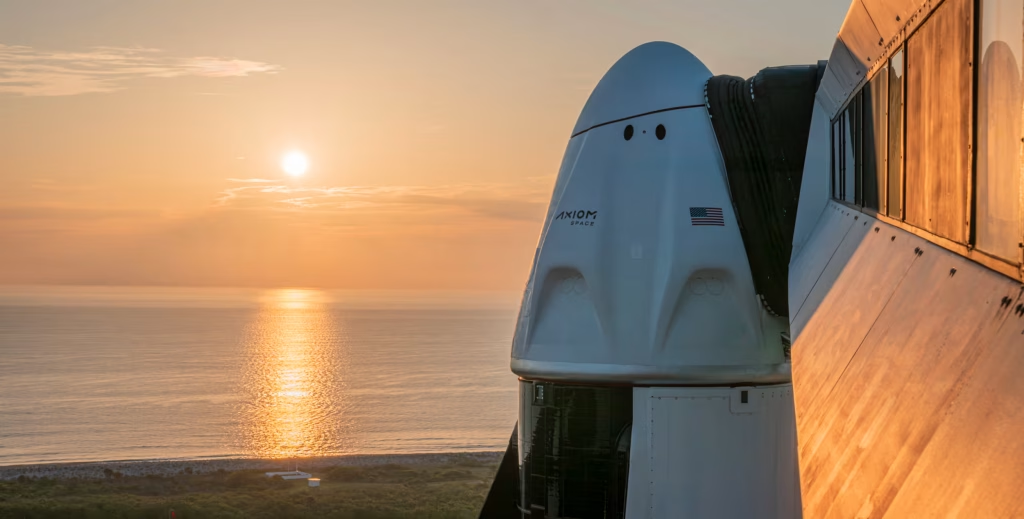
The Axiom 4 capsule is seen as the sun sets behind it. Credit: SpaceX